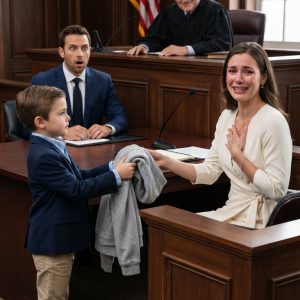
My husband smiled in the courtroom like a man watching the last heavy iron door close on my life. Beside him, his young lover crossed her legs, elegantly adjusting the hem of a tailored skirt paid for by my family’s trust. Ava reached up, her manicured fingers lightly touching the vintage diamond bracelet that used to belong to my mother, and leaned into Daniel’s shoulder.
“She still thinks she has a chance,” I read on her lips, a whisper meant only for him, though the acoustics of the mahogany-paneled room carried the ghost of her mocking tone.
I sat alone at the plaintiff’s table in a sharp, structured navy jacket. My hands were folded loosely in my lap. My face was a calm, unreadable mask, placid enough to make the two of them exchange a look of victorious amusement.
Daniel had once called me his quiet miracle. I was quiet because I never shouted when he came home smelling of sandalwood and a floral perfume that wasn’t mine. I was quiet because, in the blinding, suffocating haze of grief following my parents’ sudden death in a boating accident, I had signed thick stacks of legal documents without questioning every single page. I was quiet because I had naively believed that marriage was a fortress of mutual trust, not a panopticon of surveillance and leverage.
That was my first catastrophic mistake.
My second was allowing him to believe that my grief had rendered me stupid.
Six months after the funeral, Daniel began his systematic dismantling of my inheritance. He spoke in low, soothing tones about “temporary protection accounts.” He warned of predatory lawsuits targeting grieving heiresses. He lectured me on the dangerous tax exposure of my father’s commercial real estate empire, Whitmore Holdings. He stroked my hair while I wept into my pillow, whispering that the company needed a stronger, more ruthless hand, and that my fragile state made me entirely unsuited to manage the legacy.
Then came Ava.
She was twenty-four, boasting a glossy mane of hair, and deeply, casually cruel in the specific way only someone newly intoxicated by unearned power can be. She was introduced as Daniel’s “executive assistant.” Within weeks, she was wearing my custom silk robes in my own home, intercepting his private calls at midnight, and referring to the estate my great-grandfather built as “our house.”
When the sheer audacity of it broke through my depression and I finally threatened divorce, Daniel did not panic. He simply changed his tactics.
Not suddenly. He was much too methodical for that. Carefully. Insidiously.
First, the passwords to our joint accounts failed. Then, my administrative access to the company servers evaporated overnight. When I finally demanded the original trust documents from our family lawyer, I was handed heavily amended versions. They explicitly showed that I had voluntarily and permanently transferred absolute voting control to Daniel.
When I confronted him in the foyer of our home, waving the forged papers, he merely adjusted his cuffs, offered a pitying smile, and said, “You signed everything, Claire. Don’t embarrass yourself in public. You’re not well.”
The night I finally found Ava in my master bedroom, admiring herself in my mother’s antique mirror while wearing that irreplaceable diamond bracelet, something inside me snapped. I reached for the wall-mounted security panel to call the estate guards.
Daniel lunged from the shadows. He grabbed my wrist, twisting it violently until a sharp cry escaped my throat, before shoving me backward into the heavy oak doorframe.
Ava didn’t even flinch. She simply laughed, a cold, tinkling sound, and said, “Cameras won’t help you, Claire.”
By the time the sun rose, the security cameras had been systematically ripped from the walls. The central servers in the basement were smashed to pieces with a golf club. Daniel calmly told the responding officers that I had suffered a hysterical, grief-induced episode and fallen down the stairs. By noon, his high-priced attorney had filed an emergency injunction for total control of the marital estate, painting a tragic picture of a wife who was mentally unstable, prone to violent outbursts, and completely financially incompetent.
Now, sitting in the fluorescent glare of the courthouse, Daniel looked the part of the polished, long-suffering spouse. Ava looked innocent and painfully expensive.
Their attorney, a shark in a grey suit, addressed the judge with practiced theatricality. “Your Honor, Mrs. Whitmore has presented no evidence. No security footage. No witnesses to corroborate her wild tales of abuse or coercion. She possesses nothing but bitterness and a tragic inability to accept her own diminished mental capacity.”
Daniel leaned slightly toward me across the aisle. His voice was a silken thread of malice. “After today, Claire, you’ll have nothing left. Not even your name.”
I looked down at the sleeves of my navy jacket, the heavy fabric hiding the brutal marks he thought time and foundation had successfully erased.
You really think I was just sitting in the dark, crying? I thought to myself.
I looked up, met my husband’s gloating eyes, and smiled back.
It wasn’t a smile of defeat. It was the smile of a trap snapping shut.
The preliminary hearing stretched onward, feeling less like a legal proceeding and more like a slow, meticulous execution.
Daniel’s attorney swaggered before the bench, projecting a slideshow of bank records, signed wire transfers, trust amendments, and carefully curated medical notes from the night Daniel claimed I had “fallen.” Every single document looked devastatingly official. Every signature on the asset transfer forms looked exactly like mine. Every word spoken was engineered to cement my new identity: a fragile, broken widow who had married a patient, loving man, only to repay his devotion with paranoid accusations.
In the gallery, Ava dabbed at perfectly dry eyes with a monogrammed handkerchief.
“My client has endured public humiliation,” the lawyer boomed, placing a heavy, sympathetic hand on Daniel’s shoulder. “He stepped in to save Whitmore Holdings when his wife could not. He only wants to protect the family fortune from her destructive impulses.”
The family fortune.
My father had built Whitmore Holdings from a single, drafty warehouse near the riverfront. My mother, a mathematician by trade, had kept every ledger by hand until the company expanded beyond the limits of paper and ink. I didn’t just grow up with money; I grew up with the mechanics of it. They taught me the anatomy of ironclad contracts before I learned cursive. They taught me to never trust a spreadsheet unless I knew exactly who benefited from the hidden formulas.
Daniel, blinded by his own greed, had conveniently forgotten that part of my history.
He had also forgotten who personally trained the company’s internal cybersecurity and audit teams for five years before we were married.
I did.
My attorney, Sarah Vance, sat beside me in a charcoal suit, as silent and sharp as a scalpel. We had agreed on this strategy weeks ago. She had let Daniel perform his martyrdom. She had let Ava preen for the gallery. She had let their lawyer stack their fabricated lies so incredibly high that the inevitable fall would shatter every bone in their narrative.
When the judge finally adjusted his glasses and asked whether the plaintiff had a response, Sarah stood up. The scraping of her chair echoed like a gunshot.
“Yes, Your Honor. But before we present our physical evidence, we request that Mr. Whitmore remain under oath to clarify a few operational details regarding the assets he claims to be protecting.”
Daniel’s confident smile twitched, just for a fraction of a second. Ava’s fingers tightened instinctively around my mother’s diamond bracelet.
Sarah walked to the center of the room. “Mr. Whitmore, you testified that on October 12th, Mrs. Whitmore signed documents transferring $45 million in liquid assets and total voting control to offshore entities you established, correct?”
“Yes,” Daniel said smoothly. “To protect the assets from her erratic spending.”
“And you initiated these transfers through the Whitmore Holdings internal financial portal using the administrative tokens she surrendered to you?”
“I did.” Daniel lifted his chin. “It was entirely legal and authorized.”
Sarah didn’t look at him. She looked at the judge. “Your Honor, I am submitting Exhibit A: A sworn affidavit from the Federal Bureau of Investigation’s Financial Crimes Division, alongside logs from Whitmore Holdings’ central IT infrastructure.”
Daniel’s brow furrowed. FBI?
“You see,” Sarah continued, her voice ringing clear and cold, “what Mr. Whitmore failed to realize is that the documents Mrs. Whitmore signed under extreme duress did not authorize a transfer of wealth. They authorized a protocol I designed for Whitmore Holdings called the Dead Man’s Switch.”
The courtroom went dead silent.
“The moment Mr. Whitmore logged into the system and pressed ‘execute’ on those transfers,” Sarah explained, turning to face my husband, “he did not move forty-five million dollars into his shell companies. He moved it into an impenetrable, federally monitored Blind Trust. Simultaneously, the system trapped him in a digital ‘Sandbox’—a simulated financial environment.”
Daniel gripped the edge of his table. The color began to drain from his face.
“For the last six months, Mr. Whitmore and his associate, Ms. Lane, have been looking at fake numbers on a fake dashboard,” Sarah said mercilessly. “But worse for him, the Dead Man’s Switch protocol automatically flagged his unauthorized attempt to route the company’s core assets to unverified offshore accounts. He didn’t secure a fortune, Your Honor. He systematically documented his own attempt at massive wire fraud, transmitting the evidence directly to federal regulators.”
A collective gasp rippled through the gallery. The judge flipped sharply through the thick file Sarah had just handed the bailiff.
“This is absurd!” Daniel’s lawyer shouted, springing to his feet. “This is a fabrication! My client has bank statements—”
“Your client has screenshots of a video game,” Sarah interrupted coldly. “The real money hasn’t moved a cent. But his intent to steal it is permanently logged on federal servers.”
Daniel stared at me, his eyes wide with a sudden, suffocating terror. The invincible armor he had worn into the room was cracking, piece by piece. But as the judge began to read the FBI affidavit, I knew the financial ruin was only the appetizer.
He was broke, yes. But he still thought he could walk away a free man.
He still thought no one could prove what he did to me in the dark.
The air in the courtroom had grown thick, the previous smugness replaced by a suffocating tension. Daniel was breathing heavily, his tie suddenly looking like a noose around his neck. His lawyer was frantically whispering in his ear, clearly trying to perform damage control on a sinking ship.
But Sarah was not finished.
“Your Honor,” Sarah said, her voice dropping an octave, becoming softer but infinitely more dangerous. “While the financial fraud is now a matter for the federal authorities, we are here today regarding the emergency injunction and the assault that took place on the night of March third.”
Daniel’s lawyer jumped up again. “Objection! We’ve already established there is no evidence of an assault! The cameras were vandalized by the plaintiff herself in a manic state!”
“Overruled,” the judge barked, clearly furious after reading the wire fraud documentation. “I will hear exactly what Ms. Vance has to say. Proceed.”
Sarah turned her gaze to Daniel. “Did you strike your wife that night, Mr. Whitmore?”
His jaw clenched. He was a cornered animal now, but his ego wouldn’t let him retreat. “Absolutely not. I have never laid a hand on her. She tripped over a rug in the hallway and struck her shoulder against the doorframe.”
Sarah glanced back at me. That was the signal.
I stood up slowly, deliberately. Every eye in the room locked onto me. Daniel watched me with a mixture of intense irritation and a creeping, primal dread. In the gallery, Ava whispered loudly to her lawyer, “What is she doing?”
I reached for the lapels of my heavy navy jacket and slipped it off my shoulders, folding it neatly over the back of my chair. I was wearing a sleeveless silk blouse underneath.
Another gasp, sharper this time, moved through the courtroom like an electric current.
Across my right shoulder and collarbone, vivid even weeks later, was a dark, horrific constellation of bruises. They were the marks Daniel had hidden under threats and forced silence. But they were not just random discolorations.
“Your Honor,” Sarah said, pulling a sleek, medical-grade ultraviolet light from her briefcase. “We call Dr. Aris Thorne, an independent forensic pathologist, to the stand.”
Dr. Thorne, a severe-looking woman with zero tolerance for theatrics, took the oath and stepped down from the box, approaching me. The judge leaned so far forward over his bench I thought he might stand up.
“Dr. Thorne,” Sarah asked. “You examined Mrs. Whitmore the morning after the incident, at a private clinic across state lines. What did you find?”
“Blunt force trauma,” Dr. Thorne stated clinically. “But the contusion pattern was highly specific. It was not consistent with a fall against a flat surface or a standard doorframe.”
Sarah dimmed the overhead lights nearest our table. Dr. Thorne clicked on the UV light and swept it over my exposed skin.
Under the violet glow, the subcutaneous bleeding fluoresced. The bruise wasn’t just a blob of purple and yellow. It had defined, geometric edges. It had a distinct, unmistakable shape stamped directly into my flesh.
It was a perfect hexagon, with a raised circular indentation in the center.
“As you can see,” Dr. Thorne narrated, “the impact left a precise stamp of the object that struck her.”
Sarah walked over to the defense table. She pointed a manicured finger directly at Daniel’s right hand, which was gripping the edge of the mahogany table so hard his knuckles were white.
“Mr. Whitmore,” Sarah said, her voice echoing in the hushed room. “Could you please hold up your right hand? The one wearing the custom, heavy-platinum signet ring? The one gifted to you by Mrs. Whitmore’s late father, featuring a hexagonal crest with a circular family seal?”
Daniel froze. He looked down at the massive, arrogant piece of jewelry he wore every single day—the symbol of his usurped power. He tried to slide his hand off the table, to hide it in his lap, but the judge’s voice cracked like a whip.
“Keep your hands on the table, Mr. Whitmore!”
The silence that followed was absolute. The UV light illuminated the perfect match on my skin. It was undeniable. It was physical, irrefutable proof of his violence, literally branded onto me by the very man who swore he never touched me.
Daniel’s face emptied of all color. His lawyer looked at the ring, looked at my shoulder, and slowly, defeatedly, sat back down, putting his head in his hands.
“You deleted the camera footage, Daniel,” I said quietly, my voice carrying across the silent expanse between us. “But you forgot that my body remains evidence.”
Ava, watching from the gallery, suddenly looked terrified. The invincible man she had hitched her wagon to was bleeding out on the courtroom floor. But she didn’t realize that her turn had just arrived.
The courtroom had descended into a low, chaotic murmur. The judge was aggressively banging his gavel, demanding order while glaring daggers at Daniel. My husband looked entirely unspooled. The calculated, handsome facade he relied on to manipulate the world had melted away, leaving a desperate, sweaty man staring at his own ring in horror.
Sarah Vance, however, remained a pillar of icy calm. She waited for the room to settle, savoring the absolute destruction of the defense’s case.
“Your Honor,” Sarah said, projecting her voice over the lingering whispers. “We have established Mr. Whitmore’s intent to commit federal wire fraud. We have established, via forensic evidence, his physical assault on my client. But there remains the issue of conspiracy, coercion, and the systemic destruction of the security servers to cover up these crimes.”
“Is there more, Counselor?” the judge asked, sounding genuinely exhausted by the sheer volume of deceit.
“There is, Your Honor. And for this, I must direct the court’s attention to the gallery.” Sarah turned sharply, pointing directly at Ava. “Specifically, to Ms. Ava Lane.”
Ava flinched as if she had been physically struck. She looked wildly at Daniel’s lawyer, who refused to make eye contact with her.
“Ms. Lane is currently wearing a vintage diamond bracelet on her left wrist,” Sarah stated. “A piece of jewelry that belonged to Mrs. Whitmore’s late mother. A piece that was reported stolen from the primary estate residence six months ago.”
“Objection!” Daniel’s lawyer weakly protested. “Relevance? This is a family court hearing, not a larceny trial.”
“The relevance, Your Honor,” Sarah countered seamlessly, “is that the bracelet in question is not merely a piece of jewelry. It is the prosecution’s star witness.”
I watched Ava. Her hand instinctively clamped over the diamonds, her eyes darting toward the exit.
You loved that bracelet, Ava, I thought. You loved parading it around my house, wearing it to your expensive lunches, flaunting it as proof that you had replaced me.
“Mrs. Whitmore’s father,” Sarah explained to the enraptured courtroom, “was a man who dealt in high-stakes commercial real estate. Years ago, after a credible kidnapping threat against his wife, he had his head of security retrofit her favorite piece of jewelry. That diamond bracelet, Your Honor, contains a military-grade, micro-acoustic recording device and a GPS tracking chip. It is designed to activate via voice recognition and sync automatically to a secure, off-site cloud server that only my client controls.”
Ava stopped breathing. She looked down at her wrist as if a venomous snake was coiled around it.
“For the past six months,” Sarah continued, her voice taking on a terrifying cadence, “Ms. Lane has worn that bracelet every single day. She wore it into the bedroom when she and Mr. Whitmore plotted to forge the trust documents. She wore it in the car when they discussed moving the assets offshore. And, crucially, she wore it on the night of March third, standing mere feet away when Mr. Whitmore assaulted his wife and subsequently destroyed the security cameras.”
Sarah pulled a small remote from her pocket and aimed it at the court’s audio-visual system.
“Exhibit C, Your Honor. Audio recovered from the stolen bracelet.”
She pressed play.
The sound of shattering glass filled the courtroom. Then, Daniel’s voice, panting, furious, entirely stripped of his usual charm.
“Where are the core backups? Tell me right now or I swear to God, Claire—”
Then, the sickening thud of a body hitting wood. My suppressed cry of pain.
Then came Ava’s voice. Crystal clear, captured perfectly by the microphone resting on her own wrist.
“Just hit the servers with the golf club, Daniel. The cameras are already down. By tomorrow, she won’t even own her own name. We’ll say she went crazy and broke them herself.”
“Are you sure about the signatures?” Daniel’s recorded voice asked.
“I traced them myself,” Ava’s voice laughed, a cruel, arrogant sound that now hung in the courtroom like a death sentence. “The notary is my cousin. It’s done. We own Whitmore Holdings.”
The audio clicked off.
The silence that followed was heavier than lead. Ava was visibly shaking, tears ruining her expensive makeup, her fingers desperately fumbling with the clasp of the bracelet, trying to tear it off her wrist as if it were burning her skin.
Daniel stared at her. He didn’t look at me. He looked at his young, beautiful accomplice, realizing that the very trophy she had stolen to mock me was the exact instrument of their mutual annihilation.
Cornered, stripped of his lies, and facing decades in federal prison, the final shreds of Daniel’s loyalty evaporated. He turned to the judge, his eyes wild with the frantic calculus of a cornered rat. He was about to make his final, fatal move.
“She manipulated me!”
Daniel’s voice cracked as he lunged forward, slamming both hands onto the defense table. His attorney tried to pull him down by his jacket, but Daniel shook him off violently. The polished executive was gone; only a panicked animal remained.
“Your Honor, listen to the tape!” Daniel pleaded, pointing a trembling finger at Ava in the gallery. “You heard her! She traced the signatures! The notary is her cousin! I was grieving! I was vulnerable! She manipulated my grief to take over the company. The fraud, the offshore accounts—it was all her idea! She orchestrated the entire thing!”
A collective gasp sucked the air from the room. I watched, utterly fascinated, as the alliance built on my destruction spectacularly collapsed in on itself.
Ava stopped fumbling with the bracelet. She froze, her tear-streaked face twisting into an expression of profound, venomous betrayal. The man who had promised her an empire was now publicly offering her up as a human sacrifice to save his own skin.
“You lying coward,” Ava hissed. Her voice wasn’t loud, but in the dead quiet of the courtroom, it carried like a blade.
“Order!” the judge bellowed, banging his gavel. “Mr. Whitmore, sit down immediately! Ms. Lane, you will remain silent!”
But Ava was beyond judicial authority. The polished, glossy veneer of the ‘executive assistant’ shattered. She stood up, kicking her designer chair backward. She bypassed the low wooden gate separating the gallery from the floor, ignoring the bailiff who stepped forward to intercept her.
“He wants to talk about who orchestrated what?” Ava screamed, her voice shrill with panic and rage. She dug frantically into her designer purse and pulled out her smartphone. “You want to play the victim, Daniel? Let’s show the judge what you really had planned for your ‘beloved’ wife!”
“Stop her!” Daniel yelled, genuine terror finally breaking through his voice. He scrambled out from behind his table, but two bailiffs immediately tackled him against the mahogany railing, pinning him hard.
“Your Honor!” Ava cried out, holding her phone high in the air as a female deputy grabbed her arm. “He wasn’t just trying to steal the money! I have encrypted messages on this phone. Voice memos! Last week, when Claire refused to vacate the house, Daniel met with a mechanic. He paid ten thousand dollars in cash to have the brake lines on Claire’s Mercedes subtly compromised. He said a fatal accident would be ‘cleaner’ than a messy divorce!”
The courtroom erupted into absolute pandemonium.
“She’s lying!” Daniel shrieked from against the railing, his face pressed into the wood. “She’s insane! It’s a lie!”
“I have the receipts! I have the audio of him laughing about it!” Ava shrieked back, struggling against the deputy, desperate to hand the phone to the judge. “I didn’t want anyone to die! I just wanted the money! He’s a monster! He tried to kill her!”
I sat perfectly still, my hands still folded in my lap. I had known about the offshore accounts. I had known about the forged signatures. I had known about the physical assault.
But the brakes? The murder plot? That was new.
A cold spike of adrenaline pierced my chest, chilling me to the bone. He really would have killed me. If I hadn’t moved up the timeline of this trap, if I had waited even one more week to play my hand, I would be a tragic headline, and they would be drinking champagne on my grave.
The judge was on his feet, his face purple with fury. “Bailiffs, place both Mr. Whitmore and Ms. Lane in custody immediately! Confiscate that phone! I am suspending this civil hearing and referring this entire catastrophic mess to the District Attorney for immediate criminal indictment on charges of wire fraud, conspiracy, domestic battery, and attempted murder!”
The click of heavy metal handcuffs echoed in the room.
They were dragging Ava away first. She was sobbing hysterically, screaming obscenities at Daniel, her expensive heels dragging across the polished floor.
Then, they hauled Daniel to his feet. His suit was rumpled, his tie askew. The platinum signet ring on his right hand—the one that had bruised my skin and betrayed his violence—caught the harsh fluorescent light.
He looked over his shoulder as the deputies muscled him toward the side exit. His eyes found mine. The arrogance, the anger, the manipulation were entirely gone. He just looked hollowed out. A pathetic, broken shell of a man who had gambled a kingdom and lost his soul.
“Claire,” he choked out, his voice suddenly small, pathetic, pleading. “Claire, please. They’re going to put me away forever. Please… we can fix this.”
The deputies paused for just a second, waiting for my reaction.
I stood up. I didn’t reach for my jacket. I walked slowly around the plaintiff’s table, feeling the solid oak floor beneath my feet. I walked over to the clerk’s desk, where Ava’s confiscated belongings had been dumped.
I picked up my mother’s diamond bracelet. The metal was still warm from Ava’s skin. I calmly fastened the heavy, glittering clasp around my own wrist, feeling the familiar, comforting weight of my family’s legacy lock into place.
I looked at my husband, at the man who had tried to erase my existence, and delivered the final blow.
“You never understood, Daniel,” I said, my voice smooth, steady, and utterly devoid of mercy. “You thought you were playing chess. I was writing your obituary.”
Eight months later, the morning sun poured like liquid gold through the massive glass atrium of the newly renovated Whitmore Holdings headquarters.
The air smelled of fresh espresso from the lobby café and the crisp, clean scent of ozone from the high-speed elevators. The chaotic, suffocating darkness of that courtroom felt like it belonged to another lifetime, or perhaps to another person entirely.
I stood in the center of the lobby, a cup of black coffee in one hand, watching the maintenance crew polish the grand marble wall behind the reception desk. My name was back exactly where my father had placed it years ago, bolted in heavy, brushed steel lettering:
Claire Whitmore, Chief Executive Officer.
The fallout from the trial had been swift and utterly devastating for them.
Daniel’s high-priced lawyers abandoned him the moment the federal asset freeze hit. Without my money to shield him, he was chewed up and spat out by the justice system. The “Sandbox” trap had perfectly preserved his intent to commit massive wire fraud, and Ava’s frantic surrender of her phone had provided the nail in his coffin regarding the murder conspiracy. He was currently awaiting trial in a federal detention center, bankrupt, terrified, and staring down the barrel of a twenty-five-year minimum sentence.
Ava, realizing that Daniel was going to let her drown, had fully cooperated with the prosecution. She took a brutal plea deal. Last I heard, the court had ordered her to pay massive restitution, and she was working a minimum-wage job behind a counter in a strip mall three states away, far from the cameras, the diamonds, and the stolen houses she had craved so desperately.
As for me, I had learned that grief does not make you weak; it strips away the polite fictions of the world and leaves you with the raw, brutal truth of who you are.
I walked into my private elevator and scanned my keycard. The doors slid shut, sealing me in quiet luxury as I ascended to the top floor.
I no longer wore heavy navy jackets to hide anything. Today, I wore a sharply tailored, sleeveless white sheath dress. I wore it because it looked powerful. I wore it because it left my shoulders bare, showing the world that I had survived the worst they could do to me, and I was still standing. The faint, barely visible shadow of a hexagon on my collarbone was not a mark of shame; it was a battle scar.
I stepped out of the elevator and walked into my expansive corner office. The panoramic views of the city spread out before me, a kingdom reclaimed.
I walked over to my heavy mahogany desk. Resting in the center, exactly where it belonged, was my mother’s old, leather-bound accounting ledger. The one she had used when Whitmore Holdings was just a dream and a single warehouse.
I sat down, picked up a heavy fountain pen, and opened the book to the very last page. I bypassed the columns of numbers and the meticulous tally marks of my family’s history.
At the bottom of the page, beneath decades of my parents’ hard work, I wrote a single, definitive line:
The truth does not disappear because someone breaks the camera.
I blew on the wet ink, closed the heavy leather cover with a satisfying thud, and looked out the window at the city I now ruled. I took a deep breath, savoring the absolute freedom of the morning, and prepared to take back the future they thought they had buried.
If you want more stories like this, or if you’d like to share your thoughts about what you would have done in my situation, I’d love to hear from you. Your perspective helps these stories reach more people, so don’t be shy about commenting or sharing.