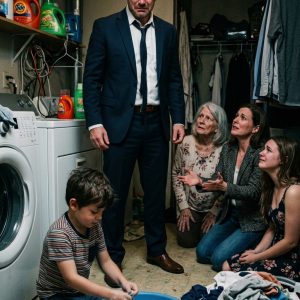
The Chronicle of a Mother’s Vengeance: The Yellow Sundress
Chapter 1: The Illusion of Justice
The air inside the courthouse that morning felt like an invisible noose, slowly tightening around my throat with every breath I managed to draw. The oppressive atmosphere of those centuries-old, oak-paneled walls was suffocating. A musty perfume of decaying wood and lemon polish amalgamated with the arid, biting draft spewing from a dilapidated ventilation shaft above. It all condensed into a stifling, leaden fog that made my senses swim, accompanied by a relentless, high-pitched hum vibrating in my skull.
This sensory distortion was the lingering penalty of the heavy chemical armor I had been relying on just to endure the agonizing passage of time. For six months, potent antidepressants had draped a thick, frosted pane of glass over my perception of reality. The world moved in a sluggish, warped pantomime. I felt perpetually marooned in a nightmare from which I could not awaken, a ghost haunting my own tragedy.
I remained seated at the plaintiff’s heavy mahogany table, my trembling hands anchored to my lap, yet I felt entirely untethered from my physical form. My hollow gaze was fixed rigidly ahead on the man who had been the pillar of my existence—my soon-to-be ex-husband, Jason.
His posture was a masterclass in fabricated sorrow. His head dipped low, his broad shoulders quivering with the precise cadence of a man shouldering an unfathomable grief. The faded, slate-gray dress shirt he wore was a calculated choice, designed to make him appear neglected and pitiful. His perpetually styled hair was artfully rumpled, and his bloodshot eyes brimmed with unshed tears. To the uninitiated observer, it was the heartbreaking portrait of a devoted, desperate father valiantly attempting to salvage the remnants of his family after his wife’s psychological collapse following the sudden disappearance of their young daughter.
It was a flawless, Oscar-worthy performance. He had effortlessly bewitched every soul in that chamber, from the seasoned bailiffs to the whispering strangers crowding the gallery.
The presiding judge’s voice boomed from the bench, deep, clinical, and devoid of empathy. Each syllable dropped like a blacksmith’s hammer against the anvil of my eardrums.
“Noting the mother’s current, profoundly unstable psychological condition,” the judge intoned, adjusting his spectacles, “coupled with the tragic reality that the daughter’s disappearance six months prior has rendered the mother incapable of societal functioning… this court rules that the mother is temporarily unfit, both financially and mentally, to provide adequate care for a minor.”
The room held its breath.
“Therefore,” the judge finalized, “full and immediate custody of the six-year-old male child shall be awarded to the father.”
Those sterile, bureaucratic words violently tore away whatever fragile shreds of humanity still tethered me to the earth. Yet, remarkably, I did not weep. I did not scream. No theatrical outbursts escaped my lips. Instead, a terrifying, cavernous void opened within my chest. It was as though the capacity for human emotion had been surgically extracted from me long ago.
The judge hoisted his wooden gavel, poising it in the air to seal my doom and adjourn the hearing. That suspended fraction of a second felt like the absolute termination of my existence—the death certificate of my marriage, the foreclosure of my family, and the eradication of the final, desperate sliver of hope I had fiercely guarded for half a year.
But just as the wood began its descent, a small, crystal-clear, heartbreakingly innocent voice pierced the heavy silence, flash-freezing the blood of every person in the room.
“Excuse me, Your Honor.”
I blinked, the heavy fog parting slightly. It was my six-year-old son, Noah.
“If I have to go live with Dad,” the boy asked, his voice echoing off the vaulted ceiling, “who is the little sister in the freezer going to live with?”
The courtroom plunged into a vacuum of absolute, horrifying silence.
I felt my own pulse flatline for a complete, agonizing second. When my heart finally restarted, it slammed against my ribs with such feral violence that I physically gasped. The pharmaceutical haze suffocating my brain shattered into a million jagged pieces, as if struck by a steel bat.
Suddenly, everything was ruthlessly, terrifyingly lucid.
I snapped my neck to the side, locking eyes with my son. Noah stood tall, his eyes—exact replicas of my own—clear, unwavering, but swimming with genuine childhood confusion. There was not an ounce of fear in his small frame, only a devastating innocence as he delivered a sentence that defied the boundaries of human comprehension.
I didn’t lunge across the table. I didn’t wail like a banshee. True, apocalyptic psychological agony does not permit the human nervous system to behave normally. The trauma merely commanded my muscles to seize. My throat constricted into a rigid pipe. My stomach violently rebelled, twisting upon itself until I doubled over the polished table, expelling a stream of acidic bile onto the pristine hardwood floor.
Wiping my mouth, I forced my gaze back to Jason.
The masquerade was over. Every drop of blood had abandoned his face, leaving behind a chalky, spectral white. His pupils had shrunk to terrified pinpricks. A violent tremor seized his hands, causing his knuckles to inadvertently strike the heavy stainless steel Yeti tumbler resting on his table. It clattered to the floor, the metallic reverberation echoing like a gunshot. The spilled water dripped methodically onto the floorboards—drip, drip, drip—each sound magnifying the unspeakable horror suspended in the air.
Jason’s attorney practically scrambled backward, his chair screeching. He babbled frantically, attempting to weave a narrative that the boy was heavily traumatized, experiencing psychotic delusions, speaking utter nonsense. But even the high-priced lawyer couldn’t suppress the frantic tremor in his own voice.
The judge did not utter a single word in response. His face a mask of grim realization, he reached under his bench and slammed a hidden panic button. His voice, now laced with absolute ice, barked orders to the armed bailiffs.
“Lock the doors. Nobody leaves. Get Major Crimes down here immediately.”
I remained in my chair, entirely paralyzed, feeling a glacial chill slither down my spine. It was the distinct sensation of watching someone unlock the heavy iron gates leading straight into the abyss.
I didn’t know it yet, but my descent into hell was only just beginning.
Chapter 2: The Chamber of Frost
Two agonizing hours later, I found myself restrained by my own seatbelt in the rear of a shadowy, unmarked police sedan. To my left sat lead Detective Carter, a seasoned investigator whose deeply lined face and scalpel-sharp eyes hinted at a career built on witnessing the worst of human nature.
He had vehemently opposed my presence on this excursion. He cited protocol, liability, and basic human decency. But I had dug my own teeth into the flesh of my hand until the copper taste of blood coated my tongue, threatening to tear my own skin off if he left me behind. Recognizing the feral, unyielding desperation of a mother, he reluctantly relented, ferrying me toward the geographic coordinates I instinctively knew would incinerate the remnants of my sanity.
The cruiser’s tires crunched over broken gravel as we pulled into an abandoned, decaying industrial sector on the forgotten southern perimeter of the city. We halted before a detached, corrugated metal garage. I remembered dimly that Jason had acquired this worthless plot of land years before we even exchanged vows, claiming it was an “investment.”
It was utterly desolate. The air was thick with damp rot.
Carter stepped out, motioning for his tactical unit to advance. They gripped the rusted handle of the roll-up metal door and hoisted it upward. The screech of tearing metal violently sliced through the frigid afternoon air. Instantly, an abhorrent cocktail of odors assaulted my senses: rancid motor oil, blooming black mildew, and an underlying, metallic sweetness that made my stomach churn with fresh nausea.
Deep within the cavernous shadows of the garage, illuminated only by the tactical flashlights slicing through the gloom, sat an archaic, heavy-duty chest freezer.
It was still plugged into a jury-rigged extension cord. It emitted a low, guttural, vibrating hum—the rhythmic, mechanical whisper of something fundamentally disconnected from the world of the living.
Detective Carter paused. He slowly pulled a pair of blue latex gloves over his knuckles, the rubber snapping sharply. He turned to face me, a rare flicker of profound human hesitation softening his hardened features.
“Laura,” he murmured, his voice barely carrying over the mechanical hum. “Turn away. Walk back to the car. What you are about to witness cannot be un-seen. It will break you.”
But I couldn’t retreat. My boots were fused to the cracked concrete. Deep within the marrow of my bones, I understood that whatever lay hidden beneath that insulated lid was all that remained of the child I had birthed.
Carter sighed, a heavy, resigned sound. He gave the nod. Two technicians pried the sealed lid open.
Immediately, a thick, billowing cloud of white, sub-zero vapor spilled over the edges, pouring onto the floor like a captive spirit finally unshackled from its purgatory.
The vapor thinned. And then, my eyes adjusted to the frost.
A familiar shade of marigold yellow. A tiny sundress, the fabric stiff and glittering with ice crystals. A small, delicate figure curled tightly into a fetal position amid the frostbitten darkness.
My daughter.
In that microscopic fraction of a second, the entire architecture of my universe imploded. The ambient noise of the police radios, the shuffling boots, the wind howling through the metal panels—it all evaporated into an absolute, deafening vacuum. All vibrant colors bled out of my vision, leaving only a grayscale nightmare dominated by that agonizingly bright yellow fabric. That single, horrific image seared itself into the soft tissue of my brain, a branding iron of grief that would never, ever cool.
I didn’t wail. I didn’t collapse into hysterics. My knees simply unhinged, and I plummeted to the freezing, oil-stained concrete. The impact sent a shockwave of pain up my shins, but it felt distant, irrelevant. Silent, heavy tears cascaded down my cheeks, completely bypassing my conscious permission.
In that desolate garage, I accepted the absolute annihilation of my life. I had lost it all.
But as the seconds ticked by, a strange alchemy occurred within my chest. The suffocating agony began to crystallize. It hardened, cooling into a dense, impenetrable emotional armor. It was no longer a frantic, flailing grief. It was something infinitely more dangerous. It was a singular, absolute imperative.
This is not the end, I vowed silently to the frozen air. I will dismantle him.
Chapter 3: Traces of a Masquerade
I have no coherent memory of exiting that decaying structure. When the psychological blackout finally lifted, I found myself tethered to a bolted steel chair inside a sterile, painfully bright interrogation room at the precinct. Harsh fluorescent tubes buzzed overhead, casting sickly shadows and making the world look exceptionally cruel.
My hands lay flat on the metal table, yet they vibrated with uncontrollable, rhythmic spasms. It was as though my central nervous system was attempting to process the trauma while my conscious mind remained entirely anesthetized.
Detective Carter occupied the chair across from me. He didn’t immediately launch into an interrogation. He allowed the heavy silence to hang, offering me a perimeter to collect my fragmented thoughts. But the quiet only amplified the chaotic cacophony screaming inside my skull, all of it circling that blinding yellow dress.
Eventually, Carter slid a condensation-beaded paper cup of water across the stainless steel surface. His tone was measured, deliberate, anchoring us to the procedural reality.
“Laura. I need you to anchor yourself. I need you to answer a few critical questions. Every microscopic detail matters right now.”
I offered a jerky nod. My throat felt like it was lined with shattered glass, but I forced the vocal cords to engage. “Ask.”
“Over the past six months,” Carter began, his eyes narrowing slightly, “did you harbor even a fraction of suspicion toward your husband?”
The inquiry made me blink. Not because it was a difficult question, but because it felt absurdly simplistic in the wake of the apocalyptic truth I had just witnessed. I shut my eyes, sealing out the blinding lights.
“No,” I replied, my voice a flat, deadened monotone. “I genuinely believed she had chased a butterfly, wandered off the path, and vanished into the woods. I mobilized search parties. I maxed out credit cards printing thousands of glossy flyers. I knocked on strangers’ doors until my knuckles bled. I spent my nights scrutinizing grainy Ring doorbell footage from every suburban intersection. I didn’t have the mental bandwidth to suspect a predator, let alone the man sleeping beside me.”
Carter studied my face, not merely listening, but dissecting every twitch of my facial muscles for signs of deceit. Finding none, he shifted tactics.
“Let’s focus on today. This morning, before the custody hearing. Did Jason do anything irregular? A deviation from his baseline behavior?”
I slowly shook my head. But then, a seemingly insignificant anomaly bubbled to the surface of my memory. A detail so trivial at dawn, yet so profoundly sinister in hindsight.
“He woke up before dawn,” I whispered. “He brewed a pot of French roast. He even poured me a mug and brought it to the bedroom. He hasn’t done that in half a year. He sat on the edge of the mattress and told me he wanted the proceedings to end peacefully. He told me not to stress. I… I just assumed he was acting out the final scene of the ‘decent, forgiving ex-husband’ before he took my son away.”
Carter’s jaw tightened. He scribbled a rapid note on his legal pad, his demeanor shifting from empathetic to strictly tactical.
“We have Jason secured in holding,” Carter stated, his voice dropping an octave. “But you need to brace yourself, Laura. This investigation is going to be infinitely more convoluted than a simple domestic homicide.”
I didn’t inquire what he meant. The forensic gears in my mind were finally grinding to life. I was beginning to comprehend that my child’s demise wasn’t an explosive crime of passion. It was a masterpiece of deception, a crime buried so meticulously that it had outsmarted a precinct full of seasoned detectives for six months.
The heavy door clicked, swinging inward to reveal a uniformed officer who leaned down and murmured urgently into Carter’s ear. I couldn’t decipher the syllables, but the sudden rigidity in Carter’s posture spoke volumes.
“Don’t move,” Carter commanded, abruptly standing up and exiting the room.
Left alone with the blank cinderblock walls, a chillingly lucid string of logic assembled itself in my mind.
If Jason were innocent of malice, he wouldn’t have looked like a man facing the gallows when his son mentioned the freezer.
If this were a tragic accident, a father would never entomb his own flesh and blood in ice.
If he had nothing to hide, he wouldn’t have legally maneuvered to secure absolute control over our surviving child right as the risk of exposure peaked.
I clenched my hands into tight fists, driving my fingernails so deeply into my palms that crescent moons of blood bloomed on my skin. I felt absolutely zero physical pain. The agony had been wholly replaced by an icy, predatory clarity.
Carter returned exactly fifteen minutes later. He bypassed the chair, standing tall and imposing over the table.
“We’ve officially read him his rights,” Carter announced grimly. “His initial statement is on the record. He claims he was driving her home when she suffered a sudden, severe, and acute asthma attack. He says he panicked, realized she was gone, and hid the body because he feared he would be blamed. He reported her missing to buy time to figure out a plan.”
A sound escaped my throat—a dry, abrasive scraping noise that I barely recognized as a laugh. “And you believe that fictional garbage?”
Carter locked eyes with me. “I never believe anything entirely. But as of this exact moment, we lack the physical forensic evidence to dismantle his narrative. As for the freezer… he alleges he couldn’t bear the thought of decomposition.”
I sat in silence for five long seconds before I deployed a painfully simple counter-argument. “If my child was actively suffocating from a medical emergency in the passenger seat of his car, why does his phone log not show a frantic call to 911? Why didn’t he drive onto the sidewalk to reach the nearest emergency room?”
Carter’s silence confirmed everything. The entire department was wrestling with that exact paradox.
Another detective slipped into the room, sliding a thick manila folder across the table. Carter scanned the top document, his expression darkening further. He looked back at me.
“We pulled her pediatric records. Your daughter had a documented history of severe asthma and anaphylactic allergies. However, there are no prior incidents of a life-threatening episode. Furthermore, the preliminary field coroner’s assessment shows no external signs of mechanical asphyxiation, blunt force trauma, or foul play. What I am telling you, Laura, is that from a purely forensic standpoint, the DA cannot definitively charge this as a homicide.”
Those words struck me with the force of a speeding train. I had spent years working as a fraud investigator for a massive corporate insurance firm. I knew exactly how the legal system functioned. Without irrefutable proof of intent, Jason could manipulate a jury. He could plead out to ‘tampering with human remains.’ He would serve a fraction of a sentence and walk free, leaving my daughter’s memory to rot.
I pushed my chair back. The metal legs screeched against the floor. My legs felt like lead, but my voice was possessed by a freakish, terrifying stability.
“I need to look him in the eye.”
Carter shook his head instantly. “Absolutely not. This is an active investigation—”
“I want to see him,” I repeated, dragging out every syllable, transforming the request into a non-negotiable decree.
Carter studied the unyielding fire in my gaze. He sighed, defeated by the absolute certainty radiating from my posture. “Five minutes. And I am standing right behind you.”
The holding cell was significantly colder. Jason sat hunched over a bolted steel table, his wrists secured by heavy metal cuffs. Yet, his facial expression had shifted dramatically from the courtroom panic. He looked composed. Resigned. Rehearsed.
When the heavy door echoed shut, he slowly lifted his head. His voice was a raspy, manufactured whisper. “Laura… I am so, so sorry.”
I didn’t blink. I stared straight through his pathetic facade for an uncomfortably long time before I spoke.
“Tell me how her heart stopped.”
He swallowed heavily. “I already told the detectives. She started wheezing. It was a massive asthma attack.”
“Why did you bypass the hospital?”
He paused—a fractional delay, the hallmark of a man accessing a script rather than a memory. “I panicked. I froze. I didn’t know what to do.”
“And the freezer? The desperate rush to legally strip me of my son?”
That struck a nerve. His eyes darted toward the two-way mirror for a microsecond before snapping back. “I couldn’t let Noah live with a mother who was losing her grip on reality. I was protecting him.”
A faint, razor-thin smile touched my lips. “Who exactly is the intended audience for this performance, Jason?”
He remained silent, but beneath his stoic mask, I could see the microscopic fault lines fracturing.
I leaned over the table, invading his personal space, lowering my voice to a lethal hiss meant only for his ears. “You should know… Noah told the entire courtroom. Every single person heard it.”
The sentence was a psychological dagger plunged directly between his ribs. His pupils dilated violently. His breathing hitched, disrupting his calm rhythm. In that beautiful, fleeting second, I knew I had located the chink in his armor.
He tried to dismiss it, his voice wavering slightly. “Kids… kids have wild imaginations. They talk nonsense.”
“Then let us see exactly how long you can sustain this pathetic charade,” I whispered.
I stood upright, turned on my heel, and marched out of the interrogation room without a backward glance.
The opening gambit had been played. The war had officially commenced.
Chapter 4: Traces in Crayon
I refused to return to my empty house immediately. Instead, I claimed a hard plastic chair in the desolate, dimly lit hallway of the precinct. The sickly fluorescent glow washed over the linoleum, creating an atmosphere of purgatory. The chaos in my mind had ceased. The frantic heartbeat had slowed to the steady, calculated thrum of a heavy diesel engine roaring back to life after years of dormancy.
Sitting in that oppressive silence, fragmented shards of memory began to float to the surface. But I was no longer viewing them through the distorted lens of a grieving mother. I was analyzing them through the clinical, ruthless perspective of an insurance fraud investigator.
Small, seemingly innocuous details began linking together to form an insidious tapestry.
I mentally dragged myself back to that crisp spring afternoon six months ago. The day Jason had cheerfully announced he was taking our daughter to a newly opened family fun center in the distant suburbs.
I had been sitting cross-legged on the living room rug, frantically editing my resume on a laptop. Since stepping away from my career to manage the household, my financial independence had vanished, leaving me entirely reliant on Jason’s lucrative corporate salary. He was perpetually “grinding at the office,” frequently coming home long after midnight.
That specific day, however, he had been uncharacteristically proactive. He insisted I needed a break, offering to take our daughter off my hands for the afternoon. I had felt a profound wave of gratitude. I even explicitly instructed him to stop by the boutique and purchase the specific yellow sundress she had been obsessing over for weeks.
In retrospect, the entire afternoon was a meticulously choreographed setup.
I yanked my phone from my purse and ruthlessly scrolled back through six months of text messages. The screen was a graveyard of my frantic, unhinged pleas for updates during the initial search. Jason’s replies were universally brief, measured, and oddly detached. Not once did he slip. Not once did he project guilt. He had constructed the perfect public persona of a devastated father, while secretly visiting his garage to check the power supply on a chest freezer.
Carter emerged from the bullpen, pausing when he spotted me still occupying the plastic chair. His expression softened with a mixture of pity and respect. “You haven’t gone home to rest.”
I lifted my gaze. The glassy, medicated stare was permanently gone. “Do you actually believe a single word he said?”
Carter sank into the chair beside me, resting his elbows on his knees, staring at the scuffed floorboards. “In this building, we trust nothing. But skepticism isn’t admissible in court. We can’t throw out his statement without empirical evidence to shatter it.”
“The narrative is riddled with glaring structural flaws,” I countered, my voice sharp. “A child suffers an acute medical emergency. A father—an educated, resourceful man—doesn’t dial emergency services, doesn’t speed to an ER, and instead opts to conceal a corpse. Does that pattern of behavior align with panic, or does it align with preservation?”
Carter exhaled a heavy sigh. “The tech division is already pulling his entire digital footprint from that specific Tuesday. We’re running algorithms on traffic cameras, toll transponders, dash-cam network sweeps, and scrubbing every financial transaction tied to his name.”
“You need to scrutinize the minutiae of his bank statements,” I instructed, leaning in.
Carter raised an eyebrow, clearly taken aback by my authoritative tone. “Explain your logic.”
“Before I became a housewife, I was a senior investigator for a top-tier insurance conglomerate,” I told him, holding his gaze. “I spent my life dismantling fraudulent claims. When a human being lies about a catastrophic event, they expend all their cognitive energy covering up the massive, glaring details. They construct the grand alibi. But they invariably neglect the micro-transactions. A random receipt, a detour for a coffee, a toll booth at the wrong hour… those tiny anomalies accurately map out the reality of their behavior.”
Carter remained silent for a long moment, processing the asset sitting beside him. He finally nodded. “I’m tracking.”
I stood up, smoothing the wrinkles from my clothes. “I refuse to sit by a landline waiting for a polite update. I want full visibility on this.”
“Absolutely out of the question. You’re a civilian, Laura.”
“I don’t require a tin badge,” I shot back. “I just require the data.”
Carter scrutinized my face. “Are you truly prepared for what we might dredge up? Because if we keep turning over these rocks, you’re going to uncover horrors significantly uglier than a freezer in a garage.”
I didn’t flinch. I stared into his hardened eyes until he understood that I had already survived the worst thing a mother could endure. “Let’s dig.”
I returned to my house long after midnight. Unlocking the front door, I was assaulted by an eerie, deafening silence. The environment was a perfect, undisturbed time capsule. The throw pillows were perfectly aligned. The dining chairs were tucked precisely. Yet, it was entirely devoid of my daughter’s chaotic laughter and the presence of a husband who, I now realized, was an utter stranger.
I bypassed my bedroom and walked straight into my daughter’s room.
It was a small sanctuary painted in soft blush pink. Her wooden desk still held a scattering of half-finished crayon masterpieces. Time in this specific room had violently halted six months ago.
I didn’t allow myself to cry. I sat in her small, white chair, pulled open the center drawer, and extracted the thick, spiral-bound sketchbook she carried everywhere. I began flipping through the textured pages. Her drawings were clumsy, disproportionate, but bursting with vibrant, chaotic energy.
Then, my fingers stopped.
I stared at a specific page tucked near the back, one I had previously dismissed as childish scribbling. It was a crude, waxy rendering of a grand, sprawling house with imposing pillars. Next to a massive black SUV stood three stick figures.
One was distinctly my daughter. One was distinctly Jason, colored with his signature blue tie.
The third figure was a woman. She was drawn tall, with an aggressive mane of dark hair, wearing a sleek, dark dress. She was positioned uncomfortably close to Jason.
My pulse began to race, drumming against my temples. I flipped frantically back to the beginning of the sketchbook. In every single preceding illustration, she had drawn a standard family unit of four. Me, Jason, and the two children. There had never, in the history of her artwork, been an intrusion by a third adult.
I pulled out my phone, snapped a high-resolution photo of the page, and immediately texted it to Carter with a succinct caption: Look closely at this.
Less than ten minutes elapsed before my screen illuminated. It was Carter. His tone was strictly professional, devoid of pleasantries.
“Where did you source this image?”
“Her desk drawer. I haven’t laid eyes on this book since the week she vanished.”
Carter paused. I could hear the faint rustle of paperwork through the receiver. “We just received the preliminary traffic camera telemetry back from the state DOT. Jason’s SUV never traveled east toward that family fun center.”
I gripped the phone tightly. “Where did the vehicle travel?”
“We’re manually tracing the exact route now. But there was a highly irregular, extended stop on the extreme west side of the city. A highly affluent, private gated community.”
I squeezed my eyes shut, the pieces aligning in the darkness. “He didn’t act alone.”
Carter remained silent, a tacit agreement. I stared back at the crude crayon drawing glowing on my phone screen. The grand house. The strange woman. It wasn’t a child’s fantasy. It was a forensic breadcrumb my daughter had unknowingly left behind—a critical variable I had completely overlooked in my grief.
My daughter’s death was a conspiracy. And I now had a map to the conspirators.
I wasn’t just going to find the truth. I was going to burn their house down with it.
Chapter 5: The Single Dose
I didn’t wait for the sun to rise. I was parked outside the precinct before the morning shift even clocked in. When I pushed through the swinging doors of the Major Crimes division, my steps were grounded and rhythmic. The fragile, stumbling victim who had vomited in a courtroom twenty-four hours ago was dead.
Carter was standing before a massive corkboard, a fresh cup of black coffee in hand. The board was a chaotic web of printed traffic-cam stills, a topographical city map, and thick red marker lines tracking Jason’s vehicular movements on the day of the incident.
He didn’t feign surprise when I marched up to the board. “I figured you wouldn’t stay sidelined.”
“I don’t have time to play the waiting game,” I stated, analyzing the map.
Carter used a red pen to tap a specific, sprawling subdivision on the wealthy west end. “His license plate pinged a reader in this exact grid at approximately 2:45 PM. The vehicle vanished from the municipal grid for roughly fifty minutes before re-emerging on the southbound interstate.”
“He stopped inside the gates,” I concluded softly. “The neighborhood from the drawing.”
“Westwood Estates,” Carter confirmed. “It’s a fortress. Private security, heavily monitored. We are actively drafting subpoenas for their surveillance servers, but corporate red tape makes it a slow burn.”
“Did you secure his financial ledgers?”
Carter reached onto his desk and handed me a printed spreadsheet. “One anomaly flagged by the algorithm. A point-of-sale transaction at an independent pharmacy located precisely two miles outside the Westwood perimeter. The timestamp fits perfectly within the fifty-minute window his vehicle was off the grid.”
I snatched the paper, my eyes immediately homing in on the merchant code and the transaction amount. In the insurance world, emergency medical purchases were notoriously difficult to falsify after the fact.
“I need to be inside that pharmacy. Now.”
Carter frowned deeply. “Laura, I told you, you are not badged personnel.”
“I know,” I countered, staring him down. “But I possess the exact psychological skillset to spot a liar twisting data, and you know it.”
A heavy silence stretched between us before Carter finally relented with a sharp nod. “You stick to my shadow. You do not intervene unless I signal.”
We departed immediately in his unmarked sedan, navigating the morning traffic toward the opulent west end. The scenery rapidly shifted from working-class strip malls to expansive, manicured boulevards shaded by ancient oaks. Massive stone estates sat hidden behind towering privacy hedges. It was a realm of insulated wealth, a stark contrast to my own life. Jason had been operating a parallel existence right beneath my nose.
The pharmacy was an immaculate, boutique establishment on a corner lot. The moment we pushed through the glass doors, the pharmacist behind the elevated counter visibly stiffened at the sight of Carter’s gold shield.
Carter kept it brief, requesting the archival point-of-sale data for a specific date six months prior.
I lingered near the vitamin aisle, adopting the posture of a passive observer while scrutinizing the pharmacist’s micro-expressions. I watched her hands tremble slightly as she navigated the database.
“I have the record,” she announced, her voice unnaturally tight. “A male subject utilized a credit card. He purchased emergency allergy intervention.”
I abandoned my cover and stepped directly to the counter. “Specify the medication.”
She flinched at my tone, turning the monitor slightly toward us. “An epinephrine auto-injector. An EpiPen.”
Time completely suspended itself in that sterile room. My heart slammed violently against my sternum. Not out of shock, but because the ultimate, damning puzzle piece had just forcefully locked into place.
“So… on that exact afternoon, he purchased the exact chemical compound that could have restarted her breathing,” I murmured, my voice a lethal whisper.
Carter remained stoic, but his investigative instincts flared. “I require the closed-circuit security footage covering the register for that timestamp.”
The pharmacist hurriedly accessed the security server. A grainy, high-angle video populated the screen.
There was Jason.
He didn’t look like a calculated mastermind in that moment. He looked feral. His movements were jerky, erratic, driven by pure, unadulterated panic. He snatched the small white paper bag from the counter, practically threw his credit card at the terminal, and sprinted toward the automatic doors in under ninety seconds.
I stared at the digitized ghost of my husband. Every physical cue screamed of a man engaged in a terrifying race against the clock. That specific flavor of adrenaline only manifests during an active, catastrophic emergency.
“If he possessed the antidote,” I asked the empty air, “why did she still perish?”
“We are tracking the exit route now,” Carter stated, signaling the pharmacist to burn the footage to a drive.
We retreated to the sedan. Carter immediately got on the encrypted radio, aggressively pushing the cyber unit to expedite the Westwood Estates warrants. I stared blankly out the passenger window at the sprawling mansions.
“If he wasn’t flying solo,” I proposed suddenly, breaking the silence.
Carter glanced over. “Walk me through your theory.”
“I’m postulating that the phantom woman from my daughter’s sketchbook resides behind one of these iron gates.”
Carter didn’t dismiss the leap in logic. “Search your memory banks. Did Jason ever casually mention a specific female associate?”
I closed my eyes, sifting through years of mundane dinner table conversation. A blurry, insignificant anecdote finally surfaced. Jason, who worked in administration for an elite private academy, had once complained about an overbearing, highly influential parent—a wealthy benefactor who frequently monopolized his time in his office. I had dismissed it as petty academic politics at the time.
“There was someone,” I opened my eyes, the realization chilling my blood. “But I never learned her name.”
“We will subpoena the academy’s donor directory,” Carter stated, hitting the gas.
The trajectory of the investigation had violently shifted. This was no longer merely a domestic tragedy involving a coward. There was a second architect to this nightmare.
And I was going to tear down her perfect walls.
Chapter 6: The Woman in the Estate
When the unmarked cruiser finally rolled to a halt before the imposing, wrought-iron barricades of Westwood Estates, a bone-deep certainty settled into my marrow. Jason didn’t merely dabble in a secret affair; he had integrated himself into a syndicate of power and deceit that I couldn’t have fathomed. This neighborhood, with its immaculate cobblestones and armed gate guards, was the true graveyard of my daughter’s future.
Carter flashed his credentials at the heavily armed guard, issuing a stern demand for immediate cooperation. I hung back, my eyes sweeping over the palatial structures hidden behind lush foliage.
The heavy gates parted. We cruised slowly down the winding, pristine avenues. Carter cross-referenced the GPS coordinates provided by the plate-reader data. We parked in a secluded cul-de-sac, stopping in front of a striking, aggressively modern mansion dominated by sharp angles and dark glass.
“His telemetry explicitly places the vehicle in this driveway,” Carter noted, checking his firearm before stepping out.
I stared at the massive oak front door. My daughter’s crude crayon strokes superimposed themselves over the reality in front of me. The imposing structure. The isolation. It was terrifyingly accurate.
Carter pressed the glowing doorbell. A uniformed housekeeper answered, her polite smile instantly evaporating at the sight of the detective’s badge. Carter swiftly articulated our purpose.
“Ms. Evelyn is currently indisposed, but I can summon her,” the housekeeper stammered, ushering us into a cavernous foyer.
“I strongly suggest you do,” Carter replied.
While Carter remained planted near the entrance, I wandered deeper into the extravagant living space. It was a cathedral of wealth, yet entirely devoid of warmth. It felt like a sterile museum exhibition. My eyes scanned the designer furniture and abstract sculptures until they violently arrested on a sleek, silver photograph frame resting atop a glass console.
It was a professional portrait. A striking woman with an aggressive mane of dark hair, draped in a bespoke designer dress, posing rigidly next to a young boy. Her aesthetic was flawless, but her eyes were twin voids of absolute ice.
My heart executed a painful stutter-step. It was her. The precise incarnation of the monster in the crayon drawing.
“Recognize the face?” Carter asked, moving silently to my shoulder.
“Intimately,” I breathed.
Before Carter could formulate a response, the sound of sharp heels clicking against marble echoed through the hall. The woman from the photograph materialized.
She wore a tailored, slate-gray power suit that probably cost more than my first car. Her hawkish eyes darted analytically toward Carter, then locked onto me. For a microscopic fraction of a second, the impenetrable mask slipped. I witnessed a raw, unfiltered flash of panic before she forcibly reassembled her composure.
“I am Evelyn, the proprietor of this residence. To what do I owe the pleasure of this intrusion, officers?” Her voice was a masterclass in smooth, condescending authority.
Carter introduced himself and bypassed the pleasantries. “We are conducting an active homicide inquiry regarding an individual named Jason. Are you acquainted?”
Evelyn allowed a perfectly calculated beat of silence. It was a micro-hesitation I had seen Jason employ a hundred times. “Yes. He is an administrative employee at the academy my nephew attends.”
“Can you confirm if you engaged with him on the afternoon of—” Carter listed the specific, fateful date.
“No. I have no recollection of such an encounter.” The denial was deployed far too rapidly. Too polished.
I abandoned my passive stance. I closed the distance between us, invading her airspace, locking my eyes onto hers. “Do you have any recollection of a little girl wearing a bright yellow sundress?”
The ambient temperature in the room plummeted. Evelyn stared back at me, and for the very first time, genuine, unadulterated terror fractured her irises. I had struck the exact pressure point.
“I possess absolutely no idea what you are rambling about,” she stated, her voice hardening defensively.
Carter shot me a sharp, tactical glare, silently ordering me to stand down. He smoothly resumed control. “We are presently securing warrants to seize your exterior surveillance drives for that specific week.”
Evelyn’s jaw clenched tightly. “You may do so once you present the paperwork.”
“We will,” Carter assured her coldly. “In the interim, I strongly advise you against attempting to leave the jurisdiction.”
She offered a curt, dismissive nod, but her hands were rigid at her sides.
We marched back to the cruiser. As I slid into the passenger seat, I felt a grim sense of satisfaction. There was a massive, rotting secret concealed behind those imported marble walls. And I only needed to apply the correct leverage to shatter the facade.
“Assess the target,” Carter demanded as he ignited the engine.
“She is unequivocally lying,” I stated.
“Your forensic justification?”
“The velocity of her responses. The rigid eye contact. The immediate defensive posture. Those are the reflexive defense mechanisms of a suspect who has aggressively rehearsed their alibi.”
Carter drummed his fingers on the steering wheel. “If the cyber unit extracts footage proving his vehicle was parked here, we have her on perjury.”
I shook my head. “Digital footprints won’t secure a conviction. Apex predators like Evelyn don’t merely hide evidence; they obliterate it. We need the underlying motive.”
We returned to the precinct as twilight bruised the sky in shades of purple and black. But within the corridors of my mind, a blinding spotlight was illuminating the path forward. I had successfully unmasked the secondary architect.
Back in the squad room, we stood before the murder board.
“The HOA gate cameras successfully captured Jason’s license plate,” Carter announced, pinning a grainy photo to the cork. “He was definitely in her territory for fifty minutes.”
“Which definitively places the fatal event within that fifty-minute window,” I observed, my voice eerily calm.
A junior detective handed Carter a fresh dossier. “Background check on the target.”
Carter scanned the document, his eyebrows raising. He passed it to me. Evelyn was listed as the Regional Executive Director for a massive network of private, high-end urgent care facilities. She possessed infinite access to medical supplies, a vast network of influential contacts, and the intellect to engineer a cover-up.
“Do you believe she physically committed the act?” Carter asked quietly.
“No,” I replied with absolute certainty.
Carter frowned. “Explain.”
“Someone who can maintain a resting heart rate while staring down a homicide detective is either an innocent bystander, or a professional who anticipated our arrival. I wager everything on the latter.”
The heavy implication hung in the air. This was an orchestrated execution of a cover-up.
“But the burning question remains,” I muttered, pacing the floor. “If he had the EpiPen in his hand… why didn’t he plunge it into her thigh?”
The paradox looped endlessly until a sudden, horrific revelation slammed into me like a physical blow.
“Carter. Rerun the pharmacy footage. Right now.”
Carter blinked, confused. “You’ve already dissected it.”
“Play it again. Frame by agonizing frame.”
The digital tech queued the video on the main monitor. I stood inches from the glowing pixels, meticulously tracking Jason’s frantic sprint into the store, the swipe of the card, the grasping of the paper bag.
“Freeze the frame. Right there,” I ordered sharply.
The image locked onto the exact moment Jason’s hand enclosed the pharmacy bag. I leaned in, scrutinizing the dimensions of the paper sack, and then slowly rotated to face Carter.
“Do you see the anomaly?”
Carter squinted at the frozen pixels. A few agonizing seconds passed before the color rapidly drained from his hardened face.
“He… he only purchased one.”
“Precisely,” I whispered, the word carrying the weight of a death sentence.
The junior detective in the back looked confused. “What’s the significance?”
I turned to the room, drawing on years of medical insurance claim analysis. “Individuals managing severe, life-threatening anaphylaxis are universally instructed to carry two auto-injectors. One to stall the immediate reaction, and a secondary backup in the event the first dose fails or paramedics are delayed. It is standard medical doctrine.”
“But he only acquired a single unit,” Carter murmured, horrified.
“Which unequivocally proves,” I continued, my voice trembling with contained fury, “that he knew exactly who was receiving the dose.”
The squad room fell dead silent. You could hear the hum of the hard drives.
“You are implying,” Carter started, struggling to vocalize the thought, “that he was forced to make a selection.”
I didn’t nod. I simply stared at the frozen image of the coward I had married. “If two human beings are simultaneously collapsing into anaphylactic shock, and you possess a single antidote… whoever holds the needle gets to play God.”
Carter exhaled a shaky breath. “We need to unearth the financial motive. Immediately.”
The trap was set. Now, I just needed the bait.
Chapter 7: The Final Chess Piece
Sleep was a biological impossibility that night. I sat alone in the pitch-black living room of my empty house, systematically connecting the final, invisible threads. The puzzle was assembling itself into a grotesque mosaic of human depravity. My child hadn’t died in a random, tragic accident. She was the collateral damage of a calculated choice.
By sunrise, I was back at the precinct, fueled entirely by adrenaline and vengeance.
Carter was waiting, a thick stack of financial audits resting on his desk. He didn’t ask about my well-being; he simply slid the files across the table.
“Financial Crimes division struck gold,” Carter said, his voice grim. “We audited Jason’s accounts stretching back eight months. Three months prior to the incident, he began executing massive, untraceable cash withdrawals and offshore wire transfers to a registered Shell LLC.”
“Who is the registered agent of the LLC?” I demanded.
Carter handed me the incorporation document. The name printed at the bottom was a final, damning confirmation.
Evelyn.
“The circle is complete,” I noted, tracing the name with my finger. “Jason and Evelyn were colluding long before my daughter was eliminated.”
“The prevailing theory is extortion,” Carter suggested. “She was bleeding him dry.”
“No,” I countered, shaking my head. “She’s not a common blackmailer. She’s a corporate fixer. She was brokering a transaction. Who did Jason meet with in the days leading up to the disappearance?”
Carter pulled up a digital calendar extraction. “A man named Greg. A former commercial real estate partner. Greg recently filed for bankruptcy and is currently drowning in federal litigation for severe contract fraud.”
“I require a face-to-face with Greg,” I stated, standing up.
“Highly irregular and dangerous, Laura.”
“I am beyond caring. Orchestrate the meeting.”
Four hours later, Carter and I pushed open the glass doors of a grim, highway-adjacent diner. The smell of stale coffee and fried grease hung heavy in the air. Tucked into a shadowed corner booth sat Greg—a man who looked as though he had aged a decade in a year, constantly scanning the room with paranoid eyes.
When he spotted the detective, his instinct was to bolt, but Carter’s imposing presence pinned him to the vinyl seat. I slid into the booth directly across from him.
“I am Jason’s wife,” I introduced myself, my voice devoid of any warmth. “We are in possession of the wire transfers. We have the LLC documents. We know everything about the financial hemorrhage.”
Greg swallowed audibly, sweat beading on his forehead. “I… I don’t have any knowledge of what you are referencing.”
I leaned across the sticky table. “I know my daughter did not perish in a tragic, unforeseen accident. I know it was a manufactured scenario. If you want to avoid federal accessory charges for homicide, you will speak.”
Greg’s facade crumbled instantly. He rubbed his face with shaking hands. “I just demanded the capital he legally owed me! We were facing a brutal federal deposition regarding a fraudulent zoning contract. I gave him a hard ultimatum: reimburse me, or I flip to the feds and take him down with me.”
“And where does Evelyn factor into this equation?” I demanded.
“Evelyn… Evelyn is a high-end phantom,” Greg stammered, his eyes darting wildly. “She specializes in manufacturing ‘acts of God’ for desperate clients. Jason paid her exorbitant fees to engineer a scenario. An incident dramatic enough to force a medical delay in the federal deposition schedule, granting him a thirty-day window to liquidate his hidden assets and escape the country.”
The floor beneath the diner seemed to evaporate. “What specific type of incident?”
Greg looked down at his trembling hands. “A staged, severe medical emergency. Jason was instructed to induce a highly controlled, mild allergic reaction in himself on the morning of the deposition.”
The horrific reality slammed into my consciousness with the force of a physical blow.
“But on the day he drove to Evelyn’s compound to acquire the concentrated allergen…” Greg’s voice broke into a pathetic whimper, “he brought the kid with him. Something went catastrophically wrong. The kid inadvertently accessed the compound in the vehicle.”
My lungs forgot how to process oxygen.
“By the time Jason realized the severity, they were both exhibiting symptoms of severe exposure,” Greg confessed, tears spilling onto the table. “He sped to the pharmacy. He told me… he swore to me… he only had access to a specific, untraceable debit card to avoid triggering a fraud freeze on his primary accounts. He only had enough untraceable funds to purchase a single EpiPen.”
The diner spun violently around me.
Jason had hired a corporate mercenary to stage a medical crisis to evade federal prison. He had accidentally poisoned his own flesh and blood. And when confronted with a binary choice—administer the life-saving antidote to his suffocating child or save himself from the staged reaction—he chose his own miserable existence.
He injected himself, watched his daughter suffocate in the passenger seat, and subsequently entombed her in a freezer to maintain his alibi.
I stood up slowly, the vinyl seat peeling away from my legs. I looked down at Greg with absolute disgust, then turned my gaze to Carter.
“Put the cuffs on him,” I whispered. “And then, let’s go hunting.”
Chapter 8: The Aftermath
The ensuing forty-eight hours dissolved into a chaotic, relentless blur of executing search warrants, wailing sirens, and the satisfying clink of heavy steel handcuffs.
Faced with the prospect of spending his remaining years in a federal penitentiary, Greg immediately folded, offering up Evelyn on a silver platter. Evelyn, a woman entirely governed by self-preservation, realized her untouchable empire was collapsing. To salvage a plea deal, she ruthlessly turned state’s evidence, providing the district attorney with every digital receipt, text message, and encrypted file implicating Jason in the conspiracy.
Before the transport unit transferred Jason to the county maximum-security lockup, I demanded one final audience.
I stood on the opposite side of the reinforced glass in the visitation block. He wore standard-issue orange, his hands shackled to his waist. The meticulously groomed, confident corporate executive was gone, replaced by a hollow, broken shell. He lacked the courage to even lift his gaze to meet mine.
“You chose yourself,” I stated, the microphone carrying my steady voice through the glass. “You traded her life for your freedom. And in the end, you lost both.”
He finally looked up, his face contorted in an ugly mask of agony, and began to openly sob. “I was terrified, Laura! I was going to lose everything… the estate, the accounts, you, Noah… my entire life!”
“You had already lost it the moment you made the choice,” I replied coldly. I set the phone receiver down on the metal cradle, turned my back, and walked out of the prison without breaking stride.
Weeks later, the oppressive, medicated fog was a distant memory. I sat parked in the idling car outside the local elementary school, the late afternoon sun casting a warm, golden hue over the playground.
The dismissal bell rang, a cheerful, piercing sound.
Moments later, Noah burst through the double doors, his heavy backpack bouncing rhythmically against his shoulders. He sprinted across the lawn and threw his small arms around my waist, burying his face in my coat.
He pulled back, looking up at me with those clear, innocent eyes—the very eyes that had shattered Jason’s empire with a single question.
“Is everything finally okay now, Mom?” he asked softly.
I knelt down on the pavement, gently brushing a stray lock of hair from his forehead. I offered him a genuine, unbroken smile.
“Yes, buddy,” I whispered, holding him tight. “Everything is going to be okay.”
I did not receive a fairy-tale ending. My daughter had been violently taken from me, and the foundational pillars of my marriage were revealed to be built on toxic lies. But I had refused to remain a passive victim. I had waded into the darkest abyss imaginable, dragged the horrific truth into the blinding light, and most importantly, I had secured the absolute safety of my son.
For today, that was enough.
Podcast Epilogue:
And as the sun sets on tonight’s episode of the Twilight Chronicles, the chill that lingers in the air isn’t merely born of the shocking details of a heinous cover-up. It is the heavy, suffocating reality of how rapidly a supposedly ‘normal’, affluent family can be entirely annihilated by a single, cowardly choice.
If I were narrating this tragedy from a purely clinical distance, I might hesitate to judge the profound fragility of human nature. Jason was a man cornered by his own monumental arrogance and financial malfeasance. The crushing weight of debt, the terror of public ruin, and the prospect of a cage can push a desperate mind to the absolute precipice of morality.
But the price of attempting to play God is invariably higher than whatever you are desperately trying to preserve. You can survive bankruptcy. You can survive the loss of your reputation. But the exact moment you barter the life of your own flesh and blood for your own survival, the bridge back to humanity collapses forever.
However, for Laura—the mother standing at the epicenter of this unimaginable nightmare—I harbor nothing but the most profound respect. Not because she wielded a weapon or acted as an invincible action hero, but because she made the agonizing choice to confront the darkest, ugliest truth imaginable. Society is full of people who would have chosen the comfort of blissful ignorance to maintain the illusion of a perfect family. Laura chose the brutal, devastating truth to ensure the survival of her son.
As for Greg and Evelyn, they remain stark reminders that the catastrophic collateral damage of white-collar crime and back-room extortion almost always falls upon the most innocent and vulnerable among us.
For everyone tuning in tonight, the underlying lesson is terrifyingly simple: Slow down. Scrutinize your choices, particularly those that impact the innocent people sitting across from you at the dinner table. Do not wait until your world is burning to the ground to realize what truly held value. Life does not demand absolute perfection, but it always, inevitably, presents you with the choice to do the right thing.
Like and share this post if you find it interesting.