The pain wasn’t a dull ache; it was a serrated blade dragging repeatedly across my lower abdomen. I lay pinned beneath the stiff, bleached sheets of Room 412 in St. Jude’s Medical Center, staring blankly at the ceiling tiles. Every inhalation felt like swallowing glass. Every exhalation was a silent prayer for the intravenous morphine to finally kick in. It didn’t.
Beside my bed, in a clear plastic bassinet that looked entirely too much like a medical specimen container, my newborn daughter, Hazel, let out a soft, reedy whimper. She was tiny, fragile, and utterly dependent on a mother who could barely lift her own head. I tried to shift my weight toward her, but the violent burning of my fresh emergency C-section incision violently reminded me of my physical limits. Two days ago, I had nearly bled out on an operating table. I was supposed to be dead. Looking around the sterile, shadowed isolation of my recovery room, a dark, intrusive part of me wondered if anyone would have actually noticed.
My husband, David, would have noticed. He would have been here, his large, warm hand enveloping mine, his deep voice soothing the frantic monitors into a steady rhythm. But David was gone. A catastrophic Black Hawk training failure at Fort Bragg two months prior had stolen him from me, leaving behind a crisply folded American flag, a modest military life insurance payout, and a silence in my home so profound it felt like a physical weight. I was twenty-eight, a widow, and entirely alone.
With trembling, pale fingers that felt like they belonged to a stranger, I fumbled for my phone resting on the plastic bedside tray. The screen’s glare stung my exhausted eyes. Hazel whimpered again, her tiny fists rooting toward her mouth. She was hungry, and I was physically failing her. Desperation, cold and humiliating, forced me to open my messages and type a plea to my mother, Beatrice.
“Mom, please. Can someone come to the hospital and help me? The pain meds aren’t working at all. I’m bleeding through the dressings, and I can barely stand up to hold Hazel. I’m scared.”
I hit send. I watched the little delivery checkmark appear. I waited. The digital clock on the wall ticked forward, each red number a testament to my agonizing isolation. Thirty minutes. An hour. Two hours.
When the phone finally vibrated, my heart gave a pathetic, hopeful flutter. I opened the message. It wasn’t a promise to come. It wasn’t even a question about the baby. It was a photograph.
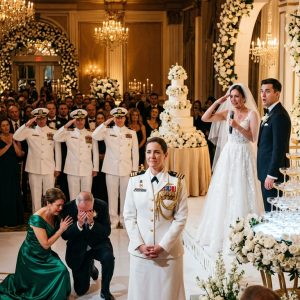
The image displayed a lavishly decorated ballroom overlooking the ink-black expanse of the Long Island Sound. Towering swans carved from crystal-clear ice flanked a cascading champagne fountain. Men in tailored tuxedos and women in shimmering evening gowns blurred in the background, a testament to obscene wealth and superficiality.
Beneath the photograph, Beatrice’s text read:
“You’ve always been the strong one, Clara. Handle it yourself. We are in the middle of Melody’s formal engagement announcement. Christian’s family is incredibly noble, and we cannot afford any distractions tonight. Try taking some Tylenol.”
I stared at the glowing pixels until they blurred. Melody, my younger sister. The golden child. For twenty-five years, my parents had cultivated Melody like a rare, delicate orchid, pouring every ounce of their affection and financial resources into her social ascension. And now, she had finally landed her prize: Christian Dumont, a man claiming to be the heir to a centuries-old European aristocratic fortune. My family was desperate to bind our surname to his, to finally secure their coveted seat in high society.
A single tear slipped down my cheek, pooling hot and salty in my ear. They were drinking vintage champagne while I was leaking blood onto a hospital mattress. To my own family, my life—and the life of my fatherless daughter—was nothing more than an inconvenient, poorly timed distraction from their social climbing.
The sorrow inside me curdled. The pleading, desperate girl who just wanted her mother’s comfort began to die in that dim room, replaced by something entirely different. Something cold.
As I struggled to reach over and adjust the flow rate on my IV drip, the screen of my phone suddenly flashed with a harsh, glaring yellow notification. It was a high-priority alert from my bank. I tapped it with a numb finger.
URGENT: Pending external transfer request.
Amount: $4,000.00.
Source: Joint Savings (Legacy).
My breath hitched, catching painfully in my chest. That was the account holding David’s death benefits. It was the absolute last of my financial lifeline, the money meant to cover this catastrophic hospital bill and keep a roof over Hazel’s head. My father, Arthur, had retained legacy administrative access to the account from when David and I were first married and deployed overseas. He had no legal right to the funds, but the digital pathway remained open.
Approve or Decline? the screen demanded.
Chapter Two: The Blood Price
I didn’t press decline. Not immediately. The sheer audacity of the notification paralyzed me. I stared at the sum—four thousand dollars. It wasn’t a life-changing amount of money to a billionaire, but to a widowed mother recovering from a near-fatal hemorrhage, it was the difference between survival and ruin. It was diapers. It was formula. It was the copay for the surgeon who had sewn my uterus back together.
I tapped Arthur’s contact and brought the phone to my ear. My pulse drummed a frantic, sickening rhythm against my skull.
He answered on the second ring. A chaotic symphony of jazz music, clinking crystal glasses, and boisterous laughter flooded the line, drowning out the quiet, rhythmic beep of my heart monitor.
“Make it quick, Clara,” Arthur’s voice boomed over the receiver, slurred with the unmistakable arrogant drawl of a man who was two martinis deep and feeling invincible. “We are greeting the French ambassador’s attaché in five minutes.”
“Dad,” I croaked, my voice sounding hollow and ragged. “What are you doing? There’s a pending transfer for four thousand dollars on my account. That’s David’s insurance money. I need that for the hospital bills. I need it for Hazel’s care.”
Arthur sighed, a heavy, performative sound of absolute irritation. “Calm down, Clara. Stop being so dramatic. It’s a temporary withdrawal.”
“Temporary? You’re stealing from your dead son-in-law’s fund?”
“Don’t use that ugly word,” he snapped, his tone shifting from dismissive to hostile. “Christian’s family arrived in town unexpectedly, and they wanted to upgrade our hotel suites to the imperial wing at the Oceanside Manor. We need to look the part, Clara. If we look cheap, the marriage contract might fall through. Do you have any idea the kind of generational wealth we are securing tonight?”
“Dad, I’m bleeding,” I whispered, the words trembling with a final, desperate attempt to find a shred of humanity in the man who raised me. “I can’t afford my own care.”
“We’re doing this for the family’s future!” Arthur barked over a swell of applause in his background. “You’ll get it back tenfold once Melody marries into the Dumont estate. Look at the bigger picture. Stop being so incredibly selfish for one night. Just approve the damn transfer so my card doesn’t decline at the concierge. I have to go.”
The line went dead. The silence in my hospital room rushed back in, heavy and suffocating.
I slowly lowered the phone. I looked down at the plastic bassinet. Hazel had fallen back asleep, her tiny chest rising and falling in shallow, perfect breaths. She was innocent. She had no father, and now, she effectively had no extended family. They would gladly drain her of her last resources, leaving her to starve, all to purchase the illusion of nobility.
Something fundamental shattered inside my chest. It wasn’t a noisy breaking, but a quiet, seismic shift. The illusion of familial duty evaporated, taking with it my grief, my self-pity, and my desire to ever plead for their love again. If they viewed me as prey, I would stop acting like a victim.
I looked back at the flashing bank alert on my screen. I could decline it. I could lock the account, call the bank, and fight a messy, exhausting domestic battle with Arthur over authorization codes. But a sudden, chilling clarity washed over me. Arthur was driven by blinding greed, and greed makes people terribly, beautifully stupid.
“Go ahead—take it,” I whispered to the cold, sterile hospital room, my voice devoid of any emotion.
My thumb hovered over the screen. I pressed Approve.
The screen flashed green. Transfer processing.
I let my head fall back onto the thin pillow, a strange, dark calm settling into my bones. My family believed they were stealing from a helpless, recovering woman to buy their way into high society; they had no idea they were purchasing a one-way ticket to their own destruction.
Just ten minutes after the transfer was finalized, my phone vibrated with a totally different cadence. It wasn’t a text. It was an automated security report from Titan Risk Management, the elite private intelligence firm David had consulted for before his death. As his widow, my primary accounts were still shadowed by their localized threat-detection software.
I opened the encrypted email. My eyes scanned the red text. Titan’s algorithm had flagged the routing number of the destination account Arthur had just wired the four thousand dollars into. It wasn’t a standard luxury hotel escrow. It was classified as a high-risk entity under active federal surveillance.
Chapter Three: The Honeypot
My pain was momentarily eclipsed by a surging rush of adrenaline. I pushed myself up, ignoring the fiery protest of my surgical staples, and reached for the heavy, black tactical laptop David had left behind. It had been sitting on the hospital chair, brought by a sympathetic neighbor who had packed my emergency overnight bag.
Resting the machine carefully on my lap, I booted it up. My fingers moved with muscle memory, bypassing the basic operating system and logging into the secure, heavily encrypted VPN tunnel David had set up for us. During his time in military intelligence, and later consulting for Titan, he had taught me the architecture of deep-background checks. “Information is armor, Clara,” he used to say. Tonight, it was going to be a weapon.
I needed to know exactly who my sister was marrying.
I opened a secure browser and accessed a law-enforcement aggregated database David’s credentials still partially unlocked. I didn’t search for “Christian Dumont.” Fake aristocrats didn’t leave real digital footprints; they left carefully curated PR articles. Instead, I pulled up Melody’s public Instagram account on my phone, saved a high-resolution photo of her beaming fiancé from a recent post, and ran it through Titan’s sophisticated facial-recognition software.
The progress bar crawled across the screen. Analyzing biometric markers… Cross-referencing interpol and federal registries…
Ping.
A match populated on the screen, and the breath caught in my throat. It wasn’t a French passport or a European estate registry. It was a federal wanted poster.
The man staring back at me, with his charming aristocratic smile and styled hair, was not Christian Dumont. His real name was Gary Higgins. Born in Ohio. He had no French estate, no noble lineage, and absolutely no wealth. What he did have was a rap sheet a mile long. He was a wanted federal fugitive, the mastermind behind a massive, multi-state identity theft and wire fraud syndicate that specifically targeted wealthy, gullible social climbers. He would pose as a nobleman, convince the family to “invest” in fake European ventures or pay exorbitant “escrow fees” to clear international marriage contracts, and then vanish into the wind.
I stared at the screen, a dark, humorless smile touching the corner of my lips. My parents hadn’t just bought into a scam; they had mortgaged their entire reputation on a wanted felon.
But it got worse. Or, depending on how you looked at it, perfectly poetic.
I traced the routing number Arthur had used for the $4,000 transfer. I cross-referenced it with Higgins’ active file. The bank account Arthur had eagerly wired the money into was flagged as a monitored “honeypot.” It was a dummy account set up by federal authorities specifically designed to trace Higgins’ accomplices and financiers.
By wiring money into this specific, monitored network under his own legal name, from an account he administered, my father hadn’t just paid for a hotel upgrade. In the eyes of the federal government, Arthur Evans had just registered himself as an active financier of a federal fraud ring. He had crossed state lines with the digital wire, elevating it to a federal crime.
My phone vibrated violently against the mattress. The caller ID read: RESTRICTED.
I answered, keeping my voice perfectly steady. “Hello?”
“Mrs. Clara Evans?” a deep, authoritative voice asked. “This is Special Agent Garrison from the FBI Financial Crimes Division. I realize the hour is late, ma’am, and our records indicate you recently suffered a medical emergency, but we’ve detected a highly anomalous transaction originating from a shared legacy account under your name. The funds were directed to a high-priority suspect under our surveillance. Are you in a safe location, and are you aware of this transaction?”
I looked at the sleeping form of my daughter. I thought of the ice sculptures. I thought of Arthur telling me not to be selfish as I bled.
I took a slow, deep breath, tasting the sterile hospital air. “I am perfectly safe, Agent Garrison. And yes, I am aware of the transaction. My father, Arthur Evans, initiated the transfer against my desperate medical needs. He utilized his legacy access to fund a luxury event tonight for a man he knows as Christian Dumont. I have all the time-stamped digital records, the hostile text messages proving his intent, and I am willing to cooperate fully with your investigation.”
There was a brief pause on the line, the sound of a professional recalibrating his approach to a remarkably calm victim. “You understand that this man is Gary Higgins, a fugitive?”
“I do now,” I replied softly. “I have no desire to protect the people who robbed my late husband’s estate to fund a criminal. What do you need from me?”
“Your absolute silence, Mrs. Evans. Do not contact your father. We have been trying to pin down Higgins’ exact physical location for six months. He’s slippery. If your father’s wire transfer was for an event tonight, we have our location.”
“They are in the imperial wing ballroom of the Oceanside Manor on Long Island,” I provided effortlessly, serving my family up on a silver platter. “My sister, Melody, is live-streaming the event publicly on her social media.”
“Excellent,” Agent Garrison said, the crisp sound of typing echoing over the line. “Mrs. Evans, I want to thank you for your profound cooperation. You’ve just handed us the linchpin.” He paused, his voice dropping an octave into absolute, tactical seriousness. “We are executing a sweep of the Long Island estate where the engagement party is currently being held. The raid begins in exactly one hour. Your father will be detained as a primary person of interest.”
Chapter Four: The Fall of the House of Evans
I didn’t sleep. The pain medication had finally begun to dull the physical agony of my incision, wrapping my body in a heavy, floaty warmth, but my mind was razor-sharp. I propped my phone against the plastic water pitcher on my tray table, turning the brightness down so the glare wouldn’t wake Hazel.
I opened Instagram. Melody’s profile was glowing with a purple ring, indicating she was broadcasting live. I tapped it.
The screen filled with the dazzling, nauseating opulence of the Oceanside Manor’s grand ballroom. Melody was holding the camera high, panning across a sea of wealthy local business owners, minor politicians, and country club socialites. The room dripped with forced elegance. Waiters in white gloves circulated with trays of Beluga caviar and vintage Dom Pérignon.
“To all my followers,” Melody cooed into the microphone, her face flushed with champagne and triumph, flashing a cubic zirconia ring that Higgins had undoubtedly promised was a priceless family heirloom. “We are just moments away from the official toast! The Dumont family legacy is officially merging with ours!”
She flipped the camera to the front of the room. There was Arthur, his chest puffed out like a proud rooster, a custom tuxedo straining against his waistline. Beside him stood Beatrice, smiling warmly, looking down her nose at the catering staff, radiating the smug satisfaction of a woman who believed she had finally secured her permanent place in the upper echelon of society. And in the center stood Gary Higgins, looking impossibly suave, playing the role of Christian Dumont to absolute perfection.
Arthur tapped his crystal glass with a silver spoon. The chiming sound echoed through my phone speaker, quieting the lavish room.
“Family, friends, and esteemed guests,” Arthur boomed, his voice echoing with unearned authority. “Tonight, we raise a glass to my new son-in-law, Christian! A man of true noble heritage. The Evans family is proud to announce not just a union of hearts, but a union of enterprise. We are proud to invest heavily in his family’s European ventures, forging a legacy that will last generations!”
Applause rippled through the ballroom. Melody beamed. Beatrice dabbed fake tears from her eyes.
I watched the screen, my heart beating a slow, steady drum in my chest. Three… two… one…
Suddenly, the massive, oak double doors at the back of the grand ballroom didn’t just open; they were violently breached. The heavy thud of the doors slamming against the walls overpowered the delicate string quartet playing in the corner.
“FBI! Nobody move! Keep your hands where we can see them!” a voice roared through a heavy-duty megaphone.
Melody’s camera jerked wildly, capturing a chaotic blur of motion. Before Arthur could even lower his champagne glass, a dozen tactical officers flooded the elegant room, their dark Kevlar vests and drawn weapons a brutal contrast to the silk and chiffon of the guests.
Pandemonium erupted. Women screamed, dropping their crystal flutes. High-society men dove behind ice sculptures.
Gary Higgins didn’t hesitate. The charming aristocrat dropped his facade instantly, turning on his heel and bolting toward the swinging doors of the catering kitchen. He didn’t make it five feet. Two heavily armored agents launched themselves forward, tackling Higgins directly onto a massive buffet table. The table collapsed under their combined weight, sending expensive caviar, imported cheeses, and shattered glass cascading across the marble floor in a spectacularly messy display.
“Christian!” Melody shrieked, the camera dropping to capture only the floor and the frantic shuffling of expensive shoes.
“Arthur?” Beatrice gasped, her voice shrill and panicked over the audio feed.
I watched as the phone was kicked aside, its lens now angled perfectly to capture Arthur. Two agents had grabbed my father, violently twisting his arms behind his back. The champagne glass shattered on the floor.
“What is the meaning of this? Unhand me! Do you know who I am?” Arthur bellowed, his face turning a dangerous shade of crimson.
Agent Garrison stepped into the frame, his badge glinting under the chandelier light. He looked entirely unimpressed by the wealth surrounding him. “Arthur Evans, you are under arrest for conspiracy to commit wire fraud, money laundering, and aiding a federal fugitive,” Garrison announced loudly, his voice cutting through the hysteria. The sharp, metallic click-click of heavy steel handcuffs locking around Arthur’s wrists was the loudest sound in the world.
The guests around them audibly gasped, physically backing away from Beatrice as if she were suddenly diseased. I could see the glow of dozens of cell phones lighting up the background as the elite of Long Island eagerly recorded the spectacular, devastating fall of the Evans family.
Melody’s live stream abruptly cut to black, displaying a Broadcast Ended message.
I locked my phone, the dark screen reflecting my own tired, peaceful face. I looked over at Hazel. She slept through it all. I reached out, gently resting my hand on her warm, rising chest. We were safe. The cancer had been excised.
Four hours later, long after the hospital had quieted into its deep night rotation, my phone rang. It was a collect call from a county holding facility. I accepted the charges.
“Clara!” Arthur’s voice was utterly unrecognizable. Gone was the booming arrogance, the smug superiority. He was weeping. A frantic, pathetic, breathless sobbing. “Clara, oh my god, Clara, you have to help me. They took my belt. They put me in a cage. You have to call the FBI right now. Tell them—tell them the four thousand dollars was a medical expense! Tell them you authorized it for a specialist, not an investment! If you don’t lie for me, they’re going to seize the house, Clara. I’ll go to federal prison. Please, Clara, please!”
I listened to his frantic pleading. I listened to the man who had told me to take a Tylenol while I bled out. I stayed entirely silent for a long, agonizing moment, letting the weight of his terror hang in the air between us.
“You told me to handle things myself, Dad,” I whispered into the darkness, my voice smooth as glass. “Good luck doing the same.”
I hung up, blocked the number, and finally, for the first time since David died, I closed my eyes and fell into a deep, dreamless sleep.
Chapter Five: The Tides of Maine
Three months passed. The world, as it always does, spun forward.
The news of the “Fake French Aristocrat Gala Raid” had dominated the tri-state tabloids for weeks. It was a spectacular social execution. The Evans family name became a punchline at every country club from the Hamptons to Greenwich. Left with no other option, and facing overwhelming digital evidence provided by his own daughter, Arthur accepted a brutal plea deal. He avoided federal prison, but the financial penalties and restitution fees were catastrophic. He was forced to liquidate his retirement accounts, sell his luxury vehicles, and remortgage the family estate just to pay the criminal defense lawyers. He was a broke, disgraced man wearing a digital ankle monitor.
Melody’s grand engagement was shattered, her reputation ruined by her association with Gary Higgins. She retreated into a bitter, isolated depression, locking herself in her childhood bedroom. Beatrice, stripped of her wealth and her social standing, could no longer show her face at any charity gala or luncheon without inciting vicious whispers. The toxic empire they had built on appearances had crumbled into dust.
I didn’t stick around to watch the ashes settle.
I sat on the wraparound wooden porch of my new cottage, inhaling the sharp, clean scent of the Atlantic Ocean mixed with the pine trees of coastal Maine. The physical pain of my C-section was entirely gone, leaving behind only a faint, silver scar across my lower abdomen—a permanent, physical reminder of my survival and the day I chose to fight back.
Beside me, in a sturdy wooden bassinet, Hazel cooed happily, reaching her chubby hands up toward the sun-dappled leaves of the oak tree shading our porch. She was healthy, thriving, and blissfully unaware of the chaos she had been spared.
After my discharge from the hospital, I had used David’s untouched military benefits—the funds I had safely secured after Arthur’s arrest—to buy this modest, beautiful home outright. It was located six hundred miles away from the toxicity of Long Island. I had hired Mrs. Gable, a kind, retired local nurse, to act as a part-time nanny while I regained my strength. I spent my days unpacking David’s books, walking on the rocky shoreline, and proving to myself, hour by hour, that I didn’t need my parents’ permission, approval, or presence to build a beautiful life.
I had found absolute peace. I was untethered from the demands of people who never valued me. The silence of the Maine woods was not the heavy, isolating silence of grief I had felt in the hospital; it was the comforting silence of a sanctuary.
The peaceful quiet of the Tuesday afternoon was suddenly broken by the harsh crunch of tires on gravel.
I looked up from my tea. A silver sedan, dusty from the long interstate drive, pulled up to the edge of my driveway. The engine was cut, and the driver’s side door opened.
My heart didn’t race. My palms didn’t sweat. I simply watched with mild, detached curiosity as Beatrice stepped out of the car.
She looked a decade older. The immaculate, salon-styled hair was frizzy and unkempt. The tailored designer clothes had been replaced by a wrinkled blouse and simple slacks. She looked haggard, her eyes scanning my beautiful, sturdy home with a complicated mixture of deep envy and raw desperation. Clutched tightly to her chest was a thick manila envelope protruding with legal documents.
She unlatched the front gate and began the long walk up the porch steps, entirely unaware that the daughter she was coming to manipulate no longer existed.
Chapter Six: The Untouchable
Beatrice stopped at the base of the porch steps, her hands trembling slightly as she gripped the manila folder. She looked at me sitting in the wicker chair, and then her eyes darted to Hazel, who was babbling softly at a seagull flying overhead.
“Clara,” Beatrice said, her voice cracking. It lacked the haughty command it used to possess. “You look… well. The sea air suits you.”
I didn’t offer her a seat. I didn’t offer her tea. I simply looked at her, letting the silence stretch until it became profoundly uncomfortable for her. “What do you want, Beatrice?”
She flinched at the use of her first name, a flash of her old indignation rising, but she quickly swallowed it down. Desperation makes a poor beggar of pride.
“We’ve had a terrible time, Clara,” she began, the tears springing to her eyes a little too easily. “The press has been merciless. Your father’s legal fees were astronomical. The fines… the government took almost everything. Melody is profoundly depressed, she won’t even leave her room. We are drowning, Clara.”
She took a step up the stairs, holding out the folder. “We need you to sign this co-signatory form for a high-risk home equity loan. Because of your father’s felony record, no reputable bank will touch us. But your credit is pristine, and you own this property free and clear. We just need you to leverage it for us, just for a little while, so we don’t lose the Long Island house. We are family, Clara. You have to help us.”
I stood up slowly. The air off the ocean was brisk, but I felt entirely warm. I looked down at the woman who had birthed me, and I searched my soul for a shred of guilt, a shred of obligation, or even a shred of anger. I found absolutely nothing but an impenetrable, unyielding calm.
“Family?” I asked softly, the word feeling foreign on my tongue. My voice carried the quiet, dangerous strength of a woman who had navigated the dark and emerged untouchable.
“Yes, family!” Beatrice cried, stepping closer. “We are your blood! We raised you!”
“Family,” I repeated, my tone dropping to a deadly whisper, “doesn’t leave you to bleed alone in a hospital bed while they drink champagne. Family doesn’t steal from a grieving widow’s child to pay for ice sculptures.” I gestured down to the bassinet. “My family is right here.”
“But Clara, we are your parents!” Beatrice pleaded, genuine panic setting into her features as she realized her traditional weapons of guilt and duty were deflecting off me like paper arrows against steel. “You can’t just abandon us! It’s your duty!”
“You were my parents,” I corrected her gently, offering a sad, final smile. “But today, I am a mother. And my first, absolute duty is to protect my daughter from parasites. I will not risk the roof over Hazel’s head to save the mansion you used to lock me out of.”
“You vindictive little…” Beatrice started, her true colors flashing viciously before she caught herself.
“Stop,” I commanded, the single word ringing out with absolute authority. Beatrice froze. “Do not say another word. You chose your legacy, Beatrice. You chose the illusion of status over the reality of your daughter’s life. Now, you get to live with the consequences of that choice. Please leave my property. If you ever contact me again, or if Arthur attempts to circumvent my blocks, my lawyers will handle it with the federal prosecutor who handled your husband’s plea deal. Are we clear?”
Beatrice stared at me. Her mouth opened and closed silently. She looked at the sturdy house, the healthy baby, and the eldest daughter she had fatally underestimated. The realization washed over her, crushing her shoulders forward—the gentle, pleading girl they had exploited for decades was dead, buried under the Long Island soil.
Without another word, her face pale and slack with defeat, Beatrice turned around. She walked down the steps, her posture broken, and climbed back into her dusty car. I watched as she backed out of the driveway and drove away, disappearing down the winding coastal road, out of my life forever.
I turned back to the bassinet and gently lifted Hazel into my arms. I pressed my face against her soft, warm cheek, inhaling the sweet scent of baby lotion and ocean air. I walked to the edge of the porch, looking out at the vast, open Atlantic as the sun began to set, painting the sky in brilliant, fiery shades of gold and violet. The storm had fully passed. The toxic wreckage of the past was gone, and in its place, a quiet, beautiful life had just begun.
As I turned to carry Hazel inside to make her dinner, my phone chimed softly from the porch table. I picked it up. It was an official, encrypted email from the executor of David’s estate at Titan Risk Management.
Mrs. Evans, this is confirmation that the final legacy trust fund for Hazel Evans has been legally secured. The accounts are fully locked, ring-fenced, and untouchable by any external party. Her future is safe forever.
I smiled, locking the screen. I walked inside my home, closed the heavy wooden door, and threw the deadbolt, locking the world out, and keeping my perfect family safely inside.
If you want more stories like this, or if you’d like to share your thoughts about what you would have done in my situation, I’d love to hear from you. Your perspective helps these stories reach more people, so don’t be shy about commenting or sharing.