Chapter 1: The Price of Blood
This is the chronicle of my own quiet, devastating coup d’état.
There is a distinct, metallic scent that precedes a catastrophic explosion—a cocktail of scorched ozone, diesel vapor, and pulverized earth. For two years, that scent had been my ghost, haunting the corners of my childhood bedroom. I was twenty-eight years old, a former combat medic in the United States Army, and my world had been violently compressed into the dimensions of a standard-issue aluminum wheelchair.
The IED in the Arghandab River Valley hadn’t quite managed to kill me, but it had made a ruin of my right leg. Beneath layers of heavy, sterile bandages, my calf was a jigsaw puzzle of shattered tibia, grafted skin, and severely compromised nerve endings. It throbbed with a dull, rhythmic agony that synced perfectly with the bass thumping from the DJ booth across the manicured lawns of my parents’ sprawling estate in Oakbrook Heights, Illinois.
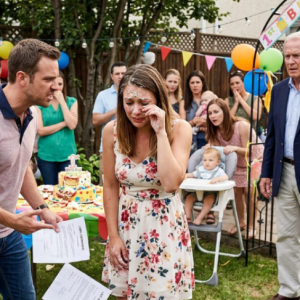
It was a brilliant, cloudless Sunday. A Father’s Day garden party, though the term “party” was a grotesque understatement. It was a theatrical exhibition of wealth.
I sat at the edge of the limestone patio, gripping the rubber wheels of my chair, the rubber warm against my calloused palms. Around me, a small army of white-coated caterers drifted through a sea of high-society guests in pastel linen suits and silk sundresses. They carried silver trays heavy with beluga caviar and flutes of imported champagne. The air smelled of expensive gardenias and superficiality.
I was an unwanted prop in this play. My mother, Diane, had spent the entire morning aggressively maneuvering me behind large floral arrangements, terrified my visible trauma would ruin the aesthetic of her curated event. But I wasn’t here to mingle. I was here for a matter of physical survival.
I spotted my father, Arthur, holding court near a towering, intricately carved ice sculpture of a soaring eagle. He was a silver-haired patriarch whose entire personality was built around his country club handicap and his corporate title. I pushed my wheels, navigating the uneven flagstones, fighting the biting pain that shot up my spine with every jolt.
I wedged my chair between him and a venture capitalist he was trying to impress.
“Dad,” I said, my voice tight. “I need to talk to you. Alone. It’ll only take a minute.”
Arthur frowned, the polite, wealthy smile not quite reaching his eyes. He excused himself and pulled me roughly behind the sprawling buffet tent, away from the prying eyes of his peers.
“Maya, what is it?” he hissed, aggressively adjusting the platinum Rolex on his left wrist. “You are making the guests visibly uncomfortable. I told your mother to buy you a longer skirt. Those bandages look like something out of a horror film.”
I swallowed the bile rising in my throat. I didn’t have the luxury of pride today. “The surgeon called on Friday, Dad. The VA denied the full coverage for the experimental nerve-graft. They consider it ‘elective salvage.’ I need the $5,000 co-pay by tomorrow morning. If I don’t get this specific graft, the tissue necrosis will spread.” I took a jagged breath. “If they don’t operate, they take the leg below the knee on Tuesday.”
Arthur sighed. It wasn’t a sigh of parental sorrow; it was the sharp, annoyed exhalation of a man being inconvenienced by a broken appliance.
“Maya, we’ve discussed this,” he said, his tone utterly devoid of warmth. “Your mother and I are on a strict budget this quarter. The markets are volatile. Besides, the Veterans Affairs office should handle your little military mishaps. That’s what we pay taxes for. We simply don’t have the liquid cash to throw at experimental procedures that might not even work.”
I stared at him, my mind short-circuiting. A strict budget. I looked past his shoulder at the ice sculpture melting into a silver basin, at the three bartenders pouring fifty-dollar shots of tequila.
“Dad, it’s five thousand dollars,” I whispered, the desperation finally cracking my stoic military facade. “You spent that much on the floral arrangements this morning. I am losing my leg. Please.”
“Stop being dramatic, Maya. A prosthetic is perfectly fine these days. Now please, mingle. Or better yet, go back to your room.” He patted me condescendingly on the shoulder, turned on his heel, and walked away, plunging back into the laughing crowd.
I sat alone in the shadow of the tent, staring down at my ruined limb, the reality of my impending amputation washing over me like ice water. I gripped the wheels, preparing to retreat into the house and accept the grim, irreversible fate awaiting me on a surgeon’s table.
But then, the string quartet suddenly stopped playing. A hush fell over the garden.
From the front of the estate, the heavy, guttural rumble of a massive diesel engine shook the ground. A custom, heavy-duty truck was slowly backing up the grand, circular driveway, towing a massive, sleek shape completely concealed beneath a heavy crimson velvet tarp.
Chapter 2: The $150,000 Insult
Arthur jogged to the front of the crowd, a wireless microphone miraculously appearing in his hand. The guests flooded around the driveway, clutching their champagne flutes, murmuring in breathless anticipation. I rolled my chair forward, lingering on the periphery, a sick, cold dread coiling in my gut.
My younger sister, Sienna, stood next to Arthur. She was twenty-four, the undisputed golden child, a self-proclaimed “lifestyle influencer” whose entire existence was funded by our parents. She wore a pristine white designer sundress, bouncing on her heels, clapping her hands over her mouth in performative shock.
“Family and friends!” Arthur’s voice boomed over the estate’s hidden speakers. “Father’s Day is usually about the patriarch. But today, I want to celebrate my greatest achievement. My beautiful daughter, Sienna, has just been accepted into the master’s program at NYU. To celebrate her bright future, her mother and I decided she needed a little something for those summer weekends in the Hamptons!”
Arthur grabbed the edge of the crimson velvet and yanked it backward.
The tarp fell away to reveal a breathtaking, brand-new luxury speedboat. It was a fiberglass masterpiece of navy blue and blinding white, complete with twin outboard motors and a plush, cream-colored leather interior. I knew the model from my father’s boating magazines. It was a Cobalt. It retailed for no less than $150,000.
The crowd erupted into roaring applause. Sienna shrieked, throwing her arms around Arthur’s neck, before scrambling up the boarding ladder onto the deck of the boat. Someone handed her a massive bottle of Dom Pérignon.
I sat paralyzed. The pain in my leg vanished, entirely eclipsed by the sheer, staggering audacity of the betrayal. Five thousand dollars to save my physical body was an impossible burden, a “strict budget” constraint. One hundred and fifty thousand dollars for a toy to celebrate a fake academic achievement was a Tuesday expense.
Tears, hot and humiliated, spilled over my eyelashes. I didn’t sob out loud; I just wept silently, the salt stinging my cheeks.
Sienna popped the cork. The champagne sprayed violently into the air, raining down on the driveway. She leaned over the pristine fiberglass hull, her eyes locking onto me sitting in the shadows. Her smile vanished, replaced by a sneer of pure, unfiltered disgust.
“Oh my god, Maya, stop crying,” Sienna yelled, her voice easily carrying over the cheering crowd and the fizzing champagne. She rolled her eyes dramatically. “You are literally always doing this! Stop killing the vibe of our party! Go be miserable somewhere else.”
No one defended me. Diane simply looked away. Arthur was busy shaking hands.
I didn’t say a word. I turned my chair around and began the agonizingly long, solitary roll down the neighborhood sidewalks. I couldn’t stay under their roof for another second.
Hours later, the sun had set. I was sitting in the oppressive dark of the cramped, first-floor apartment I rented on the gritty outskirts of the city. My leg was elevated on a stack of pillows, the pain now a roaring fire in my nerve endings. I was mentally preparing to call the VA hospital and schedule the amputation.
Suddenly, a frantic, rhythmic knocking rattled my cheap wooden door.
I wheeled myself over and pulled the deadbolt. Standing in the hallway, panting heavily, was my fifteen-year-old brother, Toby. He was the only mistake Arthur and Diane had ever made—an unplanned, largely ignored child who had somehow escaped their toxic, narcissistic conditioning.
Toby was covered in sweat. His hands and his favorite t-shirt were stained with thick, black grease. He practically fell into the apartment, dropping to his knees beside my wheelchair, chest heaving.
“Toby? What’s wrong? What happened to you?” I asked, my heart hammering in my chest.
He looked up at me, his eyes red and swollen from crying. He reached into his pocket and pulled out a fistful of crumpled bills—twenties, tens, fives, and singles. He dumped the chaotic pile directly into my lap.
“I heard them, Maya,” Toby sobbed, his voice cracking with adolescent heartbreak. “I heard what Dad said to you behind the tent. I know about Tuesday.”
“Toby, where did you get this?” I asked, staring at the dirty money.
“I took my bike. I packed up Grandpa Arthur Sr.’s vintage woodworking tools. The ones he left me before he died. I pedaled down to the pawnshop on 4th Street,” Toby cried, wiping his nose with a greasy forearm. “The guy ripped me off. I know he did. But it’s $840, Maya. It’s all I could get.”
The air left my lungs. Those tools were Toby’s most prized possession, the only thing in our family that held genuine sentimental value. He had sold his only connection to our grandfather to save a fraction of my leg.
“Toby, no… you can’t…” I choked on my words.
“Wait,” he said, reaching into his back pocket. He pulled out a small, brightly colored rectangle of cardboard. A cheap, five-dollar scratch-off lottery ticket. He placed it gently on top of the crumpled bills.
“The guy at the gas station said it was a lucky batch,” Toby whispered, laying his head against the armrest of my wheelchair. “I know it’s not five thousand. But I just… I prayed the whole way back. I just wanted a miracle to save your leg, Maya. I can’t let them cut you into pieces.”
I threw my arms around his shaking shoulders, burying my face in his sweaty hair. I broke down entirely. Not from the pain, not from the betrayal of my parents, but from the profound, uncorrupted, desperate love of my youngest brother. We held each other in the dim light of the apartment until his breathing slowed and he finally fell asleep on my worn-out sofa.
The apartment was dead silent, save for the hum of the refrigerator. I looked at the pile of cash. I picked up the scratch-off ticket. Numbly, mechanically, I pulled a quarter from my pocket.
I began to scratch.
Silver dust fell onto my lap like snow. Diamond. Diamond. The scratching sound was loud in the quiet room. Diamond. I moved to the prize box, scraping away the silver film, expecting to see a five-dollar reimbursement.
The numbers appeared. I blinked. I rubbed my eyes, thinking the trauma and the painkillers were causing a hallucination. My breath hitched in my throat. My heart stopped beating. The room violently, sickeningly tilted on its axis, and the world as I knew it ceased to exist.
Chapter 3: The Architecture of Vengeance
Fifty Million Dollars.
The words were printed in bold, block letters beneath the matching diamonds. It was the state’s grand prize.
I didn’t scream. I didn’t jump out of my chair, because I couldn’t. Instead, I sat in absolute, dead silence for four straight hours. The terrified, broken daughter vanished, burned away by the adrenaline surging through my veins. The military strategist, the medic who had kept men alive under heavy machine-gun fire, took the helm.
By sunrise, the plan was fully formed.
I did not tell Toby. I kissed him on the forehead, sent him home in an Uber, and told him the VA had miraculously approved my surgery overnight. I lied to protect him. Because what I was about to build was a weapon of mass financial destruction, and I needed the blast radius perfectly contained.
Within a week, I was gone. I didn’t claim the ticket with a giant cardboard check and a photo op. I hired a notoriously ruthless, high-power law firm in Chicago. They claimed the prize under the impenetrable veil of a blind trust, legally incorporated as Apex Holdings.
Two days later, I was on a private medical transport flight to Geneva, Switzerland.
I didn’t just get the $5,000 co-pay surgery. I bought the absolute best experimental limb-salvage medical care on the planet. For six months, I lived in a pristine, alpine medical facility. The surgeons repaired my nerves, reconstructed my tibia with titanium, and grafted synthetic tissue over the scarring. The physical therapy was grueling. It was hours of screaming, sweating, and pushing my body past the breaking point, driven entirely by the icy resolve to stand on two feet when the day of reckoning arrived.
While I was rebuilding my body in the Swiss Alps, I was actively dismantling my family back in the States.
Through the encrypted tablets provided by my wealth management team at Apex Holdings, I watched my family’s descent into ruin. It was a masterclass in narcissistic self-destruction. Arthur’s logistics business took a massive, unexpected hit from a disrupted supply chain. But instead of downsizing, Arthur and Diane doubled down on their illusion of wealth.
Sienna’s speedboat was a financial black hole. The mooring fees at the Oakbridge Yacht Club, the specialized insurance, the $10,000-a-month maintenance, and the lavish, catered parties Sienna threw on the deck every weekend began to bleed Arthur dry.
Desperate to keep up appearances, Arthur did exactly what my analysts predicted he would do. He took out massive, high-interest loans, using the family estate as collateral.
From my hospital bed overlooking Lake Geneva, I gave the order.
My proxy shell corporations systematically, invisibly bought up every single one of my father’s loans. When he defaulted on a payment, I bought the debt. When he took out a second mortgage, my bank held the paper. Like a spider spinning a web in the dark, I surrounded them. They were funding their fake, golden life with my money, completely unaware that the daughter they had thrown away was the very hand tightening the noose around their necks.
Nine months later, my legs were strong. The limp was barely noticeable. The scars remained, but they were no longer a source of shame; they were battle armor.
Back in Illinois, the trap snapped shut.
Arthur’s business officially filed for bankruptcy. The banks called in the loans. Facing imminent foreclosure, the loss of the yacht, and potential criminal fraud charges for lying on his secondary loan applications, Arthur was thrown a final, desperate lifeline.
His creditors informed him that a single, private equity firm had acquired all of his debt. Apex Holdings.
Arthur received a certified letter. The anonymous CEO of Apex Holdings was willing to grant him a mandatory, in-person meeting to discuss a potential restructuring of his assets. It was his last chance to save his kingdom.
He had no idea he was walking into a slaughterhouse.
Chapter 4: The Apex Predator
The boardroom on the top floor of the Apex Holdings skyscraper in downtown Chicago was designed to be intimidating. The walls were floor-to-ceiling glass, offering a dizzying, God-like view of the city. The massive conference table was cut from a single slab of black marble.
I sat at the head of the table in a high-backed, black leather executive chair, deliberately turned away from the heavy mahogany doors, gazing out at the skyline. I wore a sharp, impeccably tailored charcoal suit. My cane, a sleek, black carbon-fiber piece I occasionally used for balance, rested silently against my desk.
The doors clicked open. My lead attorney, Mr. Sterling, escorted them in.
“The CEO will see you now,” Sterling announced, his voice devoid of emotion.
I heard the shuffling of expensive leather shoes. I could hear Arthur breathing heavily, the distinct wheeze of a panicked man.
“Thank you. Thank you for taking the time,” Arthur began, his voice trembling, stripped of all its usual country-club arrogance. “Sir, or Madam, I know my portfolio looks distressed. But if you just give us a brief extension. If you foreclose on the estate and seize the yacht, my family will be on the street. We just need a little time to liquidate some minor assets.”
“Please,” Diane chimed in, her voice thin and desperate. “We are respectable people. Our daughter Sienna is in grad school. We can’t lose everything.”
I took a slow, deep breath, letting the scent of power fill my lungs. I placed my hands on the armrests.
I slowly swiveled the chair around.
Arthur, Diane, and Sienna stood frozen on the opposite end of the marble table. The silence that fell over the room was absolute, heavy enough to crack the glass.
I calmly stood up. I planted both perfectly healed, strong legs firmly on the hardwood floor. I didn’t lean on the desk. I didn’t use the cane. I stood tall, exuding an absolute, terrifying authority, and walked with slow, deliberate steps to the edge of the table.
The color instantly, violently drained from Sienna’s face. Her jaw dropped open, her eyes wide with a primal, instinctual terror. Diane clutched her pearl necklace, taking a stumbling step backward as if she had seen a ghost.
“You…” Diane gasped, the word catching in her throat like a fishhook. “Maya?”
Arthur’s face morphed from confusion to shock, and finally, to a horrified, sickening realization. He looked at my legs. He looked at the tailored suit. He looked at the vast, intimidating boardroom. The math was doing itself in his head, and the sum was absolute ruin.
“Hello, Arthur,” I said, my voice dropping to a terrifying, steady calm that echoed off the glass walls. I didn’t call him Dad. He lost that title the day he told me to mingle while my flesh died.
“I don’t… I don’t understand,” Arthur stammered, sweat beading on his forehead, his hands shaking violently. “You’re the CEO? You own the debt?”
“Every single penny of it,” I replied, leaning slightly forward, resting my palms flat on the cold marble. “I own your house. I own your failed business. I own your cars. And, most importantly, I own that fiberglass monstrosity you bought Sienna for Father’s Day.”
Sienna let out a whimpering sob, shrinking behind her mother. “Maya, please… it was just a joke that day… I didn’t mean it…”
I locked eyes with Arthur, ignoring her entirely. I let the silence stretch, forcing him to drown in it.
“You refused to pay five thousand dollars to save my leg,” I said, my words slicing through the air like a scalpel. I tilted my head, offering a smile that contained zero warmth. “Tell me, Arthur. Why on earth would I pay five million dollars to save your yacht?”
Arthur’s knees gave out. He collapsed onto the plush carpet of the boardroom, weeping openly, grasping the edge of the marble table. “Maya, please! I’m your father! We’re blood! Have mercy!”
“You taught me everything I know about mercy, Arthur,” I whispered.
I reached out and pressed a small silver button on the intercom console. The heavy mahogany doors swung open instantly, revealing two massive, stern security guards.
“Mr. Sterling,” I said, not taking my eyes off the weeping man on the floor. “Escort these people out of my building. Initiate the foreclosure proceedings immediately, and send the repo trucks to the Oakbridge Yacht Club.”
As the guards physically hauled my parents and screaming sister out of the boardroom, I felt a deep, profound satisfaction. But as the doors clicked shut, my private phone vibrated on the desk. It was a text from my private investigator. Breaking them financially wasn’t the end of the war; there was one final, crucial asset I needed to extract from enemy lines.
Chapter 5: Spoils of War
Three weeks later, the physical manifestation of my family’s fake empire was unceremoniously dismantled.
Through the dashcam footage provided by the repossession agency, I watched the $150,000 luxury speedboat get hauled away from the Oakbridge marina. Sienna was screaming at the repo men, standing in the cracked driveway of the cheap, rented, two-bedroom townhouse they had been forced to move into after the bank padlocked the estate. They were thrust into the working-class squalor they had spent their entire lives mocking. It was a psychological fate far worse than death for a family of narcissists.
Across town, the air was entirely different.
I stood in the entryway of a sprawling, secure penthouse suite overlooking Lake Michigan. The walls were painted in warm, inviting tones. The sunlight poured in through the massive windows.
The front door opened, and Toby walked in. He was taller now, his shoulders a little broader, but his eyes still held that same pure, uncorrupted light. He carried a single duffel bag.
It had taken two weeks of vicious legal warfare. When Arthur and Diane realized they were utterly destitute, they tried to use Toby as leverage, demanding a massive “allowance” in exchange for his custody. They didn’t realize I had already intercepted the hidden clause Mr. Sterling found—Arthur had attempted to fraudulently open credit lines in Toby’s name to hide assets before the bankruptcy. I handed the evidence to the district attorney. My parents traded their leverage for a plea deal to avoid federal prison.
I had filed for, and effortlessly won, emergency full custody. Toby was legally emancipated from their toxicity forever.
“Welcome home, kid,” I said, stepping aside to let him take in the sheer scale of the penthouse.
Toby dropped his bag, his jaw slack. He walked slowly down the hallway, peeking into the massive, high-tech kitchen and the sprawling living room. I guided him toward the end of the hall and pushed open the door to his new bedroom.
It was massive, outfitted with the best gaming computer money could buy, a king-sized bed, and a wall of windows. But Toby didn’t look at the screens or the view.
His eyes locked onto the solid oak desk in the corner. Sitting perfectly centered on the polished wood was our grandfather’s vintage, scuffed wooden toolbox.
Toby gasped, rushing over. He ran his hands over the worn handles, popping the latch to see the meticulously cleaned chisels and planes inside.
“I tracked down the pawnshop,” I told him gently, standing in the doorway. “The owner tried to play hardball. I ended up buying it back for ten times its value. It was the best money I’ve ever spent.”
Toby turned around, tears streaming down his face, and tackled me in a hug so fierce it nearly knocked me off balance. “Maya… how did you… how is all this happening?”
“You bought a lucky ticket, Toby,” I whispered, holding him tight. “You bought a miracle.”
I didn’t just buy the tools back. That morning, I had quietly signed the legal charter for the Toby’s Miracle Foundation, a fully funded, half-billion-dollar charitable organization dedicated exclusively to paying the out-of-pocket medical expenses, surgeries, and prosthetics for wounded military veterans. No soldier would ever have to beg for their physical dignity again.
As I watched Toby excitedly organize his grandfather’s tools, pulling them out one by one, a profound sense of protective peace washed over me. I harbored no lingering rage toward Arthur, Diane, or Sienna. They were ghosts to me now, trapped in a hell of their own design. I had won the war, and the spoils were beautiful.
But as the afternoon sun began to dip below the Chicago skyline, my encrypted phone vibrated in my pocket. It was an alert from the foundation’s screening department, flagging an incoming application that required my immediate, personal attention.
Chapter 6: The Golden Ticket
Two years later.
It was a crisp, brilliantly clear Sunday morning. Father’s Day.
I laced up my running shoes, the familiar, comforting tightness wrapping around my feet. I stood at the starting line of the Chicago Lakefront 10K, surrounded by hundreds of runners. The air horn blasted, and I took off.
My legs—both of them—carried me effortlessly over the pavement. The wind whipped through my hair, cooling the sweat on my forehead. There was no pain, no phantom throbbing, only the rhythmic, powerful striking of my soles against the ground. I ran with the fluid grace of a woman completely unbound.
As I crossed the finish line, checking my smartwatch to see I had beaten my personal record, a tall, seventeen-year-old boy practically tackled me in a bear hug. Toby, wearing a volunteer t-shirt for the Foundation, hoisted me into the air, cheering wildly.
Later that afternoon, the penthouse was quiet and cool. Toby was down by the building’s pool, laughing loudly with a group of friends he had made at his new, elite prep school.
I sat at my desk, sipping a glass of iced tea, reviewing the quarterly philanthropic reports for the foundation. Hundreds of surgeries funded. Hundreds of lives salvaged.
Out of habit, I checked my personal spam folder. A new email had slipped through.
Sender: [email protected]
Subject: Please Maya.
I clicked it open, feeling nothing but a mild, clinical detachment.
Maya, I know you hate us. I know you’re punishing us. But Mom is sick, and Dad is working at a hardware store. I maxed out my last credit card trying to keep the electricity on at this awful townhouse. Can you please just loan me a few thousand? Just to get by? We are blood, Maya. Please.
I didn’t feel anger. I certainly didn’t feel pity. I simply felt nothing. The emotional umbilical cord had been severed years ago, cauterized by their own greed.
I didn’t read past the first sentence. I moved the cursor and clicked Delete Forever. The digital whining vanished into the void.
I closed the laptop and walked out onto the sprawling balcony of the penthouse. The warm summer air wrapped around me. I looked down at the pool, watching Toby execute a terrible, splashing cannonball, his laughter drifting up to the twenty-fifth floor.
I stepped back inside and paused in the grand hallway. My eyes landed on a small, brightly colored rectangle of cardboard. It was a cheap, five-dollar lottery ticket, meticulously preserved and framed in solid gold, hanging at the exact center of the wall.
I smiled, running my fingers over the glass. Sometimes, the family we lose is the greatest gift we could ever receive. The storm that destroyed my past was the exact, violent catalyst I needed to build my beautiful, unbreakable future. I was whole.
If you want more stories like this, or if you’d like to share your thoughts about what you would have done in my situation, I’d love to hear from you. Your perspective helps these stories reach more people, so don’t be shy about commenting or sharing.