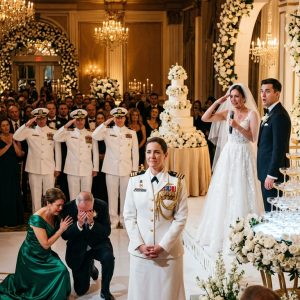
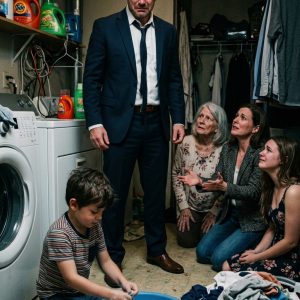
The Severed Promise
Chapter 1: Threads of Spun Gold
My son Leo possessed the kind of hair that caused strangers to pause in grocery store aisles. They were not merely blond; they were a cascade of immaculate, spun-gold ringlets that caught the afternoon sunlight and transformed him into something resembling a Renaissance painting. When he sprinted across the backyard, those soft coils bounced with a joyful, chaotic rhythm.
I adored every single strand of it.
My mother-in-law, Brenda, harbored a deep, visceral resentment toward it.
For the better part of two years, every visit to our home was accompanied by the same jagged, passive-aggressive critiques, delivered over the rim of her teacup. Brenda was a woman who believed the world operated on a strict binary of aesthetics. Men were to be sharply manicured, emotionally stoic, and shorn. Women were to be presentable, accommodating, and quiet.
“He looks entirely too feminine, Amy,” she would sigh, her eyes narrowing as Leo sat on the rug, building a tower of blocks. “People are going to make assumptions. You’re coddling him into softness.”
“Boys simply shouldn’t wear their hair draped past their ears like some sort of vagabond,” she’d remark on another occasion, violently smoothing an imaginary wrinkle from her designer skirt.
My husband, Mark, was my anchor in these turbulent waters. He never allowed the comments to breathe.
“Leo’s appearance is not an item on today’s agenda, Mom,” Mark would state, his voice dropping an octave, establishing an invisible but ironclad perimeter around our son. “Leave it.”
Brenda would offer a brittle, bloodless smile, retreating into a stony silence. But I knew the architecture of that silence. It wasn’t the quiet of surrender; it was the stillness of a predator waiting for the grass to rustle. She hadn’t accepted our boundaries. She was simply biding her time, waiting for an opening in our defenses.
What Brenda stubbornly refused to acknowledge—or perhaps maliciously chose to ignore—was the profound, heartbreaking reason behind Leo’s flowing hair.
Those golden curls were never a fashion statement. They were a sworn pact.
Fourteen months prior, our world had collapsed when our younger daughter, Lily, was diagnosed with acute lymphoblastic leukemia. The subsequent seasons were a blur of sterile hospital corridors, the relentless beeping of heart monitors, and the metallic scent of chemotherapy drugs. When the aggressive treatments inevitably forced Lily’s dark hair to fall out in tragic, wispy clumps on her pillow, the devastation in her five-year-old eyes had broken me entirely.
It was Leo, then barely four, who had stood in the doorway of our bathroom, clutching a plastic dinosaur, watching his sister cry over her bald reflection.
He marched up to her, put his small hand on her shoulder, and delivered a vow with the solemnity of a tiny knight. “Don’t be sad, Lil. I’ll grow mine out. I’ll grow it until yours comes back. We can share.”
And he honored that oath with a fierce, unyielding devotion. He fought off every suggestion of a trim. He proudly informed his kindergarten teachers, pediatric nurses, and bewildered neighbors that his hair belonged to his sister. During Lily’s darkest, most agonizing days in the pediatric oncology ward, when the nausea and pain were unbearable, she would reach out with a frail, trembling hand, twist one of Leo’s golden springs around her index finger, and whisper that it was her “lucky sunshine.”
Brenda knew all of this. She was intimately aware of the oncology appointments, the late-night emergency room dashes, and the fragile, terrifying months we had barely survived as a family unit. Yet, in the hollow chambers of her mind, a child’s emotional sanctuary was utterly secondary to her archaic, rigid perception of gender norms.
I thought our boundaries were secure. I thought my son was safe within the walls of his elementary school.
I was catastrophically wrong.
What I didn’t know was that Brenda had already set her ambush in motion, leading us toward a Thursday that would shatter our family forever.
Chapter 2: The Abduction of a Vow
The Thursday in question disguised itself as an ordinary, aggressively mundane morning.
At exactly eight-fifteen, I guided Leo through the double doors of Maplewood Elementary. I knelt, pressed a kiss into the fragrant halo of his curls, adjusted his backpack, and watched him trot happily into his classroom. I returned home, brewed a second pot of coffee, and settled at my dining room table to clear a backlog of freelance graphic design work while Lily, exhausted from a recent round of maintenance meds, slept soundly in the adjacent room.
The digital clock on the microwave clicked to 12:03 PM when my mobile phone began to vibrate violently against the oak table.
It was the school’s primary office number. A cold, serpentine dread uncoiled in the pit of my stomach. School calls at noon were never to report good news.
“Mrs. Carter?” The secretary’s voice was measured, deliberately calm—the tone professionals use to prevent panic. “This is Sarah from the front office. We are just calling to follow up and ensure everything is alright. Your mother-in-law came to collect Leo a little after eleven o’clock due to a sudden family emergency.”
The oxygen vanished from the room. The edges of my vision blurred with static.
“Excuse me?” I stammered, my fingers gripping the phone so tightly my knuckles flushed white. “What emergency? I didn’t authorize a pickup.”
“She stated it was a severe medical situation involving your husband, Mrs. Carter. She was quite frantic. Given she shares your last name and was previously on an older, outdated emergency contact list we had archived… we allowed the dismissal.”
My entire circulatory system turned to ice. There was no emergency. Mark was safely in his corporate office downtown; we had texted twenty minutes ago about dinner plans. Brenda had circumvented the security protocols. She had lied to educators.
She had stolen my child.
“He is not supposed to be with her,” I said, my voice dropping into a guttural, terrifying register I didn’t recognize. “I will handle this.”
I severed the connection and immediately dialed Brenda’s cell phone. It rang until it hit voicemail. Her cheerful, recorded greeting felt like a taunt. I dialed again. Nothing. A third time. Silence.
My fingers, trembling violently, typed a frantic, capitalized text to Mark: YOUR MOTHER TOOK LEO FROM SCHOOL. SHE IS NOT ANSWERING. COME HOME NOW.
For the next two agonizing hours, I became a ghost haunting my own living room. I paced the hardwood floor, wearing a path from the kitchen island to the large bay window that overlooked our suburban driveway. Every passing car sent a jolt of adrenaline through my veins. My mind conjured horrifying scenarios. Had she taken him out of state? Was she trying to establish some insane form of custody?
At exactly 2:14 PM, a silver Lexus turned the corner and rolled leisurely up our concrete driveway.
I didn’t wait for the engine to shut off. I threw open the front door and sprinted barefoot across the damp lawn. I yanked the rear passenger door open before Brenda had even unbuckled her seatbelt.
What I saw inside that car will be burned into my retinas until the day I die.
Leo was unbuckled, pressed against the far door, his small chest heaving with silent, rhythmic hiccups. His face was blotchy, streaked with a river of tears. But it was his head that made my breath catch in my throat.
His beautiful, golden halo was gone.
In its place was a brutal, uneven buzz cut. The skin of his scalp was visible in patchy, raw scrapes where the clippers had been pressed too hard, applied with haste and malice. He looked like he had been sheared like a sheep in a slaughterhouse.
In his tiny, trembling right fist, clutched so tightly his fingernails were digging into his palm, was a single, severed golden curl.
“Leo,” I breathed, my voice cracking, reaching into the cabin to pull his rigid body into my arms. “Oh, my sweet boy. What happened?”
He buried his face into my neck, his hot tears soaking my collar. “Grandma cut it, Mommy,” he sobbed, his voice raw and broken. “She held me in the chair. She wouldn’t stop.”
Brenda finally emerged from the driver’s seat. She smoothed the front of her cashmere cardigan, entirely unbothered, wearing a mask of triumphant satisfaction. She looked at me as if she had just performed a heroic civic duty.
“There,” she announced, her voice ringing with grotesque pride. “The deed is done. Now he finally looks like a respectable little boy. You can write me a thank-you note when you calm down and realize I was right.”
A wave of pure, unadulterated rage—a primal, maternal fury—washed over me. I wanted to scream. I wanted to tear the cashmere from her shoulders. But Leo was hyperventilating against my chest, his small body vibrating with trauma. He was my priority.
I didn’t say a single word to the woman standing in my driveway. I turned my back on her, carried my weeping son into the safety of our home, and locked the deadbolt behind us.
I collapsed onto the living room sofa, pulling a blanket over the two of us. I rocked him back and forth, humming a lullaby I hadn’t sung since he was an infant. He wept until he was utterly depleted, never once opening his fist to release that single, solitary curl.
Two hours later, the front door unlocked, and Mark stepped into the foyer.
He was out of breath, his tie loosened, panic written across the lines of his face. He rushed into the living room, his eyes scanning frantically until they landed on the couch.
When Mark saw the jagged, militaristic shave on his son’s head, he stopped dead. It was as if he had run full-speed into an invisible wall of glass. All the color drained from his face, leaving him a pallid, ghostly white.
He dropped to his knees on the rug, slowly crawling toward the couch. He reached out with a trembling hand, letting his fingertips hover over the raw, pink patches on Leo’s scalp, afraid to cause him any more pain.
Leo lifted his swollen eyes to look at his father. His lip quivered.
“Dad,” Leo whispered, his voice shattering in the quiet room. “Why did Grandma cut my promise?”
Mark closed his eyes. A single tear leaked from the corner of his eye and tracked down his jawline. The air in the room felt unspeakably heavy. Because we all knew the truth. Brenda hadn’t just altered his appearance. She had taken a physical manifestation of a brother’s love, an armor forged in the fires of pediatric cancer, and thrown it in the trash.
Mark leaned forward, enveloping Leo in a desperate, fierce embrace. He buried his face in what was left of his son’s hair.
“I’ve got you, buddy,” Mark swore into the quiet room, his voice devoid of its usual warmth, replaced by something cold, sharp, and terrifyingly calm. “I promise you, I’m going to handle this. She will never hurt you again.”
That night, as the house fell silent, I discovered that Mark’s definition of ‘handling it’ was going to be far more devastating than a simple argument.
Chapter 3: The Architecture of Retribution
Midnight had come and gone. The house was cloaked in heavy silence. I had finally managed to get both children to sleep—Lily blissfully unaware of the afternoon’s trauma, and Leo exhausted from his grief, still clutching his severed curl in his sleep.
I crept down the stairs to get a glass of water, the wooden floorboards cold beneath my bare feet. As I rounded the corner into the kitchen, I saw a sliver of light bleeding from the dining room.
Mark was sitting at the head of the long oak table. The harsh, blue glow of his laptop illuminated his face, casting deep shadows under his eyes. Beside the computer sat a yellow legal pad, heavily annotated with aggressive, blocky handwriting. A half-empty glass of scotch sat forgotten near his elbow.
I padded softly into the room and stood behind his chair. I glanced at the screen. It wasn’t his usual spreadsheet or marketing report. It was the website for a prominent local family law firm. His legal pad was a terrifying ledger: Names of school administrators. Exact timestamps of phone records. Excerpts from state statutes regarding unauthorized medical/bodily alteration of a minor. Grandparents’ rights (and how to sever them).
“Mark?” I whispered, placing a gentle hand on his tense shoulder. “What are you doing?”
He didn’t jump. He simply stopped typing, his hands hovering over the illuminated keyboard. He stared at the screen for a long, agonizing moment before turning his head to look at me. His eyes were completely devoid of exhaustion; they were burning with a terrifying, calculated focus.
“I am getting ready,” he replied, his tone chillingly even. “She breached the perimeter, Amy. She thought she could rewrite the rules of our family because she believes she holds the ultimate authority. I am going to remind her exactly what her place is.”
The next forty-eight hours were a masterclass in psychological tension. Mark operated with the eerie efficiency of a military strategist preparing for a siege. He took Friday off from work, spending hours on the phone pacing the backyard, his voice low and intense.
Then, on Saturday morning, the landline rang.
I glanced at the caller ID. Brenda Home.
My stomach recoiled. I wanted to rip the phone from the wall. But Mark held up a single finger, signaling me to wait. He took a deep breath, smoothed his features into an unreadable mask, and picked up the receiver.
“Hello, Mom,” he said smoothly.
I couldn’t hear her exact words, but I could hear the sickeningly sweet, singsong cadence of her voice bleeding through the earpiece. She was calling to invite us to her traditional Sunday family dinner. She was behaving as if Thursday had been nothing more than a minor misunderstanding, a trivial disagreement over a spilled glass of milk. She assumed, as she always did, that we would simply absorb the insult, rug-sweep her blatant violation of our parental rights, and show up for her potluck to keep the peace.
I shook my head violently, mouthing the word NO.
Mark met my eyes, entirely unblinking.
“Of course, Mom,” Mark replied, a dangerous silkiness entering his voice. “We wouldn’t dream of missing it. Yes, we’ll bring the children. See you at six.”
He placed the receiver back in its cradle. The silence in the kitchen was deafening.
“Are you insane?” I hissed, stepping toward him. “You want to take him back into that house? After what she did? He’s terrified of her, Mark!”
Mark reached out and gripped both of my arms, holding me steady. “Amy, listen to me. I need you to trust me. I am not taking him there to be victimized. I am taking him there to be vindicated. But I need your help to execute this.”
He walked over to his briefcase and pulled out an external hard drive.
“I need you to open your video editing software,” he instructed softly. “I want you to build a timeline. I want every video clip, every photograph. From the day Lily was diagnosed. The day her hair started falling out. The moment Leo made his promise in the bathroom. The videos of him in the oncology ward letting her play with his curls. I want you to document the anatomy of that promise.”
I stared at the black metallic drive in his hand. Understanding slowly began to dawn on me, replacing my panic with a cold, solidifying resolve.
I took the drive. “How long do I have?”
“Until tomorrow at five,” he said.
For the next twenty-four hours, I lived inside a digital time capsule of our deepest family trauma. I sat in the darkened home office, tears streaming down my face as I watched my daughter fade to a ghost on the screen, only to be anchored to the earth by the fiercely loyal gravity of her brother.
I found a specific clip from eight months ago. A young, substitute nurse had asked Leo, in passing, why a handsome young man was letting his hair grow so long.
On the screen, a four-year-old Leo looked up from his coloring book, his golden curls falling into his eyes, and answered with profound, devastating simplicity: “Because promises grow slow. And Lily needs my sunshine.”
I spliced it together. I layered the audio. I built a monument to a brother’s love. By the time I exported the final file on Sunday afternoon, my eyes were swollen shut, but my heart was encased in titanium.
We were armed. And it was time to go to dinner.
Chapter 4: The Last Supper
Brenda’s home was a monument to superficial perfection. It was an immaculate, sprawling colonial located in an upscale gated community, where the lawns were manicured with mathematical precision and the interiors smelled aggressively of bleach and expensive potpourri.
When we arrived at 6:00 PM sharp, the driveway was already lined with the vehicles of Mark’s extended family. Aunts, uncles, and cousins had gathered for the sacred Sunday ritual.
I held Leo’s hand tightly as we walked up the bluestone path. He was wearing a soft gray beanie pulled low over his ears to hide the butchered remains of his hair. He was trembling slightly, pressing his small body against my leg. Lily held Mark’s hand, happily swinging a small stuffed bear.
Brenda threw open the heavy oak door, radiant in a floral silk blouse, wearing the smile of a conquering general.
“Oh, look who has arrived!” she chimed loudly, ensuring her voice carried into the formal living room where the relatives were sipping wine. She immediately zeroed in on Leo. Before I could intercept, she reached out and plucked the beanie off his head with a swift, violating motion.
Several cousins in the background murmured greetings, their voices trailing off as they noticed Leo’s jarring new appearance.
“Doesn’t he look so much more handsome?” Brenda announced to the foyer, gesturing to his jagged scalp. “So neat and tidy. A proper young gentleman at last.”
Leo whimpered, instantly darting behind Mark’s legs, burying his face in his father’s slacks.
I bit the inside of my cheek so hard I tasted copper. Mark simply placed a protective hand on Leo’s back, looked directly into his mother’s eyes, and offered a smile that didn’t reach his corneas.
“Let’s just get to dinner, Mom,” he said evenly.
The dining room table was laden with roasted meats, heavy casseroles, and crystal glassware. The atmosphere was thickly polite, laced with an undercurrent of confusion as relatives continually threw covert, questioning glances at Leo’s shorn head.
For forty-five minutes, we endured the agonizing theater of small talk. The weather, the stock market, the cousins’ upcoming vacations. Mark ate methodically, his face a mask of serene composure. I barely touched my water.
As the plates were being cleared, Brenda couldn’t resist taking a victory lap. She dabbed her mouth with a linen napkin and sighed contently.
“Well, I must say, it is a relief to have that hair issue resolved,” she declared to the entire table, her voice ringing off the crystal chandelier. “Just in time for the school picture day next week, too. Honestly, Mark, you’ll thank me when you see the portraits. Children don’t know what’s best for them; sometimes a grandmother just has to step in and make the hard executive decisions.”
The table fell quiet. Uncle Robert coughed awkwardly into his fist.
Mark slowly placed his linen napkin on the mahogany table. He stood up. He didn’t rush. His movements were deliberate, commanding the total attention of the room.
“You’re right, Mom,” Mark said, his voice echoing in the sudden silence. “Decisions were made. But before we move on to dessert, there is a presentation I believe everyone in this room needs to witness to fully understand the context of your… executive decision.”
Without waiting for permission, Mark walked over to the antique credenza where he had quietly placed his laptop bag upon arrival. He pulled out the computer, unspooled an HDMI cable, and plugged it directly into the massive, flat-screen television Brenda used to display digital art on the dining room wall.
“Mark, what on earth are you doing?” Brenda snapped, a flicker of genuine apprehension finally breaking through her smug veneer. “This is a dinner party.”
“This is an intervention,” Mark corrected coldly. He pressed a button on his keyboard.
The dining room plunged into shadows as the television flared to life.
The opening frame was a photograph of Lily, pale and fragile, hooked up to an IV pole, clutching her favorite blanket. A collective gasp echoed from the aunts at the table.
For the next four minutes, the dining room became a sanctuary of truth. They watched the agonizing reality of our lives that Brenda had so callously ignored. They saw the tears. They saw Lily brushing her falling hair into a trash can.
And then, they saw Leo.
They heard his high, sweet, unbroken voice echoing from the speakers. “I’ll grow mine until yours comes back. We can share.”
They watched a montage of seasons passing. Leo refusing to wear a hat in the winter so his hair wouldn’t get tangled. Leo sitting quietly while I brushed the golden knots out, wincing but never complaining.
The final clip played. It was the footage of Lily in her hospital bed, her skin translucent, gently twisting one of Leo’s golden curls around her finger, whispering, “Don’t cut it yet, Leo. It still helps.”
The screen faded to pitch black.
The silence in the dining room was absolute, broken only by the sound of Aunt Sarah openly weeping into her hands.
Brenda’s fortress was crumbling, but the final blow was yet to be delivered.
Chapter 5: The Severance
Mark stepped back to the head of the table. He reached into his breast pocket and slowly retrieved a small, clear plastic evidence bag. Inside, resting like a sacred relic, was the single, jagged golden curl Leo had salvaged from the floor of the barbershop chair.
Mark placed the bag precisely in the center of the mahogany table, right next to Brenda’s crystal wine glass.
“This,” Mark said, his voice vibrating with a quiet, lethal intensity, pointing to the plastic bag. “Is what you decided to cut. You didn’t just give my son an unauthorized haircut, Mother. You butchered a vow. You stole his sacrifice. You looked at a promise forged in a cancer ward, and you decided your country-club aesthetic was more important.”
Brenda’s face was the color of old parchment. Her mouth opened and closed silently, like a fish pulled from the water. She looked around the table, seeking an ally, but her siblings and nieces were staring at her with unvarnished disgust.
“It… it was just hair,” Brenda stammered, her voice suddenly thin, stripped of all its previous authority. “It grows back. You’re being horribly dramatic, Mark. I was trying to help him fit in.”
“No,” Mark corrected, stepping closer to her chair, looming over her. “It was a pledge of protection. A pledge you kidnapped him from school to destroy.”
Mark turned back to his briefcase. He withdrew a thick, manila envelope and dropped it onto the table with a heavy, final thud. It landed directly in front of Brenda’s plate.
“What is this?” she whispered, staring at the envelope as if it contained a venomous snake.
“Consequences,” Mark replied.
“Inside that envelope are legally binding documents, drawn up by our attorney on Friday,” Mark explained, his tone entirely clinical. “Page one confirms that your name has been permanently struck from every authorized pickup list, emergency contact form, and medical proxy for both of my children across the entire district. You are barred from school grounds.”
Brenda gasped, her hand flying to her throat.
“Page two,” Mark continued relentlessly, “is a formal cease-and-desist letter. It outlines that any future attempt to remove my children from a secure location without the explicit, written consent of either Amy or myself will not result in a family phone call. It will result in an immediate police report for parental kidnapping. We will press charges to the fullest extent of the law.”
“You… you hired a lawyer?” Brenda cried out, genuine shock finally shattering her ego. She looked at the faces around the table, desperate. “Over a haircut? Mark, I am your mother!”
“I hired a lawyer because you manipulated a school receptionist, abducted my minor child, and forced a physical alteration onto his body against his will to satisfy your own vanity,” Mark shot back, his voice finally raising to a thunderous volume that shook the crystal glasses. “You lost the privilege of the title ‘Grandmother’ the moment you turned on those clippers.”
Desperate, utterly cornered, Brenda turned her pleading eyes toward me. She reached out a shaking hand across the table.
“Amy,” she begged, tears of humiliation finally spilling over her heavily mascaraed eyelashes. “Please. Tell him this is a massive overreaction. You know I love the children. Tell him this is too much.”
I looked at the woman who had terrorized my family’s peace for years. I felt no pity. I felt only the solid, unyielding strength of a mother protecting her young.
I stood up, resting my hands on the back of Leo’s chair.
“No, Brenda,” I said, my voice steady and cold. “Leo cried for hours because he believed he had failed his sister. Lily cried because she thought she caused him to be punished. You fractured their hearts to feed your pride. This envelope isn’t an overreaction. It is exactly the minimum amount of boundary required to keep our family safe from you.”
Then, a tiny, fragile voice broke through the heavy tension of the room.
Lily stepped out from behind Mark’s leg. She walked slowly over to the table, her bald head shining under the chandelier. She looked directly at her grandmother, her large brown eyes pools of innocent sorrow.
“Grandma,” Lily said softly, her voice carrying the weight of a thousand hospital visits. “He was doing it for me. Why did you take my sunshine away?”
For the first time in her rigidly controlled life, Brenda was entirely robbed of a rebuttal. The excuses died in her throat. The justifications evaporated. Faced with the raw, pure heartbreak of a cancer survivor, the sheer ugliness of her actions was laid bare under the bright lights for the entire family to witness.
She collapsed back into her chair, covered her face with her trembling hands, and finally uttered a choked, broken apology.
It didn’t erase the trauma. It didn’t glue the hair back onto Leo’s head. But it was the first time in her existence she had been forced to choke down the bitter truth of her own toxicity.
Mark picked up Leo, I took Lily by the hand, and without another word to the weeping woman at the head of the table, we walked out of the house, leaving the manila envelope and the single golden curl behind.
Chapter 6: The Return of the Sun
Time, as it always does, marched forward, carrying the debris of the past in its wake.
A year has passed since the Sunday dinner that shattered our extended family dynamics. The seasons cycled through, bringing with them the slow, miraculous grace of healing.
Lily’s final scans came back entirely clear. She is officially in remission. Her hair has returned, not as the dark, straight strands she once had, but as a thick, beautiful crown of soft, chestnut waves. She laughs louder now, runs faster, and the shadow of the oncology ward is slowly fading from her vibrant eyes.
Leo is now six. And his hair? It returned with a vengeance.
The jagged, military buzz cut slowly softened, growing back into the wild, untamable, bright golden curls that bounce in the sunlight when he chases his sister through the sprinklers in the backyard. He no longer wears a beanie. He wears his mane like a crown of victory.
Our relationship with Brenda is effectively a ghost town. She is allowed to send birthday cards through the mail, and we permit her a brief, heavily supervised video call on major holidays. She has never been allowed back inside our home, and she is never left alone with our children. Some whispers have reached us from distant relatives—aunts and cousins who claim we were too draconian, too unforgiving.
“It’s just hair,” they whisper at their own dinner parties. “It always grows back.”
They are right about the biology. Hair does regenerate. Cells divide. Follicles push new strands through the scalp.
But biology doesn’t account for the soul.
Whenever I hear those whispers, my mind doesn’t go to the new growth on Leo’s head. It flashes back to that terrifying Thursday afternoon. I see my five-year-old boy standing barefoot in the damp driveway, his chest heaving with inconsolable grief, his tiny fist clamped shut over a single severed curl. I remember the look in his eyes—the look of a boy who believed his sacred oath, his shield of love for his dying sister, had been violently stolen from him.
So no, they are entirely wrong. It was never just about hair.
It was about autonomy. It was about respect. And most importantly, it was about a golden promise made in the darkest of times, and the absolute lengths a family will go to protect the light.
Like and share this post if you find it interesting.