Chapter 1: The Anatomy of a Hostage Situation
The glow of my laptop screen cast a sickly, pale light over the kitchen table. It was 11:30 PM on a Tuesday, exactly one month before the event that would permanently alter the trajectory of my bloodline. I was rubbing the bridge of my nose, staring at a meticulously color-coded Excel spreadsheet. My profession was construction project management; my daily life consisted of calculating load-bearing walls, mitigating structural liabilities, and forecasting deficits for multi-million-dollar high-rises.
But the spreadsheet I was looking at wasn’t for a skyscraper. It was the financial ledger of my own life. And the foundation was crumbling.
My wife, Sarah, walked into the kitchen. She moved quietly, her bare feet making no sound on the hardwood. She placed a warm, gentle hand on my tense shoulder. She smelled of lavender soap and quiet exhaustion.
“We need to put a deposit down for Noah’s reading tutor, Ken,” she said softly, her voice carrying the fragile weight of a mother who was tired of begging for her own children. “The center only holds the spot for forty-eight hours. It’s four hundred dollars.”
I winced, closing my eyes. I reached for my phone, my thumb swiping open the banking app. The balance mocked me. “I… I can’t this week, Sarah.”
I felt her hand stiffen against my shirt. “What do you mean you can’t? You just got your quarterly project bonus.”
“My mom called this afternoon,” I whispered, staring at the grain of the oak table, entirely unable to meet my wife’s eyes. “Brenda’s transmission blew on her SUV. She needs her car to get to interviews. Mom said if I didn’t wire the two grand to the mechanic, Brenda would lose her apartment lease. I had to do it.”
Sarah’s hand dropped from my shoulder as if my skin had suddenly turned to ice. She took a step back.
“Kenneth,” Sarah said, her voice trembling with a potent mixture of grief and suppressed rage. “Brenda is thirty-four years old. She posts pictures from bottomless mimosas and rooftop brunches every single weekend on Instagram. She hasn’t been to an interview in three years. Your mother doesn’t visit us. She doesn’t call to ask how Emily’s piano recital went. She doesn’t ask why Noah is struggling in school. They don’t visit you, Ken. They invoice you.”
I swallowed the lump of defensive bile rising in my throat. I defended them out of pure, conditioned habit. I recited the script my parents had hammered into my skull since I was a child, the mantra of the emotionally manipulated.
“Family helps family, Sarah,” I muttered, sounding like a cult member repeating dogma. “It’s just a rough patch. Brenda just needs a break. Mom and Dad are on fixed incomes. I’m the one doing well. It’s my duty.”
“Your duty is sitting asleep in the bedrooms down the hall,” Sarah replied, a tear finally escaping and tracing a path down her cheek. “You are setting your own house on fire to keep your sister warm. And one day, there’s going to be nothing left for us.”
She turned and walked out of the kitchen, leaving me alone in the dark.
The hollowness in my own voice terrified me that night. But I shoved it down. I packed it away in the same mental compartment where I hid my resentment, my exhaustion, and my self-respect. I was the good son. The reliable one. The beast of burden.
That hollowness deepened into a sickening, paralyzing dread exactly three weeks later. My phone buzzed on my desk at the construction site. It was a WhatsApp message from my mother, Joyce. It wasn’t a question. It wasn’t a request accompanied by a ‘please’ or a ‘thank you.’
It was a PDF attachment. An invoice from The Grand Azure, the most ostentatious, overpriced banquet hall in the city. The total was for $15,000.
Beneath the PDF was a single line of text: Send the money to the venue portal today. They release the date for my 70th birthday tomorrow if the catering balance isn’t secured.
I stared at the screen, the noise of the jackhammers outside fading into a dull hum. Fifteen thousand dollars. It was the money Sarah and I had painstakingly saved to finally replace our rotting roof. It was my children’s safety net.
But the conditioning was too deep. The fear of my mother’s weaponized guilt, the inevitable phone calls calling me a selfish, ungrateful son, paralyzed my logic. With shaking fingers, I logged into the venue portal, entered my credit card information as the secondary payer, and authorized the balance hold. I bought the silence.
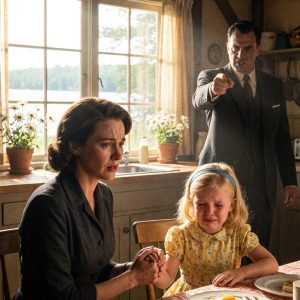
But the true cost of my blind, pathetic loyalty didn’t fully materialize until the evening of the party. It didn’t hit me when I saw the ice sculptures, or the imported orchids. It hit me when we arrived at the sparkling banquet hall, and my eight-year-old daughter, Emily, dressed in her absolute best Sunday dress, looked up at me with wide, innocent eyes, only to be physically directed by her own grandfather away from the family centerpieces and toward a dark, isolated table meant for the catering overflow.
Chapter 2: The Table by the Ficus Trees
The ballroom of The Grand Azure was a suffocating monument to my mother’s vanity. Crystal chandeliers cast a warm, golden glow over tables draped in heavy ivory linen. A string quartet played softly in the corner. In the absolute center of the room sat the head table, elevated on a slight dais.
Sitting at the head table was Brenda. She wore a designer gown that cost more than my mortgage payment. Flanking her were her two children, both wearing custom-tailored outfits, excitedly tearing into personalized gift bags my mother had left at their place settings. They looked like royalty.
I held Emily’s hand in my right, and Noah’s in my left. Sarah walked silently beside me. We approached the head table, the dutiful peasants arriving to pay homage.
My father, a man whose spine had dissolved decades ago under my mother’s rule, stood near the edge of the dais holding a glass of scotch. He didn’t smile when he saw his grandchildren. He simply raised his glass and pointed toward the back of the room.
“Your kids can sit over there, next to the plants,” my father ordered, his tone utterly dismissive. He gestured toward a small, unadorned table half-hidden in the shadows, wedged awkwardly between two massive, decorative ficus trees and the swinging metal doors of the kitchen.
I froze. The ambient noise of the party seemed to drop away. I looked at the table. It didn’t even have the gold-rimmed charger plates the other tables had. It was the loser table. The exile table.
I turned my head and looked at my mother, Joyce. She was holding court near Brenda, wearing a $400 burgundy silk suit I had literally purchased for her twenty-four hours prior because she claimed she had “nothing suitable to wear.”
I walked over to her. “Mom,” I kept my voice low, trying to maintain the fragile peace. “There’s no room for Sarah and the kids at the family tables. Dad just pointed us toward the kitchen doors.”
Joyce sighed, a long, theatrical exhalation of profound annoyance. she didn’t even look at me; she was busy adjusting her diamond earrings in the reflection of a mirrored pillar.
“Don’t make this a problem tonight, Kenneth,” she chided, swatting at the air as if I were a buzzing gnat. “The seating chart is perfectly balanced. Children need to understand they don’t always get the best seats in life. Brenda’s kids are part of the bridal-party aesthetic I wanted for the photographs. Your kids are just… a bit too rambunctious. Sit by the plants. It’s fine.”
Brenda leaned over, taking a sip of champagne, a cruel, self-satisfied smirk playing on her glossy lips. She loved it. She thrived on the reinforced hierarchy.
I looked down. Noah, my sweet, quiet six-year-old boy, had spent three hours that afternoon drawing a massive, purple, crayon-covered birthday card for his grandmother. He was holding it in his little hands. As he heard Joyce’s words, he slowly, heartbreakingly, slid the crumpled construction paper behind his back. His bottom lip began to tremble.
Emily’s grip on my hand went entirely slack. Her bright eyes dropped to the expensive carpet. She understood. Even at eight years old, she understood the language of exclusion.
The message was clear, broadcasted in high-definition to my entire nuclear family: You are not enough. You are not real family. You are just the help.
I looked at Sarah. Silent, agonizing tears were welling in her eyes as she watched the people she had tried to love emotionally abuse her children.
In that single, suspended second, the dutiful son inside Kenneth Miller died.
The death was entirely silent. I didn’t yell. I didn’t flip a table. I didn’t throw a punch. Instead, my brain experienced a profound, terrifying cognitive override. The emotional conditioning of my childhood evaporated, leaving behind the cold, ruthless logic of a senior project manager evaluating a toxic asset.
My mind, trained to manage multi-million dollar construction budgets, simply reclassified my parents and my sister. They were no longer family. They were a hostile liability. They were a bad contract. And I was terminating the agreement.
“Perfect,” I whispered. My voice was so flat, so devoid of emotion, that my mother finally looked at me, a flicker of confusion crossing her face.
I didn’t say another word to her. I turned, walked over to my wife, placed my hands gently on my children’s backs, and guided them to the dark table by the kitchen doors. We sat down in the shadows.
A moment later, the venue’s event coordinator, a sharp-looking woman with an earpiece, approached our isolated table. She held an iPad glowing in the dim light.
“Mr. Miller?” she asked politely. “I’m so sorry to bother you, but I just need the secondary payer’s signature to authorize the final run-of-show. This authorizes the premium open bar, the live mariachi band, and allows us to run the card on file for the final eight-thousand-dollar catering balance at the end of the night.”
She held out the tablet.
I took the device. The screen illuminated my face. My eyes, reflecting the blue light, felt as cold as dead stars. I didn’t just sign. I tapped the button in the top right corner labeled Modify Package.
And as I began unchecking boxes with methodical, terrifying precision, I realized I wasn’t just ruining a birthday party.
I was dismantling an empire.
Chapter 3: The Architecture of a Cash Bar
The iPad felt light in my hands, but the weight of what I was doing was immense. It was the weight of thirty years of manipulation finally being severed.
I tapped the screen.
Premium Open Bar (Hosted). I hit the toggle. The screen flashed. I switched it to Cash Bar (Domestic Beer & Well Liquor Only).
Live Entertainment: 12-Piece Mariachi Ensemble. I scrolled to the cancellation clause. I tapped Terminate Service.
Finally, I navigated to the billing profile. I found my name: Kenneth Miller. Secondary Guarantor. I selected my credit card ending in 4402. I pressed Delete Payment Method. A warning popped up: Removing secondary payment will transfer all remaining liabilities to the Primary Cardholder (Brenda Miller). Proceed?
I didn’t hesitate. I pressed Confirm. I scribbled my initials on the digital line, handed the tablet back to the coordinator, and gave her a polite nod.
“Everything is updated,” I said smoothly. “Please ensure the changes take effect immediately.”
“Of course, sir,” she said, tapping her earpiece and hurrying away.
I sat back in my chair, draped in the shadows of the fake ficus trees. The party was in full swing now. The grand double doors were closed, trapping a hundred and fifty guests inside an illusion that was about to evaporate.
At 8:30 PM, Brenda swaggered up to the massive, mahogany bar. She was flanked by three of her equally parasitic friends. She leaned against the polished wood, snapping her manicured fingers at the bartender.
“Three Grey Goose martinis, slightly dirty, and keep them coming,” Brenda ordered loudly, ensuring everyone around her heard her commanding the staff.
The bartender, a young man who suddenly looked incredibly uncomfortable, tapped the order into his point-of-sale terminal. He looked up, clearing his throat.
“That will be forty-eight dollars, ma’am,” he said politely.
Brenda threw her head back and laughed. It was a shrill, grating sound that cut through the soft background music. “Oh, honey, no. It’s an open bar. My brother paid for it. Put your wallet away, girls.”
The bartender didn’t smile. He shook his head slowly. “I’m sorry, ma’am. The sponsor modified the contract twenty minutes ago. It’s a cash bar. And we are only authorized to serve domestic beer and well liquor. The top-shelf bottles have been locked.”
Brenda’s mouth dropped open. The smug arrogance vanished, replaced by a violent, ugly flush of red that crept up her neck. Her friends exchanged awkward, judgmental glances, suddenly stepping away from the bar.
“Excuse me?” Brenda hissed, her voice rising to a screech. “Do you know who I am?”
Across the room, near the dance floor, the twelve-piece mariachi band, dressed in immaculate silver-studded suits, had just finished setting up their instruments. Suddenly, the bandleader looked at his phone, frowned, and blew a sharp whistle. To the absolute shock of the dancing guests, the band abruptly packed their trumpets and guitars into their velvet-lined cases, turned in unison, and walked right out the back service doors.
The silence that followed was deafening.
Joyce panicked. I watched her practically sprint across the ballroom in her heels, grabbing the event coordinator by the arm.
“Where is the music?!” Joyce demanded, her voice carrying across the silent room. “And where are the passed crab cake hors d’oeuvres? They were supposed to be out ten minutes ago!”
“I’m sorry, Mrs. Miller,” the coordinator replied, her voice professionally detached. “Those services were cancelled by the billing sponsor.”
From the dark sanctuary of the plant table, I watched it all unfold. I didn’t feel a shred of guilt. I felt a profound, overwhelming sense of peace.
Ten minutes prior, I had pulled out my phone and ordered a large, double-pepperoni pizza from a local joint down the street. I had just tipped a bewildered delivery boy twenty bucks to sneak it through the kitchen doors.
I flipped open the cardboard box. The smell of hot cheese, garlic, and greasy pepperoni filled our little corner of the room, completely overriding the faint smell of the missing crab cakes.
I pulled out a massive slice, folded it, and handed it to Noah. I gave the next slice to Emily.
For the first time all week, my children smiled. Really, genuinely smiled. They dug into the pizza, getting grease on their fingers, entirely oblivious to the high-society meltdown occurring fifty feet away.
I looked at Sarah. She was holding a slice of pizza, staring at the chaos of the cash bar, then looking back at me. She reached under the table and grabbed my free hand. Her eyes were wide with a mixture of shock, disbelief, and a profound, radiant awe. She squeezed my hand, anchoring me to the reality I should have chosen years ago.
But the missing crab cakes and the embarrassing cash bar were merely the mild tremors before the devastating earthquake.
Just as Joyce spotted me eating pizza in the shadows and began marching angrily toward our table to demand I “fix this embarrassment,” the heavy double doors of the banquet hall swung open.
The general manager of the venue walked in. He wasn’t smiling. He was flanked by two burly security guards in dark suits. And in his hand, he held a printed invoice that was about to blow the doors off a secret Brenda had kept buried for five years.
Chapter 4: The House of Cards Collapses
“Kenneth!” Joyce hissed, arriving at our table like a localized hurricane. She stood over the greasy pizza box, her face contorted in absolute fury. “Give me your credit card right now! You are humiliating me in front of the entire church! Do you have any idea how stupid Brenda looks at the bar?”
I took a slow, deliberate bite of my pizza. I chewed. I swallowed. I wiped my mouth with a cheap paper napkin.
“No,” I said quietly.
Joyce gasped, clutching her pearls in a gesture so theatrical it belonged on a soap opera. “What did you just say to me?”
Before she could begin screaming, the venue manager stepped smoothly between us. He was a tall, imposing man who had clearly dealt with high-society meltdowns before.
“Mrs. Miller?” the manager said, his voice projecting just enough for the surrounding tables to hear. The room had grown eerily quiet, the guests sensing the impending drama like animals sensing a storm.
Joyce spun around, pasting a fake, tight smile onto her face. “Yes? I apologize for the mix-up. My son is just throwing a little tantrum. He will provide the card for the balance.”
“Actually, ma’am, he won’t,” the manager replied smoothly. “As Mr. Miller has legally removed his authorization from the account, our system automatically attempted to run the primary card on file to secure the eight-thousand-dollar catering balance.”
“Fine,” Joyce snapped impatiently. “Run Brenda’s card. She gave it to you when we booked the room.”
The manager adjusted his glasses. “We did, ma’am. It was declined.”
Brenda, who had scurried over from the bar to hide behind our mother, went completely, terrifyingly pale. She looked like she was going to vomit.
“It… it must be a bank error,” Brenda stammered, her voice shaking. “Try it again.”
“I cannot try it again, Miss Miller,” the manager stated, his voice turning cold. “Furthermore, the merchant services gateway didn’t just decline the card for insufficient funds. It flagged the transaction as a Code 10. The bank reported it as a stolen account linked to a frozen, court-ordered trust.”
The absolute silence in the ballroom was shattered by a collective gasp from the surrounding guests.
I stopped eating. I set my pizza down on the paper plate. I stood up. At six-foot-two, my presence was suddenly massive. I didn’t feel like the subservient son anymore. I felt like the executioner.
“A frozen trust?” I asked, my voice cutting through the dead air like a scalpel.
I bypassed Joyce and Brenda. I looked directly at my father, who was standing a few feet away, clutching his glass of scotch so tightly his knuckles were white.
“Dad,” I said, the word tasting like ash. “You told me you needed my quarterly bonus last month to pay your mortgage. You told me the bank was threatening foreclosure. Why is Brenda running a platinum credit card linked to your frozen retirement trust?”
My father’s shoulders slumped. The remaining illusion of his dignity vanished. He couldn’t look me in the eye. He stared at his expensive Italian loafers.
“Answer me,” I commanded, projecting my voice so every single one of their judgmental, gossiping friends could hear.
“She… she made some bad investments, Kenny,” my father mumbled, his voice cracking, tears of profound shame pooling in his eyes. “She got in deep with some people. She forged my signature on the trust documents a few years ago. She drained it.”
“Dad!” Brenda shrieked, panicked, trying to grab his arm to silence him.
He pulled his arm away, the weight of the lies finally breaking his back. “If we didn’t cover for her, Kenny, she’d go to federal prison. The bank was investigating. We needed your help… we needed your money to keep the lights on, to pay the legal fees, so we could pay back the trust before the auditors found out what she took.”
The silence in the room was absolute. It was the heavy, suffocating silence of total ruin.
I looked at my mother. I looked at the $400 suit I had bought her. I looked at Brenda’s designer dress.
They hadn’t just used me. They had bled my family dry to protect a criminal. My mother had forced my children to sit by the fake plants, treating them like disposable garbage, all while actively using the money that should have gone to Noah’s reading tutor and Emily’s college fund to keep her felon daughter out of a penitentiary.
I felt a cold, terrifying calm wash over my brain. The math was finally complete. The ledger was closed.
I looked down at Noah. He was still clutching the crumpled, purple birthday card behind his back. I knelt down, gently taking the construction paper from his little hands.
I stood back up, looking my weeping, humiliated mother dead in the eye. Without breaking eye contact, I gripped the edges of the card and ripped it cleanly in half. I let the pieces flutter down onto the greasy pizza box.
“The party is over,” I said, my voice echoing off the crystal chandeliers. “And so is my subscription to this family. Have fun paying the bill.”
I turned my back on them. I offered my arm to Sarah, took Emily’s hand, and we began to walk toward the exit.
But as we reached the heavy double doors, I heard the venue manager speak into his radio. He blocked Brenda’s path as she tried to flee toward the bathrooms.
“Yes, dispatch,” the manager said clearly. “I have a suspect on site who just attempted to pass a flagged, stolen credit card for an eight-thousand-dollar transaction. Send officers to The Grand Azure immediately.”
Chapter 5: Reallocating the Assets
Three months later, the toxic ecosystem of the Miller family was nothing but scorched earth.
The family group chat, which I had permanently blocked on all our devices, was a graveyard of escalating panic and venom. I didn’t read the messages, but the legal filings told me everything I needed to know.
Without my monthly infusions of cash to hide the deficit, the dam broke. Brenda was indicted on three counts of elder financial abuse, wire fraud, and identity theft. The “bridal-party aesthetic” she loved so much was replaced by the neon-orange jumpsuit of the county holding facility.
Joyce and my father, stripped of their retirement and drowning in legal debt from trying to defend their golden child, were forced to list their pristine suburban home in a humiliating short sale. They moved into a cramped, one-bedroom apartment on the industrial edge of town. Their social standing—the only currency my mother ever truly valued—was utterly, permanently annihilated. They were pariahs in their own church.
They had tried to reach me. They bought burner phones to bypass my blocks, leaving desperate, weeping voicemails begging for “one last loan” to secure a better defense attorney for Brenda.
I deleted every single voicemail without listening past the first ten seconds.
Instead of engaging with the ghosts of my past, I secured the fortress of my future. I hired a ruthless forensic accountant and a bulldog of an attorney. I issued a total, legally binding cease-and-desist order to my parents. I legally severed any and all financial ties, ensuring their impending bankruptcy proceedings could never touch my assets or credit.
It was a crisp Saturday morning. The house was quiet, save for the sound of cartoons playing softly in the living room.
I sat at my kitchen table with Sarah. I didn’t have an Excel spreadsheet open to calculate my parents’ debts. Instead, I slid a crisp, official document enclosed in a heavy, cream-colored folder across the wood toward my wife.
Sarah opened it. Her eyes scanned the text.
It wasn’t an invoice for a banquet hall. It was the confirmation paperwork from a major brokerage firm. It detailed two fully funded 529 College Savings Plans—one for Emily, one for Noah. I had seeded both accounts with the exact amount of money, to the penny, that I would have blindly handed to my parents over the last fiscal quarter.
Below that was the receipt for Noah’s reading tutor, paid in full for the year.
Sarah looked up from the paperwork. Her eyes were brimming with tears, but they weren’t the tears of quiet desperation she had wept three months ago. They were tears of profound, overwhelming relief.
I reached across the table and took both of her hands in mine. I looked into the eyes of the woman who had stood by me while I set our lives on fire, waiting patiently for me to wake up and grab the extinguisher.
“I’m so sorry, Sarah,” I whispered, my voice thick with genuine emotion. “I am so incredibly sorry it took me this long to see who my real family is. I failed to protect you and the kids. But I swear to God, it will never happen again.”
Sarah squeezed my hands tightly. She let out a long, shuddering breath, and I could physically see the heavy, suffocating anxiety of the last decade lifting from her shoulders.
“You’re here now, Ken,” she smiled, a beautiful, genuine smile. “That’s all that matters. You’re home.”
I was finally sleeping through the night. The stress-induced migraines that used to blind me on Friday afternoons were entirely gone. My blood pressure was normal.
But true peace is rarely achieved without a final test.
On the morning of Emily’s ninth birthday, exactly one year after the incident at the banquet hall, I was outside setting up lawn games when a sleek, black courier car pulled up to the edge of my driveway.
A man in a uniform stepped out. He didn’t have a package. He held a thick, heavy legal envelope. He walked up the driveway and handed it to me.
I looked at the return address. It bore the stark, institutional seal of the State Women’s Penitentiary. It was addressed directly to me, from Inmate Brenda Miller.
The nightmare was standing at my front door, threatening to pull me back into the dark.
Chapter 6: The Return on Investment
I stood on my sunlit driveway, holding the heavy penitentiary envelope in my hands. The morning air was warm, carrying the scent of cut grass and blooming jasmine from Sarah’s garden.
A year ago, just looking at an envelope from my family would have triggered a visceral panic attack. My heart would have raced, my palms would have sweat, and I would have felt the familiar, crushing weight of obligation descending upon my chest. I would have ripped it open immediately, read the guilt-tripping lies, the desperate pleas for commissary money, the manipulation masked as victimhood, and I would have agonized over it for weeks.
I looked down at the stark black ink of Brenda’s handwriting.
I waited for the guilt. I waited for the fear.
Neither came.
Instead, I felt a profound, overwhelming sense of boredom. The envelope didn’t feel like a threat; it felt like a piece of junk mail. It was a communication from a ghost. It belonged to a reality I no longer inhabited.
I didn’t break the seal. I didn’t wonder what lies she had spun to try and hook me back in. I didn’t let a single drop of their poison cross the threshold of my property.
I walked calmly over to the large blue recycling bin at the side of my garage. I dropped the unopened envelope inside, letting it fall among the junk flyers and empty cardboard boxes. I closed the lid, turned my back on it, and walked back into my house to help Sarah frost Emily’s birthday cake.
Three years later.
The sky was a brilliant, cloudless blue. A gentle breeze rustled the leaves of the massive oak trees shading the local park pavilion I had rented for the afternoon.
It was Emily’s twelfth birthday.
The pavilion was alive with vibrant colors and genuine joy. The picnic tables were covered in bright, checkered tablecloths. There were no imported orchids, no ice sculptures, and certainly no “premium” catering tiers. Instead, there was a massive spread of barbecue, fresh salads, and a mountain of cupcakes that Sarah and I had baked the night before. The food was paid for with joy, not extorted obligation.
As a dozen kids ran around the open grass playing a chaotic game of tag, I stood by the charcoal grill, flipping burgers. The smell of the smoke was intoxicating.
I paused, resting the spatula on the edge of the grill, and looked at the main picnic table beneath the pavilion roof.
Sitting right in the absolute center, in the places of highest honor, were Emily and Noah. They were laughing hysterically with their friends, surrounded by brightly colored gifts and the unconditional, uncomplicated love of people who actually wanted to be there.
There were no fake ficus trees to hide them behind. There was no one to point a finger at them and tell them they mattered less.
Sarah walked up behind me. She wrapped her arms around my waist, resting her chin on my shoulder. She smelled of sunscreen and vanilla.
“It’s a really good party, Ken,” she smiled, watching the kids laugh.
I looked at my children. They were thriving. Noah was reading at the top of his class. Emily was confident, loud, and brilliantly creative. I looked at the college funds, the paid-off mortgage, the absolute safety of my home. I looked at the true legacy I was building.
I felt a peace so solid, so deeply rooted in the foundation of my soul, that I knew it could weather any storm the world threw at us.
“Yeah,” I said softly, turning my head to kiss my wife’s temple. “Everyone is exactly where they belong.”
If you want more stories like this, or if you’d like to share your thoughts about what you would have done in my situation, I’d love to hear from you. Your perspective helps these stories reach more people, so don’t be shy about commenting or sharing.