The Architecture of a Record
Chapter 1: The Weather of Whispers
My name is Myra Driscoll, and I was exactly forty-one years old the humid Saturday afternoon my mother-in-law unilaterally decided my seven-year-old daughter was not actual family.
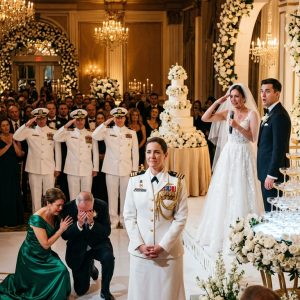
The fracture occurred during a lavish June wedding, situated on a temporary parquet dance floor, under the watchful, judgmental eyes of eighty guests. For the preceding four hours, these people had been aggressively whispering about the imminent arrival of a highly decorated military colonel. My daughter, Laya, was merely dancing. She wasn’t impeding the catering staff. She wasn’t causing a disturbance. She was simply spinning in her pristine, white buckled shoes while the DJ spun an upbeat pop anthem.
Then, an adult hand clamped violently around her fragile wrist and yanked.
What that manicured hand accomplished on the wooden floor was merely the first structure that collapsed that day. The second was the heavy, sterile door of a county emergency room at seven o’clock that evening. The third was a specific, authoritative title that absolutely nobody in that manicured yard ever expected to belong to the quiet woman standing in their periphery.
My husband’s fiercely insular family had constructed an elaborate, fictionalized mythology regarding my identity, the pedigree of my child, and our supposed subordinate ranking at their patriarchal table. They were about to discover, with devastating clarity, exactly how catastrophic their intelligence gathering truly was.
I had rotated back stateside a mere forty-eight hours prior to the ceremony, an event that my mother-in-law, Coral, summarily dismissed with a single, weaponized sentence.
“Myra is off doing her little government thing again.”
She delivered the line the way one might casually complain about a mild drizzle. I never bothered to issue a correction. I had learned early in my marriage that attempting to correct Coral cost significantly more emotional capital than it ever yielded. She was sixty-six years old, possessed a mind as sharp and unforgiving as barbed wire, and commandeered every family gathering like a general defending sovereign territory.
This specific event was her masterpiece. Her youngest son, Dale, was marrying his fiancé, Hannah, and the reception occupied the sprawling back lawn of Lake Haven Lodge. The atmosphere was suffocatingly curated: hundreds of Edison bulbs strung through the ancient oaks, a polished dance floor resting on the manicured grass, eighty folding chairs wrapped in crisp white linen, and beneath it all, a relentless current of gossip that I kept intercepting in fragments.
A colonel is arriving.
Dale’s superior from the base.
Someone incredibly important.
The rumor never seemed to possess a specific name. It had been transmitted through so many layers of relatives that it had mutated from a logistical fact into pure atmospheric pressure. Dale, of course, knew exactly who his brother had married, as did a select handful of his groomsmen. But within the rigid hierarchy of this family, you explicitly did not contradict Coral’s established narrative. And her established version of me was a vaguely embarrassing woman who was perpetually absent, engaged in some menial bureaucratic task the government refused to elaborate on.
Coral had been aggressively polishing this specific insult for weeks.
“This is Sam’s wife,” she announced, gesturing toward me while speaking to a distant cousin near the open bar. She offered a microscopic, practiced shrug. “She’s away quite a lot.”
The cousin offered me the exact, pitying smile one reserves for a stray animal. I squeezed Laya’s small hand and released it.
My husband, Sam, wrapped a heavy arm around my shoulder and leaned in. “She means well, Myra,” he whispered defensively.
He perpetually recited that line. He was forty-three years old and still actively engaged in translating his mother’s profound cruelty into something palatable. I didn’t engage in an argument. I had an energetic child to monitor and a secure smartphone resting in my blazer pocket that could potentially vibrate with a crisis no civilian in that yard could remotely comprehend.
So, I manufactured a polite smile, accepted a glass of iced lemonade that I had absolutely no intention of drinking, and quietly observed a family that operated under the supreme delusion that they understood my parameters.
Society generally assumes that military leadership is entirely comprised of aggressive screaming and chest-thumping. It rarely is. The most lethal, effective commanding officer I ever served under raised her voice exactly one time in three years, and the sheer abnormality of the sound terrified our unit more than incoming mortar fire. True authority operates on meticulous checklists, terrifyingly calm expressions, and an absolute refusal to be rushed into a tactical error.
I had constructed my entire career upon that exact foundation. When a critical supply convoy went catastrophically sideways at two in the morning outside Kandahar, I didn’t hurl a coffee mug at the wall. I opened a leather-bound notebook, documented the objective reality, and signed my name to the consequences.
That clinical methodology inevitably followed me back to civilian life. Sam learned this the agonizing way early in our marriage, when his cousin attempted to blame him for thousands of dollars of damage to a shared truck. I didn’t raise my voice at the cousin. I simply pulled the vehicle’s maintenance logs, cross-referenced the dates with toll booth receipts, and watched the fraudulent narrative collapse under its own weight.
Sam had stared at me in awe. “Why don’t you ever just tell people to go to hell?”
I offered him the doctrine I had lived by for two decades. “I don’t make scenes, Sam. I make records.”
He had chuckled, claiming it was the least romantic vow he had ever heard. Perhaps. But it had also acted as the reinforced steel keeping our marriage intact through three brutal cross-country relocations and two overseas deployments.
As the sun began to dip behind the lodge, my official dress blues were securely zipped inside a protective garment bag, resting quietly in the trunk of my sedan. Dale had called me three days prior, his voice tight with hope. “Please, Myra,” he had pleaded. “Just for the final hour. Let this family actually see what my sister-in-law does for a living.”
I had offered a non-committal answer. The brutal truth was, the prospect made my skin crawl. I had spent eight years actively shrinking myself to fit Coral’s preferred narrative. Stepping onto that pristine lawn in full military regalia felt dangerously akin to flipping on a floodlight in a room where everyone had comfortably agreed to sit in the dark.
Laya possessed exactly two driving passions in her seven years of life: rescuing stray animals and dancing.
For the wedding, she was adorned in a buttercream-yellow sundress and a pair of blindingly white, patent-leather shoes. They were the specific type featuring a delicate silver buckle that she had fiercely insisted on fastening herself. Every time she executed a pivot on the wooden floor, the rubber soles let out a sharp, cheerful squeak, a sound that sent her into fits of giggles.
The DJ transitioned into a hyper-energetic pop track—a song her cousins explicitly demanded at every gathering. Laya treated the melody like a personal summons. She dropped my hand and sprinted toward the center of the floor.
I stood at the perimeter, watching her desperately try to locate the rhythm, lose it, and triumphantly catch it again. A loose orbit of older children formed around her. She spun until the yellow fabric of her dress flared outward like a bell, then stumbled to a halt, delightfully dizzy. She scanned the crowd, her eyes wide, searching for my validation.
I offered her a crisp thumbs-up.
Her gaze immediately darted sideways, searching for Coral. My mother-in-law was positioned at the absolute edge of the parquet floor, clutching a stemless glass of Pinot Grigio, wearing an expression I couldn’t immediately decipher.
“Grandma! Watch!” Laya shrieked happily, executing her most elaborate spin yet.
Coral did not applaud. She didn’t even offer a patronizing smile. Her mouth compressed into a razor-thin line—the exact expression she utilized when a waiter placed the wrong silverware at her table.
I cataloged the slight. I filed it away in my mental ledger, but a child seeking validation from a grandparent is not a punishable offense, and I refused to march across a crowded reception to dictate a woman’s facial expressions.
Sam materialized beside me, balancing two plates of wedding cake. He tracked my gaze directly to his mother. “She’s fine, Myra,” he murmured reassuringly.
He meant Coral was fine. I wasn’t looking at Coral. I was staring at my daughter, listening to the rhythmic squeak of those pristine white shoes, burning the image into my memory.
Ten minutes later, Coral executed a flanking maneuver near the dessert station. She possessed the unsettling ability to simply materialize in your blind spot.
“May I be completely candid with you, Myra?” she inquired. In Coral’s lexicon, this was the universal warning flare that a targeted strike was incoming.
“By all means,” I replied.
She tracked Laya’s movements on the dance floor, her voice dropping to a conspiratorial hiss. “A little girl of that age requires her mother at home. Not constantly flying off to God-knows-where, doing whatever it is the government asks of you.”
I had absorbed variations of this exact reprimand for eight years. I maintained a face carved from stone. “Laya is thriving, Coral. Just look at her.”
Coral refused to look. “She is entirely feral,” she snapped. “She runs through the corridors. She interrupts adult conversations. This is the inevitable result of a household lacking a steady, present hand.”
Then, she physically squared her shoulders, pivoting to the actual tactical objective of her conversation.
“Today must be absolutely flawless, Myra. The colonel is arriving shortly. Dale’s commanding officer, or someone of equal gravity. Highly important personnel from the base.” She articulated the word colonel as if it were a rare delicacy she was savoring. “So, I must insist you keep her completely subdued.”
A familiar, exhausting urge flared in my chest—the urge to finally rip off the mask, to loudly explain precisely who might be arriving in a dress uniform that evening. I forced the urge down. Offering an explanation would feel suspiciously like begging for her respect, and I had permanently retired from the begging business.
“I will keep her within my sight,” I stated. It was a factual statement, and it was the absolute maximum I owed her.
She patted my forearm with a sickeningly sweet, condescending touch and floated back toward the bridal table.
Sam, having overheard the tail end of the interaction, offered me that infuriating, apologetic half-smile. “She’s just intensely nervous about the logistics, Myra. Let it slide. It’s Dale’s big day.”
I let it slide.
I have replayed that specific tactical decision in the theater of my mind a thousand times, despite knowing it was the correct protocol. However, choosing not to engage is fundamentally different than choosing not to observe.
Coral did not govern this family as a solo dictator. She was flanked by her brother, Brett, a sixty-three-year-old man who treated every social gathering like a corporate boardroom he was actively chairing. He was aggressively loud, thoroughly convinced modern society had grown pathetically soft. When two toddlers chased each other dangerously close to his chair, he barked, “Children are to be seen and never heard!” with enough volume to halt conversations. He looked visibly smug when the children froze in terror. Brett thrived on inducing paralysis.
And then there was Tara. Sam’s thirty-one-year-old cousin navigated the reception with her smartphone elevated like an Olympic torch. She obsessively documented everything, layering the footage with toxic, whispered commentary. I caught her aiming her camera directly at Laya on the dance floor.
“Someone is clearly raising a little barnyard animal,” Tara murmured to a bridesmaid beside her, ensuring her voice bled into the microphone. The bridesmaid giggled.
I felt a surge of pure, hot adrenaline spike the back of my neck. I forced it back into the vault.
Extracting a reaction was Tara’s entire currency. I would discover later that this precise moment was when she began constructing her alternate reality. Her thumbs flew across the glass screen, dropping curated, malicious video clips into the sprawling ‘Family Updates’ group chat—a digital space I was explicitly excluded from. Long before any physical violence occurred, half the extended family had already downloaded a narrative featuring a chaotic, undisciplined child and a negligent, cold mother.
None of them recorded Laya desperately asking her grandmother to look at her. None of them documented Coral’s icy refusal.
By six o’clock, the barometric pressure of the reception had noticeably shifted. There were too many anxious glances directed toward the entrance. Brett was holding court near the bartender, his voice booming. Coral was practically vibrating with anticipation, checking her gold wristwatch every three minutes, waiting for her phantom VIP.
I have stood in highly classified operational zones where the threat of death was tangible, and the human nervous system intimately knows the difference between standard anxiety and an impending ambush.
This was a warning siren.
So, I defaulted to my training. I established a protocol. I crouched down to Laya’s eye level during a break in the music, grasping both of her tiny, sweaty hands.
“Hey, bug. I need you to stay in my immediate airspace for a little while, okay?”
She scowled, her lower lip jutting out. “But Mama, I’m dancing.”
I offered a soft smile. “I know you are. But I need you to dance exactly where I can see you.”
She offered a rapid, dismissive nod—the specific type of agreement children utilize that expires in roughly sixty seconds.
I located Sam near the buffet line. I didn’t mince words. “I may receive a priority communication from the duty desk shortly. If I have to step to the perimeter, you have the watch. Your eyes remain locked on Laya. Not your phone. Not your uncle. Laya.”
He nodded, deeply distracted, his eyes scanning the crowd for his brother. “Yeah, Myra. I got it.”
“Sam.” I lowered my voice to a frequency that commanded attention. “I am entirely serious.”
He finally looked at me, a flash of irritation crossing his features. “I said I have her. Just relax, Myra. It’s Dale’s day.”
There it was. The absolute summation of his character in four words. I didn’t press the issue. He was a fundamentally decent father when the seas were calm. And for the next forty minutes, the waters remained deceptively smooth.
I ensured Laya was within an arm’s reach. I tactically positioned my body so I possessed a clear line of sight to both my daughter and the main gate. I executed the procedures a highly trained, careful operative executes.
I document these details not to absolve myself, but because later, when the authorities demanded to know how I allowed the assault to occur, I required the answer for my own sanity.
I didn’t allow it to happen. I calculated every possible variable, except the sheer, terrifying velocity at which a sixty-six-year-old woman can cross a wooden floor when she decides a seven-year-old child is an unacceptable stain on her perfect aesthetic.
At exactly 6:40 PM, the encrypted phone in my pocket aggressively vibrated.
I glanced at the screen. It was the duty desk. In my specific line of work, that is a communication you either accept immediately or spend the next week explaining to a tribunal.
I executed exactly three steps backward, reaching the very edge of the manicured lawn. I angled my shoulder to block the ambient noise of the reception, keeping the dance floor in my peripheral vision, and pressed the receiver to my ear.
“Driscoll,” I answered.
It was a standard logistical status update. The entire exchange consumed less than forty-five seconds. It was entirely non-urgent.
But within that microscopic window of distraction, the world tilted on its axis.
Behind me, the DJ triggered the infamous second song. I heard the synchronized clapping, the joyful shrieks of the children, and the familiar, rubbery squeak of small shoes desperately attempting to match the tempo.
And then, I heard an entirely different frequency.
It was a sharp, vicious adult voice slicing straight through the bassline. And buried beneath that voice was a high, terrified child’s scream that I felt resonate in the marrow of my spine before my brain could even process the sound.
Chapter 2: The Sound of Fractured Wood
I snapped my body around, dropping the encrypted phone directly onto the grass.
Coral was standing dead center on the parquet dance floor. Her hand was clamped like a vice grip around Laya’s fragile, seven-year-old wrist. She was actively dragging my daughter backward off the wooden surface and onto the turf, while Laya’s small legs scrambled frantically, unable to maintain the violent pace.
One of the pristine white shoes caught on the edge of the wooden floorboards, violently ripping off her foot. It lay there on its side, a tragic, abandoned artifact.
Laya’s right arm was wrenched upward and backward at a sickening, unnatural angle.
And Coral, her face contorted with a terrifying, self-righteous certainty, was projecting her voice so that every single guest in the eighty-chair radius could hear her mandate.
“No undisciplined child of a soldier is going to ruin my son’s perfect day! Get her out of my sight!”
The entire reception yard seemed to shatter into mute, paralyzed fragments.
Uncle Brett was already in motion, physically inserting his massive frame between Sam and the dance floor. He planted a heavy palm flat against Sam’s chest, barking something about “not making a scene.”
Tara’s smartphone was already elevated, the red recording light glowing ominously in the dusk.
Hannah, the bride, stood entirely frozen beside the multi-tiered cake, her hands clamped over her mouth in horror, her eyes wide with shock.
Laya wasn’t crying for attention. She wasn’t throwing a tantrum. She had collapsed onto the grass, cradling her right arm tightly against her stomach. She was emitting a continuous, high-pitched, keening sound—the specific, haunting noise of a mammalian creature that has been violently pushed past the threshold of pain and straight into systemic shock.
I crossed that distance faster than I have ever moved in combat gear.
I did not scream at Coral. I did not hurl an insult. I completely ignored her existence. I dropped to my knees on the damp grass directly in front of my daughter, and the elaborate wedding, the phantom colonel, the eighty witnesses—they all instantly evaporated into the ether.
There is a protocol for massive trauma. There is a checklist for the unthinkable, provided you have been subjected to the right crucible. That checklist is the only barrier preventing your own hands from violently shaking.
I gently cupped Laya’s tear-streaked face in both of my palms. “Look directly into my eyes, baby. I have you. You are secure.”
Her terrified, dilated pupils finally locked onto mine. “Good,” I whispered.
I shifted my visual assessment to the injured limb without making physical contact. She was guarding it aggressively, her elbow bent, her palm pressed flat against her diaphragm, completely unwilling to supinate the wrist.
The injury wasn’t in the wrist, despite the dark, plum-colored bruises in the shape of Coral’s fingers already blooming under the skin. It was the elbow.
I have applied tourniquets to shattered femurs in the pitch-black desert, but I had never triaged my own flesh and blood.
Above me, Coral’s panicked monologue escalated. The initial absolute certainty was beginning to splinter. She was frantically spinning to address the paralyzed guests, desperate to control the narrative before the shock wore off.
“I had to intervene!” she babbled, her voice climbing in pitch. “Someone had to enforce boundaries! She was a menace to the elderly guests!”
I refused to engage. I have studied interrogation psychology extensively. Absolute silence forces a guilty party to talk faster, to dig their own grave deeper, to expose their desperation. And Coral was enthusiastically grabbing a shovel.
I carefully slid my arms beneath Laya’s trembling body, hyper-aware of the compromised joint, and lifted her against my chest. I stood up smoothly. I reached down and retrieved the abandoned white shoe from the floorboards, clutching it in my left hand.
Only then did I shift my gaze to my husband.
Sam was standing four feet away. Brett’s hand had finally dropped from his chest. Sam’s complexion was the color of wet ash. He looked completely and utterly broken.
“We are going to the emergency room,” I stated. My voice was a flat, terrifying monotone. “Right now.”
That icy lack of hysteria seemed to unnerve the surrounding family members significantly more than a screaming match would have.
Brett puffed out his chest, attempting to reclaim his authority. “Now see here, Myra, there is no need to overreact. Children are remarkably resilient. It’s likely just a sprain—”
I simply walked straight through his personal space, forcing him to step backward or be physically leveled. I carried my weeping daughter toward the wrought-iron gates.
Behind me, the desperate hum of Coral’s revisionist history resumed. The child was out of control. I barely touched her. Myra is utilizing this as an excuse to ruin the evening.
Let her weave her pathetic fiction. I had a county hospital to reach and a skeletal structure to realign.
The walk to the gravel parking lot felt like a grueling, ten-mile march, despite being less than sixty yards. Laya’s high-pitched keening had transitioned into a violent, full-body shiver. Shock was setting in. I despised that physiological response more than the crying.
I carefully maneuvered her into the back seat, painstakingly buckling the heavy restraints around her good shoulder, supporting the injured arm with a rolled-up jacket. I placed the solitary white shoe on the passenger seat.
My pristine dress blues hung in their black canvas bag, gently swaying against the rear window as I slammed the door shut. I didn’t even process their existence. My mind was rapidly calculating the distance to the county trauma center and debating whether activating emergency flashers would attract unwanted municipal attention.
Before I could engage the ignition, Sam came sprinting across the gravel.
He slapped his hands against the driver’s side window, his face a portrait of a man being torn violently in two opposing directions. It was the tragic, eternal conflict of Sam Driscoll: his toxic, demanding family pulling against the woman he had vowed to protect.
I rolled the window down exactly three inches.
“Myra, listen to me,” he pleaded, his breathing ragged. “Mom is hyperventilating. She’s sobbing into Brett’s shoulder. She says if we abandon the reception now, in front of everyone, it’s going to look like an admission of guilt.”
I tightened my grip on the leather steering wheel until my knuckles cracked. “Your daughter’s elbow is physically dislocated from its socket, Sam. I am leaving.”
“Can’t we just… wait ten minutes? Let the tension diffuse?”
“No.”
He looked frantically over his shoulder at the glowing string lights, at the chaotic swarm of relatives, and then looked back at Laya, who was whimpering in the shadows of the backseat. Something fundamental in his posture collapsed.
“Okay,” he whispered, defeated. “I’ll come with you.”
“If you feel compelled to stay and manage the optics for your mother, then stay,” I told him. It wasn’t a vindictive statement. I was offering him a clean exit. “But the vehicle is moving in five seconds.”
In the ultimate, agonizing test of his character, Sam stayed.
He stayed because his mother was weeping, because the bride was allegedly in hysterics, and because the fragile ecosystem of his family was imploding. Sam possessed a fatal flaw: he could never walk away from a burning building if his family was holding the matches.
I understood the physics of his failure perfectly.
I shifted the car into drive and accelerated out of the gravel lot, the tires kicking up a cloud of white dust. And for the very first time in eight grueling years of marriage, I did not check my rearview mirror to ascertain if the Mercer family approved of my departure.
My smartphone began a relentless vibration sequence before I even merged onto the state highway.
They weren’t phone calls. They were rapid-fire notifications from the ‘Family Updates’ group chat. The alerts were being forwarded to me by the one solitary cousin who had always treated me with a shred of basic dignity.
She sent a screenshot accompanied by a single, chilling text: You need to see what they are doing.
I caught a red traffic light at an empty intersection. Laya was dozing fitfully in the back, exhausted by the adrenaline crash. I picked up the device and tapped the video file Tara had uploaded.
It was a brilliantly, sociopathically edited clip.
It lasted precisely six seconds. It began after the initial violent grab. The footage exclusively showcased Laya aggressively twisting, crying, and physically pulling away from an adult’s hand. The audio of Coral’s vicious declaration had been entirely scrubbed. There was no visual evidence of the wrenched arm or the abandoned shoe.
The accompanying caption read: “This is the tragic reality when a child receives absolutely zero discipline at home. #RuinedWedding”
Beneath the video, the digital mob was already ravenous.
Such a tragedy for Dale on his special day.
If a mother cannot control her offspring, she should hire a sitter.
Where exactly was Myra during all this? Probably checking her email.
Not a single relative asked why a sixty-six-year-old woman was employing physical force on a seventy-pound child. Not one.
I sat at the intersection, the harsh red glare of the stoplight washing over the dashboard. I felt a massive, volcanic urge to type furiously—to deploy a tactical strike of logic, to upload a thousand-word defense that dismantled their lies piece by piece.
But my training engaged. You never engage a hostile force on a battlefield they have already rigged with explosives. You cannot win an argument inside an echo chamber that requires you to be the villain to sustain their own innocence.
I placed the phone face-down on the passenger seat, right next to the white shoe.
“Let them type,” I whispered into the quiet cabin.
Laya stirred in the back. “Mama?”
“I have you, baby,” I said softly. “We are two miles away.”
The light flashed green. The phone vibrated continuously against the leather seat for the remainder of the drive, a relentless drumbeat of slander. I ignored it completely, because I knew the digital theater was entirely irrelevant.
The real war was about to begin, and it required a heavily fortified bunker.
Chapter 3: The Clinical Truth
The county emergency room on a humid Saturday evening operates as its own distinct theater of human misery.
We breached the sliding glass doors at precisely a quarter past seven. The waiting room was a sea of fluorescent lights, exhausted parents, and the metallic scent of antiseptic. I carried Laya through the crowded space, bypassing the initial queue entirely.
The triage nurse, a hardened veteran with tired eyes, took a single, sweeping glance at the precise, guarded angle of Laya’s right arm. She didn’t ask for a medical history; she immediately pointed us toward a curtained trauma bay, overriding the protocol.
The attending physician materialized three minutes later. She was young, possessed a calm, unhurried demeanor, and carried the specific, gentle authority required for pediatric trauma. She crouched down to Laya’s eye level, perfectly mirroring my own tactic.
“Hello, sweetheart,” the doctor murmured softly. “Can you show me exactly where the bad pain lives?”
Laya used her uninjured left hand to point hesitantly toward her right elbow, completely refusing to articulate the damaged joint.
The doctor gently palpated the surrounding tissue, maintaining a steady stream of soothing chatter about the bright yellow fabric of Laya’s dress. Her fingers moved with expert precision. Finally, she stood up and met my gaze.
“It’s a textbook radial head subluxation,” she stated quietly. “Colloquially known as nursemaid’s elbow. The annular ligament slips and traps the head of the radius. It’s statistically less common once they reach her age and bone density, but…” She paused, her eyes narrowing imperceptibly. “…a sudden, violently aggressive pull on the extended arm can absolutely still slip the joint.”
She delivered the final sentence without overt accusation, but the unasked question hung heavy in the sterile air: Who applied the violent force?
I delivered the unvarnished truth with zero decorative language.
“A sixty-six-year-old relative grabbed her by the wrist and forcefully dragged her off a wooden dance floor,” I said, my voice clinical and flat.
The doctor’s pen halted mid-stroke on the chart. She stared at me for a prolonged second, processing the absence of familial protection in my statement. She offered a slow, deliberate nod.
“Understood,” she replied. “The immediate good news is that the reduction procedure is rapid and highly effective. The secondary protocol… we will discuss in a moment.”
She didn’t need to elaborate on the ‘secondary protocol.’ I was intimately familiar with the rigid, unforgiving machinery of institutional bureaucracy. I knew exactly what gears I had just engaged by uttering the truth.
I gripped Laya’s good hand tightly as the doctor stepped out to retrieve an assistant.
Laya looked up at me, her eyes wide and shimmering with unshed tears. “Mama… am I in trouble for the wedding?” she whispered.
The question cracked my ribs open. “No, my brave girl,” I said, kissing her forehead. “You are not in trouble. None of this is your fault. The adults failed today, not you.”
The reduction itself required less than five seconds. The doctor cradled the injured arm, placed a firm thumb over the radial head, and executed a swift, smooth supination and flexion of the forearm.
There was a distinct, sickeningly soft click that echoed in the small bay—a sound that permanently imprints itself onto a mother’s psyche.
Laya let out a sharp yelp of surprise, blinked rapidly, and within sixty seconds, she was tentatively reaching for a colorful sticker the nurse offered, utilizing the exact same limb that had been paralyzed for the past hour. The resilience of pediatric biology is nothing short of miraculous.
The doctor retreated to her rolling stool and addressed me with absolute professional severity.
“The joint is secure. Maintain mild observation for forty-eight hours,” she instructed. Then, her posture rigidified. “Now, I must be completely transparent regarding the mandatory legal framework. When a child presents with this specific mechanism of injury—forceful traction applied by an adult—I am legally mandated as a reporter to notify the authorities.”
She held my gaze. “This is not a subjective judgment of your character as a mother. It is state law. The file is immediately routed to the county Department of Child and Family Services. Furthermore, because the injury was the direct result of intentional adult contact, the protocol automatically triggers a law enforcement notification. An on-call officer will likely visit the hospital tonight to initiate a preliminary report.”
I nodded slowly. I felt a profound, tectonic shift deep within my core. The part of my soul that demanded verifiable facts and signed documents felt the ground suddenly solidify.
This was no longer a fluid, manipulatable narrative that Coral could endlessly spin in a group chat to sympathetic cousins. It was now a permanent, institutional record. It had entered a judicial system that cared absolutely nothing about who cried the hardest at a wedding reception or whose feelings were damaged.
The senior nurse, a woman whose badge identified her as Bonnie, lingered in the bay after the physician departed. She quietly slipped a folded piece of heavy stock paper into my palm.
“Your official discharge and case number,” Bonnie murmured, her eyes kind but sharp. “Along with the badge number of the responding officer. Families always desperately need this information later, and they never think to ask for it in the moment.”
I closed my fist around the paper. It felt like a loaded weapon.
I knelt by the gurney and carefully guided Laya’s foot back into the abandoned white shoe, securing the delicate silver buckle myself. She watched me with enormous, exhausted eyes.
“Mama,” she said, her voice barely a whisper. “Grandma shouted that I’m not real family. Am I real family now?”
I held her small, white-clad foot between both of my hands, fighting a sudden, violent surge of rage that threatened to compromise my composure. Before I could formulate an answer that wouldn’t terrify her, the privacy curtain was pulled back.
A uniformed police officer stepped into the bay.
She was a woman roughly my age, her dark hair pulled back into a severe, regulation bun. A tactical notebook was already open in her hand. She introduced herself with a low, non-threatening cadence, explicitly designed not to escalate the child’s anxiety, and requested we step into the chaotic hallway for a private interview.
Bonnie produced an apple juice box seemingly out of thin air to occupy Laya, and I stepped beyond the curtain.
“The attending physician flagged the injury mechanism,” the officer stated, her pen hovering over the paper. “I simply require your unvarnished account of the inciting incident.”
So, I delivered the intelligence briefing.
I provided the exact timestamp. The geographic location. The specific identities. I detailed how a sixty-six-year-old relative grabbed my seven-year-old by the wrist and applied enough physical traction to dislocate the radial head, dragging her across a public dance floor in front of approximately eighty witnesses, while explicitly stating her desire to physically remove the child.
The officer’s pen flew across the page. When I finished, she looked up, her expression carefully neutral.
“I prefer to be brutally honest about how this machinery operates, ma’am,” she said. “In this jurisdiction, an adult intentionally causing physical trauma to a minor can be classified under criminal battery. However, I do not authorize charges. I compile the medical diagnostics and the witness testimonies, and the county prosecutor makes the ultimate determination. I cannot guarantee you a specific outcome tonight.”
“I am not demanding an outcome,” I replied evenly.
She paused, slightly taken aback. “Frankly, most parents are.”
“I am not asking for a punitive strike,” I clarified, my voice cold steel. “I am demanding that the objective facts be placed on the official record. That is the only outcome I require.”
She studied me intently, analyzing a reaction that entirely defied her standard operating experience. She nodded slowly, documenting my response. “We will require corroborating statements from individuals who visually witnessed the event. Do you have witnesses who will formally testify?”
Eighty people had witnessed the assault. The terrifying variable was how many of them possessed the spine to speak the truth against Coral Mercer in a family dynamic where loyalty was exclusively measured by complicit silence.
“I don’t have that intelligence yet,” I admitted. “But I intend to find out tonight.”
At precisely 8:15 PM, Sam breached the ER doors.
He was still wearing his tailored wedding suit, though the silk tie had been discarded, and his hair was a chaotic mess from repeatedly running his hands through it. He burst through the privacy curtain and stopped as if he had hit an invisible wall.
He absorbed the visual data: Laya resting with her arm in a temporary soft sling, sipping juice, a sticker on her cheek. He saw the dark, finger-shaped contusions blooming on her tiny wrist. He saw the official police paperwork clutched in my hand.
For the first time all day, Sam was forced to look at the undeniable, physical reality of the violence, rather than his mother’s carefully curated, hysterical version of it.
“Oh, my sweet Laya bug,” he choked out, collapsing to his knees beside the gurney.
She leaned her head against his shoulder. He remained there for a long time, his face buried in her hair.
When he finally stood up, his eyes were bloodshot, and his jaw was locked tight. He asked me the question with extreme caution, knowing the answer was going to detonate his reality.
“Mom is screaming to everyone at the lodge that you called the police on her. The entire family is melting down. Did you… did you actually call the cops, Myra?”
“The hospital administration initiated the call,” I corrected him, maintaining my absolute calm. “They are legally mandated to report suspected abuse. I provided the responding officer with a factual statement. That is the objective truth, and you are free to disseminate it to anyone who inquires.”
He dragged both hands down his face. “Myra, this is going to completely annihilate the family.”
“The family was annihilated the second she put her hands on my child,” I fired back, my voice finally carrying a razor’s edge. “I just stopped pretending the building wasn’t on fire.”
He fell silent, absorbing the devastating finality of my stance. In a hollow voice, he asked, “What is your next move?”
I looked at my daughter, blissfully safe and heavily sedated by adrenaline exhaustion.
“Nothing theatrical,” I said. “I am going to drive back to that reception, and I am going to articulate the truth in the only language that family has ever respected.”
Sam frowned, deeply confused. “What language is that?”
I didn’t answer him. Some realities cannot be explained; they must be visually demonstrated.
I instructed Sam to transport Laya safely home and wait for me. Then, I walked out into the muggy night air, toward my sedan, where a specific black garment bag was waiting patiently in the dark.
I was about to change into my armor.
Chapter 4: The Armor of Eagles
The ten-minute drive to our house was executed in total silence. I left the radio off. The digital dashboard clock glowed a menacing red.
I pulled into the driveway just as the hired babysitter was leaving, profoundly confused by the abrupt, chaotic termination of her evening. I bypassed the kitchen and walked straight into the master bedroom.
I laid the heavy black canvas garment bag flat on the pristine duvet cover and slowly pulled the zipper down.
My formal dress blues lay perfectly pressed inside. The deep, rich navy fabric seemed to absorb the ambient light of the room. The silver buttons marched in a flawless, disciplined line down the center of the jacket. And resting on the epaulets, heavy and undeniable, were the silver eagles.
I want to be unequivocally clear regarding my motivation in this moment, because it would be incredibly easy for an observer to misinterpret this action as a petty, vindictive flex of power. It was not vengeance.
I had spent eight long years permitting Coral, Brett, and the entire insular Mercer clan to define my parameters. I allowed them to categorize me as the embarrassing, absent wife. The woman whose career was a vague, bureaucratic joke. The negligent mother whose child was feral because I lacked domestic instincts.
I had permitted this sustained psychological abuse because correcting them felt suspiciously like begging for a seat at a table I didn’t even respect. I had operated under the delusion that stoicism was a virtue.
I was officially terminating that permission.
I was not donning the uniform to conquer them; I was putting it on to permanently revoke my own invisibility in a family I had originally tried to love.
I slipped my arms into the tailored jacket. I fastened each silver button with slow, deliberate precision. It was the physical manifestation of locking a vault. I checked the alignment of the eagles in the full-length mirror. I didn’t look like an actor in a costume. I looked exactly like the woman I had been every single day of the last twenty years.
I patted my pocket, ensuring the folded slip of paper with the police case number was secure. I thought about the ongoing reception at the lodge. Knowing Coral’s pathological need to control the narrative, the party was undoubtedly still limping along on life support. She would never allow the crowd to disperse while she still had an audience to manipulate.
There was still time. The mysterious colonel they had been salivating over all afternoon was, finally, en route.
I retrieved my keys from the dresser. Just as I entered the front hallway, the front door swung open. Sam had arrived with Laya.
The two fractured halves of my existence violently collided in the foyer.
Sam froze the absolute second his eyes registered the uniform. He had seen official photographs, of course. They sat in frames on his desk. But he had never witnessed me physically wear the dress blues standing in our own civilian hallway.
A profound, complex emotion swept across his exhausted face—a reaction I had been waiting eight years to see from him. It was a sudden, jarring recognition of magnitude. He didn’t offer a witty remark. He didn’t attempt to minimize the moment.
He simply exhaled, “Oh.”
Laya was slumped heavily against his shoulder, her tiny arm secured in the white hospital sling. I stepped forward and gently transferred her into my arms, taking the brunt of her weight. I lowered myself to sit on the second step of the staircase, bringing us face-to-face.
She reached out with her uninjured left hand and tentatively touched one of the cold, silver buttons on my chest.
“You look exactly like a soldier, Mama,” she whispered, her eyes wide with awe.
“I am a soldier, Laya,” I told her, my voice unwavering.
She processed that new data point in silence. Then, her mind circled back to the trauma that had been crushing her chest all evening. Children possess a terrifying memory for cruelty; they swallow the toxic words and carry them like lead weights.
“Grandma screamed that I’m not real family,” she murmured, a single tear escaping her eyelash.
I covered her small hand, pressing it flat against the silver button over my heart.
“Listen to me very carefully,” I said, my tone fierce and absolute. “Real family are the people who would never, ever forcefully drag you away from a place where you belong. That is the only acceptable metric. And you, my sweet girl, have never, for a microscopic fraction of a second, been someone who didn’t belong.”
She scrutinized my face with that devastating, hopeful seriousness unique to traumatized children. She absorbed the truth.
“Then where are you going now?” she asked.
“I am going back to the party,” I replied, standing up and carefully handing her back to her father. “To ensure every single person there understands that exact rule.”
I kissed her forehead. I glanced down at the entryway rug. Laya’s white shoes were sitting there. Sam had retrieved the abandoned shoe from the car and lined them up perfectly side-by-side. Both delicate silver buckles were securely fastened.
I stared at the shoes for two seconds. Then, I turned on my heel, walked out into the suffocatingly warm June darkness, and ignited the engine of my car. I drove back toward the glowing string lights.
The reception, predictably, had refused to die.
When my tires crunched into the gravel lot shortly before nine o’clock, the Edison bulbs were still blazing against the night sky. The crowd had thinned considerably, but a persistent core of guests still milled around the edges of the dance floor. It possessed the deeply unsettling energy of a party operating purely on nervous momentum long after the actual joy had evaporated.
I killed the headlights and sat in the dark cabin of my sedan for a full minute, conducting a tactical surveillance through the open side of the massive tent.
Coral was actively working the room. The choreography was sickeningly familiar. She drifted strategically from cluster to cluster, placing a delicate hand on an arm, shaking her head with performative sorrow, executing the role of the tragically wronged matriarch flawlessly.
Even from fifty yards away, I could practically lip-read her script: Myra is unstable. Myra manufactured a scene to ruin Dale’s wedding. Myra deployed the police against her own family over a minor scuffle.
Brett remained anchored near the bar, nodding aggressively, utilizing his physical bulk to lend gravity to her lies. Tara was actively shoving her smartphone into the faces of anyone who couldn’t escape fast enough, playing that heavily edited, six-second clip on a loop.
But as I observed the crowd closer, I noticed the fractures in their campaign.
The room wasn’t entirely convinced. An older couple standing near the ruined cake table maintained a grim, physical distance from Coral’s orbit. A bridesmaid wearing a pink dress kept throwing nervous, haunted glances toward the exact spot on the wooden floor where Laya’s shoe had been abandoned.
And Hannah, the bride, sat completely isolated at the head table. Her pristine white gown looked tragic. Her elaborate makeup was destroyed by tracks of black mascara. She didn’t look like a woman whose magical day had been ruined by a misbehaving child; she looked like a woman who had witnessed an atrocity and was fundamentally unable to unsee it.
When you assault a child in front of eighty people, you can spin the narrative for an hour, but the violence leaves a toxic residue that PR cannot wash away. The lie was currently dominating the airspace, but it was a filthy, contaminated victory.
And then, drifting across the humid lawn, I heard the specific phrase that altered the atmospheric pressure of the entire venue.
“The colonel is finally here.”
Someone stationed near the entrance gate had spotted a uniform approaching through the dark.
I have been officially announced into crowded rooms thousands of times. The word colonel possesses a distinct psychological gravity, especially when deployed against a civilian population that has spent six hours eagerly anticipating the arrival of a VIP.
The entire population of the tent physically pivoted toward the main gate in synchronized unison.
I watched the transformation from the shadows. I watched their faces rapidly arrange themselves into the obsequious, respectful expressions they had been practicing all afternoon. Brett abruptly stopped talking and aggressively tugged his suit jacket straight. Tara immediately lowered her phone, realized the potential for clout, and raised it again, aiming the lens directly at the entrance.
And Coral—the architect of this entire miserable day—smoothed the fabric of her expensive dress with both hands. She pasted a blindingly radiant, gracious hostess smile across her face and stepped forward to receive her highly anticipated salvation.
They were all mentally scanning the darkness for a man.
I knew that with absolute certainty. Every single person in that tent was looking for a grizzled, silver-haired male officer whose chest was heavy with medals. They expected an older patriarch who would shake Dale’s hand, validate their existence, and bathe the Mercer family in borrowed, unearned glory.
That was the phantom colonel Coral had promised them.
I stepped out of the shadows of the parking lot and walked purposefully toward the illuminated gate. The gravel crunched loudly beneath my polished shoes, an even, unhurried, terrifyingly calm rhythm.
The first individual to clearly identify me was a young man standing near the perimeter, clad in a crisp Air Force dress uniform. One of Dale’s active-duty groomsmen.
His eyes tracked my approach. He registered the heavy silver eagles resting on my shoulders a full second before his brain processed my facial features.
His spine snapped violently rigid. His arm shot upward in a reflex that bypassed conscious thought entirely, executing a flawless, razor-sharp salute. He locked his eyes dead front, holding the position with absolute reverence.
In a military setting, physical movement ripples outward like a shockwave. Civilians instinctively follow the trajectory of a salute the same way they follow a pointing finger.
One by one, the eighty faces under that tent traced the airman’s gaze directly to me.
I breached the threshold of the lights in my dress blues, and the reception went completely, utterly silent. It wasn’t the silence of paused conversation; it was the suffocating silence of a vacuum.
The young airman maintained his rigid salute until I returned the gesture with crisp precision. He dropped his arm, exhaled, and the remainder of the room was left with absolutely nowhere else to look.
I stopped walking. I stood at the edge of the parquet floor and allowed them to look.
I have learned through decades of command that silence, when wielded as a weapon, crushes people far more effectively than shouting. I stood perfectly still and allowed eighty civilians to read the silver eagles. To read the combat ribbons. To read the white embroidered name tape that clearly spelled DRISCOLL.
I watched the catastrophic mathematical equations resolve in real-time across their faces. The whispers ignited like dry brush.
That’s the colonel.
That’s Sam’s wife. That’s the woman who—
Dale broke the paralysis first. The groom, my brother-in-law, marched across the floor. He stopped three feet away from me. Despite the civilian tuxedo, years of ingrained protocol overrode his environment. He snapped to attention and executed a crisp salute to his own sister-in-law.
“Ma’am,” Dale said, his voice cracking with emotion.
He had known my rank for years. He had simply been forbidden from articulating it out loud at his mother’s aggressively curated dining table.
I returned the salute, stepping forward to place a gentle, grounding hand on his forearm. I didn’t speak, but the gesture communicated everything: I am not here to destroy you, Dale.
Then, I shifted my gaze toward the head table. I locked eyes with Coral.
She was completely immobilized. Her right hand was hovering awkwardly in the air—frozen mid-way through the gracious, welcoming gesture she had prepared for a stranger. The radiant hostess smile was melting off her face like wax near a flame.
Her eyes darted frantically over the pristine navy fabric, the silver buttons, the eagles, and finally, my face. I watched the two violently opposing halves of her reality violently crash into each other. The prestigious VIP she had been bragging about all day was the exact same woman she had dismissed as an absentee failure. The esteemed military officer she was desperate to impress was the mother of the child she had just assaulted and labeled a “soldier’s brat.”
Her mouth opened, but no sound emerged. For the first time in her sixty-six years on earth, Coral Mercer had absolutely no script to read from.
“They… they said a colonel was arriving,” she stammered in a hoarse whisper. The acoustics of the silent tent carried the panicked words to everyone. “That’s you.”
“It’s me,” I confirmed.
I didn’t raise my volume. The suffocating quiet of the room amplified the words for me.
In the agonizing pause that followed, the oblivious DJ’s automated playlist cycled to the next track. Absurdly, faintly, the opening chords of the ‘second song’ echoed through the speakers, complete with the rhythmic clapping beat. A few of the toddlers instinctively swayed before their horrified parents violently yanked them still.
Coral’s survival instincts finally kicked in. She resorted to the only weapon she had left: weaponized charm.
The frozen mask thawed into something desperate and dangerous. She stepped forward, extending her hands, her voice artificially pitched to project to the cheap seats.
“Myra! Sweetheart!” she trilled, forcing a laugh. “There has clearly been a catastrophic misunderstanding! We were all simply terrified for little Laya’s safety. How is the dear girl? You rushed away so frantically, none of us even had a chance to—”
“She suffered a dislocated elbow,” I stated. Flat. Clinical. Loud enough to bounce off the canvas roof. “The attending trauma physician reset the joint an hour ago.”
A collective, audible gasp rippled through the guests. Coral flinched as if I had struck her.
She desperately doubled down, her pace quickening. “Children are so fragile! Accidents occur at large gatherings. It is nobody’s fault, truly! I was merely attempting to guide her away from the elderly guests. I was protecting her! And you have escalated this into a massive, theatrical production!”
She gestured wildly at my uniform, at the stunned crowd, at the night sky. “This entire spectacle!”
Brett immediately flanked her, utilizing his bulk to shield her. “Nobody calls the authorities on their own blood!” he bellowed to the crowd, as if sheer volume could alter reality. “This is a gross overreaction! Let’s all take a breath and act like rational adults!”
I did not match his volume. When the opposition resorts to shouting, the most devastating counter-measure is to drop your decibel level until they are forced to lean forward to hear their own execution.
“I did not manufacture a spectacle, Coral,” I said softly, the quiet forcing the entire tent to hold its breath. “I put on the uniform that I bled to earn so that the members of this family would finally be forced to acknowledge exactly who I am.”
I locked my eyes onto hers, trapping her in the gaze. “You utilized the term ‘soldier’s child’ as a slur against my daughter. You spent the entire afternoon salivating over the arrival of a soldier. Well, here I am.”
Coral’s voice climbed into a thin, scraping register of panic. “You are intentionally humiliating this family!”
“No,” I corrected her gently. “I am permanently terminating the era where you possessed the authority to dictate who qualifies as family.”
I slowly reached into the breast pocket of my jacket. I extracted the folded piece of heavy stock paper. I did not wave it aggressively in the air. I simply held it between my fingers—a tangible, undeniable artifact of reality.
I physically turned away from Coral, dismissing her relevance, and addressed the eighty paralyzed witnesses.
“My daughter is seven years old,” I announced to the crowd. “Tonight, an emergency room physician had to physically force her elbow back into its socket. By state law, the hospital is mandated to report that specific injury mechanism to the authorities. I provided my official statement to a police officer ninety minutes ago.”
I allowed the gravity of the legal machinery to settle over the crowd.
“The investigating officer informed me that the county prosecutor will require corroborating accounts from individuals who visually witnessed the inciting incident on this floor.”
I panned my gaze across the faces. I saw the relatives who had nodded eagerly to Coral’s lies. I saw the ones who had stared at the grass in shame.
“I am not going to debate anyone regarding what they believe they saw,” I stated simply. “I am only going to ask one question. Did you see it?”
The silence stretched to the breaking point. Coral’s eyes darted frantically, searching for an ally. Brett opened his mouth to shout another objection.
And then, the older gentleman standing near the cake table—the one with the grim, haunted expression—slowly set his crystal cocktail glass down. He squared his shoulders and took a deliberate step forward.
“I saw it,” he said. His voice was shaking with adrenaline, but his posture was iron. “The little girl was doing absolutely nothing wrong. That woman grabbed her by the arm and violently yanked her clear off the floorboards. I’ve felt physically sick about it for two hours.”
A woman seated two tables away stood up immediately after him. “I saw it happen, too.”
Then, the bridesmaid in the pink dress stepped forward, her voice a quiet, firm whisper. “She ripped the child’s shoe off. I watched the entire thing.”
One by one, the dominoes fell. They stood up. It wasn’t an angry mob; it was a collection of human beings who had been forced to carry a heavy, toxic lie, and were finally being granted permission to set the burden down.
Finally, Hannah, the bride, stood up at the head table. She ignored her new husband. She ignored the crowd. She stared directly into Coral’s terrified eyes.
“I saw you do it, Coral,” Hannah said, her voice echoing with profound devastation. “On my wedding day. And I will never, ever forgive you for it.”
At the edge of the tent, the glowing screen of Tara’s smartphone slowly lowered, and then went completely dark.
The defense had entirely collapsed. And right on cue, the executioner arrived.
Chapter 5: The Reckoning of Records
As if the universe had perfectly choreographed the finale, the sweeping beams of a vehicle’s headlights sliced across the gravel parking lot.
The investigating officer from the hospital had informed me she might visit the venue to collect preliminary statements while the memories were uncorrupted. She walked through the iron gates with a slow, measured, unhurried stride, her tactical notebook already flipped open.
She paused at the edge of the light, absorbing the bizarre tableau: the dead-silent tent, the woman standing in full dress blues, the dozen guests standing in defiance, and the matriarch looking as though she was actively having a stroke.
“Good evening, folks,” the officer announced, her voice projecting authority. “I understand several individuals here may have witnessed an incident involving a minor earlier tonight. I’d appreciate speaking with anyone willing to provide a factual account.”
That was the spark that ignited the powder keg. Coral’s meticulously maintained composure didn’t just crack; it violently detonated.
“This is absolute insanity!” Coral shrieked, her voice splintering into a hysterical pitch. “This is my son’s wedding! You are all turning against your own blood because she marched in here wearing a costume!” She aggressively pointed a trembling finger at my uniform. “She parades in here in her little outfit, and suddenly I am treated like a violent criminal? I have sacrificed everything for this family! Everything!”
She was openly screaming now, spinning in panicked circles, desperately seeking a single face that would validate her rage. She found nothing but stone.
I did not move a single muscle. I did not elevate my voice a fraction of a decibel. When she finally paused to drag oxygen into her lungs, I dropped my final payload into the silence.
“I informed you a long time ago, Coral,” I said, my voice echoing like a gavel striking wood. I looked at the officer, then at the standing witnesses, and finally at the folded paper in my hand. “I do not make scenes. I make records.”
There was absolutely no triumphant smirk on my face. There didn’t need to be. The record was already permanently etched into a hospital diagnostic chart, a police ledger, and the minds of a dozen standing witnesses who would never pretend to be blind again.
Coral looked wildly around the tent. She looked at Brett, who had finally recognized a losing battle and retreated into silence. She looked at the guests who actively refused to meet her gaze. The terrifying realization finally dawned on her: this was a crisis she could not charm, manipulate, or talk her way out of.
In a final act of utter desperation, she turned to the only weapon she had left.
“Sam,” she pleaded, her voice breaking. “Tell your wife to stop this madness.”
I hadn’t heard his vehicle pull into the lot. He must have driven back to the lodge the absolute second the babysitter relieved him, pathologically incapable of staying away from a room that was actively imploding.
He was standing just inside the perimeter of the tent, his suit jacket discarded, his shirtsleeves rolled up. Every single head in the venue snapped toward him. Coral had explicitly designated him as the deciding vote, and the entire family knew his history.
For eight agonizing years, Sam had played the diplomat. He had split the difference. He had smoothed over the jagged edges of his mother’s cruelty, begged me to turn the other cheek, and sacrificed his wife’s dignity on the altar of temporary peace.
I watched him standing there, the crushing weight of the entire family’s expectation bearing down on his shoulders. I did not utter a single syllable. I offered him no lifeline. This specific battle belonged exclusively to him.
Sam looked at his mother, whose face was contorted in a pathetic, desperate plea. He looked at me, standing tall in the uniform he had always minimized. And finally, his eyes drifted down to the empty patch of wood on the dance floor where his daughter’s shoe had been ripped away.
When he finally spoke, his voice was thick with gravel, but the spine behind it was forged from iron.
“Mom,” Sam said, the word ringing out clearly. “You put my seven-year-old daughter in the hospital.”
Coral immediately opened her mouth to launch a defense, but Sam violently talked over her—an act of defiance I had never witnessed in almost a decade.
“No!” he shouted. “I stood there and watched you grab her! I allowed Uncle Brett to physically hold me back instead of breaking your grip, and I am going to be profoundly ashamed of my cowardice for the rest of my natural life.”
He swallowed hard, his fists clenched at his sides. “I should have stopped you on that dance floor. I am stopping you right now.”
Across the tent, Dale stepped forward, moving to stand shoulder-to-shoulder with his older brother. The groom looked utterly exhausted, but resolute.
“Colonel or not, she is my niece, Mom,” Dale stated, his voice devoid of sympathy. “You were wrong. On my wedding day, you committed an atrocity. And every single person in this tent knows it.”
Coral stood entirely isolated in the center of the parquet floor, trapped between the condemnation of her two sons. And for the very first time in her reign, absolutely no one rushed forward to absorb the blow for her.
What transpired next was genuinely shocking.
Coral did not launch into another tirade of rage. The fight simply drained out of her body like water from a cracked vase. She collapsed heavily into a white folding chair, her shoulders slumping forward. When she spoke, her voice sounded ancient and brittle.
“You have no idea what it is like,” she whispered to the floor. “To be the woman who orchestrates everything, who bleeds for the aesthetic, and is thanked for absolutely nothing.” She stared blankly at her trembling hands. “At my own wedding, forty years ago… my husband’s mother stood up in front of the entire congregation and loudly declared I would never be sophisticated enough for this family.”
She slowly lifted her eyes to meet mine. For a fleeting microsecond, the monster vanished, leaving behind something profoundly human, cornered, and deeply tragic.
“I stood there in my cheap dress, and I swore to God I would never, ever be the woman they looked past again. I just wanted tonight to be perfect, Myra. I just wanted to finally matter to these people.”
I felt the gravitational pull of her confession. I am not a sociopath. I recognize that a psychological wound left untreated for four decades festers into a lethal infection.
But I have also learned the hardest lesson of command: understanding the origin of an abuser’s trauma does not equate to excusing the violence they perpetrate. The two concepts must remain permanently segregated.
I slowly closed the distance. I crouched down so my eyes were perfectly level with hers—the exact tactic I utilize when disciplining Laya. I kept my vocal tone incredibly gentle.
“I am genuinely sorry that trauma was inflicted upon you, Coral,” I said softly. “I mean that sincerely. No human being should ever be made to feel like an interloper at their own family’s table.”
I allowed the empathy to hang in the air for a second before hardening the steel beneath the words.
“But surviving abuse forty years ago does not grant you immunity. It does not grant you the right to violently lay your hands on a seven-year-old child and degrade her as a ‘soldier’s brat.’ There is absolutely no version of your historical pain that magically transforms tonight’s assault into something I will ever forgive.”
She broke eye contact, staring at the grass. She finally comprehended the catastrophic permanence of her actions.
I stood back up. Crouching in front of an adversary for too long surrenders tactical leverage they haven’t earned. The police officer was waiting patiently near the bar, the witnesses were still standing in solidarity, and the administrative cleanup of the night was just beginning.
But there was one final, vital requirement. The new rules of engagement had to be articulated publicly, in front of the exact same audience that had witnessed the abuse. A boundary established in private is nothing more than a polite suggestion.
“This is the new operational reality,” I announced, projecting my voice to the entire tent. I delivered the mandate with the cold, absolute certainty of a commanding officer issuing a non-negotiable directive.
“I am not demanding the county prosecutor pursue maximum charges. The judicial outcome is entirely their jurisdiction. I will not beg the state to punish you, and I will absolutely not beg them to show you leniency.”
I shifted my gaze from Coral to Brett, who had practically turned to stone in the corner.
“However. Until a genuine, unprompted apology is delivered directly to Laya, and until the county concludes its legal investigation, you do not have permission to be in the same room as my daughter without Sam or myself physically present.”
I let the sentence detonate.
“Not at Thanksgiving. Not at birthdays. Not for three minutes unsupervised in a hallway. You have permanently forfeited the privilege of unmonitored access to a child you were willing to physically damage for the sake of aesthetics.”
I scanned the room. “This is not an act of revenge. This is simply the new security protocol. And it is not subject to appeal.”
Nobody dared to argue. Brett stared intensely at his dress shoes. Tara had miraculously migrated to the very edge of the tent, desperate to evaporate into the parking lot. Coral remained seated, her hands dead in her lap, offering no rebuttal—which was, ironically, the first genuinely honest action she had taken all evening.
I turned to the police officer and formally offered my cooperation for the investigative process.
Before departing, I sought out the bride and groom. I found Dale and Hannah standing near the ruined, uncut cake. The magical day they had meticulously planned for a year had been hijacked and destroyed by a narcissist’s cruelty, and I felt a profound sorrow for their collateral damage.
I reached out and took both of Hannah’s trembling hands. “I am deeply sorry your wedding devolved into this nightmare,” I told her. “You deserved a flawless celebration, and I am furious you were robbed of it.”
Hannah shook her head aggressively, her eyes fierce despite the ruined mascara. “Do not dare apologize to me,” she whispered fiercely. “You protected your little girl. That is literally the only honorable thing that happened in this yard tonight.”
Dale stepped forward and embraced me, mindful of the dress uniform. He whispered in my ear that he was profoundly proud to call me his sister. I told him to order the DJ to play a slow song and to go dance with his wife while the string lights were still burning, because the night didn’t have to belong exclusively to Coral just because she tried to steal it.
I executed an about-face and walked back toward the iron gates.
Behind me, the tent remained tomb-silent for a long moment. And then, hesitantly, the music swelled back up. The DJ, displaying either profound bravery or total ignorance, triggered the infamous ‘second song’ once again. I heard the rhythmic clapping initiate, and the sound of Dale and Hannah stepping onto the wooden floorboards.
I did not look back at Coral Mercer. I was permanently finished looking back at Coral Mercer.
The gravel was cool beneath my dress shoes. The thick June air smelled faintly of cut grass and cheap cologne. I slid into the driver’s seat of my sedan, glancing at the empty booster seat in the back.
My daughter was home. She was medically stabilized. She was safe. I had successfully dismantled an abusive dynasty, and I had not raised my vocal volume a single decibel to accomplish it.
I placed the folded slip of police paperwork carefully into the center console, shifted into drive, and navigated toward the only people whose judgment of my character had ever truly mattered.
Chapter 6: The Boundary Line
The bureaucratic machinery of the county did eventually engage. A caseworker from Family Services contacted me the following Tuesday. She was empathetic but forensic in her questioning.
After reviewing the ER diagnostic reports and an unexpectedly massive stack of sworn witness testimonies—far more than I had anticipated—the prosecutor’s office reached a determination. Because Coral possessed no prior criminal record, they opted against a public trial or dramatic handcuffs. Instead, they mandated her entry into a rigorous diversion program requiring intensive psychological counseling, leaving a conditional mark on her record that would shadow her for years.
I had submitted the objective truth into evidence and allowed the system to weigh it. That was the only justice I required.
The fallout within the family ecosystem was a fascinating psychological study in reversal. Once the dam broke and the actual witnesses began contradicting Coral’s narrative in the group chat, the tide violently shifted. Tara quietly deleted her heavily edited video, though the damage to her own credibility was permanent. Uncle Brett’s booming authority evaporated; he stopped holding court at family functions.
Several distant relatives who had viciously attacked my character online sent those pathetic, convoluted paragraphs that attempt to apologize without ever explicitly utilizing the word “sorry.” I accepted their retreats without comment and immediately moved forward. Carrying grudges is an exhausting physical labor, and I needed my strength to carry my daughter.
Sam underwent a profound metamorphosis. He permanently ceased translating his mother’s toxicity. When Coral inevitably called a month later, attempting to bypass the established boundaries and request a “quick lunch” with Laya, Sam shut her down with terrifying efficiency. I didn’t have to say a word. It turned out the man I married possessed a titanium spine all along; he had just been conditioned for four decades to keep it folded in a drawer for the sake of artificial peace.
Coral has not been permitted in the same room as Laya unsupervised since that June night. She eventually mailed a handwritten card containing a genuine, unvarnished apology. I read it aloud to my daughter and allowed Laya to dictate what we did with the paper.
Laya’s elbow achieved full mobility within forty-eight hours, exactly as the trauma doctor had predicted. Children physically mend at a rate that defies logic.
The psychological healing required slightly more time.
Several weeks later, on a mundane Sunday morning, I was brewing dark roast coffee in the kitchen. The local radio station was playing softly in the background. Suddenly, the opening chords of the ‘second song’ drifted from the speakers, complete with the infectious, clapping backbeat.
Laya paused, her spoon hovering over a bowl of cereal. She carefully inspected her right arm, testing the memory of the pain. Finding nothing but strength, she slowly slid down from the barstool.
She was wearing her white patent-leather shoes. Both silver buckles were securely fastened.
She stepped onto the center of the kitchen linoleum and began to dance. She spun with reckless abandon until her hair whipped wildly around her face, moving with the exact same uninhibited joy she had displayed on that wooden floorboards weeks ago.
And this time, absolutely no one marched across the room to break her spirit.
She caught me watching her from the counter. She stopped spinning, breathing heavily, and extended her uninjured right hand toward me. I set my coffee mug down, stepped onto the linoleum, and danced furiously with my daughter in the safety of our home.
When the song finally faded to commercial, she collapsed against my legs, laughing and out of breath. She looked up at me, the lingering shadows of doubt finally dissolving from her eyes. She asked the question one final time, but the fear was gone.
“Mama… am I real family?”
I dropped to my knees, bringing myself exactly to her eye level. I gripped both of her small shoulders.
“Listen to me, Laya,” I said, my voice filled with absolute conviction. “Respect is never something you demand by being the loudest, most aggressive person in the room. True respect is something you earn by being the person who fiercely protects the smallest, most vulnerable person in that room. You are my family. You are the center of my universe. And no one will ever tell you otherwise again.”
That is the official record. One hijacked dance, one uniform, and one little girl who simply needed to know she possessed the absolute right to belong.
If anyone has ever manipulated you into believing you had to bleed to earn a seat at your own family’s table, let this narrative serve as your permanent operational directive. You don’t. You never did. And you never will.
Like and share this post if you find it interesting.