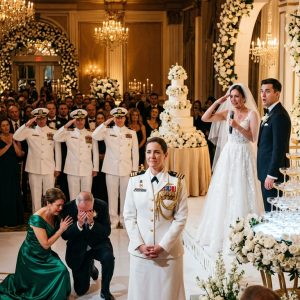
The Echoes of a Shattered Glass
Chapter 1: The Anatomy of an Explosion
A sharp, crystalline crash echoed through the banquet hall, instantly silencing the dull roar of a hundred conversations.
Time seemed to fracture alongside the shattered wine glass. Dozens of heads swiveled in unison. A woman near the carving station let out a startled gasp. And less than twenty feet away from me, entirely paralyzed beside a table heavily laden with miniature cheesecakes and sweating shrimp cocktails, stood Melissa Grant. My former best friend. The very woman who had hijacked my fiancé on the eve of my wedding.
A spreading pool of dark red vintage soaked into the garish geometric patterns of the carpet. Nobody moved. Nobody dared to breathe. And for the most bizarre, fleeting second, a genuine laugh bubbled in the back of my throat. I didn’t want to laugh because the situation was humorous. It was because, seven excruciating years earlier, I would have surrendered my very soul to witness Melissa lose her meticulously curated composure in a public arena.
Back in those days, I was the one whose hands trembled uncontrollably. I was the one dropping coffee mugs and car keys. I was the woman whose entire universe had been detonated overnight, leaving nothing but smoking craters where my future was supposed to be.
But I am getting ahead of the narrative. To understand the sweet, poetic justice of a spilled Cabernet in a Springfield, Missouri ballroom, you first have to understand how I ended up staring down a ghost from my past. Because seven years ago, I was absolutely certain my life had reached its terminal point.
In the crisp, golden September of 2018, I had just crossed the threshold of forty, and I was finally preparing to walk down the aisle. This wasn’t the fiery, reckless passion of youth. This was engineered to be the pragmatic, sensible union. The mature marriage. The specific brand of commitment that only looks appealing after you’ve survived enough romantic wreckage to prioritize emotional stability over butterflies.
I had been attached to Ryan Mercer for nearly four years. He was the charismatic sales manager at a sprawling Ford dealership on the town’s northern edge. Everyone adored Ryan. He possessed that terrifying, magnetic charm: he never forgot a first name, he gripped your hand with calloused sincerity, and he possessed an uncanny ability to make absolute strangers feel like cherished confidants within five minutes of meeting them.
With the cruel clarity of hindsight, I now recognize that his charm was the core of the rot. Men constructed like Ryan are emotional chameleons; they know precisely what melody your heart wants to hear, and they sing it with pitch-perfect deception. But back then, blinded by the comfort of routine, I believed I had secured my forever person.
The historic downtown church was secured with a non-refundable deposit. The reception hall’s exorbitant fees were cleared. My ivory silk gown hung like a phantom in the guest room closet, encased in protective plastic. My fiercely loyal Aunt Linda had already navigated the four-hour drive down from Wichita, and my cousin Denise had touched down from Dallas. The stage was immaculately set.
The afternoon prior to the ceremony, Melissa arrived at my house to assist with the agonizing task of alphabetizing place cards. She and I possessed a bond forged in the crucible of middle school. We had navigated the treacherous waters of terrible haircuts, toxic boyfriends, and catastrophic life choices together. Or, at least, that was the grand illusion I operated under. We sat at my battered mahogany dining table, mindlessly consuming greasy lo mein from Chinese Kitchen, sorting cardstock.
Ryan swung by briefly after his shift. He pressed a warm, seemingly affectionate kiss to my forehead, muttered a practiced joke about the bankrupting nature of the wedding industrial complex, and vanished into the evening. Not a single alarm bell rang. The atmosphere was completely devoid of static. If a time traveler had appeared in my kitchen right then to warn me that I was experiencing the final, peaceful moments of my existence, I would have dismissed them as a lunatic.
Dawn broke on my wedding day painting the sky in strokes of bruised purple and fragile pink. I vividly recall brewing a pot of dark roast, standing barefoot on the cold linoleum, staring out the kitchen window. I felt the standard cocktail of emotions: a flutter of nerves, a profound wave of gratitude, and the eager anticipation society dictates a bride must feel.
By eight in the morning, Ryan’s digital silence was noticeable. He hadn’t replied to my playful texts. By nine, my calls were routed straight to his sterile voicemail. By ten o’clock, a cold, metallic dread began to spool in the pit of my stomach.
The ceremony was slated for two in the afternoon. Early guests were already milling about the church vestibule. My bridesmaids were wrestling with hairspray and bobby pins. The frantic florist was arguing with the coordinator over the placement of hydrangeas. And the groom was a ghost.
At exactly 11:37 AM, my phone violently vibrated against the marble countertop. A single text message materialized on the illuminated screen.
I’m sorry. I can’t do this.
That was the entirety of his farewell. No tearful phone call. No agonizing, face-to-face explanation. Four years of shared holidays, whispered secrets, and intertwined finances, aggressively severed by a cowardly sequence of seven words.
Initially, my brain rejected the data. He’s just spiraling, I reasoned frantically. Cold feet are a cliché for a reason. He’ll turn his truck around.
Then, the kitchen door swung open, and Cousin Denise stepped into the harsh overhead light. The blood had entirely abandoned her face, leaving her looking like a marble statue. With a trembling hand, she extended her phone toward me. It was a photograph, freshly uploaded to Facebook.
It featured Ryan and Melissa, standing uncomfortably close by the pumps of a desolate gas station on the outskirts of the county limit. A mutual acquaintance had snapped it thirty minutes prior.
Memory fragmentation is a documented symptom of severe emotional trauma. It doesn’t file your experiences into neat, chronological folders; it violently scatters them like papers in a hurricane. I remember the hollow clatter of my phone hitting the floor tiles. I remember Aunt Linda’s sudden, jagged sobbing. I vaguely recall an anonymous voice asking if someone needed to contact the pastor. I remember finding myself seated on the floor, staring blankly at the baseboards.
But the most barbaric element of a shattered life—the part the movies conveniently omit—is the unrelenting bureaucracy of a canceled wedding. Even as your heart violently hemorrhages, the administrative machinery demands attention. Deposits remain mercilessly unyielding.
I sacrificed the next six hours of what was supposed to be the happiest day of my life chained to my phone. I dialed guest after guest, mechanically reciting the exact same humiliating script. No, the date hasn’t been moved. No, Ryan isn’t in the hospital. No, nothing is remotely okay.
The interaction with the bakery owner remains seared into my brain. When I pleaded for even a partial refund for the massive, five-tier confection, she flatly refused. “Well,” she chirped with staggering callousness, “my teenage daughter gets a massive free cake out of the deal, so I guess somebody walks away a winner.”
I stared at the receiver in my hand. And then, a harsh, jagged laugh tore its way out of my throat. If I hadn’t laughed in that precise moment, I would have undoubtedly shattered every window in my house. For years following that day, the mere mention of buttercream frosting caused my jaw to clench. The human brain is a bizarre architect, permanently linking the mundane with absolute devastation.
The months that trailed the explosion weren’t characterized by cinematic drama. They were far worse. They were brutally, suffocatingly ordinary.
I became intimately acquainted with a brown corduroy couch in a therapist’s office every Thursday at 4 PM. I was forced to list my beloved house on the market because a single income couldn’t sustain the mortgage. I packed my fractured life into cardboard boxes and retreated to a cramped, second-floor apartment. I developed the paranoid habits of a fugitive, mapping out the grocery stores, coffee shops, and restaurants Ryan and Melissa frequented, ensuring our paths never crossed.
Springfield is a sprawling town, but it functions like a claustrophobic village. Avoiding your demons requires a tactical genius, but I adapted.
Survival is stubborn. Slowly, the gears of my life began grinding forward. Not because I possessed an overwhelming desire to persevere, but simply because time refuses to halt. I channeled my obsessive need for control into launching Whitaker Events. I started small—organizing modest retirement banquets, intimate anniversary dinners, and sterile corporate luncheons. It was grueling, unglamorous labor, but it kept the electricity on. Eventually, the trickle of clients became a steady stream. I hired a small staff. I built a foundation that was solid, reliable, and deeply honest.
Seven years dissolved into the ether. And then, on a mundane Tuesday afternoon, a thick, cream-colored envelope arrived in my mailbox.
Springfield High School Class of 1995 Reunion.
30 Years.
Holiday Inn Conference Center.
I stared at the embossed lettering, feeling a phantom ache in my chest. With a flick of my wrist, I tossed it directly into the kitchen trash can.
But as the evening shadows lengthened, an insidious question began gnawing at my resolve. Are you still running, Dana? Are you seriously allowing Ryan and Melissa to dictate the geographical boundaries of your existence seven years later?
That thought incensed me far more than the prospect of enduring a terrible party. I marched back to the bin, retrieved the slightly crumpled envelope, and purchased a ticket online.
For the next four weeks, I marinated in a stew of profound regret.
Now, as the humid September evening wrapped around my car in the hotel parking lot, my knuckles were bone-white as I gripped the steering wheel. I sat in the suffocating silence for fifteen minutes, watching laughing groups of alumni stroll past my windshield. I adjusted my rearview mirror, staring deeply into my own tired but resilient eyes.
“Get a grip, Dana,” I whispered into the empty vehicle. “You are not that broken forty-year-old woman anymore. You survived the fire.”
With a ragged exhale, I killed the engine, pushed the door open, and marched toward the glowing entrance of the hotel. Little did I know, the night was a loaded gun, and destiny was waiting patiently behind those double doors to finally pull the trigger.
Chapter 2: The Lion’s Den
The Holiday Inn banquet hall possessed an olfactory signature that had remained entirely unchanged since the late nineties: a potent, slightly depressing blend of stale roasted coffee, industrial-grade carpet cleaner, and an aggressive floral air freshener desperately attempting to mask the scent of thousands of previous mediocre conventions.
I lingered near the threshold, my fingers nervously tracing the edges of the flimsy plastic name tag pinned to my blazer. It read Dana Whitaker, an entirely redundant accessory considering I was surrounded by faces I had memorized during algebra class at age fourteen.
The initial twenty minutes were a masterclass in superficial survival. Several old classmates rushed over, wrapping me in nostalgic embraces. We engaged in the standard, carefully choreographed reunion waltz. How are your parents? Are you still living on the east side? What line of work are you in? They were perfectly sanitized conversations, expertly engineered to tiptoe around the massive, elephant-sized betrayals of the past.
For a brief, naive moment, I allowed myself to relax.
“Well, if it isn’t the woman of the hour.”
I pivoted to find Cheryl Benson navigating through the sea of tables. During our senior year, Cheryl had essentially run the school’s gossip syndicate under the guise of the yearbook committee. Some character traits are impervious to time. She pulled me into a fierce hug, then stepped back, her sharp eyes conducting a thorough visual inspection of my tailored suit.
“You look fiercely good, Dana. Seriously.”
“And you remain a terrible liar, Cheryl,” I deflected with a warm chuckle.
She offered a sly grin. “I learned to lie from the very best.”
We fell into a comfortable rhythm, mocking our atrocious senior portraits displayed on a memorial board near the stage. I laughed loudly at a recounted story about a chemistry experiment gone wrong in 1994. Maybe, I thought, taking a sip of heavily iced water, maybe I had manifested a panic attack over nothing. Maybe the cowards wouldn’t even show their faces.
Then, the heavy brass handles of the main ballroom doors depressed, swinging inward.
The shift in the room’s atmospheric pressure was palpable. Even after a seven-year hiatus, my nervous system recognized their silhouettes instantly. Ryan Mercer and Melissa Grant strolled into the glowing light, walking shoulder-to-shoulder. They were the flawless embodiment of a couple who weaponized their social media presence, broadcasting curated joy to mask domestic misery.
Melissa was draped in a clinging, cream-colored silk gown that likely cost more than the down payment on my first automobile. Ryan was sporting a tailored, navy sports jacket that screamed aggressive success. They didn’t just walk into the room; they presented themselves to it, radiating the toxic confidence of people who fundamentally believed they were the main characters of everyone else’s lives.
They were instantly swarmed. Ryan aggressively pumped hands; Melissa deployed her signature double-cheek kisses. I desperately shifted my gaze toward the ceiling, praying for invisibility.
But predators have excellent vision. Melissa’s eyes swept the room and locked directly onto mine.
I watched her meticulously painted smile freeze. It was a microscopic glitch in her programming—barely half a second—before the smile rebooted, stretching even wider, practically blinding in its forced enthusiasm.
She’s terrified, a small, vicious voice whispered in my mind. Good.
“Dana.”
The voice slid down my spine like a droplet of ice water. I heard Ryan before I saw him. It is a terrifying phenomenon how a specific vocal timbre can violently yank you backward through a wormhole of time. I slowly turned. He was standing three feet away, flashing the exact same crooked, boyish grin that used to make me feel invincible. Tonight, it just looked predatory and exhausting.
“Ryan,” I replied, my voice remarkably steady. “It’s been a while.”
“Seven years,” he noted, sliding his hands into his expensive pockets. “I guess it has.”
A suffocating silence descended upon our little triangle of space. I wasn’t quiet because my mind was blank. I was quiet because I had a thousand razor-sharp retorts ready to deploy, but I utterly refused to grant him the satisfaction of my emotional labor.
Like a shark smelling blood in the water, Melissa suddenly materialized at his flank. Her suffocating, heavy floral perfume assaulted my senses a full second before she spoke.
“Dana!” she gasped, placing a manicured hand over her chest.
“Melissa.”
Another brutal stretch of silence.
Then, Melissa unleashed a radiant, artificial beam. “Oh my absolute goodness, it feels like it has been an eternity!”
Her tone was shockingly casual, as if we had serendipitously bumped carts in the produce aisle of a supermarket, rather than the reality that she had systematically dismantled my life and stolen the man I was going to marry. The sheer audacity of her commitment to the delusion was almost awe-inspiring.
I prayed the interaction would die a natural death there. It did not. Ryan anchored his feet, and Melissa mirrored him. Before I could engineer an escape route, several other alumni drifted into our orbit, completely oblivious to the fact that they were wading into an active minefield.
For five minutes, a tense civility reigned. Then, Melissa began to perform.
She didn’t engage in conversation; she delivered a monologue. She spun elaborate, dizzying tales about their winter escape to Cabo San Lucas. She loudly complained about the exhausting logistics of fully remodeling their sprawling lakehouse. She named-dropped luxury cruise lines and exclusive golf clubs. Every single anecdote she shared was a thinly veiled flex, aggressively circling back to their immense wealth and staggering social elevation.
At one point, she let out a theatrical sigh, adjusting a heavy diamond bracelet on her wrist. “Honestly, we’ve been traveling so relentlessly lately, I barely know what time zone my own body is in.”
That single, arrogant sentence probably exceeded my annual grocery budget.
A kind-hearted woman named Karen, sensing the suffocating tension, desperately attempted to pivot the spotlight. “What about you, Dana? How is your career progressing?”
I offered Karen a genuine smile of gratitude. “My business is thriving, actually.”
“Oh? What is it you do now?”
“I’m the founder and owner of an event planning firm.”
Karen beamed. “Dana, that is fantastic! Being an entrepreneur is incredible.”
Before I could accept the compliment, Ryan forcefully inserted himself into the dialogue. “Small business ownership is a vicious grind these days,” he declared, his voice dripping with faux-sympathy.
It wasn’t an overt insult, which made the venom so much deadlier. It was weaponized concern. The specific, calculated tone people employ when they want to publicly diminish your achievements while appearing supportive.
I tightened my jaw, maintaining a polite facade. “It certainly has its demanding moments.”
Ryan slowly nodded, looking down at me with profound condescension. “Well, I am just genuinely glad to see you’re doing okay.”
The patronizing emphasis he placed on the word okay sparked a dangerous fire in my chest. He was treating my survival like a meager consolation prize. He was patting me on the head for simply not expiring in the gutter.
I couldn’t breathe. I murmured a hasty excuse about needing to refill my glass and practically fled toward the refreshment tables at the far end of the hall.
When I reached the safety of the linen-draped tables, I noticed my hands were violently shaking. A profound wave of self-loathing washed over me. I despise this, I thought frantically. I despise that after thousands of days of healing, his mere presence can still reduce me to a trembling wreck.
“Breathe, Dana,” I commanded myself in a fierce, barely audible whisper. It was the same mantra I had utilized on the therapist’s couch. It was the same command I had given myself in the parking lot.
When I finally managed to stabilize my heart rate and turned around, my blood ran instantly cold.
Ryan was standing there. Alone.
The predatory glint in his eyes was unmistakable. Have you ever stood outside before a massive thunderstorm, sensing the catastrophic drop in barometric pressure before the first drop of rain falls? That was the exact sensation radiating from him.
He lazily picked up a crystal tumbler from the table, took a slow sip of bourbon, surveyed the surrounding crowd to ensure we had an audience, and then locked his gaze onto me.
“You know,” he murmured, his voice projected just loudly enough for the surrounding clusters of people to hear. “I spent a long time wondering how things would have ultimately played out between us.”
I refused to give him a reaction. I stared at him, my expression carved from stone.
“I mean, looking at us now, obviously, the universe ensured everything worked out for the absolute best.”
The storm had officially made landfall.
“I suppose that is one highly specific way to interpret history,” I replied, my voice icy.
Ryan let out a sharp, barking laugh. He leaned into my personal space. “Honestly, Dana?”
I braced my feet. I knew, with absolute certainty, that a killing blow was coming.
“Leaving you,” he stated, enunciating each syllable with brutal precision, “was the most brilliant decision I have ever made in my entire life.”
The ambient noise in the ballroom evaporated.
A suffocating, heavy silence rippled outward from our position, infecting the surrounding guests like a virus. A man mid-laugh snapped his mouth shut. A woman dropped her gaze to the floor. Someone a few feet away muttered a shocked, “Oh, wow.”
Nobody chuckled. Nobody nodded in agreement. But crucially, not a single person stepped forward to defend me. And in that terrifying void, their silence felt like complicity.
Ryan smirked, his chest puffing out slightly. He looked immensely satisfied, like an actor who had flawlessly delivered a monologue he had been obsessively rehearsing in the mirror for seven years.
For a horrifying second, my hard-won armor shattered. I was violently ripped back in time. I was back on the kitchen linoleum. I was back staring at the glowing pixels of that text message. I was back drowning in the agonizing question of why my love hadn’t been sufficient. Seven grueling years of emotional reconstruction, and with one expertly crafted sentence, he had slid a knife directly into the old scar tissue.
I glanced past his shoulder. Melissa was standing a few yards away. She wasn’t attempting to intervene. She didn’t look mortified. She was simply watching, her eyes completely devoid of empathy.
That visual was the catalyst. It snapped me back to reality. They haven’t evolved, I realized with sudden, crystalline clarity. They simply accumulated more expensive clothes.
I drew a long, slow breath, forcing the trembling in my hands to cease. I painted a tiny, razor-thin smile across my lips.
“Well, Ryan,” I said, my voice cutting through the dead silence of the room. “I am genuinely thrilled that at least one of us walked away with exactly what they deserved.”
Ryan blinked, thrown off balance. He had undoubtedly prepared for hysterics. He expected me to scream, to throw a drink, to flee the room in a torrent of humiliated tears.
Instead, I calmly picked up my water glass, executed a flawless turn, and began walking toward the opposite end of the ballroom. My heart was a frantic drumbeat against my ribs, and my skin was ice-cold. As I walked, the urge to sprint out the emergency exit was overwhelming. I had played my part. The night was a disaster. I needed to escape.
But as I neared the exit, a heavy, metallic clanking echoed through the hall.
The main ballroom doors were thrown wide open.
And the man standing in the threshold was about to alter the trajectory of the entire evening.
Chapter 3: The Unforeseen Cavalry
A few people near the entrance glanced up, mildly annoyed by the interruption. Then, a few more turned their heads. Within seconds, the collective attention of the entire room abandoned the lingering tension of my confrontation and violently snapped toward the doorway.
A man had just breached the perimeter of the banquet hall. Trotting enthusiastically beside him, clutching his hand, was a tiny, energetic little boy.
And without a moment’s hesitation, the two of them locked onto my location and began marching directly toward me.
The immediate murmurs of recognition rippling through the crowd confirmed his identity. It was Ethan Brooks.
Ethan’s presence in this specific room was an anomaly. Springfield isn’t a metropolis teeming with celebrities, but within the regional business ecosystem of Southwest Missouri, Ethan was a recognized titan. He was the architect of a highly lucrative logistics empire, a man whose name commanded respect in boardrooms across the state.
Back in our high school days, Ethan had been the definition of invisible. He was a painfully introverted kid who inhabited the back corners of the classroom, quietly accumulating flawless grades while aggressively avoiding the social crossfire. If you had polled the graduating class of 1995 to predict our most astronomically successful peer, Ethan’s name wouldn’t have cracked the top twenty.
Life possesses a wicked sense of irony when it comes to rewriting expectations.
He was undeniably older now. The passage of time was evident in the distinguished silver dusting his temples and the slight recession of his hairline. Yet, he carried his frame with a devastatingly quiet authority. He didn’t strut. He didn’t wear flashy designer logos. He moved with the grounded, unshakeable comfort of a man who had entirely stopped caring about the opinions of the room.
Anchored to his right hand was Noah. Four years old, with a mop of unruly brown hair, vibrant blue sneakers equipped with light-up soles, and a miniature Springfield Cardinals baseball cap shoved haphazardly onto his head.
The absolute second Noah’s eyes found my face in the sea of strangers, his features erupted into a grin of pure, unadulterated joy. Before Ethan could tighten his grip, the boy violently yanked his hand free.
The entire ballroom held its collective breath.
Noah broke into a frantic sprint across the patterned carpet, heading straight for my legs. I barely managed to drop to my knees before a forty-pound missile of affection launched itself directly into my chest.
And then came the single word that nobody in that gossipy, judgmental room—including myself—was remotely prepared to process.
“Mama!”
The word detonated in the heavy silence, echoing off the acoustic tiles with the force of a gunshot. It was loud, joyous, and fiercely possessive.
Noah locked his small arms around my neck, burying his face in my shoulder. “Mama, we found you!”
A synchronized wave of audible gasps swept through the alumni. I explicitly heard Karen whisper to her husband, “Wait… did that child just call her Mama?”
And precisely at that exact moment of maximum psychological tension, a sharp, crystalline crash echoed through the banquet hall.
I slowly lifted my chin from Noah’s shoulder.
Melissa stood frozen beside the cocktail table. The stem of a wine glass had slipped completely through her manicured fingers. A spreading pool of dark red vintage soaked into the garish geometric patterns of the carpet. Her jaw was literally hanging slack. For the first time in the seven years since she had destroyed my reality, the mask had completely shattered. She didn’t look arrogant. She didn’t look superior.
She looked absolutely, profoundly horrified.
Standing a few feet to her left, Ryan’s expression was a masterpiece of cognitive dissonance. The smug victor of five minutes ago had been replaced by a man struggling to comprehend complex math. But his confusion rapidly mutated into something far more satisfying: raw, unfiltered anxiety.
I tightened my embrace around Noah, fighting back a surge of fierce, protective tears. “Hey, my sweet boy. You actually came.”
He nodded against my collarbone with frantic enthusiasm. “Ethan promised there would be chocolate cake!”
I let out a genuine, wet laugh. “Of course he did. Your priorities are flawless.”
Ethan finally closed the distance, coming to a halt beside us. He slid a warm, grounding hand onto my shoulder. “I deeply apologize for the dramatic entrance. The babysitter had a family emergency, and this one,” he gestured to Noah, “refused to accept a night without you.”
“Don’t you dare apologize,” I murmured, looking up into his steady, intelligent eyes.
Ethan offered a slow, knowing smile. “I’m not. Not really.”
A ripple of nervous, appreciative laughter moved through the immediate circle of classmates. The suffocating toxicity Ryan had injected into the room was suddenly diluted by the chaotic innocence of a child.
The paralysis broke, and human curiosity took over. People began cautiously stepping closer, their eyes burning with questions. Small towns thrive on assumptions, and my carefully constructed narrative as the ‘tragic, abandoned spinster’ had just been nuked from orbit.
Karen was the first to breach the perimeter. “Dana, my goodness! Who is this incredibly handsome little man?”
Before I could formulate an introduction, Noah proudly puffed out his chest. “I am Noah Brooks!” he announced, as if issuing a royal decree.
Karen laughed, charmed despite the confusion. “It is an absolute honor to meet you, Noah.” She shifted her gaze upward, and the realization finally hit her face. “Wait… Ethan? Ethan Brooks?”
Ethan offered a polite, deferential nod. “Guilty as charged, Karen.”
That single confirmation was the match in the powder keg. Within sixty seconds, the whispered realization of Ethan’s identity—and his staggering net worth—had infected the entire ballroom.
I glanced past the growing crowd. Ryan and Melissa remained rooted to their spot by the spilled wine. Neither of them had moved a muscle. They looked like statues caught in the blast radius of a bomb.
Good, I thought, a dark thrill warming my blood.
Ethan leaned down, his voice dropping to an intimate frequency meant only for me. “The atmosphere in here is thick. Did we interrupt a firing squad?”
“Not a successful one,” I replied softly.
“Are you absolutely certain?” Ethan’s gaze drifted over my head, locking directly onto Ryan. His eyes narrowed imperceptibly. He didn’t know the exhaustive, agonizing details of the betrayal. He didn’t know about the canceled florist or the cruel baker. But he knew enough. He knew why the mere mention of Ryan Mercer’s name made my jaw clench in my sleep.
There is a pervasive, irritating narrative in society that a broken woman over forty requires a wealthy knight in shining armor to swoop in and rescue her from obscurity. Let me be unequivocally clear: Ethan did not rescue me. By the time he walked into my orbit, my rescue mission had already been completed by my own two hands.
What Ethan offered wasn’t salvation; it was sanctuary. He offered a profound, unshakeable partnership built on mutual respect—a concept I had entirely discarded as a fairy tale.
Our paths had violently collided three years prior during a sprawling, high-stakes corporate summit in Branson, Missouri. My event firm had secured the massive contract, and I was running on three hours of sleep, critically understaffed, and convinced the entire weekend was on the verge of catastrophic failure. Ethan was booked as the primary keynote speaker.
In my frantic rush between conference halls, I collided with him, upending a massive cup of scalding black coffee directly onto his pristine stack of presentation dossiers. It was a nightmare scenario. I braced myself for the inevitable corporate rage.
Instead of shouting, Ethan simply pulled a handkerchief from his pocket and began blotting the paper. “Well,” he had mused calmly, “I suppose the audience won’t be able to read my notes now. They’ll actually have to listen to me.”
He then spent the next half-hour physically helping my exhausted crew move heavy banquet tables. It was a revelation. Powerful men do not perform manual labor to help the hired help.
The definitive turning point, however, occurred a year later. A brutal, freak winter ice storm paralyzed Springfield, knocking out the power grid for three days. My apartment complex lost its heating system. I casually mentioned the freezing temperatures during a brief phone call regarding a future event.
At 6 AM the following morning, I opened my door to find Ethan Brooks standing in the freezing corridor. He was holding two high-powered industrial space heaters, a massive generator, and enough non-perishable groceries to sustain a bunker. He didn’t make a grand, romantic speech. He didn’t ask to come in for coffee. He simply ensured I was safe, and then he left.
The older you get, the more you realize that consistent, boring reliability is the most romantic trait a human being can possess.
And then, there was Noah. Noah’s biological mother had passed away in a horrific traffic collision two years before I met them. I never prodded for the traumatic details, and Ethan rarely volunteered them. Grief demands its own sovereign territory, and I respected the boundaries.
But as Ethan and I grew closer, Noah slowly integrated into the fabric of my life. Sunday morning pancake rituals. Frantic trips to the local zoo. Movie nights built around animated dragons. They were microscopic, seemingly insignificant moments that quietly compounded into an unbreakable bond.
The pivotal moment had arrived eight months ago. While coloring at my kitchen island, Noah had casually looked up and called me ‘Mama’.
I immediately froze, my heart breaking for him. I knelt down to his eye level. “Oh, honey,” I whispered gently. “I love you very much, but I’m not your Mama.”
Noah looked at me with that piercing, terrifyingly logical clarity that only toddlers possess. “I know that.”
“Then why did you call me Mama?”
He shrugged his small shoulders. “Because you are my other Mama.” He then returned to aggressively coloring a purple dinosaur, entirely unbothered by the emotional earthquake he had just triggered.
We never corrected him again. Not because Ethan forced the issue, but because a child’s heart knows precisely what it requires to heal.
And now, this incredible little boy was sitting on the carpet of a depressing hotel ballroom, happily devouring a chocolate brownie, entirely oblivious to the fact that his mere existence had just initiated the psychological destruction of my greatest enemies.
I looked up. Ryan was aggressively whispering something to Melissa. The polished veneer was cracking. They were no longer the authors of the narrative.
And just as I prepared to finally enjoy my evening, Cheryl Benson stepped out of the crowd, her face set in a grim, determined mask. The secrets were about to spill.
Chapter 4: The Anatomy of a Betrayal
If you have never endured the specific psychological warfare of a small-town high school reunion, you must understand a fundamental law of physics regarding these events: Nobody ever truly stops observing.
They feign distraction. They clink glasses. They laugh too loudly at mediocre jokes. But beneath the surface chatter, an invisible radar network is constantly sweeping the room. And the moment the power dynamic violently shifted with Ethan’s arrival, every single antenna in the hall zeroed in on Ryan Mercer.
For the first time in the seven years since his grand betrayal, Ryan looked genuinely terrified. He wasn’t just embarrassed; he was experiencing the sickening vertigo of a man realizing the solid ground beneath his feet is actually a trapdoor.
I watched as Cheryl Benson moved with lethal purpose toward the makeshift bar where Ryan had retreated. She leaned in close, her posture rigid, and whispered something directly into his ear. I saw Ryan’s jaw clench. He snapped a harsh response. Cheryl didn’t flinch. She delivered one final sentence, and Ryan’s face drained of all remaining color.
Human beings are feral creatures when it comes to scandal. Curiosity is a contagion far more potent than loyalty. People began casually inching closer to the bar.
I was currently negotiating with Noah over the acceptable ratio of cookies to vegetables for tomorrow’s dinner when Cheryl broke away from Ryan and marched directly toward our table. She stopped, glancing nervously at Ethan, then back to me.
“Are you holding up okay?” she asked, her voice tight with unreleased tension.
I offered a serene smile. “Considerably better than I anticipated, honestly.”
Cheryl nodded slowly. There was a dangerous, heavily burdened gravity in her eyes. It was the look of a woman who had carried a toxic secret for entirely too long and had finally reached her breaking point.
“Listen to me, Dana,” she began, her voice dropping to a conspiratorial hush. “There is something I need to tell you. Something I have never breathed a word of to another living soul.”
The playful atmosphere immediately evaporated. Ethan, sensing the impending detonation, smoothly scooped Noah up. “Hey, buddy,” he said cheerfully. “I saw a table in the back with crayons and paper. Let’s go draw a masterpiece, alright?” He offered me a reassuring nod and whisked the boy away, establishing a perimeter of privacy.
Cheryl crossed her arms tightly across her chest, a defensive barrier against the truth she was about to unleash. “You remember that I worked in the finance department at Grant Motors for a few years, right?”
Grant Motors. Melissa’s father’s sprawling empire of automotive dealerships. It was common knowledge. “I remember. What does that have to do with anything?”
She took a ragged breath, staring at the floor before forcing herself to meet my gaze. “I knew what was happening with Ryan long before the wedding blew up.”
A cold, heavy sensation settled over my ribs. It wasn’t the searing pain of fresh heartbreak; it was the eerie, clinical anticipation of an archeologist finally unearthing the missing piece of a cursed puzzle. For seven years, the mechanics of their affair had been a black box. I knew the outcome, but the timeline was a ghost.
“I kept my mouth shut back then,” Cheryl confessed, her voice thick with shame. “Because… honestly, Dana, I was a coward. And I didn’t think you could survive hearing it.”
I absorbed the blow without flinching. She was entirely correct. Seven years ago, the truth would have pushed me over the psychological edge. “I appreciate the honesty now,” I said calmly. “Tell me exactly what you mean.”
Cheryl glanced over her shoulder. Ryan was staring daggers at her from across the room, but he was pinned in place by the surrounding crowd. He was trapped.
“Everyone assumes Ryan and Melissa had this sudden, overwhelming moment of forbidden passion right before the wedding,” Cheryl said, her tone dripping with disgust. “That isn’t what happened.”
“Then what did?”
“They had been sleeping together for eight months.”
I felt the air violently evacuate my lungs.
Eight months. It wasn’t a moment of drunken weakness. It wasn’t cold feet. It was a calculated, sustained campaign of deception. While I was agonizing over floral arrangements, while Melissa was holding my hand during dress fittings, while Ryan was kissing me goodnight… they were actively making a mockery of my existence.
“Are you absolutely certain of this timeline?” I whispered, my voice trembling with suppressed rage.
Cheryl let out a harsh, bitter bark of a laugh. “Unfortunately, yes. I processed the expense reports. The mysterious hotel charges on his company card when he supposedly had ‘regional sales conferences.’ But Dana… that isn’t even the sickest part.”
She stepped an inch closer. “This grand romance of theirs? It was never actually about Melissa.”
I stared at her, my mind stalling. “I don’t understand.”
“It was about her father’s empire,” Cheryl stated, laying the ugly truth bare on the table. “Ryan was obsessed with the dealerships. I heard him talking in the breakroom. He wanted equity. He wanted a fast track to the executive board. He didn’t want to spend twenty years grinding as a regional manager.”
The final puzzle piece snapped into place with a sickening thud.
The motivation wasn’t an epic, tragic love story that swept them away. It was a hostile corporate takeover disguised as romance. Ryan hadn’t abandoned me because I was fundamentally flawed, or unlovable, or insufficient.
He abandoned me because Melissa represented a financial shortcut. He traded a loyal partner for a lucrative portfolio.
The sheer, banal ugliness of it all was staggering. And yet, beneath the revulsion, a profound sense of liberation washed over me. The agonizing question of ‘Why wasn’t I enough?’ that had haunted my therapy sessions finally evaporated. I was always enough. He was just greedy.
“That is an absolute fabrication!”
Ryan’s voice cracked like a whip. He had finally abandoned the bar and stormed across the room, unable to endure the slow execution of his reputation. The surrounding crowd practically vibrated with anticipation. The circle tightened around us. We were the main event.
Ryan tried to paste on his trademark charismatic smirk, but his eyes were wild with panic. “Come on, Cheryl. You’re seriously going to stand here and invent corporate espionage stories because you’re bitter you got fired?”
Cheryl stood her ground, her spine rigid steel. “I wasn’t fired, Ryan. I resigned because I couldn’t stomach working for a sociopath.”
The venom in her voice was lethal. Truth is a terrifying weapon; it doesn’t require shouting to cause damage.
Before Ryan could launch a counter-offensive, a deep, calm voice echoed from the edge of the circle.
“Actually, I think we’d all love to hear the rest of the financial analysis.”
It was Ethan. He had returned, slipping seamlessly into the fray. The crowd parted for him instinctively.
Ryan’s panicked eyes locked onto the new threat. He desperately attempted to pivot, to leverage his aggressive salesman charm against a superior predator. “Ethan,” he said, thrusting his hand forward in a painfully forced gesture of camaraderie. “Good to see you, man. I hear the logistics business is booming.”
Ethan looked at the extended hand for a long, agonizing three seconds before finally, reluctantly, taking it. It was the most brutally dismissive handshake I had ever witnessed.
“It is highly profitable, yes,” Ethan replied smoothly.
Ryan swallowed hard, desperate to reclaim the alpha position. “Well, that’s great. I guess not everyone gets lucky in this economy.”
It was a pathetic, transparent attempt to attribute Ethan’s massive success to mere chance, elevating his own supposed ‘hard work’.
Ethan didn’t blink. He tilted his head slightly, studying Ryan as if inspecting a defective piece of machinery. “You know, Mercer,” Ethan drawled, his voice carrying clearly over the dead-silent room. “I should have recognized you immediately.”
Ryan puffed out his chest. “Oh yeah?”
“Yeah,” Ethan nodded thoughtfully. “Weren’t you the junior salesman at the Ford lot who desperately tried to unload a used F-150 with a blown transmission on me about ten years ago? The one you swore ran like a dream?”
The entire ballroom held its breath for a microsecond.
And then, the room detonated into uncontrollable laughter.
It wasn’t a polite chuckle. It was a roaring, devastating wave of communal mockery. Karen was practically weeping. Two guys near the back high-fived. The illusion of Ryan Mercer—the wealthy, sophisticated titan of industry—was violently stripped away, leaving only the image of a sleazy, dishonest used-car peddler.
Ryan’s face flushed a deep, violent crimson. “I… I have absolutely no memory of that.”
“I possess a flawless memory for people who attempt to defraud me,” Ethan replied, his tone chillingly pleasant.
The laughter surged again. It wasn’t cruel; it was simply the sound of a collective spell breaking. The audience was finally seeing the man behind the curtain. And once a fraud is exposed, he can never command the stage again.
Ryan looked frantically around the circle, desperately seeking a friendly face, an ally, a lifeline. He found nothing but judgment and amusement.
The time had come. I stepped forward, inserting myself between Ethan and Ryan. I didn’t have a rehearsed speech. I didn’t need one. After carrying the weight of his betrayal for seven years, the words were already carved into my bones.
“Ryan,” I said softly.
He whipped his head toward me, his eyes wide and cornered. For the first time in our history, he couldn’t look away. I commanded the space.
“For two thousand, five hundred and fifty-five days,” I began, my voice ringing out with crystal clarity, “I tortured myself. I convinced myself that you abandoned me on the eve of our wedding because I was fundamentally broken. I believed I simply wasn’t enough to hold your interest.”
Out of the corner of my eye, I saw Melissa flinch violently.
“But tonight,” I continued, staring directly into his hollow eyes, “I finally received the missing context. You didn’t leave me because you stumbled upon a superior, transcendent love.”
I paused, letting the silence amplify the incoming strike.
“You left me because you found a faster route to the bank.”
Nobody moved. Nobody breathed. The silence was absolute. There were no theatrics required. The naked, ugly truth was devastating enough on its own.
I took a final, liberating breath. I looked at Ryan, and then I shifted my gaze to Melissa, who was trembling like a leaf in a hurricane.
“I don’t harbor any hatred for either of you anymore,” I said, and to my profound shock, it was the absolute truth. The white-hot rage had entirely vanished.
Ryan blinked, his mouth opening and closing like a suffocating fish.
I offered them both a small, genuinely peaceful smile. “I just feel an overwhelming sense of pity for the miserable prison you’ve built for yourselves.”
I turned my back on them and walked toward Ethan. I felt physically lighter, as if a lead apron I had been forced to wear for a decade had suddenly unclasped and crashed to the floor. There was no screaming. There was no physical violence.
True vengeance, I realized in that brilliant moment, wasn’t about destroying your enemies. It was about rendering them completely and utterly irrelevant to your future.
Chapter 5: The Balcony Confession
The immediate aftermath of a public execution is surprisingly mundane. The music eventually swelled back up. The bartenders resumed pouring heavy-handed drinks. But the gravitational center of the reunion had irreparably shifted. Ryan and Melissa were now the infected patients of the party; people gave them a wide, uncomfortable berth.
Roughly twenty minutes later, I noticed Melissa slipping out a side door, navigating the dimly lit hallway that led toward the hotel’s rear terrace. She looked incredibly fragile, like a porcelain doll covered in hairline fractures.
An instinct I couldn’t entirely articulate compelled me to follow her. Perhaps it was a morbid desire for total closure. Perhaps it was the lingering ghost of a friendship that had died a violent death.
I pushed through the heavy glass doors and stepped out onto the second-floor balcony overlooking the sprawling asphalt parking lot. The oppressive humidity of the day had finally broken, replaced by a sharp, cool September breeze that signaled the death of summer. Inside, the muffled, thumping bass of nineties hip-hop vibrated against the glass. Out here, the only soundtrack was the distant, rhythmic hum of semi-trucks hurtling down Interstate 44.
Melissa was huddled near the far railing. Her arms were wrapped tightly around her torso, her shoulders hitched up defensively against the chill.
For a prolonged moment, I considered retreating back inside to the warmth of Ethan and Noah. Engaging her was a massive emotional risk. In my countless hours of therapy, I had drafted a hundred monologues directed at Melissa. In my fantasies, I eviscerated her with razor-sharp wit, leaving her weeping in a puddle of regret.
But reality is rarely that cinematic. The anger was gone, leaving only a hollow curiosity.
I stepped forward. My heels clicked softly against the concrete.
Melissa stiffened, turning her head slowly. The ambient light from the streetlamps illuminated the tear streaks cutting through her expensive foundation. We stood there, two women separated by five feet of space and a chasm of seven years of absolute silence.
She let out a long, ragged exhale, staring back out at the glowing red taillights on the highway.
“You looked incredibly happy in there with him,” she whispered.
I blinked, momentarily disarmed. Of all the defensive postures I expected her to adopt—anger, denial, viciousness—quiet resignation wasn’t on the list.
“I am,” I replied evenly. “More than I ever thought possible.”
She nodded slowly, a jerky, mechanical motion. “I can see that. It radiates off you.”
Her sincerity was deeply unsettling. It felt profoundly sad. We lapsed back into a heavy silence, listening to the wind rattle the dry leaves in the trees below.
Suddenly, a harsh, jagged laugh tore from Melissa’s throat. It was a terrible sound, devoid of any actual humor.
“Do you want to know what the absolute sickest part of this entire tragedy is, Dana?” she asked, turning to face me fully.
I didn’t respond. I simply waited.
“Every single person in our social circle… everyone in that godforsaken ballroom… they all look at me and assume I am the victor. They think I won the grand prize.”
I studied her. From a purely superficial standpoint, the world absolutely believed she had conquered life. She wore diamonds the size of grapes. She drove German sports cars. She broadcasted a lifestyle of relentless, sun-drenched luxury to an audience of thousands.
“I spent seven consecutive years treating my existence like a full-time public relations campaign,” Melissa confessed, her voice thick with exhaustion. “I had to aggressively curate every photo, every dinner party, every vacation. I had to prove to the world—and to myself—that stealing him was worth the collateral damage.”
“You were very convincing,” I noted quietly. “I monitored your Instagram for the first two years. I believed the fairy tale.”
“It was a spectacular illusion,” she agreed bitterly. She gripped the cold iron railing until her knuckles matched the white of her dress. “The first twelve months were a massive rush. It felt dangerous and exclusive. Maybe even the second year was okay. But after that…”
She stopped, swallowing hard against a rising sob.
“After that, the paranoia set in.”
I frowned, stepping slightly closer. “Paranoia about what?”
Melissa let out another hollow laugh. “I started obsessing over you.”
“Me? Why?”
She turned her tear-streaked face toward me, her eyes wide and haunted. “Because, Dana, every single time Ryan looked at his phone a little too long… every time he had a sudden ‘late meeting’ at the dealership… every time he snapped at me over a trivial argument… I remembered exactly how flawlessly he lied to you.”
The words hung in the frigid air between us, heavy and undeniable.
“He sat at your dining room table, ate takeout, kissed your forehead, and walked out the door knowing he was going to destroy your life twelve hours later,” she whispered, her voice trembling. “He didn’t even flinch. So, I lay awake in my custom-built mansion every single night, staring at the ceiling, asking myself a terrifying question.”
She wiped brutally at her cheek, smearing her mascara.
“If he was capable of doing that to a woman he supposedly loved for four years… what exactly is stopping him from doing it to me the second a better opportunity walks into his showroom?”
There it was. The horrific, poetic justice of the universe, delivered on a silver platter.
She wasn’t battling financial ruin or public disgrace. She was battling the unrelenting terror of sleeping next to a proven traitor. The foundation of her marriage was constructed entirely on a blueprint of betrayal, and she lived in constant, agonizing dread of the building collapsing on top of her.
Years ago, I would have savored this confession like a fine wine. I would have reveled in her psychological torment. But standing in the cold, staring at the broken shell of the girl who used to braid my hair in middle school, I felt no triumph. I just felt a profound, overwhelming sadness for the tragic waste of it all.
“We don’t even tolerate each other most days,” Melissa admitted, her defenses completely annihilated. “He’s still chasing his shortcuts, Dana. He’s still looking for the next upgrade. It’s just different targets now.”
The irony was suffocating. A sleek black sedan pulled into the parking lot below, its headlights sweeping across the concrete before cutting out.
Melissa looked at me. It was the first time in an hour she had truly looked at me, not past me, not attempting to assert dominance.
“I was always fiercely jealous of you,” she breathed, the confession slipping out like blood from a wound.
“What? Melissa, your family owned half the town. You had everything.”
“I had things,” she corrected sharply. “You had people. You were the girl everyone inherently trusted. You were effortlessly kind. You made everyone feel safe. I spent my entire youth aggressively trying to be impressive, trying to make people envy me.” She offered a heartbreaking, self-deprecating smile. “You just spent your life trying to be a decent human being.”
I had no words to offer. The magnitude of her self-awareness, arriving seven years too late, left me entirely speechless.
“I operated under the psychotic delusion that if I could steal the man you loved, I would somehow absorb your happiness. I thought Ryan was the trophy that proved I was finally better than you.” She shook her head, staring down at her diamond-encrusted fingers. “Turns out, human beings make terrible trophies.”
It was a devastatingly profound realization, the specific type of brutal wisdom a woman only acquires after the universe has repeatedly broken her heart. It isn’t learned in your twenties; it is beaten into you in your forties.
Slowly, Melissa pushed herself off the railing. She physically adjusted her posture, pulling the shattered pieces of her facade back into place. The moment of raw vulnerability was closing.
“I need to return to the ballroom,” she said, her voice flattening out, the PR manager reassuming control. “My husband is probably looking for me to maintain appearances.”
“Probably,” I agreed softly.
She took two steps toward the heavy glass doors, then paused. She didn’t turn around.
“Dana.”
“Yes?”
“I am so deeply, profoundly sorry.”
It wasn’t a magic spell. It didn’t resurrect my ruined wedding. It didn’t refund the thousands of dollars I lost, and it certainly didn’t erase the countless hours I spent weeping on a therapist’s couch. It was simply an honest, unvarnished apology. Late. Grossly incomplete. But undeniably real.
I stared at her back for a long moment. I let the final, lingering remnants of my anger dissolve into the night air. Carrying that toxic luggage had nearly broken my spine, and I refused to carry it a single step further.
“Take care of yourself out there, Melissa,” I said.
She offered a sad, invisible nod. “You too, Dana.”
She pulled the door open, the heavy bass of the music briefly spilling out into the night, and then she was gone, swallowed back into the glittering, miserable world she had chosen. That was the absolute last private exchange we would ever share.
Chapter 6: The Epilogue of Peace
Six months after the hotel ballroom incident, the brutal Missouri winter surrendered to a glorious spring. It was the specific type of miraculous Midwestern April that forces everyone to collectively forgive the agonizing, grey months that preceded it. The oak trees exploded into violent, vibrant greens, and the rhythmic, metallic ping of little league baseball bats echoed across every municipal park in the county.
On a flawlessly sunny Saturday afternoon, I found myself perched on a set of sun-warmed aluminum bleachers at a community complex on the eastern edge of the city.
Out on the diamond, Noah was ostensibly playing second base. In reality, he was deeply engaged in a complex, tactical mission to capture a bright yellow butterfly that kept drifting dangerously close to the outfield grass.
“Keep your eyes on the batter, buddy!” I yelled, cupping my hands around my mouth.
Noah briefly turned, offered me an enthusiastic thumbs-up, and immediately resumed stalking the butterfly.
Beside me, Ethan chuckled, taking a sip from a sweating paper cup of lemonade. “I’m assuming we shouldn’t start clearing space on the mantle for his MVP trophies just yet?”
“I wouldn’t hold my breath for a college athletic scholarship,” I agreed, leaning my head against his shoulder. “Though his dedication to entomology is quite impressive.”
We sat there in comfortable, deeply domestic silence, sharing a greasy foil-wrapped hotdog. There was absolutely nothing cinematic or glamorous about the moment. It was thoroughly, unapologetically ordinary.
And it was the most precious, vital experience of my entire life.
There was a time, trapped in that terrible apartment seven years ago, when I firmly believed that a quiet, ordinary life was a synonym for failure. I thought success had to be loud. Now, I understood the truth. Peace is the ultimate luxury.
A few weeks prior, during a quiet evening at home, Ethan had brought up the concept of marriage. There was no theatrical dropping to one knee at a crowded restaurant. There was no camera crew hidden in the bushes. We were simply loading the dishwasher, and he paused, looked at me, and asked if I would consider building a permanent life together.
We mutually agreed against a massive, stressful spectacle. One catastrophic wedding production in a single lifetime was my absolute limit. We were planning a microscopic ceremony. A handful of family members, our closest friends, and Noah standing as the fiercely proud ring bearer. No frantic florists. No five-tier cakes. Just an honest promise made in the daylight.
At one point during the third inning, Ethan casually reached across the aluminum bench and interlaced his fingers with mine. It wasn’t a desperate, clinging grip. It was a gentle, grounding squeeze. A silent, physical affirmation that whispered, I am firmly planted right here, and I am not going anywhere.
If you had asked the terrified, weeping forty-year-old version of Dana Whitaker how to define success, she would have pointed to the things Ryan and Melissa had spent the last decade desperately chasing: social validation, massive bank accounts, the flawless illusion of perfection.
But as the afternoon sun warmed my skin, and Noah’s laughter drifted across the dusty infield, I realized my definition had evolved. Success wasn’t about the absence of tragedy. Success was surviving the fire and using the ashes to cultivate a sanctuary.
The people who betrayed me had operated under the supreme delusion that they possessed the absolute power to dictate the final trajectory of my existence. And for a tragically long time, I had surrendered to that belief. I had mistakenly assumed my narrative terminated the moment Ryan sent that cowardly text message. I believed my defining characteristic would forever be the woman who was abandoned.
I was catastrophically wrong.
That devastation wasn’t the final period at the end of my book. It was merely the violent conclusion of a single, agonizing chapter.
If you are currently standing in the smoldering wreckage of a betrayal, if your heart has been shattered by someone you trusted implicitly, I need you to internalize a singular, unshakeable truth. The villains in your life do not retain the publishing rights to your future. They do not get to hold the pen that writes your final act.
That ultimate power belongs entirely to you.
And more often than not, the most breathtaking, triumphant chapters of your life are the ones you never possessed the imagination to predict.
Like and share this post if you find it interesting.