The Price of Blood: A Ledger of Illusions
Chapter 1: The Anatomy of a Sunk Cost
For exactly thirty-six agonizing months, I bled myself dry to keep my older brother’s ship from sinking.
It was never framed as a loan. It was never a bargaining chip I held over his head during family arguments. To me, it was simply the unspoken tax of unconditional love.
My brother, Mark, had spectacularly detonated his life in his late twenties. Following a messy divorce, he was left with primary custody of his two teenagers, Tyler and Madison, a sprawling suburban mortgage he had no business signing, and a toxic habit of treating me as his personal crisis hotline. The calls always came past midnight. I would be lying in the dark, the blue light of my phone illuminating my exhausted face, listening to the panic vibrate through his voice.
“Elena, I swear I don’t know how I’m going to keep the lights on,” he would hyperventilate into the receiver. “I can’t lose this house. The kids have already lost their mother’s presence. I can’t let them lose their bedrooms, too.”
I swallowed the bait every single time.
I was thirty-two years old, grinding out grueling seventy-hour weeks as a senior software consultant in Chicago. I lived in a cramped, drafty one-bedroom apartment that smelled faintly of radiator iron. I drove a ten-year-old Honda Civic that aggressively rattled whenever the speedometer crept past fifty. I skipped vacations, ignored my own retirement accounts, and convinced myself that this was the noble path. Family came first. Family was the bedrock.
The first wire transfer felt like throwing a life preserver to a drowning man. Five thousand dollars. Then came the second month. Then, a “medical emergency.” Then, an “unforeseen car repair.”
Before I knew it, the exception had mutated into a permanent subscription to my brother’s survival. Every thirtieth of the month, a massive chunk of my hard-earned salary bypassed my savings and vanished into Mark’s checking account. I convinced myself that he was actively searching for a higher-paying job, that he was cutting corners, that one day, he would look at me with genuine gratitude and say, “I’m back on my feet. Thank you.”
I was a fool.
The illusion shattered completely on the evening of my thirty-second birthday.
My mother, Carol, had called me three days prior, her tone uncharacteristically sweet. She invited me down to her home in Dayton, Ohio for what she specifically marketed as an intimate, stress-free dinner.
“Nothing extravagant, sweetheart,” she had purred over the line. “Just family. We want to celebrate you.”
With my family, I should have known that “simple” was just a cover word for an ambush. I drove three hours south through a miserable autumn drizzle. Because my mother had conveniently “forgotten” to visit the ATM, I ended up footing the bill for a massive spread of upscale Italian takeout. I even brought my own birthday cake from an artisanal bakery in the city.
When I finally pushed open the heavy oak front door, the house immediately assaulted my senses. It smelled of Carol’s heavy, outdated floral perfume and the thick, suffocating tension I had navigated since childhood.
Mark was already four drinks deep. His face carried an unnatural, mottled flush. His laughter was far too loud, echoing off the hallway walls with a reckless, loose energy. His kids were slumped on the living room sofa, their faces bathed in the glow of their smartphones, barely grunting an acknowledgment when I walked in. Sitting stiffly at the kitchen island was Jessica, Mark’s ex-wife, who inexplicably still attended family functions just to maintain the drama. She offered me a brittle, tight-lipped smile before returning her gaze to her manicured nails.
I set the heavy bags of pasta and garlic bread on the counter, a cold dread already coiling in my gut. I had walked into this house hundreds of times, but tonight, the air felt dangerously thin. Something was coming, and I was standing directly on the tracks.
Chapter 2: The Birthday Ambush
Dinner was a miserable, suffocating affair.
For the first twenty minutes, we ate in a strained silence, broken only by the clinking of silverware and my mother’s relentless complaining about her neighbors’ landscaping choices. I chewed my manicotti, silently praying for the evening to accelerate so I could escape back to the quiet sanctuary of my Honda.
Then, Mark pushed his half-empty plate away and aggressively grabbed his wine glass. The stem looked fragile in his thick grip. He let out a harsh, ugly bark of laughter that instantly froze the room.
“You know what’s really hilarious about human nature?” Mark announced, his words slightly slurred but dripping with malice. “The people who do nothing but leech off everyone else are always the ones who strut around acting like they’re the grand benefactors.”
I paused, my fork hovering halfway to my mouth. I looked around the table, genuinely confused. “What are you talking about, Mark?”
He slowly turned his head. His eyes, bloodshot and mean, locked onto mine. A smug, contemptuous smirk twisted his lips.
“You,” he spat. “You’re a freeloader, Elena. A complete burden. Honestly, you wouldn’t survive a single day in the real world without me running interference for you.”
For three agonizing seconds, my brain refused to process the syllables. I actually let out a short, breathy laugh, convinced I had missed the punchline of a terrible inside joke.
“Mark,” I said, keeping my voice dangerously level. “I wire you five thousand dollars every single month. I have done that for exactly thirty-six months. Are you actually hearing the words coming out of your mouth right now?”
He rolled his shoulders, a dismissive gesture that made my blood run cold. He looked at the ceiling as if I were boring him.
“Money doesn’t mean anything,” Mark sneered. “That cash is nothing compared to the monumental debt you owe this family. You owe me just for being your older brother. For absorbing Mom’s stress. For paving the way so you could go play computer games in Chicago.”
I stared at the man sitting across from me. This was the same man who had dropped out of his sophomore year of college, drowned himself in credit card debt, rushed into a doomed marriage, and spent his entire adult life weaponizing his incompetence to extract resources from everyone around him.
“What, exactly, did you pave the way for?” I asked, my voice dropping to a harsh whisper.
Before Mark could answer, the heavy wooden dining table violently shook.
My mother had slammed her palm down flat against the wood. The water glasses rattled.
“Do not speak to your brother with that venom in your voice!” Carol shrieked, her face contorted in sudden rage.
I whipped my head toward her, desperately seeking the tether of reality. “Mom, are you insane? You know I’ve been keeping his head above water! You know about the transfers!”
“Keeping him above water?” she hissed, her eyes narrowing into dark slits. “You think a few digital transfers make you some sort of saint? You think tossing your spare change at your brother erases how deeply selfish you are?”
The floor beneath my chair felt as though it were liquifying.
“Selfish?” I repeated, the word tasting like ash in my mouth. “I work seventy hours a week. I live in an apartment the size of this dining room. I drive a car older than your grandson. I have sacrificed every ounce of my youth so your golden boy doesn’t end up on the street.”
“You ungrateful, arrogant little brat!” Carol screamed, standing up so fast her chair scraped violently against the hardwood. “After everything I did for you? I carried you, fed you, kept clothes on your back, and you sit at my table acting like you’re the savior of this family?”
I stood up. My hands were shaking so violently I had to press my knuckles against the edge of the table to steady myself. But the trembling wasn’t born of fear. It was the physical manifestation of an absolute, devastating clarity.
They hadn’t just rewritten reality. They had constructed an entire alternate universe where they were the martyrs and I was the villain, simply because acknowledging the truth would require them to admit their own parasitic nature.
“Tell me, Mom,” I asked, my voice completely devoid of emotion. “What exactly have you done for me in the last three years, besides eagerly cashing the supplementary checks I send you for ‘groceries’?”
Carol’s arm shot out, her index finger pointing rigidly toward the front door.
“Get out of my house,” she commanded. “Get out, and do not ever show your face here again.”
I looked around the table. It was my thirty-second birthday. I had paid for the food they were digesting. I had paid for the roof currently sheltering Mark’s children. I was the only person in that room who didn’t view love as a financial transaction. And I was being excommunicated.
Mark wouldn’t meet my gaze. He stared intensely at his wine glass. Jessica was suddenly fascinated by her napkin. The teenagers didn’t even look up from their screens.
I didn’t scream. I didn’t cry. I didn’t utter a single word of defense.
I calmly picked up my wool coat from the back of the chair. I walked past the kitchen counter, leaving my unopened artisanal birthday cake sitting next to the dirty takeout containers, and I walked out the front door into the freezing rain.
No one called my name. No one followed me down the driveway.
I drove for an hour in complete silence, the wipers aggressively slapping the windshield. When I finally pulled into the parking lot of a deserted rest stop, I killed the engine. I gripped the cold leather of the steering wheel, resting my forehead against it.
And then, I laughed. It was a hollow, broken sound that echoed in the dark cabin of the car.
They had thrown me out not because I had failed them, but because my mere existence was a mirror reflecting their failures. They believed I was fundamentally weak. They genuinely believed I would spend the next week consumed by guilt, and that I would eventually come crawling back, checkbook in hand, begging for their forgiveness.
I pulled my phone from my pocket. The screen cast a harsh blue light across my face. I opened my banking app.
I looked at the transaction history. I did the math right there in the dark. Three years. Five thousand dollars a month. Plus the emergency bailouts.
One hundred and eighty thousand dollars.
It wasn’t just numbers on a screen. It was my twenties. It was the backpacking trip through Europe I never took. It was the down payment on a home. It was thousands of hours of my life, digitized and fed into a black hole of entitlement.
With a steady, unhesitating thumb, I navigated to the recurring transfers page.
Mark Vale – $5,000 – Monthly.
Delete.
Carol Vale – $800 – Monthly.
Delete.
No warning texts. No dramatic emails explaining my feelings. No final arguments.
Just the absolute, terrifying finality of a digital void. Let’s see how well you tread water, I thought, when I stop draining my own lungs to give you air.
Chapter 3: The Sound of Silence
I fully anticipated a nuclear fallout.
When I woke up the next morning in my Chicago apartment, I braced myself for the barrage. I expected my phone to explode with furious text messages. I expected tearful, manipulative voicemails from my mother accusing me of destroying the family. I expected Mark to launch a campaign of guilt, utilizing his kids as human shields.
But my phone remained entirely silent.
Monday passed. Then Tuesday. Then Wednesday.
The silence was profound, heavy, and incredibly revealing. They hadn’t noticed the canceled transfers yet because it wasn’t the first of the month. They were still coasting on the assumption of my unwavering compliance. They were giving me the “silent treatment,” waiting for me to crack under the pressure of their absence.
For the first time in three years, I didn’t wake up with a knot of anxiety in my stomach about Mark’s impending crises. I went to work. I bought myself an expensive latte without mentally calculating if it would cut into my mother’s grocery stipend. I breathed.
Then came Saturday. The third of the month.
At exactly 7:14 AM, my apartment buzzer screamed.
I was sitting by the window in my oversized pajamas, cradling a mug of dark roast coffee, watching the city wake up. I ignored the buzz, assuming it was a misdialed delivery driver.
A minute later, it buzzed again. A long, sustained, aggressive sound.
Then came the heavy pounding on my actual apartment door down the hall. Someone had slipped past the lobby security. Thud. Thud. Thud. It was the frantic rhythm of an emergency.
I set my mug down on the windowsill, my pulse suddenly spiking. I crept quietly across the hardwood floor and pressed my eye against the cold brass of the peephole.
My breath caught in my throat. I completely froze.
Standing in the dimly lit hallway of my building were Mark and my mother.
But they weren’t standing proudly.
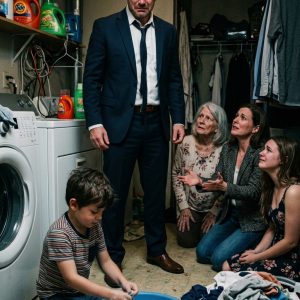
My mother, a woman whose entire personality was built on the foundation that she was never, ever wrong about anything, was physically on her knees on my welcome mat. Mark was kneeling beside her, his shoulders visibly shaking as silent tears streamed down his face.
For a full sixty seconds, I simply watched them through the fisheye lens. The two people who had discarded me like garbage four days earlier were now huddled at my threshold, reduced to begging.
I didn’t feel a rush of triumph. I didn’t feel vindicated. I just felt a profound, chilling disgust.
I reached up, unlatched the deadbolt, and pulled the door open.
Mark looked up, his eyes wide and bloodshot. My mother immediately reached out, her fingers desperately grabbing the hem of my pajama pants.
“What do you want?” I asked.
My voice didn’t sound like me. It wasn’t the soft, accommodating tone of the sister who always fixed things. It was cold, detached, and entirely hollow.
My mother stared at the scuffed hardwood floor just inside my apartment.
“We made a terrible mistake, Elena,” she whispered, her voice trembling.
It was a historic moment. The first time those words had ever crossed her lips in my thirty-two years of life.
Mark aggressively wiped his face with the back of his sleeve, looking up at me with the eyes of a cornered animal.
“Elena, please,” he choked out. “I didn’t realize… I didn’t understand how much of the foundation was just you. I went to the ATM yesterday and the account was empty. The mortgage pulled, and it bounced.”
A harsh, humorless laugh escaped my throat before I could stop it.
“You didn’t understand what, exactly?” I asked, leaning against the doorframe, refusing to step aside to let them in. “That you were completely living off my labor? You literally called me a leech while simultaneously siphoning five thousand dollars a month from my checking account.”
He flinched violently, as if I had struck him.
“I was drunk!” Mark pleaded, his voice cracking. “I was stressed. I didn’t mean a single word of it.”
“We were all just so upset, honey,” Carol interjected quickly, trying to stand up but failing, remaining in a pathetic crouch. “Families say terrible things when they are under financial stress. You know we love you.”
“No,” I said, my voice dropping to a whisper that cut through the hallway air like a scalpel. “You said exactly what you meant. You genuinely believe I owe you my life. You think my success is public property, just waiting to be distributed to cover your failures.”
Mark planted his hands on the floor, trying to push himself up. “Please, El. Let us come inside. Just let me sit down and we can talk about this like adults.”
I didn’t budge an inch. I blocked the entrance entirely.
“Talk about what, Mark?” I asked, my eyes narrowing. “Your mortgage? The foreclosure notice you received last Tuesday? The fact that you are currently three full weeks behind on the property taxes?”
All the color immediately drained from Mark’s face. He looked at me with genuine terror.
“How… how could you possibly know about the taxes?”
Chapter 4: The Reckoning at the Threshold
“I work in data analysis, Mark. I am not a moron,” I stated, my voice echoing slightly in the quiet hallway. “I know exactly what my money was supposed to be covering. I also know that you quit your second job at the logistics firm six months ago because your manager ‘disrespected’ you. I know you financed a brand-new SUV last autumn. And I saw Jessica’s public Instagram posts from her wine-tasting tour in Napa Valley last month, while you were supposedly drowning in utility bills.”
Mark’s jaw dropped. He had assumed I was just a blind, bleeding heart, writing checks without ever looking at the ledger.
“That is entirely out of context and unfair!” Mark snapped, a brief flash of his usual entitlement breaking through the tears. “You have no idea the immense pressure I am under as a single father! You don’t have children, Elena!”
“You are absolutely right,” I fired back, my tone turning to ice. “I don’t know what it feels like to have kids. But I also don’t know what it feels like to fund a luxury wine tour with the money my younger sister earned by working seventy-hour weeks until her hair started falling out from stress.”
My mother desperately grabbed the doorframe, her knuckles turning white.
“Elena, I am begging you,” Carol sobbed. “Mark needs your help. Tyler and Madison need their home. You cannot throw them out on the street.”
“I am not throwing anyone out,” I replied calmly. “The bank is. And if Mark needs help, then Mark needs to secure full-time, stable employment.”
“He has a job!” Carol shrieked defensively.
“He works fifteen hours a week doing remote consulting that barely covers the premium unleaded gas for a vehicle he has no business driving!” I countered, my voice finally rising. “That is not survival, Mom. That is an expensive, subsidized game of pretend.”
Mark’s face flushed a deep, violent red. “I am trying my hardest, Elena!”
“No, you aren’t,” I said, staring directly into his soul. “You’ve just been waiting. You have spent three years in a holding pattern, waiting for me to fix every single crisis you create. And the very moment I asked for a shred of basic human respect at my own birthday dinner, you branded me a parasite and watched your mother throw me out into the rain.”
Mark slumped back against the hallway wall, defeated. The fight drained out of him, leaving only the pathetic reality of his situation.
“I didn’t actually think you would hit the kill switch,” he whispered, staring blankly at the floor. “Mom swore you would come back. She told me you always come back because you need our approval.”
Something massive and heavy finally broke inside my chest. It wasn’t my heart breaking. It was the chains.
They had meticulously engineered their lives around my manufactured guilt. The absolute second I stopped feeling responsible for their bad decisions, their entire universe collapsed.
“You are not struggling right now because the universe is against you, Mark,” I said, delivering the final verdict. “You are drowning because every time the natural consequences of your actions came knocking, I paid them off to go away. Every single time you were supposed to hit rock bottom and learn how to climb, I threw a mattress under you.”
Mark began weeping again, a horrible, gasping sound.
“I promise I’ll do better,” he pleaded, clasping his hands together. “I swear to God. Please, Elena. Just manually authorize the transfer for this month. Just give me sixty days to figure it out.”
“No.”
The word hung in the air, absolute and impenetrable.
My mother gasped, clutching her chest as if she had been shot. “He is your flesh and blood! Those children are your niece and nephew!”
“I am more than willing to help Mark,” I stated clearly, looking at my mother. “But the cash register is permanently closed. I will happily sit down and help him draft a strict budget. I will review his resume. I will even help him pack boxes so he can sell that McMansion and move his kids into an affordable two-bedroom apartment.”
The silence that followed was the loudest answer I had ever received.
They stopped crying. They just stared at me. They didn’t want my help. They didn’t want solutions. They simply wanted my money to maintain the illusion they were successful.
“That is absolute cruelty,” Mark said, his voice laced with bitter poison.
“No, Mark,” I replied, stepping back into the warmth of my apartment. “Cruelty is letting you drown while pretending you are an Olympic swimmer. Cruelty is teaching Tyler and Madison that personal responsibility is entirely optional as long as you can guilt a relative into paying the tab.”
I placed my hand on the edge of the heavy wooden door.
“I am officially done being the family ATM. I am done sacrificing my future so you can permanently avoid adulthood.”
Carol let out a wail. “Do not make a decision you will regret on your deathbed, Elena!”
I looked down at her one last time.
“My only regret,” I said softly, “is that I didn’t close this door three years ago.”
And with that, I shut the door. I engaged the deadbolt, latched the chain, and walked away.
They remained in the hallway for another twenty minutes. I could hear the muffled sounds of crying, begging, and eventually, violent cursing. When they finally gave up and took the elevator down, my phone immediately began to vibrate on the kitchen counter.
Missed call from Carol.
Missed call from Mark.
Missed call from Jessica.
A text message from my teenage nephew, Tyler: Why are you doing this to us? Grandma says you hate us.
I stared at the screen for exactly three seconds.
Then, I powered the phone down completely, tossing it onto the couch.
For the first time in thirty-six months, my Saturday morning belonged entirely to me. I expected a tidal wave of suffocating guilt to wash over me. I waited for the panic attack to set in.
It never arrived. In its place was a quiet, expansive, beautiful peace.
Chapter 5: The Architecture of a New Life
The first full month without acting as the family savior felt surreal, like stepping off a treadmill that had been running at maximum speed for years.
There were no midnight panic attacks. No frantic calculations of my own budget to accommodate someone else’s emergency. Just a profound, unbroken silence.
When I finally turned my phone back on, the voicemails were toxic. My mother left rambling messages accusing me of historic abandonment. Mark left venomous audio clips claiming I was intentionally punishing his innocent children out of spite. Jessica even tried a bizarre bargaining tactic, offering me a “stake” in a fake business venture in exchange for a loan.
I completely ignored them all.
Three weeks into the blackout, Mark managed to call me from a burner number I didn’t recognize. I answered by mistake.
“Tyler asked me this morning why his aunt doesn’t love him anymore,” Mark said, his voice dripping with calculated emotional blackmail.
I didn’t miss a beat. “Then you need to look him in the eye and tell him the truth, Mark. Tell him that adult men have to pay their own mortgages. Tell him that I offered to help you budget and find a full-time job to save the house, but you chose to decline because you wanted my cash instead.”
He screamed an obscenity and violently hung up the phone.
They never figured it out. The facade crumbled faster than even I had anticipated.
Three months later, my Aunt Linda—the family gossip—called to inform me that the bank had officially foreclosed on the suburban house. Mark, Jessica, and the teenagers had been forced to pack up their belongings and move into my mother’s cramped three-bedroom house in Ohio.
When I heard the news, I felt a deep pang of sadness for my niece and nephew, but I felt zero regret. Mark had constructed a fragile kingdom made of my money, and he was the one who watched it burn when the wind changed. I briefly wondered if I could have handled the transition differently, but then my mind flashed back to the birthday dinner. The smirk. The contempt. Leech.
You cannot love someone into taking responsibility. You can only stop funding their stagnation.
Six months passed, and my life expanded in ways I hadn’t thought possible.
I used the five thousand dollars a month to fund weekly sessions with a brilliant trauma therapist in the city. She didn’t mince words. She looked at my bank statements and bluntly called it “financial exploitation under the guise of familial duty.”
Those words unlocked a heavy door inside me. I finally began aggressively funding my retirement. I sold the rattling Honda and bought a reliable, modern car. I booked a solo trip to Italy and drank wine in Tuscany without checking my bank balance.
My mother never reached out to apologize. She remained entrenched in her narrative of victimhood.
But a full year after the doorstep confrontation, a thick, handwritten envelope arrived in my mailbox.
It was from Mark.
It wasn’t an excuse, and it wasn’t a request for money. It was a painfully honest confession. He admitted that losing the house was the brutal wake-up call he had been dodging for a decade. He wrote that he had finally secured a grueling, full-time job managing a warehouse, sold the financed SUV, and was learning, at forty years old, how to balance a checkbook.
“You didn’t abandon me, El,” he wrote in messy ink at the bottom of the second page. “You just refused to keep watching me drown while I was screaming that I was an expert swimmer. I am so ashamed of who I was. I hope someday, you can look at me without disgust.”
I sat on my living room rug and cried until my ribs ached. Two weeks later, I sent a brief reply. I thanked him for his honesty and told him I was proud he was working. I clearly stated I was not ready to see him in person. It wasn’t full forgiveness, but it wasn’t a deadbolt, either.
Two years after I cut the financial cord, I stood on the back porch of a beautiful, historic brick home in Evanston. It had a small, fenced-in yard and big bay windows.
It was mine. The deed had my name on it.
I had been promoted to Director at my firm. I had spent the afternoon preparing food for a barbecue to celebrate my thirty-fifth birthday. The yard was filled with friends who knew my soul, not my bank account. Standing next to me, flipping burgers on the grill, was Daniel. He was a high school history teacher with a gentle laugh and an ironclad moral compass. When I had told him my family history on our third date, he hadn’t told me to forgive them because “blood is thicker than water.” He had held my hand and said, “You survived a hostage situation.”
As the sun began to set, Daniel handed me a glass of wine and wrapped his free arm around my waist.
“Do you ever regret it?” he asked softly, looking at the life we were building. “Cutting them off so abruptly?”
I leaned my head against his shoulder, watching the fireflies begin to light up the darkening lawn.
“No,” I answered, the truth ringing clear and absolute in my chest. “I regret letting my mother convince me that love was supposed to be a bleeding wound. I regret teaching Mark that his actions had no gravity. But I will never regret choosing to save myself.”
For over thirty years, I had labored under the delusion that family meant endless endurance. I thought devotion meant willingly paying a toll no one else was brave enough to pay.
I know the truth now.
True family doesn’t only fall to their knees when the ATM runs dry.
I didn’t lose my family that cold, rainy November night. I lost a very expensive, soul-crushing illusion.
And in its ashes, I built a life that was finally, irrevocably, mine.
Like and share this post if you found it inspiring and powerful!