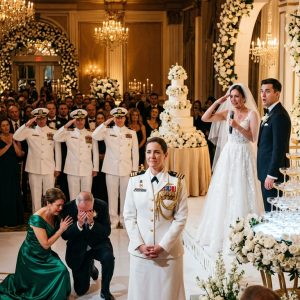
Chapter 1: The Fracture in the Grand Ballroom
My name is Victoria Anderson. I was thirty-two years old the evening my older brother struck me across the face in front of two hundred of the city’s most elite citizens, thereby committing the most catastrophic miscalculation of his privileged existence.
The sharp echo of flesh striking flesh fractured the ambient hum of the ballroom before the string quartet could even resolve the final chord of a Vivaldi concerto. A fraction of a second prior, I had been hovering near the perimeter of the head table, draped in an unadorned black gown, my fingers tightly clutching the cream-colored invitation I had nearly tossed into the incinerator three weeks ago. Now, a localized inferno raged across my left cheekbone.
My father’s distinguished birthday guests—a curated collection of donors, appellate judges, investment bankers, and ambitious politicians—were instantly petrified, their crystal champagne flutes suspended halfway to their mouths. My brother, Matthew, stood with his arm still partially raised, his index finger extending toward my chest as if I were a spilled glass of red wine ruining the imported marble floor.
“You don’t belong here!” he bellowed. His voice, usually modulated for charity luncheons and press briefings, was feral. It possessed enough volume to ensure that every single power broker in the Grand Heritage Hotel heard the decree.
Nobody blinked. Nobody rushed to my defense.
Seated beneath an opulent gold-leafed banner commemorating his seventieth birthday, my father, Arthur Anderson, simply stared at me. His expression was not one of paternal concern, but of profound irritation, as if my public humiliation were merely an unfortunate logistical hiccup interrupting his flawless celebration. Beside him, my mother kept her gaze anchored to her untouched plate of seared scallops. And Matthew? He wore a triumphant smirk, convinced he had finally scrubbed the smudge of my existence from our pristine family portrait.
For seven years, they had universally agreed upon my designated role: the defective daughter, the wayward single mother who had tarnished their social standing, the unstable woman who had walked away from an empire with absolutely nothing. For seven years, I allowed them to marinate in that fabricated reality.
I did not raise a hand to retaliate. I did not let a single tear breach my eyelashes. I merely ran my tongue along the inside of my lip, registering the faint, metallic tang of blood, and shifted my gaze toward the VIP table nearest the podium.
That was the precise moment the Governor of our state decided to stand up.
The wooden legs of her antique dining chair scraped against the marble, a harsh, abrasive screech that sounded remarkably like a declaration of war. Governor Eleanor Hayes adjusted the cuffs of her tailored blazer, her eyes sweeping over the frozen elite like a hawk surveying a field of paralyzed mice.
“You people,” the Governor projected, her voice carrying an icy, terrifying authority, “truly have absolutely no idea who she is.”
The silence that followed didn’t just fill the room; it suffocated it.
Matthew’s triumphant smirk dissolved, his complexion draining to the color of wet ash as the Governor inhaled, preparing to deliver the rest of her thought. Before I explain the magnitude of what she revealed, and the total devastation that followed my eventual exit, I want you to ask yourself: how many times have you let someone else write your story? How many times have you swallowed your own defense because survival was more urgent than pride?
The Governor allowed the silence to stretch. She didn’t finish her sentence immediately, and that agonizing, deliberate pause was infinitely more lethal than Matthew’s shout.
My brother had a master’s degree in optics. He understood wealth management, corporate image, and narrative control. But he had never possessed the fortitude to endure silence. A vacuum of sound made him unravel. He stared at Governor Hayes with a mixture of confusion and panic, as if she had violated a sacred societal compact by acknowledging my humanity. Then, he whipped his head back to me, clearly expecting the familiar gravity of shame to yank my eyes down to the floorboards.
It did not.
I had navigated horrors far more visceral than a temper tantrum in a tuxedo. I had spent countless nights sitting on the linoleum floors of municipal hospital corridors, my infant daughter Sophie burning with a fever across my lap, while an overworked triage nurse asked in a monotone voice if I had any family to call. I had signed a predatory lease for a drafty studio apartment when the total balance of my checking account was exactly seventy-six dollars. I had trained myself to smile through grueling job interviews while knowing full well that my own blood relatives had quietly blacklisted me across half the corporate sector, branding me as an emotionally volatile liability.
A slap at a billionaire’s gala could sting my skin, certainly. But it could not penetrate the fortress of the woman they had already attempted—and utterly failed—to annihilate.
The Governor finally broke the vacuum, her tone measured and devastatingly clinical.
“She is Victoria Anderson,” Eleanor stated. “She is the compliance auditor whose meticulous groundwork prevented three separate public housing initiatives from collapsing beneath the weight of bureaucratic fraud and political negligence. And, more pertinently to this room…”
She let her eyes lock directly onto my father.
“…she is the sole architect of the anonymous legal trust that prevented this very foundation from being seized by federal prosecutors last year.”
A collective gasp, followed by a tidal wave of furious whispering, washed over the ballroom.
What would he do now? I thought, watching my brother’s eyes dart toward the exits. The golden boy is finally out of shadows to hide in.
Chapter 2: The Architecture of Exile
The murmurs in the ballroom intensified, a buzzing hive of realization. I watched my father’s knuckles turn white as his hand clamped down on his linen napkin. For the very first time all evening, my mother lifted her chin, her eyes wide with a frantic, uncomprehending shock.
Matthew forced a laugh from his throat, but it emerged brittle and hollow. “That is utterly absurd,” he deflected, pitching his voice to the nearest tables. “She paints children’s murals in community centers. She practically begs municipal workers for scraps of attention. Please, Governor, do not attempt to manufacture a hero out of her just because you pity her pathetic situation.”
The Governor’s expression remained entirely glacial. “I do not pity her, Matthew. I trust her.”
That single sentence—I trust her—landed with far more concussive force than his hand against my face.
Matthew had dedicated the better part of a decade to constructing his persona as the infallible heir. The man who wore his family legacy like bespoke armor. He was a fixture at philanthropic luncheons, pontificating about civic duty. He expertly angled his jaw for the cameras at ribbon-cutting ceremonies for pediatric wings he would never step foot inside again. He paraded himself as the vigilant protector of the Anderson empire. He had no inkling that for years, I had been the one protecting the empire from him.
I rotated my shoulders, turning away from my brother, and fixed my gaze on the patriarch of the room.
“Did you actually invite me tonight, Dad?” I asked, keeping my voice low, yet perfectly audible in the breathless room. “Or did someone else force my name onto the security manifest after they realized I legally needed to be present?”
My father’s jaw worked silently. He offered no response, which was all the confirmation I required.
The invitation had arrived at my cramped apartment on heavy, double-thick cream cardstock. It hadn’t been addressed to ‘Vicki,’ or ‘Our Dear Daughter,’ or any of the diminutive nicknames they deployed when they wished to minimize my existence. The calligraphy had clearly stated: Victoria Anderson, Special Guest. I had known the moment I broke the wax seal that his hand had never touched it.
Sensing the shifting tide, Matthew closed the distance between us, dropping his voice to a venomous whisper intended only for me. “Walk away right now, before you humiliate yourself any further. Leave.”
I glanced past his shoulder, catching a glimpse of my own reflection in the polished silver of a tiered dessert tray. The red welt across my cheekbone was blooming into a vibrant purple.
“No,” I replied, the word sliding out smooth as glass. “I already walked away once. That was the last mercy I will ever grant this family. Tonight, I am staying.”
Seven years prior, at the age of twenty-five, I was permitted to occupy a low-level desk in the Anderson Family Foundation’s community outreach division. My existence there was designed to be decorative. I was tasked with categorizing grant photography, organizing catered lunches, and driving out to dilapidated neighborhoods my brother only utilized as talking points in his keynote addresses.
But I was observant. I watched impoverished families get relocated into transitional housing where thick black mold was hastily painted over with cheap primer. I logged contractor invoices that were submitted and paid twice for foundational repairs that were never actually executed. I found a terrifying pattern of identical billing amounts submitted by supposedly competing vendors.
Initially, my naive brain chalked it up to administrative incompetence. Then, late one Thursday evening, I dug into the archived server. I discovered Matthew’s digital signature and initials on final approval forms—authorizations directly attached to the very civic projects he was currently utilizing to boost his profile for a potential political run.
I compiled the discrepancies. I carried a thick, terrifying binder of evidence into my father’s mahogany-paneled office. I can still vividly recall the exasperated, tired mask he wore—the face he reserved for middle-management employees who brought him problems instead of solutions. He didn’t even flip past the executive summary.
He leaned back in his leather chair, steepled his fingers, and asked me if I comprehended the catastrophic damage that could be caused by “emotional, hormonal accusations.”
Matthew had entered the office ten minutes later, already briefed, already armed. He labeled me a jealous neurotic. He casually suggested that my unplanned pregnancy was inducing paranoid delusions. He spun a narrative that I was lashing out because I possessed the mediocre intellect of an artist and would never be entrusted with actual executive power.
By the time the dinner bell rang that evening, reality had been successfully rewritten. I was no longer a diligent auditor who had uncovered a massive embezzlement ring; I was a bitter, hysterical sister attempting to sabotage the golden son. By the conclusion of that week, my security badge was deactivated. By the end of the month, my father stood in the foyer of our estate and coldly informed me that I was not welcome back until I offered a full, written apology to my brother.
I had packed two suitcases. I took a concealed flash drive containing copied documents. And as I walked out into a freezing rainstorm, I felt Sophie flutter beneath my ribs—a microscopic heartbeat reminding me that I no longer had the luxury of falling apart.
That was the fatal flaw in Matthew’s grand design. He believed that banishment would break me into silence. He didn’t realize that exile was merely a classroom.
He gave me time, I thought, pulling my focus back to the present moment in the ballroom. And time is the only thing a fire needs to consume a mansion.
Chapter 3: The Ghost in the Ledger
Governor Hayes swiveled gracefully toward the sea of bewildered guests.
“Since this gala was heavily marketed to the press as a celebration of corporate integrity, philanthropy, and public service,” she announced, her voice echoing off the vaulted ceiling, “I believe every donor in this room deserves full transparency regarding why Ms. Anderson was formally compelled to attend.”
My father finally stood up, pushing his heavy chair back with a jarring screech. “Eleanor, please. This is an internal family matter. We will handle this privately.”
“No, Arthur,” the Governor countered without missing a beat. “Your son forfeited the right to privacy the moment he physically assaulted her in front of the press and your entire board of directors.”
The ballroom descended into a state of absolute, breathless paralysis. For the first time in my entire existence, the silence in a room full of powerful people was not a weapon being wielded against me. It was an audience, waiting for my instruction.
Matthew’s jaw locked. The feral rage in his eyes began to morph into something far more dangerous: rapid calculation. He wasn’t stupid. He recognized that there were specific names and numbers I could utter that would immediately elevate this from a scandalous family spat to a federal inquiry. Data had always been the sole language he couldn’t intimidate into submission.
I unclasped my small, velvet evening bag and ran my fingertips over the cool, metallic edges of a silver flash drive.
I truly had not come to this hotel to orchestrate the public execution of my father’s reputation on his birthday. I had agreed to attend because the Governor’s office had requested I give the Anderson patriarch one final, agonizing chance to review the facts in a private antechamber before the subpoenas were unsealed on Monday morning.
But Matthew couldn’t help himself. He had chosen to raise his hand. He had violently dragged a private reckoning into the blinding light of a public stage. And the universe has a funny way of operating: when an abuser selects a grand audience for your subjugation, they inadvertently assemble the perfect jury for their own downfall.
“This is a coordinated performance!” Matthew suddenly barked, throwing his arms wide, adopting the posture of a persecuted martyr. “My sister has possessed a pathological need for the spotlight since childhood. She vanishes for years, marinates in her own failures, and miraculously materializes the moment she sinks her hooks into the Governor’s office. It’s a pathetic, convenient shakedown.”
He looked directly at our father, communicating a desperate plea through his rigid posture. Dad, fix this. Do not let them turn your legacy into a tabloid circus.
My father looked at me. I mean, he truly looked at me, dissecting my posture, the unwavering set of my shoulders, the bruising on my face. A sudden, terrifying flicker of comprehension passed behind his eyes. It wasn’t paternal affection. It was the dawning, horrific realization that the daughter he had discarded like spoiled goods had returned wielding a loaded gun.
“Victoria,” my father rasped, his voice suddenly sounding ancient. “What… what exactly is happening here?”
I felt a dark, cynical humor bubble in the back of my throat. I wanted to laugh, not because a single element of this tragedy was amusing, but because that question was exactly seven years too late.
“What is happening, Dad,” I projected, ensuring the reporters near the back caught every syllable, “is that the Anderson Family Foundation was utilized as a personal slush fund to steal from the most vulnerable communities in this state. What is happening is that Matthew realized the books were bleeding, and he required a convenient scapegoat in case the auditors ever came knocking. And what is happening is that he selected me, because he mathematically calculated that I was the weakest, most disposable asset in your portfolio.”
My mother let out a small, strangled gasp, whispering my name.
“Don’t you dare speak to him like that!” Matthew snapped, taking a threatening half-step forward.
I didn’t flinch. I held my ground, leaning slightly toward him. “You just struck me across the face in front of your peers and screamed that I don’t belong here. Please don’t feign outrage now that I am publicly agreeing with you. You are absolutely correct, Matthew. I no longer belong inside your counterfeit reality.”
Near the towering dessert buffet, a freelance photographer slowly lowered his DSLR camera, exchanging a panicked look with a security guard, entirely uncertain if he should continue documenting the implosion. Governor Hayes subtly held up a hand, signaling the guard to stand down.
The room had officially transitioned from a gala into a tribunal.
Matthew attempted to salvage the narrative by deploying his greatest asset: weaponizing etiquette. He smoothed the lapels of his Tom Ford tuxedo, brushed a thumb across his lower lip in a pantomime of regret, and bestowed a deeply wounded, theatrical sigh upon the crowd.
“I must deeply apologize to all of you,” he announced, looking everywhere except at me. “Emotions are clearly volatile this evening. My sister has a documented psychiatric history of fabricating dramatic delusions, and I allowed my temper to get the better of me. This is neither the time nor the venue for a mental health crisis.”
It was a masterclass in manipulation. I could physically feel the tension ease in several of the older board members. They desperately wanted an excuse to look away. They preferred the minor discomfort of a family spat to the catastrophic financial ruin of a genuine scandal.
But Governor Hayes casually unclasped a leather dossier her aide had placed near the floral centerpiece.
“Actually, Matthew,” the Governor countered smoothly, “this is precisely the venue. Because your foundation utilized this evening’s invitations to solicit an additional ten million dollars in pledges from these esteemed guests for the RoseBridge housing initiatives—projects that are, as of three hours ago, under active federal review.”
The fleeting relief in the room evaporated instantly.
My father gripped the edge of the table, his knees visibly buckling. “Under review?”
“Standard bureaucratic procedure,” Matthew fired back, though a bead of sweat had finally breached his hairline.
I took one deliberate step past my brother, addressing the crowd. The throbbing in my cheek had transformed into a white-hot clarity.
“There was absolutely nothing ‘standard’ about the RoseBridge structural invoices,” I declared. I watched a senior executive from the city’s largest holding bank stiffen in his chair at the mention of the project name.
“There is nothing standard,” I continued, my tempo increasing, “about disbursing three quarters of a million dollars to a demolition subcontractor that had officially filed for bankruptcy and dissolved six months prior to the invoice date. There is nothing standard about routing emergency plumbing relief funds directly into a shell consulting firm registered to Matthew’s former university roommate. And there is certainly nothing standard about my digital signature magically appearing on authorization forms dated three full days after my father’s security team physically confiscated my building credentials.”
Matthew’s flawless facade shattered. “You forged those copies!” he spat, a desperate feral animal backed into a corner. “You were always skilled at sketching things, Victoria. You always knew how to make ugly little fabrications look incredibly convincing.”
He was attempting to slice me open twice—mocking my art and accusing me of federal perjury in the same breath. Seven years ago, that specific cocktail of condescension would have broken my rhythm. I would have stammered. I would have raised my voice, sounded shrill and defensive, allowing the room to dismiss my panic as guilt.
But I was no longer the terrified twenty-five-year-old girl pleading for her father’s approval.
I turned my back on my brother completely and looked at the Governor. “May I?”
She offered a single, grim nod.
I pulled the silver flash drive from my bag, walked over to the AV station near the towering champagne pyramid, and held it up. This tiny piece of metal, I thought, holds the ghost of every tear I shed in the dark.
Chapter 4: The Golden Son Unravels
“Every piece of metadata, every hidden wire transfer, and every forged signature on this drive has already been authenticated and submitted to the state prosecutor’s council,” I announced softly, placing the drive on the table.
I looked back at my father, who was staring at the silver rectangle as if it were a live grenade. “Tonight was designed to be quiet, Dad. The Governor’s office was going to offer you a private briefing. They were going to allow you to freeze the new pledge campaign quietly, citing administrative delays, and permit the executive board to cooperate with the investigation without a media circus. I came here tonight because, despite everything you let him do to me, I thought you deserved to hear the truth from your own blood before you read about it on the front page of the morning paper.”
My father physically flinched at the phrase ‘front page.’
Matthew lunged at the opening. “Exactly! She wants the headline! She is vindictive! She wants to orchestrate a revenge campaign because she couldn’t handle being financially cut off and forced to live like a commoner!”
I felt the ballroom inhale sharply, latching onto that heavy, seductive word: Revenge.
It would have been incredibly easy to claim it. A dark, jagged piece of my soul wanted to scream that yes, I wanted to burn his life to the ground. But the actual truth was much heavier, and infinitely more devastating than mere vengeance.
“No, Matthew,” I said, my voice dropping to a register that forced the room to strain to hear me. “If my motivation was revenge, I would have handed these documents to the press years ago, back when Sophie and I were eating dry cereal for dinner in a studio apartment with broken radiators. I would have ruined you when I discovered that every major architectural and legal firm in this city had received a discrete phone call from this family, warning them not to employ me.”
I took a slow breath, letting the weight of my next words settle. “If I wanted to destroy this family’s legacy, I would not have spent the last three years covertly utilizing my own settlement funds to establish an anonymous trust. A trust designed specifically to repay the first wave of defrauded RoseBridge tenants, preventing them from filing the class-action lawsuit that would have bankrupted this foundation twelve months ago.”
My father’s head snapped up. His eyes were wide, bloodshot. “You… you did what?”
There it was. The seismic fracture in the grand Anderson mythology. My mother slumped forward, burying her face in her hands, her shoulders shaking violently, but I could not pause for her grief.
“The Anderson name only survived 2023 because the families whose homes were rotting from the inside out received restitution from a trust they believed was funded by a benevolent, anonymous angel investor,” I explained, staring directly into my father’s horrified eyes. “That investor was me. I utilized the entirety of a corporate whistleblower settlement I won under my mother’s maiden name. I did it because those families desperately required safe housing, and because, in my own foolish, pathetic heart, I harbored a tiny hope that one day, you might value the truth more than your impenetrable pride.”
For the first time in his thirty-five years of life, Matthew Anderson was struck entirely mute.
Governor Hayes stepped out from behind her chair. “Your daughter shielded your foundation from total annihilation, Arthur. Your son simply sat back, took the credit, and allowed your donors to believe his brilliant legal maneuvering had solved the crisis.”
The atmosphere in the ballroom mutated. It was no longer the electric hum of scandalous gossip. It was the heavy, suffocating weight of universal judgment, forming and calcifying in real time.
My father’s complexion had turned the color of old parchment. He slowly rotated his head toward his golden boy. “Matthew,” he whispered. “Is she telling the truth?”
Matthew’s mouth opened. A desperate squeak emerged. Then his jaw clicked shut.
That silence was the final nail. Seven years of being branded as volatile, jealous, and delusional completely disintegrated within the vacuum of my brother’s inability to formulate a lie.
But the execution was not complete. The RoseBridge files were merely the appetizer, and Matthew knew it. His hand twitched, instinctively reaching toward the table where the flash drive sat.
I slammed my palm down over the metal casing before he could move.
“Don’t,” I warned, my voice practically a low hum. “You have already put your hands on one thing tonight that did not belong to you. I highly recommend you do not make it two.”
His eyes changed then. The polished, charismatic sociopath vanished, replaced by a terrified animal scanning for escape routes. He looked at the heavy oak doors, guarded by security. He looked at the board members, who were actively shifting their chairs away from him. He looked at the billionaire donors, who were already speed-texting their crisis PR teams.
“You think this makes you a saint?” Matthew hissed, venom dripping from his teeth. “You cowered behind a fake name. You let the entire city believe you were a failure. You were nothing!”
“No,” I corrected him softly. “You needed the city to believe I was a failure so you could sleep at night. I simply stopped expending energy trying to correct people who were fundamentally committed to misunderstanding me.”
That specific phrase pierced through the corporate jargon. I saw a prominent appellate judge—a man who had literally turned his back on me at a charity drive years ago—stiffen with a sudden, profound realization. I saw it in the trembling hands of the cellist in the corner. They suddenly understood the supreme violence of having your narrative hijacked by someone with more power.
My father stumbled away from the head table. “Victoria,” he croaked. My name sounded foreign on his tongue, rusty from years of disuse. “If… if you had this proof… why didn’t you come to me again? Why didn’t you try to show me?”
That question cut deeper than the physical blow to my face. Even now, in the face of insurmountable evidence, he was subconsciously attempting to shift the burden of his ignorance back onto my shoulders.
I refused to give him the comfort of an excuse.
“I did try, Dad. Twice.” I maintained absolute eye contact. “The first time, you lectured me about how family loyalty required blind obedience. The second time, I mailed you the summary ledger via certified courier. Your executive assistant returned the envelope to my apartment, unopened, with a sticky note stating you were not accepting correspondence from me.”
My father let out a sound like a dying engine.
“After that envelope came back,” I continued, “I made a choice. I chose to focus on Sophie. I chose to focus on making rent. I chose to build a quiet life. I chose peace over a war I was never allowed to win.”
Behind him, the projector hummed to life. The Governor’s aide had quietly plugged the drive into a laptop. A massive, brilliantly illuminated spreadsheet beamed onto the wall directly behind the wreckage of the seventy-year-old birthday cake.
Northline Consulting. Harbor Civic Solutions. Ashford Development Support.
Rows upon rows of wire transfers, dummy vendor IDs, and authorization signatures. The Governor didn’t need to narrate the slide. The data screamed its own indictment. One company belonged to his fraternity brother. Another to a former PR assistant. A third—the most lucrative shell—was registered to a woman Matthew had introduced to the press as a “freelance policy advisor,” whom he was actually paying out of the foundation’s emergency relief fund to cover the lease on a luxury downtown penthouse.
A collective sound of pure, unadulterated disgust rippled through the elite crowd.
Chapter 5: The Weight of the Crown
My father gripped the back of his chair so tightly I thought the wood might splinter. “Matthew,” he demanded, his voice breaking into a pathetic plea. “Tell me you have an explanation for this. Tell me this is a misunderstanding.”
Matthew’s eyes darted frantically toward me, and for a split second, the facade dropped entirely. I didn’t see a powerful executive; I saw the cruel, terrified twelve-year-old boy who used to break my toys and blame the maid.
“She engineered this!” he screamed, his voice cracking. “She fabricated the data! She has always been obsessed with taking my place at the head of this family!”
I almost smiled. Not a joyful smile, but a grim, melancholic acknowledgment of his absolute blindness.
“Take your place?” I echoed, letting the microphone amplify my words across the room. “Is that truly the depth of your imagination, Matthew? You think this was a coup for a corner office? I never wanted your chair at the head of Dad’s suffocating table. I just wanted my goddamn name back.”
The Governor’s aide clicked to the final slide.
It wasn’t a spreadsheet. It was a high-resolution scan of a handwritten letter. My letter. The desperate, tear-stained plea I had written seven years ago, begging my father to just look at the math before he banished me.
And scrawled diagonally across the top right corner, in Matthew’s unmistakable, aggressive cursive handwriting, was a note directed to the executive assistant:
Do not let Dad see this garbage. She is completely unstable. Shred it and handle quietly. – M.
My father’s knees finally gave out. He collapsed backward into his chair, staring at the screen as if the ghosts of his own hubris had manifested to drag him to hell. My mother let out a loud, agonizing sob, burying her face into her husband’s shoulder.
And then, the most remarkable phenomenon occurred.
Nobody rushed to comfort Matthew. Nobody shouted objections. The titans of industry, the politicians who had clinked glasses with him twenty minutes ago, suddenly looked at him as if he were highly radioactive. This was the ultimate punishment he had spent his life terrified of—not federal prison, not financial ruin, but becoming socially toxic to the elite.
My father forced himself to stand again. The metaphorical crown he had worn all evening seemed to be crushing his spine.
“I… I built this family on the absolute sanctity of our reputation,” Arthur stammered, addressing the room, though his eyes were hollow. “I erroneously believed that if I rigorously controlled the exterior image, the internal rot would eventually cure itself.”
He slowly turned his head to look at me. The arrogant patriarch was gone; only a shattered old man remained. “I was wrong, Victoria. I was so incredibly wrong.”
Those three words—I was wrong—were microscopic compared to the mountain of trauma I had endured. Hearing them didn’t magically heal the trauma. It didn’t refund the years of missed birthdays for Sophie, or erase the nights I spent sobbing on a bathroom floor with a towel stuffed in my mouth so I wouldn’t wake my child. But it did act as a crowbar, prying open a heavy iron door inside my chest that I had welded shut just to survive.
Matthew lunged forward, grabbing our father’s arm. “Dad, stop! Do not legitimize her! Don’t do this here!”
My father violently yanked his arm away, and for the first time in my memory, he looked at his son with pure, unadulterated revulsion. “You do not get to dictate the terms of this room anymore, Matthew.”
Governor Hayes calmly closed her dossier. “The executive board will receive formal, subpoenaed notice at 8:00 AM tomorrow. The current ten-million-dollar pledge campaign is officially suspended. All foundation assets connected to the flagged initiatives will remain frozen by the state pending full cooperation.”
Instantly, the ballroom erupted into quiet, frantic action. Assistants were dialing phones. Donors were aggressively whispering to their legal counsel. Matthew could literally hear the capital evaporating from his empire.
Panic completely stripped the aristocratic veneer from his face. He spun toward our father. “You are honestly going to take the word of a hysterical dropout over your own son?”
My father didn’t blink. “No, Matthew. I am finally taking the word of the evidence I refused to read.”
Cornered, stripped of his armor and his allies, Matthew turned his venom entirely on me. “Are you happy now?!” he roared, the veins in his neck bulging against his bowtie. “You infiltrated our father’s milestone birthday to orchestrate my public execution! Congratulations, Victoria! You finally got your sick, twisted revenge!”
Every eye in the room pivoted back to me. They were waiting for the climax of the drama. They were waiting to see if I would scream back, if I would validate his accusation and become the bitter, vindictive villain he so desperately needed me to be.
I walked up to the small podium where my father had been scheduled to deliver a keynote address on “Generational Family Values.” I detached the microphone from the stand. My pulse was steady.
“I want to make my intentions absolutely unequivocal to everyone in this room,” I stated, my voice echoing with a calm, lethal authority. “I did not come here tonight to harvest your applause or your pity. I came here because thousands of citizens with infinitely less resources than anyone in this ballroom were actively harmed, and the powerful men who harmed them banked on their silence.”
I looked directly into the camera lens of the freelance photographer, who had slowly raised his rig again.
“I came here because my daughter, Sophie, deserves to grow up in a universe where her silence is not the required currency to purchase her family’s love. And I came here because I spent the last seven years of my life being systematically punished for having the audacity to tell the truth in the wrong household.”
I paused, feeling a slight tremor in my fingers, but I gripped the microphone tighter.
“I am not destroying Matthew. I am merely standing back and introducing him to the devastating consequences of his own hubris.”
The room was deathly quiet. Nobody clapped. I was profoundly grateful for that; applause would have reduced the moment to cheap theater. Instead, they just sat there, absorbing the gravity of a shattered dynasty.
I turned back to my father. “You asked me why I never tried to come back. The truth is, Dad, every single time I attempted to re-enter this family’s orbit, the price of admission was making myself smaller. Tonight, your son screamed that I didn’t belong in this room. And after witnessing all of this… I think he is absolutely right.”
I scanned the opulent chandeliers, the crystal, the terrified faces of the elite. “I do not belong in a room where affection is transactional. I do not belong at a dining table where honesty is considered offensive, yet cruelty is quietly subsidized. And I certainly do not belong to a legacy that protects its public image by sacrificing its daughters to the wolves.”
My mother was openly weeping now, her makeup running down her face in dark rivulets. Matthew stood completely isolated near the fallen cake, looking around frantically for a single sympathetic face. For the first time in his entire life, the universe refused to rearrange itself for his comfort.
Governor Hayes approached the podium, her demeanor softening as she handed me a small, thick envelope. “Victoria, the tenant union from the RoseBridge community sent this to my office this afternoon, when they deduced you might be speaking tonight.”
I opened the flap. Inside was a stack of glossy photographs.
I flipped through them, tears finally prickling the corners of my eyes. A group of children grinning widely in front of a newly reinforced, mold-free apartment block. An elderly veteran holding a piece of cardboard with the words ‘God Bless You, Miss V’ written in thick marker. A young mother with twin toddlers, leaning against a freshly installed, bright blue front door.
I pressed the photographs against my chest, right over my heart, and felt the dark, jagged shard of anger inside me completely dissolve.
This was not a story of revenge through destruction. This was the ultimate vindication through proof of existence. Proof that I had not been erased. Proof that radical empathy enacted in the shadows possesses a longer half-life than corruption paraded in the light.
I looked at my brother one final time. He looked incredibly small.
“You told me I didn’t belong here, Matthew,” I said, dropping the microphone onto the podium. “You were right. I belong with the people who actually comprehend my worth.”
Chapter 6: The Blue Door
I walked out of the Grand Heritage Hotel before they even rolled away the dessert carts.
That is the detail people always obsess over when they recount the legend of that night. They always lean in and ask if I stayed in the ballroom to watch the FBI raid the offices the next morning. They want to know if I stood there and savored the sight of Matthew losing his mind as the donors demanded their checks back, if I relished watching my father officially strip him of his executive titles.
The honest answer is no. I had spent way too much of my brief time on earth calibrating my own emotional equilibrium based on their reactions. That night, I made the conscious decision that my healing process did not require an audience of hostages.
Governor Hayes escorted me through the gilded lobby. When the heavy brass doors opened, the frigid, biting night air hit my bruised cheek like a cleansing balm. Behind us, the hotel was a hive of catastrophic fallout. Cellular networks were jamming. High-priced defense attorneys were being dragged out of bed. A dynasty was actively collapsing inside a gold-leafed frame.
But out on the street, the city was perfectly still.
“You did remarkably well in there,” the Governor noted quietly, signaling for her security detail.
I let out a ragged, exhausted laugh. “I don’t feel well, Eleanor. I feel entirely hollowed out. It feels like someone just kicked open every sealed vault in my chest and left the contents exposed to the wind. I almost turned the car around three times tonight.”
She smiled, a genuine, warm expression. “I know. True courage rarely looks glamorous in the moment. It usually looks like showing up with trembling hands and doing it anyway.”
I stood under the canvas awning and pulled out my phone. There was a text message from my babysitter, accompanied by a photo. Sophie was sound asleep in her bed, her tiny fingers still clutching a blue watercolor paintbrush.
That image broke me in a way the slap never could.
I leaned against the brick facade of the hotel and wept. I didn’t cry beautifully or quietly; I sobbed with the ugly, guttural force of a decade of suppressed grief. I cried for the terrified twenty-five-year-old girl who had hauled cardboard boxes up four flights of stairs, lying to herself that poverty was a form of freedom. I cried for the daughter who had practically bled out trying to earn her father’s basic respect. I cried for every single instance I had swallowed my own voice because keeping the peace was vital to keeping my child fed.
And then, I took a deep breath of the freezing air and wiped my face clean. Because tomorrow morning, Sophie was going to ask me how I got the purple bruise on my face, and I refused to feed her a lie. I was going to look my daughter in the eye and tell her that a weak man made a cruel choice, and her mother made a brave one.
Two weeks later, the unsealed indictments hit the press.
Matthew attempted to resign from the foundation to save face, but the gesture was utterly futile. The federal prosecutors froze his personal accounts. A deluge of civil litigation followed from betrayed contractors. Once the initial shell companies were exposed, his supposed “loyal” friends scrambled over each other to offer state’s evidence in exchange for immunity. That is the fundamental truth about rooms filled with power: they do not experience moral awakenings; they merely pivot to self-preservation.
My father issued a massive, groveling public apology to the defrauded communities. His crisis PR team sent me the first draft. It was full of passive language like, “regrettable oversights occurred.” I sent it back with a single red line through the text.
The final, published statement read: “I systematically failed to listen to the daughter who risked everything to warn me.”
It wasn’t enough to magically erase seven years of trauma, but it was enough to stop the bleeding.
Three months after the gala, my mother nervously attended Sophie’s second-grade art exhibition. She hovered near the gymnasium doors, clutching a bouquet of sunflowers, looking as terrified as a trespasser. Sophie looked up at me, silently asking for permission before running over to hug her.
That single, hesitant glance told me everything I needed to know about the sanctuary I had constructed. My daughter implicitly trusted me to act as the gatekeeper to her universe. So, I did. I allowed my mother back into our lives incrementally, enforcing boundaries so massive and immovable that nobody could ever feign ignorance of them again.
My father requested a private meeting for coffee. I made him wait six full weeks before agreeing.
When we finally sat across from one another in a quiet, neutral cafe, the titan of industry looked shockingly frail. He didn’t demand instant absolution, which was the smartest move he could have made, considering my well was completely dry. Instead, he asked about Sophie’s reading level. He asked about the mechanics of my legal trust. He asked what the RoseBridge community required next.
For the very first time in my life, Arthur Anderson asked questions without possessing the arrogant assumption that he already owned the answers.
As for Matthew, he attempted to relay a final, bitter message through our mother before he fled the state to avoid the subpoenas. Tell Victoria she won.
I deleted the text. Winning was an entirely inaccurate verb. Winning implies the existence of a fair game. What I had survived was not a game. It was a toxic ecosystem engineered on favoritism, weaponized silence, and the paralyzing fear of public scandal. It was a brother who confused cruelty with power. It was a father who mistook authoritarianism for respect.
And ultimately, it was me, discovering the hard way that being violently expelled from a diseased system is often the painful prerequisite to building a healthy one.
Exactly one year after the gala, I returned to the RoseBridge neighborhood for the grand opening of a new, fully funded community arts and legal advocacy center.
There were no Tom Ford tuxedos, no champagne pyramids, and absolutely no gold-leafed banners bearing my father’s surname. There were just mismatched folding chairs, children with neon paint smeared across their overalls, and working-class tenants who embraced me with the fierce grip of actual family.
And at the front entrance, standing as a vibrant beacon against the gray concrete, was a massive, bright blue door—because Sophie had sternly insisted that every safe haven required one.
Governor Hayes attended the ribbon-cutting, but she explicitly ordered her press team to stay in the car, refusing to commodify the moment for political capital.
My father attended as well. He stood near the back of the room, wearing a simple sweater, quietly watching me guide a young boy on how to mix watercolors without muddying the canvas.
Later, as he helped me fold chairs, he paused and looked around the vibrant room. “I missed out on so much of this,” he murmured, his voice thick with regret.
I looked at him, feeling a profound, quiet strength in my spine. “Yes, Dad. You really did.”
I did not offer a platitude to rescue him from his guilt. Real love does not mandate that we pretend the knife didn’t cut deep. True healing isn’t achieved through one cinematic monologue; it is built across a thousand microscopic choices to simply not repeat the damage of the past.
Sometimes, they still fail. Sometimes, I have to step back. The apologies are genuine now, but access to my peace still requires daily earning.
People still occasionally ask me about the Governor’s dramatic interruption at the gala. They ask for the conclusion of her sentence. Here is the full quote she later provided to a local journalist:
“She is the one who protected the very people this family claimed to serve.”
I keep that newspaper clipping folded inside the drawer of my desk. I don’t keep it to stroke my own ego, but because Sophie likes to unfold it on the days she forgets that standing up for the truth can feel incredibly lonely before it feels powerful.
On the night of his seventieth birthday, my brother screamed that I didn’t belong in his world. He meant I didn’t belong among the insulated, the corrupt, and the perpetually protected.
He was absolutely right. I belonged somewhere vastly superior. I belonged beside my courageous daughter, beside the vulnerable communities who placed their faith in me, and beside the heavy, beautiful truth I had carried through the dark, even when it cost me everything I thought I wanted.
And if you are reading this, and you have ever been cast aside, minimized, or humiliated by individuals who mistook your forced silence for total defeat… never forget this:
Sometimes, the exact moment they attempt to permanently erase you from the narrative becomes the blinding flash where the rest of the world finally sees exactly who you are.
Like and share this post if you find it inspiring, and never let anyone else hold the pen to your story!