The Architecture of a Miracle
Chapter 1: The Phantom in Silver Silk
The cruelest sentence in the English language is not a declaration of war, nor is it a terminal diagnosis. The cruelest sentence is the one explicitly designed to strip a human being of their personhood, reducing them to a defective object in a room full of people who are silently agreeing with the assessment.
“Why would any man in this room waste a perfectly good waltz on a broken doll?”
Trevor Hamilton’s voice carried over the rim of his crystal champagne flute, cutting through the soft murmur of four hundred billionaires, senators, and socialites. He wore a smug, lopsided grin, anchored by a three-thousand-dollar custom Tom Ford tuxedo. Surrounding him, a pack of lacrosse players erupted into harsh, braying laughter.
I was eighteen years old. I was the sole heir to an empire. And I was completely, inescapably paralyzed from the waist down.
Sitting in my custom-molded wheelchair at the perimeter of the great ballroom of Ashford Manor, I froze. The air evaporated from my lungs. A single, hot tear breached my eyelashes, tracing the line of my jaw before vanishing into the heavy silver silk of my debutante gown. I prayed for the parquet floor—laid by hand in the year George Washington died—to fracture open and swallow me whole.
But to understand the devastating gravity of Trevor’s cruelty, and the catastrophic chain of events it was about to unleash, you have to rewind the clock. You have to understand the ghost I had become.
Two years prior, I had been the brightest, most terrifyingly ambitious girl in Charleston high society. I was a regional debate champion, a classical pianist, and a fiercely competitive equestrian. My father, Harrison Ashford III—CEO of Ashford Industries, proprietor of half the medical supply patents on the Eastern Seaboard, and a man who casually golfed with former presidents—had purchased a magnificent chestnut stallion named Carolina Sky for my sixteenth birthday.
It happened on a damp, gray morning at the Aiken Hunt Club. We were executing a complex dressage routine when a rogue crack of thunder shattered the air. The stallion panicked, rearing violently. I was thrown over the rail, my spine colliding with the unforgiving wooden fence line with a sickening thud.
My father reached my body exactly thirty seconds later. I was fully conscious, blinking up at the bruised sky, but an icy, terrifying void had replaced the lower half of my body.
“Daddy,” I had whispered into the mud. “I can’t find my legs.”
In the twenty-four months that followed, my father weaponized his unimaginable wealth, vaporizing over thirty-two million dollars in a frantic crusade to buy back my mobility. We embarked on a grim global tour of sterile rooms and sympathetic faces. The Mayo Clinic. Johns Hopkins. Stanford. The Karolinska Institute in Stockholm. Charité in Berlin.
Twelve hospitals. Twelve teams of the most decorated, arrogant neurosurgeons on the planet. Twelve identical, devastating conclusions.
Permanent spinal cord trauma. Lower-body paralysis. No surgical or non-surgical intervention recommended. The patient should be aggressively supported in adjusting to the lifelong use of mobility aids.
I stopped speaking entirely for four months after the seventh diagnosis. I stopped reading. I stopped listening to music. I had been a dancer—the kind of lyrical ballet prodigy my instructors swore would eventually grace the stage at Lincoln Center—but I couldn’t even bear to look at a pair of pointe shoes. My legs had transformed into heavy, useless bags of wet sand.
My mother, Margaret Ashford, watched the light behind my eyes extinguish like a candle caught in a winter draft. She spent her Sundays weeping in the pews of St. Michael’s Episcopal Church, begging a God she was rapidly losing faith in for a miracle.
It was my mother who had forced this gala into existence. The eighteenth birthday debutante ball. Four hundred elite guests, a twelve-piece symphony orchestra, three Baccarat chandeliers shipped from Paris in 1847, and me, propped up like a morbid centerpiece in a silver gown.
“Please, Savannah,” she had begged me a month prior, her hands trembling as she held my lifeless knees. “Just one night. Just to remind the world that you are still here. That you haven’t died.”
I capitulated because I couldn’t bear the hollow sound of her weeping. And perhaps, buried beneath layers of bitter scar tissue, some microscopic fraction of my soul still desperately wanted an invitation back into the world of the living.
I had no way of knowing that the architect of my salvation was, at that exact moment, standing three miles away in a cramped, drafty dormitory, ironing a borrowed tuxedo.
I sat near the orchestra pit, my hands gripping the leather armrests of my chair so fiercely my knuckles ached. The first waltz was approaching, and an ocean of wealthy strangers milled around me, deliberately avoiding eye contact with the crippled girl in the corner.
The nightmare was only just beginning.
What I didn’t know was that the boy preparing to shatter my entire reality possessed hands that carried the weight of a legend, and he was currently walking through the kitchen entrance, completely invisible to the world that was about to bow before him.
Chapter 2: The Ghosts of Bellwood
To comprehend the sheer impossibility of what transpired in my ballroom, one must first understand the phantom who orchestrated it.
His name was Wesley Williams. He was eighteen, rail-thin, and entirely alone in the world.
Three months before my birthday, a rusted county transit van had crunched up the pristine gravel driveway of Bellwood Preparatory Academy, the most elite, ivy-strangled boys’ institution in the South. Out of the sliding door stepped Wesley, draped in a frayed thrift-store overcoat. He carried his entire existence in one faded canvas duffel bag and a battered wooden case that, to the untrained eye, resembled a violin receptacle.
He was an orphan, transferred out of the grim confines of St. Augustine’s Home for Boys, and the sole, highly controversial scholarship student admitted to Bellwood’s senior class.
He was met on the limestone steps by Coach Lawrence Moore, a massive, broad-shouldered man possessing the severe haircut of a Marine and the kind eyes of a weary father.
“Welcome to Bellwood, son,” Coach Moore had rumbled, extending a massive hand. “The dining hall feeds the faculty and paying students first. Kitchen entrance is around back on the left. Don’t take it personal. It’s just the architecture of this place.”
Wesley had offered a single, microscopic nod. He didn’t take it personally. He had spent his entire life mastering the art of swallowing indignities.
His routine was brutal. His alarm struck at four-thirty every morning. He hauled heavy oak tables into alignment before the sun crested the river. He polished hundreds of pieces of silver flatware between AP Calculus and AP Biology. He mopped the labyrinthine hallways until midnight.
He moved like an apparition. He spoke in a hush. The wealthy heirs of Bellwood mockingly christened him ‘The Ghost.’ They walked past him, and occasionally directly into him, as if his physical form did not occupy molecular space. He never lodged a complaint.
Every night, before extinguishing the single bulb in his cramped attic room, Wesley would reach beneath his undershirt. He would touch a tarnished silver locket resting against his sternum, and whisper two words into the dark: “Goodnight, Mama.”
There were whispers, of course. Old Walter, the nocturnal janitor, swore to Coach Moore that he routinely heard music bleeding from the locked music conservatory at two in the morning. A flawless, sweeping Viennese waltz executed on the grand piano. The kind of mournful, absolute music a man plays when he is desperately trying to communicate with the dead. Coach Moore had sharply instructed Walter to forget the music, but the janitor always wondered how a destitute orphan knew the precise difference between a real violin and a case that was merely pretending to hold one.
Now, Wesley was here. At my ball.
He had been drafted onto the catering staff, wearing a tuxedo borrowed from the school’s theater department. He was currently standing near a towering champagne fountain shaped like my family’s crest, rendering himself invisible.
I, however, was agonizingly visible.
The first waltz commenced. The orchestra swelled. My mother, smelling faintly of gin and desperation, leaned down to my ear. “Savannah, look, there’s Daniel Wilson. You used to tutor him in chemistry. Let me go ask him to roll you onto the floor.”
“Mom, please, God, don’t,” I rasped, panicked.
But Margaret was already navigating the silk-clad crowd. I watched Daniel Wilson—blonde, arrogant, the son of an investment banker—look at my mother, look over her shoulder at my motionless legs, and immediately inspect his patent leather shoes.
“I’d absolutely love to, Mrs. Ashford, truly,” Daniel stammered loudly. “But I, uh, I actually promised this exact song to… someone else.”
He had no partner. He frantically acquired one from a nearby table within ten seconds. He did not glance back.
The second waltz. My mother intercepted Andrew Davis. He rubbed his wrist theatrically. “Tore a ligament in lacrosse, ma’am. I couldn’t possibly push the chair. Tragic, really.” He proceeded to aggressively twirl a redhead from Spartanburg two minutes later.
By the fifth agonizing refusal, the societal dam broke. The whispers began, hissing like steam escaping a pipe.
A woman dripping in emeralds at table nine leaned into her husband. “Darling, look away. The mother is making it worse. It’s grotesque.”
A girl I had once helped pass Latin covered her glossed mouth with a napkin to conceal a vicious giggle. Headmaster Gregory Wilson of Bellwood, attending as a courtesy to his wealthiest donor—my father—set down his scotch and found the ceiling plaster intensely fascinating.
Behind my chair, my mother began to cry. Not the delicate, polite tears of society, but harsh, ragged sobs she tried to swallow. My hands turned bone-white on the leather armrests. I stared down at the intricate beadwork of my silver hem, using every ounce of my willpower to keep my spine rigid, refusing to shatter in front of four hundred vultures.
Then, Trevor Hamilton made his grand entrance.
He arrived unfashionably late, radiating entitlement. His father, Senator Charles Hamilton, was already holding court at the primary VIP table. Trevor had dated me for nine months before my horse bolted. After the accident, he visited my sterile hospital room exactly twice. Once with a generic bouquet, once with a terrifyingly creepy teddy bear. Then, he vanished into the ether.
He stopped calling because his fraternity brothers mocked him. He stopped because his father, the esteemed Senator, had pulled him into a wood-paneled study and said quietly, “Son, a Hamilton does not tether himself to dead weight.”
He stopped because he was an eighteen-year-old coward. But cowardice possesses a sickening gravity; it eventually pulls you back to the scene of the crime to justify your weakness.
Trevor scanned the opulent room. His eyes locked onto my wheelchair, onto my weeping mother, and his mouth twisted into a sneer. He signaled his sycophants. He raised his glass.
“Why would any man in this room waste a perfectly good waltz on a broken doll?”
The laughter was immediate. It was sharp, cruel, and profoundly tribal.
“Look at her, boys,” Trevor projected, ensuring his voice bounced off the acoustics of the domed ceiling. “A damaged porcelain doll that nobody bothered to return to the manufacturer. What’s wrong, Savannah? Cat got your legs?”
I did not flinch. I did not raise my chin. I was a ghost, and ghosts do not bleed.
At table one, my father surged halfway out of his chair, a low, animalistic growl vibrating in his chest. My mother frantically lunged forward, catching his wrist. “Harrison, no! Not in front of the press, please, you’ll make it a spectacle!”
My father collapsed back into his seat, his knuckles straining so violently around his glass that the crystal stem threatened to snap.
Four hundred of the wealthiest, most powerful human beings across three Southern states stood perfectly still. Surgeons who held lives in their hands. Politicians who drafted laws. Judges who dictated morality. They all stood there, sipping vintage champagne, actively watching a paralyzed girl be psychologically dismembered.
Not a single one of them intervened.
But fifty feet away, beside the bubbling champagne fountain, the tall, thin catering boy in the ill-fitting tuxedo set down his silver serving tray.
He slowly pulled the white cotton gloves from his hands. He folded them with meticulous, terrifying precision, laying them on the silver platter. He looked across the room and caught the eye of Coach Moore.
The massive Coach gave one, barely perceptible nod. Go.
Wesley Williams stepped out of the shadows.
He was walking directly into the firing line of the most vicious social elite in the country, and as his dark eyes locked onto mine, I felt a strange, terrifying electrical charge ripple through the dead nerves of my spine.
Chapter 3: The Architecture of Defiance
Wesley crossed the longest forty feet of his life.
The orchestra was currently navigating a soft, melancholic Chopin nocturne—a desperate attempt by the conductor to carpet over the suffocating awkwardness of Trevor’s cruelty. But as Wesley moved, a strange phenomenon occurred. Every guest, at every table, turned to watch him.
They turned like wheat bowing before a sudden pressure front. A dowager countess lowered her lorgnette. A retired Supreme Court justice stopped chewing. They didn’t know the boy. They didn’t know his purpose. But the sheer, unyielding gravity of his stride commanded absolute silence.
Trevor Hamilton stepped directly into the center aisle, deploying his shoulders, his lacrosse disciples fanning out behind him like a phalanx.
“Where exactly do you think you’re going, busboy?” Trevor sneered, the alcohol making him bold. “Kitchen’s that way.”
Wesley did not break his stride. He did not slow down. He smoothly bypassed Trevor with the fluid economy of a river stepping around a useless stone.
Enraged by the dismissal, Trevor’s hand shot out like a striking snake, his fingers clamping violently around Wesley’s bicep. “I asked you a damn question, street rat.”
Wesley stopped. He looked down at the manicured hand gripping his jacket. Then, he slowly raised his eyes to meet Trevor’s.
I was thirty feet away, but I swear I saw the exact temperature in the room drop. Wesley didn’t clench his fists. He didn’t puff his chest. He merely looked at Trevor with a cold, ancient stillness. It was the primal, terrifying warning an animal receives a fraction of a second before it realizes it has hunted something that is about to tear its throat out.
Trevor’s smug smile faltered. His fingers unspooled. He released the jacket and took a half-step back.
Wesley resumed his march.
He reached the edge of the dance floor. He stopped in front of my wheelchair.
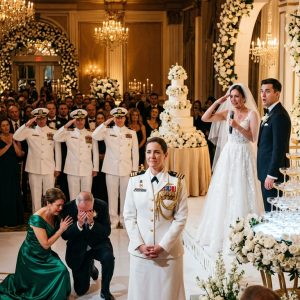
He did not stoop. He did not hunch with pity. He lowered his tall frame with absolute, fluid grace, dropping to one knee so that his eyes were perfectly level with mine. It was the exact posture of a knight presenting himself before a monarch.
Behind me, my mother gasped, stumbling back a step, her hands flying to her mouth.
“My name is Wesley Williams,” he said. His voice was a low, resonant baritone, vibrating with quiet power. “I work the kitchen at Bellwood. I am profoundly sorry for what that boy said. For all of it.”
I didn’t lift my head. The tears had finally broken free, leaving dark, humiliating stains on the silver silk stretched uselessly over my knees.
“Miss Ashford,” Wesley said softly. “May I have this dance?”
The request hung in the air. It was delivered with such gentle authority, so completely devoid of the suffocating pity I had drowned in for two years, that my chin lifted involuntarily. It felt as though he had pulled a string attached directly to my sternum.
My eyes—green, bloodshot, terrified—locked onto his deep brown ones.
“I know what they whispered about your legs,” Wesley murmured, leaning in so only I could hear. “They were wrong. Twelve hospitals were fundamentally wrong. Your spine is not the concrete prison they convinced you it was. I can feel the misalignment from where I’m standing.”
My breath hitched. My heart hammered violently against my ribs.
“But before I prove them wrong,” Wesley continued, his gaze never wavering, “I would like to be the first man in this room tonight who treats you like a woman, rather than a clinical diagnosis. Will you grant me one dance?”
My lower lip trembled violently. For two years, my right hand had suffered from a persistent, nervous tremor caused by neurological shock. Slowly, like a submerged object breaking the surface of deep water, I lifted my shaking hand from the leather armrest.
I placed it into his waiting palm.
“Yes,” I whispered.
A collective, theatrical gasp ripped through the front VIP tables.
Trevor Hamilton let out a sharp, incredulous bark of laughter, but it arrived half a beat too late and sounded incredibly brittle. “Oh, this is going to be hilarious,” he projected to his friends. “The charity case dancing with the vegetable.”
None of his friends laughed. They were too busy staring at Coach Moore, who had silently manifested directly behind them.
Headmaster Gregory Wilson shot up from his chair, his face flushed with institutional panic. “Now, see here! Wait just a goddamn minute—”
Coach Moore’s massive hand descended onto the Headmaster’s bespoke shoulder like an anvil. “Gregory. Sit your ass down.”
“Lawrence, I absolutely cannot allow a staff member to—”
“I said sit down,” Coach Moore growled, his voice vibrating with lethal intent. “You are about to witness something you will be telling your grandchildren about.”
Wesley ignored the commotion entirely. Still kneeling, still holding my trembling hand, he turned his head precisely forty-five degrees toward the orchestra pit.
He raised his free hand. He extended three fingers, holding them aloft in a hyper-specific, polished gesture.
Jeffrey Brown, the internationally renowned conductor of the symphony, saw the hand. His baton froze mid-arc. The blood drained from his face, leaving him chalk-white. He stared at the teenage busboy. He stared at my wheelchair. He stared back at the hand.
Slowly, with hands that were suddenly trembling, the great conductor lowered his baton. He leaned over his podium and frantically whispered three harsh German syllables to his string section.
The melancholy Chopin abruptly ceased. The violinists hoisted their instruments. A long, piercing, perfectly tuned ‘A’ note soared into the Baccarat crystals, hanging in the air like a drawn sword.
At table four, an eighty-one-year-old woman draped in heavy emerald silk dropped her silver-handled cane. Madame Eleanor Brooks, a legendary retired diagnostician who hadn’t been seen standing in public for three years, forced herself upright. She pressed a trembling, liver-spotted hand to her chest, her eyes locked onto Wesley with an expression of sheer terror and awe.
“Merciful God,” she whispered to the empty air. “It cannot be.”
Wesley released my hand. He shifted his weight, moving to my side. He placed his right palm lightly, almost reverently, against the back of my silver gown, hovering just above my shoulder blades.
“Trust me for exactly one minute, Miss Ashford,” he whispered into my hair. “Just one.”
And then, the thunderous, sweeping opening chord of Johann Strauss’s Tales from the Vienna Woods detonated across the ballroom.
But Wesley did not attempt to drag my wheelchair onto the floor. Instead, as the music swelled, his fingers began to move down my spine, tracing the vertebrae through the silk, and I felt a sensation I hadn’t experienced in two years: the terrifying, impossible heat of someone unlocking the cage.
Chapter 4: The Three Gates
The sweeping majesty of Strauss filled the cavernous room, but Wesley Williams was not waltzing. He was conducting an invasive, impossibly rapid medical examination right in front of four hundred people.
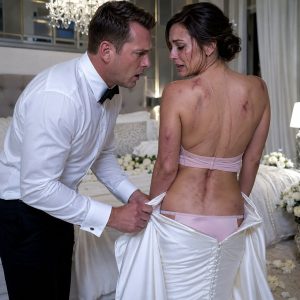
His right hand, resting lightly between my shoulder blades, began a slow, deliberate descent down the zipper line of my dress. His fingertips pressed, released, and mapped the bone structure beneath the silk. It felt as though he were reading a highly complex braille manuscript embedded in my skeletal system.
“What… what are you doing?” I gasped, my voice barely audible over the violins.
“I am listening to your bones,” he replied smoothly.
His thumb anchored at the base of my ribcage. He began to manually count the vertebrae, walking downward with terrifying precision.
T10. T11. T12. L1.
His hand slammed to a halt at the L1 junction. He remained perfectly still for three agonizing seconds. I felt the muscles in his jaw tighten.
“Four millimeters left of dead center,” he muttered, more to himself than to me. “Eight degrees of axial twist.”
His hand continued its journey, traveling lower, his fingertips fluttering like moth wings along the invisible path of the sciatic nerve root where it exited the lumbar spine, plunging down into the dead zones of my legs. He was feeling the dense, fibrotic scar tissue that had essentially formed a chokehold around my central nervous system.
He closed his eyes for one profound heartbeat. When he opened them, the darkness in his gaze had been replaced by a blazing, terrifying certainty.
“Miss Ashford,” Wesley said, his voice cutting through the music. “I need to give you three pieces of data, and I need you to absorb all of them before you speak. Understood?”
I gave a frantic, jerky nod.
“One. Your spinal cord was never severed. It is entirely intact. It has been intact since the moment you hit the dirt.”
A small, choked sound escaped my throat, like glass shattering under pressure.
“Two,” he continued, his fingers still locked onto the L1 ridge. “The vertebrae above your injury site violently rotated during the impact. It locked into an unnatural rotation, creating a massive compression on the dura surrounding the sciatic nerve root. Over the last two years, your body’s ligaments have heavily scarred over that compression. A dozen world-class surgeons looked at your MRI scans, saw a massive dead zone, and diagnosed a paralyzed cord because that is precisely what their textbooks trained them to see. Not a single one of them physically palpated the rotation.”
My hands had gone ice-cold. My chest was heaving.
“Three,” Wesley said, dropping his voice to a fierce whisper. “I can fix this. Tonight. On this floor. In approximately three minutes. If you will give me permission.”
Behind my chair, my mother lost whatever thread of sanity she was still holding onto. She lunged forward, her nails digging into the leather backrest to keep her legs from buckling.
“Sir! Who the hell are you?” she shrieked hysterically. “What are you whispering to my daughter?”
Wesley did not break eye contact with me. “Ma’am,” he said respectfully, “I am asking your daughter’s permission to heal her. Not yours. Not the Headmaster’s. Hers.”
From the far end of the ballroom, the patriarch erupted. Harrison Ashford was charging across the floor, bulldozing past waiters and floral arrangements, his face a mask of terrifying, purple rage.
“Get away from her!” my father roared. “Security! Get this boy away from my child!”
But before my father could breach the dance floor, a figure stepped into his path.
It was Madame Eleanor Brooks. She had hobbled across the room faster than a woman her age should be capable of. She thrust her silver cane out, hooking my father’s tuxedo sleeve.
“Harrison! Stop exactly where you are!” Eleanor barked, her voice possessing the crack of a whip.
“Eleanor, get out of my way, that boy is assaulting my—”
“Look at his hands, Harrison!” Eleanor screamed, pointing a violently trembling finger at Wesley. “Look at the boy’s hands!”
My father froze. He looked.
Wesley’s right hand was still anchored to my lower back. But his fingers were not groping. They were locked onto precise, microscopic anatomical landmarks. His index finger rested flawlessly on the L1 spinous process; his middle finger stabilized two vertebrae down; his thumb cradled the iliac crest. It was the grip of a master technician.
Eleanor’s voice broke into a jagged sob. “Harrison, I spent forty years training under the most brilliant spinal reconstructive surgeons on this earth. I have never, in my entire life, witnessed a human hand identify a micro-rotation of the L1 through a heavy silk ballgown in under thirty seconds. Let the boy work.”
“Eleanor, you’re insane, she’s a paraplegic—”
“Then ask her, Harrison!” Eleanor demanded. “Ask Savannah!”
My father spun toward me. His mouth hung open. The CEO who controlled billions of dollars, the man who dictated terms to governments, was entirely powerless. He had burned thirty-two million dollars chasing ghosts, and the only tangible answer was kneeling on his floor in a cheap tuxedo.
“Savannah,” my father choked out, his voice cracking. “Baby girl… whatever you want.”
I looked at Wesley. The tears had stopped falling. In their place, a tiny, terrifying ember of rage and hope ignited in my chest.
“Do it,” I whispered.
Wesley nodded once. He stood up. “I require you out of this chair, Miss Ashford. Face down. The blue velvet chaise lounge will suffice.”
The antique chaise was situated ten feet away. Wesley didn’t ask for assistance. He slid one strong arm beneath my dead knees, the other firmly under my shoulder blades. He lifted me from the wheelchair with the flawless, stabilized alignment of an ICU orderly who had performed the maneuver ten thousand times.
He carried me to the chaise. He laid me face down against the velvet, respectfully smoothing the silver silk over my lifeless legs to preserve my dignity. Then, he stood to his full height and addressed the four hundred people staring at him.
“I need every single person in this room behind the perimeter tables. Right now. Zero cell phones. Zero flash photography.”
The crowd remained paralyzed in shock.
Coach Moore stepped forward, his massive frame radiating intimidation. He issued one word.
“Move.”
Four hundred billionaires scrambled backward like frightened sheep.
Wesley knelt beside the chaise. He laid both of his warm, broad palms flat against my lower back.
“Miss Ashford,” he said, his tone shifting into clinical focus. “Step one will generate significant heat. Step two will feel like a thousand needles driving into your skin. Step three will produce a very loud, sharp sound. After that sound… we will know the truth.”
“Wesley?” I breathed into the velvet.
“Yes.”
“What if… what if you’re wrong?”
He was silent for a heavy second. “Then we will have wasted three minutes. You will return to your chair, and I will spend the remainder of my life seeking your forgiveness. But, Miss Ashford,” his hands tightened on my spine, “I am not wrong.”
He engaged what he called ‘The Three Gates’.
He applied immense, localized pressure to three specific points along my sciatic pathway. He held each compression for exactly seven beats of my heart, syncing his pressure with my pulse.
On the seventh beat of the third gate, a violent rush of energy exploded in my lower back.
“Oh my God,” I gasped, my fingers digging into the upholstery. “I feel heat. Wesley, it’s burning.”
Beside the chaise, my mother collapsed onto the floor, burying her face in her hands, sobbing uncontrollably. My father stood frozen above her, tears freely tracking down his weathered face.
From the safety of the crowd, Trevor Hamilton sneered loudly. “This is rigged! It’s a parlor trick! He probably gave her a shot of adrenaline—”
No one even turned to look at him. He was already a ghost.
Wesley rapidly repositioned his hands. His right palm locked flat over the L1 anomaly. His left forearm braced heavily beneath my lower ribs, locking my torso into a rigid plane.
“Inhale deeply,” Wesley commanded. “Exhale completely. Empty your lungs. Now.”
He waited for the absolute bottom of my breath.
“One. Two. Three.”
Wesley thrust his body weight downward and twisted.
The sound that erupted from my spine was horrifyingly loud. It was a brutal, echoing CRACK, like a heavy oak branch snapping in a quiet winter forest, or a piano hammer violently striking a bass string.
I inhaled a ragged, screaming breath. My eyes shot wide open.
A sensation like liquid lightning shot down my thighs, through my calves, and slammed into the soles of my feet. It was agonizing. It was the most beautiful pain I had ever experienced in my life.
“Oh my God,” I screamed. “I can feel them! I can feel my feet!”
Wesley did not cheer. He did not pump his fist. His eyes remained locked like lasers on the hem of my dress.
Inside my silver, custom-made heels—shoes I hadn’t voluntarily moved in twenty-four months—my pale, atrophied toes twitched.
They curled inward. They released. They curled again.
But the true terror was yet to come, because possessing sensation is entirely different from bearing weight, and the boy kneeling beside me was about to demand that I stand up in front of the world.
Chapter 5: The First Syllable of Defiance
The ballroom erupted into a chaotic symphony of weeping and stunned disbelief, but Wesley’s focus remained absolute.
“Miss Ashford,” he said, his voice a steady anchor in the storm. “I am going to assist you in sitting up. The nerve pathways are currently flooding with signals they haven’t processed in two years. It will feel as though your legs are on fire. That is the necessary agony of waking up.”
He slipped an arm beneath my collarbone and hoisted me upright on the edge of the chaise. He executed the movement with the terrifyingly practiced economy of a seasoned trauma physician. He dropped to both knees directly in front of me, taking my trembling hands in his.
“Now,” Wesley said, looking up into my face. “You must stand.”
Panic seized my throat. “Wesley, I can’t. My muscles… there’s nothing there.”
“You can,” he insisted fiercely. “Do not attempt to push off. Lean your entire upper body weight forward into my hands. Let your legs remain passive. Just allow them to exist beneath you.”
I squeezed my eyes shut. I leaned forward, effectively falling toward him.
His grip on my hands was ironclad. He absorbed my weight.
I rose. Eight inches. Twelve inches. The heavy silver silk of my gown cascaded toward the parquet floor, unfurling like a banner of victory.
My knees knocked together violently. My thighs shook with uncontrollable tremors. But Wesley’s hands held me suspended.
For three agonizing, impossible seconds, I stood completely upright on the floor of my own birthday ball.
And then, entirely independent of Wesley’s pull, my right foot dragged itself half a step forward to stabilize my weight.
My mother let out a feral, keening scream of pure joy. My father collapsed onto both knees beside her, burying his face in his hands, his shoulders heaving.
As Wesley straightened up to support my new height, the movement caught the chain of the silver locket hidden beneath his shirt. The cheap metal snagged violently on the borrowed cufflink of his tuxedo. The clasp snapped.
The locket tumbled into Wesley’s open palm. The tiny hinge swung open, exposing the photograph hidden inside.
Madame Eleanor Brooks, standing mere feet away, leaned forward to inspect the jewelry. Her cane clattered uselessly to the floor.
“William,” she gasped, all the air leaving her lungs.
The whisper carried in the stunned silence. Eleanor’s trembling hand reached out, hovering inches from the open locket, but she didn’t dare touch it.
Every veteran medical professional in the room recognized the faded photograph. It depicted a tall, powerfully built Black man in a pristine white lab coat, kneeling on the warped wooden porch of a rural clinic. He was holding a laughing, five-year-old boy in his arms. The hand-painted sign in the background read: Williams Family Medicine. Free Care. Knox Hollow, West Virginia.
“That…” Eleanor’s voice shattered. “That is Doctor William Williams. The Miracle Doctor of Appalachia.”
A shockwave of recognition detonated across the older guests. At table six, a retired chief of neurosurgery shot to his feet. The wife of the Supreme Court justice pressed her hand to her mouth—her own father had been saved by Dr. Williams’s scalpel in 1991. A socialite from Atlanta abruptly sat down on the floor, weeping, because William Williams had fused her sister’s spine in 2009, mere months before his own tragic death.
Wesley’s eyes remained locked on me, ensuring I didn’t fall, but his free hand gently closed over the locket. For the first time all night, a microscopic tremor of emotion betrayed his stoic posture.
Eleanor took a ragged step toward him. “Young man. Look at me. Are you… are you Will’s boy?”
Wesley slowly rotated his head. He looked at the woman who had, decades ago, trained his father at Johns Hopkins.
“Yes, ma’am,” he said softly.
“Oh, sweet child,” my father choked out, rising from his knees, his face a mess of tears. “Your father… your father was the man who saved my niece’s life at Charleston General during the bridge collapse.”
“Yes, sir.”
“And your mother?”
“Margaret Williams,” Wesley replied, his voice tightening. “Emergency Room charge nurse. She passed away from metastatic breast cancer four years ago. But before she died, she spent every night—four hours a night for four years—teaching me every single diagnostic and adjustment technique my father ever taught her.”
Eleanor closed her eyes, tears cutting through her expensive powder. “Why, child? Why didn’t anyone know? Why in God’s name are you washing dishes at Bellwood Academy?”
Wesley looked down at the silver casing in his palm. “Because my father always told me that a physician who heals in order to be recognized is not a doctor. He is a salesman. And on the night my mother passed, she made me swear an oath. She said, ‘Wesley, only ever utilize your hands because somebody desperately needs you. Never because an audience is watching.’“
The ballroom was so profoundly silent that the squeak of a waiter’s shoe sounded like a gunshot.
I squeezed his hand. “But tonight, Wesley… somebody needed you.”
He smiled, a sad, beautiful thing. “Yes, Miss Ashford.”
But standing was merely the prologue. Walking after twenty-four months of profound motor atrophy is attempting to speak a language you have entirely forgotten.
My right knee buckled violently.
Wesley caught me under the armpits before I dropped two inches. “Easy. I’ve got you. The neurological signal is firing, but the muscle tissue has forgotten how to translate the data. We have to reteach it. Right here. Right now.”
He locked his eyes onto mine. “I am going to walk you across this floor. Eight steps. We are going to dance the Strauss waltz the exact way you were supposed to dance it tonight. Your legs are going to scream. They will try to quit. You will lean every ounce of your existence into my frame. If you fall, I will catch you. Every single time. Do you understand?”
“Yes,” I sobbed.
Wesley turned his head two degrees toward the orchestra. Conductor Jeffrey Brown didn’t need a verbal command. He slashed his baton downward.
From the shadows, Trevor Hamilton made his final, fatal error.
“This is insane!” Trevor shrieked, his voice cracking with panic as his reality unspooled. “It’s a stunt! He drugged her! Look at her, she’s going to collapse!”
He shoved past his friends, raising his hand, intending to violently pull me back into the wheelchair to prove his pathetic point.
He didn’t make it three feet.
Coach Lawrence Moore materialized like a brick wall, stepping directly into Trevor’s path. The massive former Marine clamped his massive hand around Trevor’s wrist with the terrifying restraint of a man who knew exactly how much pressure was required to snap the bone.
“Son,” Coach Moore growled.
“Get your hands off me, you glorified gym teacher! My father will—”
“Your father is sitting right over there,” Coach Moore interrupted, his voice dropping to a lethal whisper. “And right now, he is praying you shut your mouth. You have crossed every conceivable line of decency tonight. You will step back. You will sit in your chair. And you will not utter another syllable until this young lady finishes her dance.”
“Or what?” Trevor spat, though the fear was bleeding into his eyes.
“Or,” Coach Moore said mildly, “I will allow Harrison Ashford to decide your fate.”
Trevor looked past the Coach. My father was standing three feet away. His hands were loose at his sides, his face possessing the terrifying, cold absolute zero of a billionaire who was actively calculating how many minutes it would take to systematically destroy Trevor’s entire bloodline.
Trevor swallowed hard. He stepped back. He slunk to his chair.
The orchestra swelled. Tales from the Vienna Woods, picking up at the second movement. The one that sounds like the sun breaking over a mountain.
“Right foot first,” Wesley commanded gently.
I stared at my silver shoe. I commanded it to move. The thigh muscle trembled like a plucked guitar string. Then, with agonizing slowness, the foot slid forward four inches.
“Left foot,” Wesley coached. “Do not look at the floor. Look at me.”
My left foot advanced five inches.
“Now, we breathe,” he said, shifting his weight. “Strauss dictates the rhythm. One, two, three. Let your shoulders initiate the turn. Your hips will follow.”
He stepped to his left. My body, tethered to his, followed.
Slowly, miraculously, a full circle began to trace itself upon the parquet floor of Ashford Manor. The epicenter of the room was a destitute orphan in a borrowed coat and a paralyzed heiress remembering how to fly.
On the third rotation, Wesley’s right hand drifted seamlessly into the standard closed-hold ballroom frame—the exact, highly specialized adaptive posture used by physical therapists to support patients bearing weight for the first time.
Eleanor Brooks gasped. “That… that is Vivian Hartman’s adaptive frame.”
She had no way of knowing that Wesley’s mother had been mentored by a legendary Viennese adaptive dance coach, who had taught her that the ultimate proof of a healed spine was the ability to waltz.
On the fifth rotation, I laughed. It was a loud, startling bark of pure joy. The sound shocked my mother so deeply she cried out.
On the sixth rotation, my weaker left leg gave out. I plunged toward the floor.
Wesley didn’t break the rhythm. He fluidly swept his arm beneath my knees, lifting me into a suspended cradle for exactly two beats of the music, bringing me safely back to my feet on the third beat, seamlessly resuming the turn as if it were choreographed.
The room erupted.
On the final, crashing crescendo of the Vienna Woods, Wesley guided me into a slow, supported backward lean. His hand cradled the exact spot on my spine he had healed. The Baccarat light caught the tears on my face. My silver gown flared like a blossoming lotus.
He brought me back up. I stood on my own two feet, holding the hand of my savior.
And as the deafening roar of four hundred people filled the room, the true magnitude of what Wesley Williams had set into motion finally snapped into focus.
Chapter 6: The Legacy of Knox Hollow
The applause did not cease for four consecutive minutes.
It was not polite, golf-clap applause. It was a thunderous, table-pounding standing ovation from the most cynical, hardened power brokers in the American South. Surgeons wept openly. Senators shouted themselves hoarse.
I looked up into Wesley’s exhausted, beautiful face. I pressed my hand flat against my own violently beating heart.
“I forgot I was still in here,” I whispered.
Wesley lifted my hand, pressing his lips to my knuckles with the reverence of a holy sacrament. “Welcome back to the world, Miss Ashford.”
When the noise finally crested and faded, my father, Harrison Ashford III, did something no man in his lineage had executed in three generations.
He walked to the center of the dance floor, stood before the eighteen-year-old orphan who washed dishes for a living, and dropped heavily onto one knee.
The billionaire took Wesley’s scarred, calloused hands in his own.
“Son,” my father wept, his voice echoing in the silent room. “There is no volume of wealth on this earth that can adequately balance the ledger for what you have returned to me tonight. But I swear this to you: as long as I draw breath, you will never want for anything. You will never sleep in a cold room. You will never wash another dish unless it brings you joy. From this moment forward, the Ashford family is your blood.”
Wesley’s stoic facade finally cracked. A single tear escaped his eye. He swallowed hard.
“Sir,” Wesley said softly. “My father would have done the exact same thing for you, for free.”
“I know he would have,” my father replied, standing up. He turned to face the four hundred witnesses. “For two years, the greatest medical minds told me my daughter was a lost cause. Tonight, a boy this room treated as garbage gave me back my child. Effective tomorrow morning at nine A.M., the Ashford Foundation will formally endow fifty million dollars to establish the William Williams Memorial Clinic in Knox Hollow, West Virginia. Free medical care. No exceptions. It will be overseen by the finest physicians in the country, until Dr. Williams’s son is of age to take his rightful place at its head.”
The room exploded again.
Across the floor, Trevor Hamilton sat entirely alone. His lacrosse disciples had quietly abandoned him, migrating three tables away to distance themselves from the blast radius. His father, the Senator, had already fled the property in disgrace.
The video of the waltz hit the internet before midnight.
The wife of a state senator at table six had discreetly recorded the entire sequence on her phone, from the moment Wesley knelt to the final dip. She uploaded it with a stark caption: I witnessed a miracle.
It amassed eleven million views in seventy-two hours.
By Tuesday, the New York Times had satellite trucks parked at our gates. By Friday, I gave my first live interview on the manor steps, leaning heavily on a wooden cane, with Wesley standing a quiet, protective step behind me.
The hashtag #JusticeForWesley dominated global algorithms for nine days. The livestream audio of Trevor Hamilton hurling slurs at an orphan—seconds before that same orphan accomplished what twelve hospitals could not—became the most damning viral clip of the decade.
Senator Charles Hamilton lost his reelection bid in a historic, twenty-two-point landslide. Trevor was unceremoniously expelled from Bellwood Academy within ninety-six hours, and the University of Virginia aggressively rescinded his admission. The last time anyone in our circle heard his name, he was managing a mid-tier logistics firm in Wyoming, entirely erased from the society he had tried to weaponize.
In the spring, Wesley Williams accepted a fully endowed, unconditional scholarship to the Johns Hopkins University School of Medicine—the exact institution his father had conquered thirty-one years prior. The acceptance envelope was hand-delivered to the St. Augustine’s Home for Boys by Madame Eleanor Brooks herself, who had marched into the admissions office and slammed her cane on the dean’s desk.
I underwent brutal, agonizing physical therapy. But by summer, I was walking unaided. By autumn, I was back in the saddle of a calm bay mare. I eventually accepted an offer from Duke University, where I secured my law degree, specializing entirely in disability advocacy and medical malpractice.
Every single year, on the exact anniversary of the ball, Wesley flies into Charleston. We return to the parquet floor of Ashford Manor. Conductor Jeffrey Brown lifts his baton, Madame Eleanor Brooks watches from the front row, and we dance one flawless rotation of Tales from the Vienna Woods. It is the only encore we will ever allow.
The William Williams Memorial Clinic opened its doors in Knox Hollow exactly eleven months after the ball. They bought the original wooden building from the locket photograph. Hanging in the reception area is a framed piece of parchment, displaying the final words Margaret Williams ever wrote to her son.
Only ever heal because somebody needs you. Not because anybody is watching.
This narrative was never truly about a waltz. It is an indictment of human blindness. It is a story about the people we actively choose to render invisible.
Every single grand ballroom contains a Wesley—someone carrying unimaginable gifts, quietly refilling water glasses in the shadows. Every wheelchair holds a Savannah—a vibrant soul trapped behind the world’s assumptions. And every society harbors a Trevor Hamilton—a coward who believes cruelty is a substitute for character.
The most devastating weapon in the human arsenal is the language we use to strip others of their humanity: broken doll, charity case, the help. But the most profound rebellion is the act of stepping forward in a room that was designed to exclude you, and deciding that your gift belongs to the broken person on the floor, regardless of the consequence.
Dignity does not require a functioning spine. Brilliance does not require a trust fund. It never did.
If Dr. Wesley Williams’s journey of quiet defiance and miraculous healing moved you, if you have ever been the invisible soul in the room, or if you wish you had stood up when cruelty took the floor, please like and share this post! Drop #JusticeForWesley in the comments below, and subscribe to our channel for more stories of undeniable triumph.