The Architecture of a Last Name
Chapter 1: The Weight of an Echo
I used to labor under the naive assumption that true humiliation had to be a loud, explosive phenomenon to completely destroy you. I thought it required shouting matches, shattered glass, and violent gestures. But on a crisp November evening, I learned a far more sinister truth. True devastation does not scream; it arrives wrapped in a practiced, photogenic smile, delivered across a candlelit family dinner table.
My brother leaned back in his leather chair, looking for all the world like he had been rehearsing this precise maneuver since childhood. He locked his gaze with mine, his eyes completely devoid of warmth, and let the words slip from his mouth like poison dripping off a blade.
“You don’t deserve to carry our last name.”
Nobody gasped. Nobody laughed. That deafening, complicit silence was the most agonizing part of the entire ordeal. My mother, Marlene, offered a minuscule, almost imperceptible nod—as if my brother had finally articulated a universal truth the entire family had been quietly harboring for decades. My father, Paul, immediately lowered his gaze to his half-eaten prime rib, pretending that the arrangement of his silverware was infinitely more critical than watching his twenty-nine-year-old daughter be verbally eradicated in front of fifty guests.
For several agonizing heartbeats, the atmosphere in the private dining room felt suspended in amber. Every eye in the room tracked my reaction the way a morbid crowd watches a glass vase teetering on the edge of a mahogany table, collectively holding their breath, waiting for the inevitable crack. I could feel a hot, prickly flush creeping up my neck and blooming across my cheeks, but I clenched my jaw. I adamantly refused to grant him the hysterical breakdown he so desperately craved. He maintained that sickening smirk, thoroughly bloated with his own arrogance, entirely convinced he had finally banished me back to the obscure, invisible corner where he believed I belonged.
Then, a harsh, metallic scrape shattered the quiet. The heavy oak chair at the head of the table was pushed back. My grandfather, Theodore Calloway, slowly rose to his feet.
He didn’t slam a fist. He didn’t raise his baritone voice by a single decibel. He didn’t even look particularly enraged. Yet, somehow, his calm, deliberate movements made the sprawling room grow even quieter, the silence morphing from awkward to terrifying. He turned his weathered, hawkish gaze toward my brother and spoke with the finality of a judge delivering a sentence.
“Then she’ll carry mine. And absolutely everything that comes with it.”
My brother’s triumphant smile evaporated so violently it almost looked like a physical injury. His knuckles turned a ghostly white as his hand strangled his crystal water glass. “No,” he stammered, his voice dropping to a panicked whisper. “Grandpa, you can’t do this to me.”
And in that electric, breathless moment, a chilling realization washed over my consciousness. This extravagant dinner, this gathering of elites, had never actually been about my last name. It was the culmination of a clandestine war, a secret execution my family believed had already been signed, sealed, and delivered.
But to make you truly comprehend why those words sliced straight through to the marrow of my bones, I need to rewind. I need to show you the architectural blueprints of my family’s dysfunction. You need to understand precisely what the Calloway moniker signified in our city.
I was born Jasmine Reed, tethered legally to my father’s mundane surname. However, the name that commanded hushed reverence, the name that opened doors and silenced boardrooms, belonged to my mother’s lineage. My grandfather built that towering legacy out of rust, grit, and desperate hours. He started with Calloway Works—a single, dilapidated repair garage huddled dangerously close to the riverbanks, armed with two heavily mortgaged machines and a stubborn reputation for answering the phone when the city was drowning.
Decade by grinding decade, that drafty little garage evolved. It expanded into an empire that maintained municipal floodgates, resurrected failing storm drains, and engineered emergency pump systems across the state. In his twilight years, Grandpa transformed the sprawling, oil-stained eastern wing of the facility into the Calloway Apprenticeship Foundation. It was a sanctuary for marginalized youth—kids who possessed empty pockets but a desperate hunger for a tangible skill and a second chance at life.
In the gritty heart of our municipality, being a Calloway did not denote inherited luxury or country club memberships. It meant unbreakable reliability. It meant salvation during a hurricane.
Yet, within the velvet-lined walls of my immediate family, that noble meaning had slowly, toxically mutated into a weapon of social status. My mother was intoxicated by the aristocratic deference she received at charity galas simply by dropping her maiden name. My father, a man who possessed the backbone of a wet sponge, had married into this formidable dynasty and survived exclusively by echoing the opinions of whoever commanded the largest bank account in the room.
And then there was my older brother, Damon. At thirty-one, Damon had internalized a catastrophic lesson early in his development: if you project your voice loudly enough, flash a veneered smile confidently enough, and ensure a Rolex is peeking out from beneath your tailored cuff, society will blindly mistake you for a visionary.
Damon was the golden child, crowned at birth. He was a senior partner at Apex Horizon Realty, trafficking in ultra-luxury riverfront properties, selling the illusion of community to wealthy investors who preferred the aesthetic of a neighborhood without the inconvenience of interacting with the actual locals. Every predatory deal he closed was treated as a royal decree by my mother. Every glossy magazine spread featuring him in a bespoke suit was framed as indisputable evidence of his destiny. Whenever he steamrolled a colleague in conversation, my mother applauded his “dominant leadership.” Whenever I remained measured and analytical, she lamented my “tragic lack of ambition.”
I had carved my own path as a municipal civil engineer. My daily reality was decidedly unglamorous. I spent my hours dissecting subterranean drainage schematics, inspecting corroding municipal pipes, compiling neighborhood flood-risk assessments, and maintaining the invisible, vital systems that civilians only ever think about when disaster strikes.
Grandpa was the solitary figure in my bloodline who grasped the gravity of my profession. He would summon me to his study, pour us two glasses of neat bourbon, and ask probing, technical questions. He wanted to know which sectors of the grid were failing, which low-income wards were in jeopardy, and how many working-class families could be shielded from ruin by preemptive infrastructure upgrades. When I presented my data, he listened with a fierce, unwavering intensity. He treated my words as if they carried the weight of the world.
Conversely, at Sunday family brunches, my mother would offer a patronizing, vacuous smile, pat my hand, and purr, “That sounds terribly exhausting, honey.” She would immediately pivot, her eyes gleaming, to interrogate Damon about his latest multimillion-dollar acquisition. My father would merely nod at his coffee cup. Damon would chuckle, a condescending sound that grated against my spine, and refer to me as “the pipe girl”—as if safeguarding a metropolis from catastrophic flooding was a quaint, eccentric hobby.
For an agonizingly long time, I wrapped myself in the armor of denial. I constantly reminded myself that validation was unnecessary. You don’t need a standing ovation to do work that matters, I would whisper into the mirror.
But I was lying to myself. There is a deeply specific, hollow ache that takes root in your chest when you realize you are indispensable to thousands of strangers, yet entirely invisible to the people who share your DNA.
I remember Grandpa pulling me aside one rainy afternoon in the shop. “A name is not a polished trophy to be paraded around, Jasmine,” he had murmured, his rough hand resting on my shoulder. “It is an unbreakable promise.”
I was painfully unaware at the time that he was conducting a silent audit. He was watching us, measuring our character, waiting patiently to determine which of his grandchildren comprehended the sacred distinction between shouldering a legacy and merely cashing it in.
Damon, naturally, believed he was the undisputed heir apparent. My mother fervently championed this delusion. My father, as always, abstained from offering an opinion, but his cowardly silence leaned heavily in Damon’s favor.
The first tremors of the earthquake struck roughly a month prior to Grandpa’s eighty-second birthday. During a tedious Sunday roast, Damon, flushed with wine and ego, lifted his crystal goblet. He surveyed the table, let out a predatory chuckle, and proclaimed, “Grandpa spent his life building the Calloway brand, but I’m the one who finally possesses the vision to liquidate it for what it’s truly worth.”
My mother giggled, a breathy, sycophantic sound, as if he had just delivered a stroke of unparalleled genius. My father offered a weak, obliging smile.
Grandpa did not laugh. He didn’t even blink. He simply stared at Damon, his expression an unreadable, granite mask.
That was the exact moment the tectonic plates beneath my family ruptured. I had previously assumed Damon was merely a harmless, arrogant showboat. I was entirely blind to the horrifying reality that he had already begun sharpening his knives, fully intent on carving up our grandfather’s life’s work for parts.
And as my phone buzzed in my pocket three weeks before the party, bringing a notification that would unravel everything, I realized my brother wasn’t just arrogant. He was dangerous.
Chapter 2: The Blueprint of Betrayal
The family’s digital group chat, usually a dormant space reserved for holiday logistics and my mother’s passive-aggressive articles on modern etiquette, suddenly morphed into Damon’s personal theater.
My mother initiated the barrage. Please clear your schedules for the 18th, she typed. Your grandfather’s 82nd is going to be monumental. Black-tie optional. Arrive punctually, and please, let us maintain a sophisticated atmosphere. No unnecessary drama.
In the twisted lexicon of the Reed household, “no unnecessary drama” was a direct translation for: Jasmine, do not dare contradict your brother, no matter what he does.
Merely seconds later, Damon deposited a photograph into the thread. It depicted him standing shoulder-to-shoulder with a sharply dressed, predatory-looking man outside a shimmering skyline of glass office towers. The accompanying caption read: Colossal things on the horizon for the Calloway empire. Time to evolve.
A cold knot of dread coiled tightly in my stomach, souring my morning coffee. Damon harbored absolutely zero affection for the Calloway Works. He never volunteered his weekends to mentor the apprentices. He couldn’t name a single foreman on the payroll. I vividly remembered him pinching his nose in disgust as a teenager, complaining that the historic brick facility reeked of industrial grease and stale rainwater.
But what Damon did care about—with a rabid, consuming fervor—was real estate. Specifically, the sprawling acres of prime, waterfront acreage upon which the aging workshop sat. Vultures in the development sector had been circling that neighborhood for half a decade.
My suspicions solidified two days later when my phone vibrated on my desk at the municipal planning office. It was my father.
“Jazzy,” he began, his tone adopting that cautious, placating cadence he utilized whenever he was about to ask me to absorb an injustice. “Are you having a good day?”
“Skip the pleasantries, Dad. What’s Damon done now?” I asked, my eyes scanning a complex topography map of the eastern flood zone.
I heard a heavy, ragged sigh through the receiver. “Your brother has been… drafting a comprehensive proposal. Your mother is absolutely thrilled about it. I’m just calling to ask—to beg, really—that you promise not to make things combative at the dinner next week.”
I dropped my red pen. It clattered loudly against the desk. “A proposal regarding what, exactly?”
He hesitated, the silence stretching out awkwardly. “It’s a strategy for, well, modernizing the family’s dormant assets.”
Modernizing dormant assets. The phrase tasted like ash in my mouth. That was Damon’s sterile, corporate jargon. He wasn’t talking about fortifying the training fund or repairing the roof of the welding bay.
“Dad,” I said, my voice dropping an octave, “did Grandpa authorize this ‘modernization’?”
Another agonizing pause. “Just try to be supportive, Jasmine. For once. This could result in a highly lucrative situation for all of us.”
He hung up before I could cross-examine him further. I sat in the sterile hum of my cubicle, staring blindly at the blue and green veins of the city’s drainage map. My mind, however, was anchored to the old brick walls of Calloway Works.
The property was a goldmine waiting to be excavated. Gentrification was creeping through the district like a manicured virus. Historic warehouses were being gutted and transformed into overpriced artisan bakeries; generational repair shops were being bulldozed for boutique pilates studios. Blue-collar families who had anchored the community for sixty years were being systematically priced out, evicted by rising property taxes one renovated block at a time. I understood the cynical mathematics of urban renewal. Whenever a developer slapped the label “underutilized” onto a neighborhood, it simply meant they had willfully blinded themselves to the marginalized human beings currently thriving there.
That evening, the bomb detonated in my inbox.
Damon blasted an email to the family roster containing a forty-page, high-gloss PDF presentation entitled: A Future Worthy of the Calloway Legacy.
I clicked it open, my heart hammering against my ribs. The title page rendered me nauseous. It featured a hyper-realistic 3D rendering of towering, monolithic luxury condominiums boasting rooftop infinity pools, cascading glass balconies, and subterranean private garages.
The historic brick workshop? Obliterated.
The bustling training annex? Erased.
The grease-stained courtyard where nervous teenagers first learned to run a welding torch? Paved over and replaced by a sleek, minimalist espresso bar for the elite residents.
Damon’s executive summary lauded the proposal as a “bold, necessary paradigm shift.” He possessed the audacity to describe Grandpa’s life’s work as emotionally resonant but fiscally disastrous. Worse still, he characterized the apprenticeship foundation as a marketing liability that could be rebranded into a legacy asset.
It wasn’t a sacred duty to him. It was a PR stunt.
The deeper I scrolled into the abyss of the document, the more venomous it became. Damon wasn’t just suggesting a sale. He had orchestrated a scheme to liquidate the acreage to Mercer Lane Development while simultaneously locking himself into a staggering “consulting and transition fee.” He brazenly proposed licensing the Calloway name to brand the condominiums, ensuring the family moniker would forever be associated with gentrification.
His grand compromise for the displaced youth? He suggested downgrading the life-saving apprenticeship program into a microscopic, tax-deductible scholarship fund, complete with a tasteful “historical photo wall” in the marble lobby. It was designed so wealthy tech executives could sip their macchiatos and feel a fleeting sense of philanthropic warmth without ever having to make eye contact with the desperate kids whose futures had been stolen to build their penthouses.
By the time I reached the financial projections on page thirty-eight, my hands were trembling with a rage so pure it felt like ice in my veins. There was a detailed payout matrix distributing millions among the family members, explicitly naming my mother and father.
My name was conspicuously absent. But honestly, I was too suffocated by my fury over the apprentices to care about the insult of being financially excluded.
The next morning, I bypassed my usual coffee routine and dialed Luis.
Luis was a towering, tattooed former student from the Works. He had arrived at Grandpa’s doorstep seven years ago with a criminal record, a battered duffel bag, and zero prospects. Today, because of the skills forged in that shop, he was the Chief Director of Emergency Pump Maintenance for the county’s two largest trauma hospitals.
“Jaz,” he answered, his voice tight. “Tell me you’re calling to say the rumors are garbage.”
I closed my eyes, leaning my forehead against the cool glass of my office window. “What rumors, Luis?”
“I’ve got guys on the ground. A convoy of suits in luxury SUVs did a perimeter walk of the block yesterday. One of the surveyors was asking the local deli owner about the timeline for demolishing our training rigs before the spring thaw.”
A heavy, suffocating silence fell between us.
“Jasmine,” Luis finally whispered, his voice cracking, shedding its usual bravado. “That brick building… it saved my life. I was going to die on the street or in a cell. Please. You know your grandfather listens to you. Don’t let your brother turn our sanctuary into a lobby decoration.”
“I won’t,” I promised, the words tasting like a blood oath.
I disconnected the call. In that singular moment, a profound psychological shift occurred within me. I forcibly evicted the timid, overlooked daughter who spent her life walking on eggshells. I summoned the meticulous, relentless civil engineer—the woman Grandpa respected.
If Damon wanted to play a game of structures and blueprints, I was going to show him what happened when a real engineer inspected his foundation.
Chapter 3: Gathering the Storm
I didn’t sleep for the next four days.
My dining room table vanished beneath a mountainous terrain of documents. I utilized every credential and municipal clearance I possessed. I extracted public zoning records, labyrinthine tax filings, the original trust charters Grandpa had drafted in the nineties, regional flood zone hazard reports, and the strict, legally binding conditions attached to the municipal grants funding the apprenticeship program.
I operated in a state of hyper-focused obsession. Coffee replaced my blood. I was no longer an emotional sister; I was a forensic auditor dissecting a crime scene.
By Friday at 3:00 AM, I had synthesized a devastating, fourteen-page analytical dossier. It clinically and mathematically outlined exactly what Damon’s “paradigm shift” would genuinely cost. I documented the millions in impending litigation for breaching grant covenants. I mapped out the catastrophic PR fallout, the irreversible erosion of community trust, and the ecological hazards of building subterranean garages in a designated high-risk flood plain.
It was a masterpiece of destruction.
I knew better than to deploy this weapon in the family group chat. Damon would immediately twist it, framing my data as a hysterical, jealous outburst. My mother would phone me, weeping about my “vindictive nature.” My father would simply ask why I was so determined to ruin everyone’s happiness.
Instead, I bypassed the theatrics. I attached the encrypted PDF to an email, addressed it directly to Theodore Calloway, and typed a single, unadorned sentence in the body:
I am not trying to subvert family peace, but I believe it is critical you review the empirical facts of what this proposal will actually execute.
I hit send. And then, I waited. The anxiety gnawed at my stomach lining.
Four agonizing hours later, my phone pinged. A reply from Grandpa.
Thank you, Jasmine. I have been drowning in noise. I desperately needed the mathematics.
For the first time in an eternity, a profound sense of equilibrium settled over my shoulders. The foundation felt solid again.
But across town, Damon was behaving like an emperor who had just conquered a new continent. He was radiating a sickeningly smug energy. Social media was flooded with his preparations. He commissioned a bespoke Italian suit. He retained a professional event photographer for the birthday dinner. He began making patronizing phone calls to our extended cousins, humble-bragging about his “willingness to shoulder the heavy burden of the family’s future.”
My mother became his unpaid publicist. She whispered conspiratorially to her country club friends that Grandpa was finally preparing to formally recognize Damon’s superior intellect and hand over the keys to the kingdom. Nobody explicitly stated Damon had won, but the victory parade was already marching down the street.
By the time I pulled my sedan into the valet line on the evening of the 18th, I was no longer terrified of being relegated to the shadows. I was terrified of the devastation my brother would unleash if I didn’t step into the light and shatter his illusion.
Chapter 4: The Stage is Set
Grandpa’s eighty-second birthday gala was hosted at The Ironworks Bistro, an upscale restaurant ingeniously constructed within the cavernous shell of the original, defunct Calloway repair depot—the exact geographic coordinates where Theodore Calloway had once bled, sweated through sixteen-hour shifts, and scrubbed industrial grease from beneath his fingernails while staring at stacks of unpaid invoices.
The restaurateurs had intentionally preserved the ghosts of the past. Massive, rusted iron I-beams crisscrossed the vaulted ceiling. Vintage, black-and-white photographs of the city’s industrial era adorned the exposed brick. In one prominent frame near the entrance, a much younger Grandpa stood flanked by three teenage apprentices. They were smeared with oil, clutching heavy wrenches, and beaming at the camera as if someone had just handed them the keys to the universe.
I arrived precisely ten minutes early. In my left hand, I carried a modest gift bag containing a rare, first-edition book on aqueduct engineering. Tucked securely inside the interior pocket of my wool coat was a stiff manila folder containing hard copies of my dossier.
I had made a silent pact with myself in the car: I would not draw the sword unless absolutely necessary. I desperately wanted Grandpa to enjoy his milestone. I had no desire to trigger a gladiatorial combat in front of our extended relatives, philanthropic donors, retired foremen, and the city elites who orbited my family’s wealth.
However, the moment my heels clicked against the polished concrete of the private dining annex, my naive hopes evaporated. This was not a celebration. This was a coronation disguised as a birthday party.
The aesthetics were jarring. Instead of cozy, circular tables, two massive, rectangular banquet tables had been pushed together, resembling a corporate boardroom far more than a family gathering. Elegant, gold-embossed place cards sat beside crystal wine glasses.
And there, stationed ominously at the far end of the room near the guest of honor’s vacant chair, sat Mr. Arthur Bell, the ruthless, silver-haired family attorney who had managed the Calloway trusts since before I was a concept.
Corporate lawyers do not wear tuxedos to eat red velvet cake. They attend to execute legally binding transitions.
My mother intercepted me before I could retreat. She was draped in a suffocating cloud of Chanel, wearing a strand of pearls and the rigid, practiced smile she deployed for high-society photographers.
“Jasmine, darling. You actually made it,” she chimed, her tone implying my attendance was a bizarre, slightly inconvenient surprise.
Before I could formulate a polite response, the heavy oak doors swung open behind me, and the gravitational pull of the room violently shifted. Damon made his entrance.
My mother’s entire physiology transformed. Her eyes widened, her posture straightened, and she practically vibrated with maternal worship. She rushed past me, delicately adjusting the lapels of his midnight-blue tuxedo. “Ladies and gentlemen,” she announced, her voice carrying across the chatter, “there he is. The future of this family.”
Damon let out a velvety, rehearsed chuckle, feigning modesty while subtly scanning the room to ensure he had a captive audience. He looked immaculate, expensive, and lethally self-assured. His eyes flicked to me for a fraction of a second, his smirk confirming he wanted to ensure I had witnessed his adoration.
I spotted my father hovering near the cocktail bar, gripping a glass of sparkling water like a flotation device. He caught my eye, offered a pathetic, jerking nod of his head, and immediately stared at his shoes. That was his signature move: a fleeting pantomime of affection, completely devoid of courage or genuine fatherhood.
I navigated toward the grand table. I noticed a single, empty chair positioned directly to the right of Grandpa’s designated seat. For a fleeting, foolish millisecond, I wondered if it was meant for me.
My mother materialized at my elbow, her manicured fingers digging sharply into my bicep. “Oh, no, sweetheart. Your seating is down here.”
She aggressively steered me toward the absolute middle of the table, pulling out a chair wedged between a second cousin I hadn’t seen in a decade and a boisterous, red-faced man I recognized as my father’s golfing partner.
I sat down, my jaw clenched. I watched as Damon casually strolled to the head of the table and claimed the seat beside Grandpa’s empty chair, draping his arm over the backrest as if he owned the real estate.
Grandpa had not yet arrived. This was a calculated, theatrical delay. Damon was meticulously arranging the actors on the stage before the ultimate judge entered the auditorium.
During the cocktail hour, Damon prowled the room like a politician on the eve of an election. He glided from cluster to cluster, pumping hands, clinking glasses, and speaking in a relentless stream of corporate buzzwords. Vision. Synergy. Growth potential. Legacy actualization.
He wielded the Calloway name like a master key he had stolen from a sleeping guard, desperately jamming it into every lock he could find to see what treasures it would yield.
I lingered near a structural pillar, nursing a club soda, eavesdropping on his treachery. I heard him smoothly inform one of Grandpa’s oldest, grizzled foremen that the workshop was “vastly underperforming its terrestrial value.” I listened as he assured a prominent foundation donor that “youthful, aggressive leadership” was preparing to “repackage the philanthropic mission.”
Worst of all, I watched him corner a slick, predatory-looking man near the coat check—a man I recognized from the Mercer Lane Development brochures. Damon leaned in, clapping the developer on the shoulder. “The family is heavily burdened by sentimentality, Mark, but I assure you, we are ready.”
Ready for what? I wanted to scream. Ready to incinerate sixty years of blood and sweat? Ready to sell the sanctuary where broken kids learn how to weld a future instead of fading into prison statistics?
I squeezed my glass, repeating my mantra: Timing is everything. Emotion is the enemy.
If I launched my attack too early, without the judge present, Damon would effortlessly paint me as a hysterical, jealous sibling throwing a tantrum. If I spoke without my data, my father would sigh, my mother would chastise me, and the room would dismiss me.
Suddenly, the scent of expensive cologne assaulted my senses. Damon appeared beside me, swirling a scotch on the rocks. He surveyed the room, thoroughly intoxicated by his own reflection in the bistro’s windows. He leaned in, closing the distance until I could feel his breath on my ear.
“Do me a massive favor tonight, Jazzy,” he murmured, his voice dripping with condescension. “Try your absolute hardest not to bring up corroded pipes, city permits, or poor people. Keep the depressing stuff to yourself. Grandpa deserves an evening of ambition and class.”
A glacial chill cascaded down my spine. I was intimately acquainted with Damon’s cruelty, but the sheer, sociopathic comfort in his voice stunned me. He spoke as if possessing basic human compassion was a deeply embarrassing character flaw. He genuinely viewed the vulnerable kids Grandpa spent a lifetime pulling from the gutter as unsightly blemishes that might ruin the aesthetic of his impending coronation.
I pivoted slowly, my eyes locked on his, preparing to unleash hell.
But my words died in my throat. I looked past his tailored shoulder and saw Grandpa standing in the arched doorway.
He had heard enough.
I didn’t need him to speak; his face broadcast the truth. He wasn’t overtly furious. His expression was a terrifying, absolute stillness. The kind of stillness that precedes a devastating hurricane.
Damon, entirely absorbed in his own brilliance, remained oblivious. He took a sip of his scotch, adjusted his cuffs, and smiled.
As Grandpa stepped fully into the light, the ambient noise in the room dissolved. The respect he commanded was tangible, forged over decades of sweat equity, not inherited trust funds. He embraced my mother, offered a firm handshake to my father, politely endured Damon’s booming, overly familiar birthday greeting, and then, his eyes swept the room.
He found me standing by the pillar. For one agonizing, stretched second, our gazes locked.
I cannot articulate what he saw reflected in my eyes, but I felt the immense weight of what radiated from his. A profound sorrow. A grim warning. And an endless, terrifying patience.
The executioner had arrived.
Chapter 5: The Dinner of Knives
The banquet commenced with a veneer of forced joviality. Crystal clinked, expensive wine flowed, and polite, shallow laughter echoed off the brick walls. But Damon had historically lacked the discipline to conceal his contempt once he believed the victory lap had begun.
The appetizers—seared scallops that tasted like ash on my tongue—had barely been cleared before my brother transformed the dinner into a one-man show. He wasn’t participating in a conversation; he was presiding over a tribunal.
Every disparate topic introduced by a guest miraculously became a rhetorical pathway back to his own brilliance. If a cousin brought up the city’s waterfront revitalization, Damon immediately dominated the airspace, lecturing the table on zoning loopholes and aggressive property valuation. If a retired foreman reminisced about Grandpa’s grueling, round-the-clock emergency contracts during the flood of ’98, Damon hijacked the memory to pontificate on corporate expansion and leveraging brand equity.
Eventually, an older gentleman cleared his throat. It was Mr. Alvarez, a deeply respected civil leader and one of the original board members of the apprenticeship foundation. He turned his kind, lined face toward Damon.
“The boys at the Works are doing incredible things this season, Damon,” Mr. Alvarez said warmly. “I assume, as you step up, the mission remains the priority?”
Damon offered a smile that was all teeth and zero warmth. He adopted the tone of a weary professor explaining algebra to a toddler. “Mr. Alvarez, of course, the concept of the mission is lovely. It’s a quaint part of our history. But we must be realists. Every philanthropic endeavor requires a modern, aggressive fiscal model. We can’t let sentimentality rot the foundation’s bottom line.”
My mother gazed at Damon as if he had just descended from Mount Sinai holding stone tablets. “Damon simply possesses a profound understanding of how the modern world operates,” she announced, her voice projecting to ensure Mr. Bell, the lawyer, heard her.
My father offered a pathetic, subservient nod and took a desperate gulp of his Merlot.
I kept my eyes riveted on Grandpa. He was methodically slicing his steak, chewing slowly, and contributing absolutely nothing to the discourse. His profound silence acted like an accelerant on Damon’s ego. Damon catastrophically misinterpreted the lack of objection as an endorsement.
Roughly thirty minutes into the main course, the conversational roulette wheel landed on me. Mr. Alvarez, clearly unsettled by Damon’s corporate sociopathy, leaned across the table.
“Jasmine, my dear,” he asked softly, “how did that storm water diversion project on the East Side turn out? I know you were practically living in the mud for weeks.”
For a brief, shining moment, the cacophony at my end of the table subsided. I set down my fork, grateful for the lifeline.
“It was a massive success, Mr. Alvarez, thank you for asking,” I replied, keeping my tone professional. “That specific grid had suffered catastrophic flooding three times in the last five years. By restructuring the pump schedule and installing a modernized, high-capacity drainage nexus, we managed to keep the water levels below the danger line during last month’s torrential storm. We essentially safeguarded around two hundred working-class homes from structural ruin.”
I wasn’t fishing for applause. I was simply delivering a factual report.
But before the older man could offer his congratulations, a sharp, cruel bark of laughter cut through the air.
“That’s incredibly cute, Jaz,” Damon sneered, leaning back in his chair and swirling his wine. “Truly, it’s adorable. But I think tonight’s gathering is focused on generating real, generational wealth, not discussing municipal plumbing maintenance.”
The words struck the table like a physical blow. The atmosphere instantly curdled. Several guests offered tight, profoundly uncomfortable smiles. Mr. Alvarez’s warm expression froze into a mask of cold disgust.
I glanced at my mother. Instead of reprimanding her son for humiliating me in public, she shot me a venomous, warning glare, silently chastising me for daring to bore the table with my blue-collar profession.
I exhaled slowly, fighting the tremor in my hands, and remained totally silent.
Damon, addicted to the sound of his own voice, viewed my silence as an unconditional surrender. Emboldened, he launched into an unsolicited elevator pitch for his grand proposal. He spoke of the historic riverfront property as if he were a colonial explorer who had just discovered untouched land, blatantly ignoring the fact that the man sitting beside him had spent five decades shedding blood to protect that acreage from bankruptcies and hostile takeovers.
Damon used the phrase “undervalued dirt.” He referred to the sacred workshop as a “symbolic relic.”
And then, he crossed the Rubicon.
He referred to the apprentices—the desperate, resilient teenagers fighting for their lives—as “a beautiful, marketable narrative.”
That phrase triggered a violent physical reaction in my gut. A narrative is a fiction you spin to manipulate investors. Those kids were flesh, blood, and trauma. I knew their names. Some had aged out of the brutal foster care system. Some were carrying the weight of supporting infant siblings. Some had been told by every authority figure in their lives that they were human garbage.
Calloway Works was their church. It gave them a welding mask, a living wage, and, for the first time in their lives, dignity. Damon was reducing their salvation to a bullet point on a real estate brochure.
I glanced toward the swinging doors of the kitchen. Standing near the serving station was Luis, dressed in a waiter’s uniform. He and two other former apprentices had volunteered to cater the event as a tribute to Grandpa.
Luis’s jaw was clenched so tightly a muscle twitched near his ear. His eyes were dark, shining with unshed tears and rage. He had heard every single word of my brother’s manifesto.
The tether snapped. I could no longer play the dutiful, invisible ghost.
I leaned forward, planting my forearms on the table, and let my voice cut through the room like a scalpel.
“And what precisely happens to those apprentices, Damon, when you bulldoze their workshop to build your infinity pools?”
The clattering of silverware abruptly ceased. Damon turned his head with excruciating slowness, glaring at me as if a cockroach had just interrupted his wedding vows.
“They adapt, Jasmine,” he replied smoothly, a patronizing smirk playing on his lips. “Successful organisms always do. We can’t halt progress to babysit.”
The temperature in the room plummeted. Nobody shouted. Nobody flipped a table. But a seismic, invisible shift occurred. Mr. Alvarez lowered his gaze to his lap, shaking his head in silent mourning. The Mercer Lane developer seated near the end of the table abruptly stopped chewing, his eyes darting nervously toward Grandpa, realizing the golden boy might have just detonated a landmine.
My mother, sensing the PR disaster, frantically attempted to throw a blanket over the grenade. But true to form, she only made it exponentially worse.
“Jasmine, please stop it,” she hissed, her voice a razor-thin whisper that carried beautifully. “Tonight is not the appropriate venue to champion your little charity causes. This evening is about securing your grandfather’s monumental legacy.”
I slowly turned my head to look at the woman who gave birth to me. In that devastating moment, something ancient, heavy, and rusted inside my chest finally broke free.
For nearly three decades, I had exhausted myself trying to gently educate her. I had minimized my own accomplishments to protect her fragile worldview, swallowed thousands of microscopic humiliations, and graciously accepted her half-hearted, manipulative apologies. But hearing her dismiss the survival of human beings as my ‘little causes’ was the final, liberating blow. She wasn’t misunderstanding me. She simply valued Damon’s sociopathic ambition over my humanity.
Damon, reassured by our mother’s defense, smiled expansively. He lifted his glass, addressing the room at large.
“Look, evolution makes the weaker among us uncomfortable,” Damon philosophized smoothly. “But the harsh reality is, not everyone is genetically equipped to propel a dynasty forward. Some people are designed to merely maintain the plumbing. Others are born to lead empires.”
My mother offered a vigorous, affirming nod. My father found a fascinating imperfection in the weave of the tablecloth and stared at it with profound intensity.
Grandpa’s eyes remained locked on Damon. Unblinking.
Damon, high on his own supply, kept digging his grave. He asserted that the Calloway brand desperately required a frontman—someone photogenic, someone who commanded boardrooms, someone who didn’t smell like municipal sewer water. He declared the family had been paralyzed by toxic sentimentality for too long.
Every polished, arrogant sentence was a thinly veiled reiteration of the anthem he had sung to me my entire life: You are insignificant. You are an embarrassment. You are in my way.
My hand crept toward the lapel of my coat, my fingers brushing against the manila folder. I could have ended him right then and there. I could have thrown the dossier onto the table, exposed his fraudulent consulting fees, detailed the catastrophic grant violations, and humiliated him with raw data.
But Grandpa hadn’t twitched. And because Theodore Calloway had always taught me that weaponized patience was the purest form of power, I withdrew my hand. I sat back. And I waited for the trap to spring.
Chapter 6: The Edict
The dessert plates arrived. A towering, decadent chocolate cake adorned with sparklers was placed before Grandpa. We endured a chorus of forced, off-key singing. Damon, naturally, belted out the lyrics louder than anyone else, conducting the room with his wine glass.
As the waiters cleared the china, the atmosphere thickened. Mr. Bell, the attorney, silently unclasped his leather briefcase. He extracted a thick, slate-gray envelope and placed it deliberately beside Grandpa’s coffee saucer.
The entire table went rigid. Damon noticed the envelope immediately. His physiology altered. He straightened his spine, violently tugged at his cuffs, and smoothed his silk tie, arranging his features into a mask of humble readiness, preparing for his coronation.
My mother’s eyes sparkled with greedy, unfiltered expectation. My father looked physically ill, his skin taking on a pale, greenish hue.
Grandpa rested his large, scarred hands on the table. He didn’t touch the envelope. He surveyed the room, letting the silence stretch until it was agonizing.
“Before we proceed to legalities,” Grandpa began, his voice a low, terrifying rumble, “I would very much like to hear what Damon truly believes the Calloway name signifies.”
It was the golden ticket. The invitation Damon had been salivating over for years.
He stood up, buttoning his jacket with a flourish. He offered a slight, deferential bow to Grandpa, then beamed at the audience. He launched into a sickeningly slick monologue about “duty,” “visionary horizons,” and “the courage required to make brutal but necessary financial decisions.”
Then, his eyes lazily slid toward where I was sitting. The synthetic warmth instantly vanished from his tone, replaced by an icy, arrogant cruelty.
“Of course,” Damon pontificated, “there are those among us who remain stubbornly shackled to the past, simply because the past is the only environment where they feel remotely relevant.”
I felt the tension in the room spike, the air growing thin and brittle.
He offered a predatory smile. “Some individuals hide their cowardice behind quiet, menial labor and have the audacity to label it ‘character.’ But a monolithic legacy like ours demands more than a glorified janitor who fixes drains and writes depressing municipal reports.”
I waited.
My mother did not interrupt him.
My father did not defend me.
Grandpa remained a statue.
Damon, perceiving this collective silence as absolute, undeniable permission, took a breath and delivered the killing blow—the sentence he had been circling like a vulture all evening. The room went so terrifyingly quiet I could hear the blood roaring in my ears.
Damon stared dead into my eyes, his smile sharp with pure, sadistic satisfaction, and delivered the execution.
“Jasmine, you don’t deserve to carry our last name.”
For a prolonged, agonizing moment, the universe stopped functioning. Nobody inhaled. Even the catering staff froze in the doorways, trays suspended in mid-air.
I watched my mother. She offered that small, unmistakable nod. Quick, but devastating. The physical manifestation of decades of maternal betrayal.
I looked at my father. He lowered his eyes, hiding his face in shame. Somehow, his pathetic, cowardly surrender hurt far worse than the venom spewing from my brother’s mouth.
It is a bizarre, surreal psychological phenomenon—what the human brain chooses to focus on when you are being publicly annihilated. I noticed a tiny, jagged chip on the rim of my water goblet. I watched the reflection of a flickering candle dance against the exposed brick. And I stared at Damon’s manicured hand, resting casually near the gray envelope, staking his claim on a kingdom he believed he had already conquered.
They were all waiting for the collapse. They were waiting for my eyes to well up, for my voice to crack, for me to flee the room in hysterics. That was the only role they had ever scripted for me. Jasmine absorbs the abuse. Jasmine remains quiet. Jasmine cleans up the mess so the family can maintain the illusion.
But the tears never came. I didn’t beg for my mother’s intervention. I didn’t scream at my father’s cowardice.
I simply stared at Damon, and for the first time in my life, the terrifying, larger-than-life monster I had feared since childhood vanished. I saw him with crystalline clarity. He wasn’t a titan of industry. He was a small, insecure, hollow man desperately trying to weaponize humiliation because he possessed absolutely no authentic power of his own.
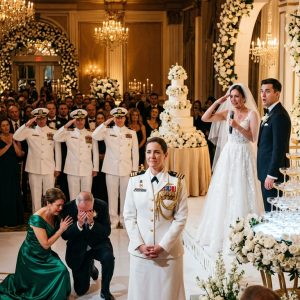
Then, the heavy oak chair scraped against the concrete. The sound sliced through the suffocating tension like a guillotine dropping.
Grandpa stood. He moved with a slow, terrifying deliberation, placing one hand flat on the table, the other resting near the gray envelope.
Damon’s smile momentarily flared brighter; the idiot actually believed Grandpa was rising to publicly anoint him. My mother sat up straighter, her pearls clinking against her collarbone. My father squeezed his eyes shut, perhaps praying for a swift death.
Grandpa did not look at the crowd. He locked his eyes onto Damon.
“You genuinely believe she is unworthy of the family name?” Grandpa asked, his tone deceptively mild.
Damon let out a short, nervous bark of laughter, still clinging to his bravado. “Well, sir, I believe someone finally had to possess the courage to say it out loud.”
Grandpa nodded once. A slow, glacial movement.
“Then she’ll carry mine,” Grandpa declared, his voice echoing off the iron beams. “And absolutely everything that comes with it.”
The smug superiority drained out of Damon’s face so rapidly it was as if someone had pulled a plug in his veins. A sickly, grayish pallor overtook his features. His fingers cramped, turning white as they gripped the back of his chair.
“No,” Damon whispered, the sound barely escaping his throat. Then, panic setting in, his voice pitched higher. “Grandpa. You can’t do this to me. Not tonight.”
“I did not do a damn thing to you,” Grandpa replied, his voice a blade of cold steel. “You brought me a platter of lies and had the audacity to label it leadership.”
Damon aggressively shook his head, his meticulously styled hair falling into his eyes. “You’re confused! You don’t understand the market! I was trying to protect what you built from rotting!”
“No.” Grandpa’s voice boomed now, rattling the crystal on the table. “You were trying to liquidate a legacy you lacked the spine to earn.”
Grandpa turned slightly and gestured to Mr. Bell. The attorney, his face completely devoid of emotion, broke the seal on the slate-gray envelope and extracted a thick sheaf of legal documents.
My mother gasped, her hand flying to her throat, her socialite mask finally shattering. “Dad, please! Whatever this is, maybe we should discuss it privately? Not in front of the guests!”
Grandpa didn’t even grant her the dignity of a glance. “He decided to broadcast his judgment of Jasmine’s character to the public. The correction will be equally public.”
Damon attempted a condescending chuckle, but it emerged as a strangled wheeze.
Grandpa snatched the first document from the lawyer’s hand. “For the past six months, Damon has been conducting clandestine negotiations with Mercer Lane Development, heavily implying he possessed executive authority over the Calloway Trust. He did not possess a shred of it.”
A collective, shocked murmur rippled through the dining room. At the far end of the table, the slick developer from Mercer Lane violently shifted in his seat, his face flushing crimson. Damon’s jaw locked.
Grandpa continued, merciless. “He submitted a proposal to bulldoze the original workshop, permanently eradicate the apprenticeship foundation, and whore out the Calloway name to market high-rise luxury housing.”
My mother whimpered, shrinking in her chair. “It… it was just a conceptual idea, Dad. Brainstorming…”
Grandpa finally looked at her, his eyes burning with disgust. “Does a ‘conceptual idea’ require an embedded, multi-million dollar personal consulting fee, Marlene?”
Damon staggered backward a half-step. There it was. The fatal blow. The dirty secret he believed he had buried deep in the appendices, now exposed to the blinding light.
Grandpa hoisted another page into the air. “The proposal not only demands a staggering personal payout for Damon upon the sale, but it also recommends gutting the apprenticeship fund, reducing it to a pathetic ‘scholarship display’ designed solely for corporate publicity.”
Near the kitchen doors, Luis turned his back, his broad shoulders shaking. Grandpa saw him. The entire room saw him. The illusion of a private family squabble was dead. This was a public trial, and the jury was the community they had attempted to betray.
Cornered, panicking, Damon pointed a trembling finger down the table at me. “She did this! She manipulated you! She poisoned your mind against your own grandson!”
Grandpa’s expression remained stone. “Jasmine provided me with empirical facts. You provided me with hollow slogans.”
Grandpa slammed a new document onto the table. “Her forensic analysis proved your grand vision would result in catastrophic legal liability, blatant grant violations, severe flood zone complications, and the total annihilation of the community partnerships I bled to establish. She didn’t demand a title. She didn’t ask for a payout. She simply begged me to look at the terrifying truth before anyone signed away our soul.”
Damon’s face twisted into an ugly, feral mask of rage. “She’s a glorified pipe inspector! She’s a low-level city employee! She doesn’t understand high-level economics!”
“She constructs systems that keep innocent people alive!” Grandpa roared, slamming his fist onto the table, causing the wine glasses to topple. “You construct fraudulent speeches to pawn off a legacy you never worked a day in your life to build!”
The resulting silence was so absolute it felt oppressive. Damon spun wildly, his eyes darting frantically, searching for an ally, a lifeline.
My mother looked physically shattered, torn between her desperate denial and the crushing reality of her golden boy’s public execution.
My father remained mute, staring at the tablecloth. But this time, his silence wasn’t a shield to protect Damon. It was a spotlight, exposing him to the wolves.
Grandpa took a deep, ragged breath, placing both hands firmly on the table to steady himself.
“Tonight, I arrived prepared to officially announce a transition of power regarding the Calloway Trust,” Grandpa declared, his voice ringing with absolute finality. “Damon lived under the delusion that this plan would elevate him to an executive advisory role. After conducting a thorough review of his clandestine actions, and after being subjected to his vile rhetoric this evening… that will not come to pass.”
Damon physically reeled, as if he had been struck with a baseball bat.
“Effective this exact second,” Grandpa continued, “Damon Reed possesses zero legal, financial, or vocal authority to represent Calloway Works, the Calloway Trust, or the Apprenticeship Foundation. Any handshake agreements, implied promises, or contracts he has suggested to Mercer Lane Development are entirely null and void. Mr. Bell has already drafted the cease-and-desist notifications.”
At the far end of the table, the Mercer Lane developer quietly stood up, buttoned his bespoke jacket, and briskly walked out of the room without looking back, leaving his wine untouched. He didn’t even offer Damon a nod.
That subtle, silent departure shattered Damon more completely than any shouted insult ever could. His illusory empire, his millions, his untouchable status, simply got up and walked out the door.
Grandpa slowly turned his head. His eyes found mine, and the hardened, terrifying mask of the patriarch melted away. His face softened, an overwhelming rush of pride and sorrow breaking something wide open in my chest.
“Jasmine,” he said, his voice thick with emotion. “I am formally asking you to accept the position of Chairwoman of the Apprenticeship Foundation, and to serve as the sole voting steward for the workshop properties. Should you choose to legally adopt the Calloway name, I will finance and support that transition publicly. But hear me clearly: whether you alter your birth certificate or not, you have already honored and carried the true meaning of that name better than anyone sitting at this table.”
The breath caught in my throat. I couldn’t form words. My entire existence, I had starved for just one member of my family to truly see me. Not a shadow. Not an inconvenience. Just me.
Damon violently slammed his open palms onto the table, rattling the china. “This is absolute insanity! You’re handing the kingdom to a bureaucrat just because she made me look foolish?”
Grandpa didn’t even flinch. “No. I am trusting her with the kingdom because you finally made yourself crystal clear.”
My mother, her voice a fragile, desperate squeak, finally intervened. “Dad, please. Damon is just… he’s passionate. He’s upset. He didn’t actually mean to hurt Jasmine’s feelings.”
Grandpa turned his wrath upon her. “He meant every single syllable, Marlene. And you nodded your approval.”
My mother recoiled as if she had been slapped, her face crumpling into a portrait of absolute devastation.
But Grandpa was not finished cleaning house. He shifted his gaze to my father.
“And you,” Grandpa sneered, his voice dripping with disgust. “You just looked away.”
My father’s shoulders collapsed inward, his spine dissolving. No human being had ever so surgically articulated the profound cowardice of his existence.
Damon was hyperventilating now, his chest heaving, the slick veneer of the corporate prodigy cracking and peeling away in front of the city’s elite.
Grandpa picked up the final sheet of paper, folded it neatly, and placed it in his breast pocket. “Damon, you owe your sister a profound apology.”
Damon locked eyes with me. His face was a battlefield of humiliation, rage, and terror. For one fleeting, microscopic second, I thought the sheer weight of his downfall might break him, that he might actually utter the words.
But the arrogance was a terminal disease. Pride won the war.
He snatched his tuxedo jacket off the back of the chair. “You’ll deeply regret this, old man,” he spat.
Grandpa’s reply was barely a whisper, but it carried the weight of a tombstone. “No, Damon. The only tragedy would have been rewarding this.”
Damon spun on his heel and stormed toward the exit. But this time, nobody scrambled out of their chairs to chase him. My mother didn’t scream his name. My father didn’t run interference.
The heavy oak door slammed shut behind him. The sound echoed through the rafters, feeling definitively like the death knell of a toxic lie our family had been desperately protecting for thirty years.
Chapter 7: The Foundation
In the wake of Damon’s exit, a bizarre, heavy silence descended upon the bistro. It wasn’t the suffocating, anxious silence of people desperate to avoid conflict. It was the profound, paralyzed silence of people who had just been forced to stare directly into the sun.
My mother instinctively half-rose from her chair, her body conditioned by decades of habit to chase after her golden child and buffer him from the consequences of his own cruelty.
But Grandpa didn’t yell. He merely said her name. “Marlene.”
She froze.
“Sit down,” he commanded softly. “For once in your miserable life, let him walk out that door without teaching him that a woman will scurry behind him to sweep up the glass he breaks.”
My mother collapsed back into her seat, her face ashen, her hands trembling so violently she had to interlock her fingers in her lap to hide it.
My father, perhaps for the first time in my adult life, looked me squarely in the eyes. The suffocating guilt swimming in his pupils was almost harder to endure than his previous apathy. He opened his mouth, his jaw working silently, before finally choking out a sentence.
“I… I knew Damon had taken a few meetings with the developers, Jazzy. I swear to God, I didn’t know the sickness had gone that deep.”
Grandpa didn’t let him off the hook. “You knew enough to call Jasmine and beg her not to make your life uncomfortable.”
My father flinched violently, closing his eyes. For thirty years, he had worshipped at the altar of false peace. He believed that the absence of shouting equated to harmony, even when maintaining that facade required me to swallow poison daily just so his son wouldn’t throw a tantrum. Tonight, the spotlight had finally illuminated his complicity. Silence may appear gentle to the untrained eye, but when it is deployed to protect a monster, it ceases to be neutral. It becomes a weapon.
The birthday dinner did not miraculously recover. The guests fractured into hushed, gossiping clusters, shell-shocked by the brutal dismantling of the golden heir. Mr. Bell leaned in to confer quietly with Grandpa. The hired photographer awkwardly packed his lenses into a duffel bag and slipped out the side door, realizing the coronation album had been canceled.
I stood numbly near my chair. I felt a gentle tap on my shoulder.
I turned to find Luis. His dark eyes were shimmering under the bistro lights. He didn’t launch into a grand speech. He simply reached out, enveloped my hand in his calloused grip, and squeezed.
“Thank you.”
Two syllables. Yet, they contained more genuine respect, more weight, and more truth than every manufactured compliment my mother had ever bestowed upon Damon in three decades.
Grandpa stepped away from the lawyer, touched my elbow, and gestured toward the rear exit. “Walk with me, Jasmine.”
We slipped away from the whispering crowd, navigating a narrow, dimly lit hallway that connected the restaurant to the preserved section of the original Calloway shop floor. The owners had left a corner perfectly untouched—a shrine of sorts. An ancient, scarred wooden workbench sat beneath a single, caged bulb. Rusted pipe wrenches hung on pegboards. And high above, faded by time, hung a hand-painted wooden sign: CALLOWAY WORKS.
Grandpa stood before the workbench, breathing in the phantom scent of motor oil. Under the harsh, uncomplimentary light, the mythical patriarch who had just annihilated my brother faded. He simply looked like an exhausted, eighty-two-year-old man whose bones ached from carrying the world. He looked like the grandfather who had once patiently taught a nine-year-old girl how to properly torque a socket wrench.
“I did not hand you the keys to the kingdom because your brother broke your heart tonight,” he murmured, tracing the deep grooves in the scarred wood.
I swallowed hard. “I know.”
He turned to me, his eyes fiercely proud. “I chose you, Jasmine, because when you discovered an injustice, you didn’t look for a way to profit. You built a fortress to protect the people who were about to pay the price for his greed.”
A single tear, hot and unbidden, finally spilled over my lashes, tracking a warm line down my cheek. I hastily wiped it away—not because I felt weak, but because I had spent my entire adult life holding my armor together with duct tape and sheer willpower, and I honestly had forgotten how to dismantle it.
“Grandpa,” I whispered, my voice thick. “I want this. But I refuse to let the foundation devolve into a weapon we use to punish Damon.”
Grandpa smiled—a sad, incredibly weary smile. “And that, my dear, is precisely why you are the only one who can be trusted to wield it.”
I officially accepted the mandate, but I forced Mr. Bell to draft three unshakeable conditions into the trust. First, the apprenticeship bays would never face a bulldozer. Second, thirty percent of all municipal contract profits generated by Calloway Works would be legally diverted into a perpetual fund to cover tools, transit passes, and state certification fees for low-income students.
Third, and most vitally: no individual sharing my bloodline would ever hold a seat on the board of directors unless they could demonstrably prove they served the mission, rather than the mission serving their ego.
Grandpa signed the addendums before I had even finished dictating them to the lawyer.
Epilogue: The True North
The legal transition was finalized three months later.
Damon’s empire of dirt crumbled with spectacular speed. Without the bulletproof credibility of the Calloway name acting as his shield, the Mercer Lane executives stopped taking his calls. The high-society investors vanished like smoke. He didn’t go bankrupt, but he suffered a far more agonizing fate: he lost the intoxicating illusion that he was a deity, finally realizing he had merely been riding the coattails of better men.
My mother’s apologies arrived like a slow, painful drip from a leaky faucet. They began as frantic, scattered voicemails, filled with sentences that started with ‘I never intended’ and mysteriously trailed off before the concept of accountability could be introduced. I did not rush to comfort her. I let her sit in the uncomfortable silence she had forced me to inhabit for years.
My father actually mailed me a handwritten letter. It was a clumsy, grammatically flawed, and deeply imperfect document. But in ink, he finally admitted that staring at his shoes had always been vastly easier than finding the courage to stand between his daughter and a firing squad. I kept the letter in my desk drawer. It didn’t possess the magic to rewrite my childhood, but it served as tangible proof that he had finally stopped running from his reflection.
As for the Calloway surname? I didn’t rush to the courthouse to alter my birth certificate.
Perhaps society anticipated I would seize the name like a battle trophy, parading it around to spite the brother who told me I was unworthy. But that was the profound irony of the entire ordeal. I had learned that a last name is merely an acoustic vibration. It can undoubtedly pry open heavy doors, but it is the unyielding steel of your character that dictates whether you deserve to step across the threshold.
Instead, I permanently affixed the Calloway name to the new master scholarship charter.
Six months after the dinner, we held the inaugural graduation ceremony in the very courtyard Damon had plotted to pave over for a coffee bar. Twenty-five teenagers walked across a makeshift stage, receiving heavy leather tool belts, union cards, and guaranteed municipal job placements.
Grandpa sat in the very front row, leaning heavily on his cane, tears freely tracking through the deep lines of his face. Luis, wearing a suit that didn’t quite fit his massive frame, delivered a welcoming address that moved the toughest welders in the room to tears.
My mother slipped in through the back gate, standing silently in the shadows near the brick wall.
Damon did not show his face. Perhaps, if life is merciful, the universe will eventually teach him that being stripped of his false authority was the greatest gift he ever received. The ultimate tragedy of his existence was mistaking terrified compliance for genuine respect, and inherited privilege for actual worth.
That explosive November evening did not magically cauterize the deep wounds within my family. Genuine trauma does not fade like a bruise. But it provided me with irrefutable, unassailable proof that I was never the ghost I believed myself to be. I had simply spent my life standing in a room populated by blind people who flatly refused to look at the light.
The most profound truth I extracted from the wreckage is this: Your intrinsic value is not calculated by the loudest, most aggressive voice at the dinner table. It is not determined by a mother who treats love as a competitive sport, nor by a father who weaponizes his cowardice to maintain an illusion of peace.
True worth is forged in the fires of accountability. It is built through relentless competence, quiet courage, and the unwavering determination to shield the vulnerable when there is absolutely nothing glamorous to be gained from the fight.
A healthy bloodline should never condition its children to slaughter each other for affection. It should demand character, revere honesty, and worship service. And if your family suffers from amnesia regarding these fundamental truths, you are under no obligation to forget who you are to make them comfortable.
I walked out of the Ironworks Bistro that night no longer playing the role of Damon’s defeated, invisible shadow. I walked into the freezing night air as Jasmine Reed—a woman who finally understood that true dignity requires absolutely no one’s permission.
So, I ask you: if the people who share your DNA attempted to dictate the boundaries of your worth, would you swallow the poison to keep the peace, would you silently walk out the door, or would you finally flip the table and let the truth shatter the silence?
Like and share this post if you find it interesting.