The Blueprint of Vengeance: A Chronicle of Calculated Ruin
Chapter 1: The Calculus of Survival
“How dare you sneak in here?”
The words ripped through the hushed elegance of Morrison’s Steakhouse, a five-star cathedral of mahogany and prime cuts. My mother, Diane Harrison, hissed the accusation a millisecond before her open palm collided with my face.
The slap landed before my brain even registered the sound of the impact. That’s the profoundly surreal nature of physical violence inflicted by your own mother in a public, high-society setting. Your auditory processing shuts down. What you register instead is the immediate, blistering heat. You register the sudden, sharp metallic tang of copper flooding the inside of your cheek. You register the agonizing drag of her massive, anniversary-edition diamond ring catching the edge of your lower lip, slicing it open like a ragged paper cut.
You register the terrifying, absolute stillness of the room. Every sterling silver fork in the forty-seat private dining room froze mid-air. The silence was so complete, so suffocating, that I could clearly hear the ice shifting and settling in the silver champagne bucket two tables away.
“How dare you sneak in here?” my father, Richard Harrison, snarled, stepping up behind her, while my mother’s manicured nails dug so viciously into my forearm that four distinct, crescent moons of blood welled up, stark and bright against the black silk of my sleeve.
Sitting directly beside me was my six-year-old daughter, Maya. She was perched happily on the lap of the governor of our state.
She held a stubby purple crayon in her tiny fist. Two seconds prior, she had been giggling, sketching a clumsy horse on the back of an embossed, leather-bound menu while Governor Michael Chin chuckled and playfully pretended her drawing possessed wings. Now, she was paralyzed. Her mouth hung open, her crayon hovering uselessly over the leather, staring at her grandmother—a woman she had interacted with exactly twice in her entire life—as if Diane were a grotesque creature that had just slithered out from a sewer grate.
My mother didn’t see the governor. She was blind to his wife, the state’s First Lady, sitting across from us draped in custom Carolina Herrera. She entirely missed the three plainclothes state troopers positioned near the exit, men who had abruptly stopped chewing their steaks and were now very, very slowly pushing their chairs backward.
Diane only saw me. She only saw the disgraced daughter she had explicitly instructed, via a frantic text message three hours earlier, to stay far, far away.
And in that frozen, chaotic moment—with my lip freely bleeding, with my little girl beginning to whimper, with twenty-five of my parents’ wealthiest, most influential friends staring in utter horror—I felt an emotion I hadn’t experienced in seven long years.
I felt a profound, crystalline calm. Because I had meticulously, ruthlessly planned for this. I had engineered every single second of this collision.
My name is Olivia Harrison. I am thirty-one years old. And for the past seven years, my entire extended family has operated under the delusion that I am a pathetic, broken failure.
The fracture began the summer I turned twenty-three.
I was dominating my second year at Georgetown Law. I was ranked at the absolute top of my cohort. I was a senior editor on the Law Review. I had already secured a highly coveted, lucrative 2L summer associate offer from Skadden Arps in their powerhouse DC office. My parents were suffocatingly proud. They actually possessed a professionally framed photograph of me, beaming in my undergraduate graduation gown, proudly displayed on the mantle of their sprawling living room. It sat right between an authentic Tiffany lamp and a silver-framed portrait of my younger sister, Veronica, winning a trivial middle-school equestrian ribbon.
And then, I got pregnant.
The father was a third-year resident at Georgetown Medical Center. His name was David. He was gentle, perpetually exhausted, Lebanese, and twenty-nine years old. And the very afternoon I sat him down in a sterile coffee shop to inform him I was keeping the baby, was the exact same afternoon he sheepishly confessed that he possessed a wife back in Beirut. A wife he had somehow ‘never quite gotten around’ to mentioning.
I stood up, walked out of the cafe, and never saw his face again.
I delivered the news to my family on a stagnant, humid Sunday afternoon. I will carry the memory of that living room to my grave. My mother was fussing over a bouquet of imported tulips in a heavy crystal vase. My father was barricaded behind the financial section of the Wall Street Journal. Veronica, twenty-one at the time and coasting through her undergrad at Vanderbilt on their dime, was perched at the marble kitchen island, aggressively shoveling yogurt into her mouth while glued to her phone.
“I’m pregnant,” I announced, keeping my voice flat and clinical. “I am keeping the child. I am going to formally defer law school for a single year. I will have the baby, recover, and then finish my degree.”
My mother slowly, deliberately set down the tulips. My father slowly, deliberately lowered his newspaper.
Veronica didn’t even bother to lift her eyes from her glowing screen. She just muttered into her yogurt cup, “Oh my god, Olivia. You are so unbelievably stupid.”
My father’s exact, unvarnished words were: “You will terminate this pregnancy immediately, or you will no longer be welcome in this house.”
My mother’s exact, unvarnished words were: “You are actively throwing away absolutely everything we sacrificed to give you. For what? A bastard child from some immigrant who won’t even put his name on a birth certificate?”
I packed a single duffel bag and left the house that afternoon.
I drove the two agonizing hours back to my cramped apartment in Georgetown. I sat on my cheap, sagging futon and I cried hysterically for exactly forty-five minutes.
And then, I stopped. I forcibly shut down the tear ducts. I walked to my desk, pulled out a legal pad, and I began to draft a list.
That is the brutal, unspoken reality nobody warns you about when you are raised by wolves disguised in cashmere like my parents. You learn to compartmentalize. You learn to aggressively plan. You learn, very early on, that raw emotion is a dangerous luxury you cannot afford, and that cold, calculated strategy is the only viable path to survival.
By midnight, I had formally withdrawn from Georgetown Law. I deferred my enrollment, though technically, I knew I could never afford to return to that specific campus. I rapidly applied to three grueling night-school programs in the area. I emailed my resume to every single legal recruiter operating within the DMV radius. I calculated precisely how much capital I possessed in my meager savings account: $18,400. I projected exactly how much I would require to survive the next eighteen months: $47,000, give or take a medical emergency.
Maya was born on a freezing Tuesday in March at 4:17 AM. She weighed a healthy six pounds, eleven ounces. I held her shivering body in the sterile hospital room entirely alone. I named her after my paternal grandmother—the singular human being in the Harrison bloodline who had ever looked me in the eye and told me she was proud of the woman I was becoming. She had passed away when I was nineteen.
I took a polaroid photo of Maya wrapped in her swaddle and sent it to my parents.
My mother replied twenty minutes later. Don’t contact us again until you fix this.
I never replied. I simply deleted the contact.
I finished my law degree at George Mason University, attending classes exclusively at night. During the day, I ground myself to dust working full-time as a junior paralegal at a mid-sized, highly aggressive defense contracting firm named Meridian Defense Solutions.
Maya slept in a portable pack-and-play shoved securely under my metal desk during the grueling late shifts. The senior partner of the firm, a terrifyingly sharp man named Robert Howarin, used to quietly leave small boxes of animal crackers he pilfered from his own daughter’s pantry on the edge of my keyboard.
I graduated in three years. I passed the bar exam on my first brutal attempt. I made associate. I ground my way up to senior associate. I secured the title of counsel. I ascended to deputy general counsel.
Three years ago, when I was twenty-eight, Robert Howarin summoned me into his corner office. He slid a thick, bound contract across his massive oak desk.
“Olivia,” Robert stated, steepling his fingers. “I want you to be my Chief Legal Officer.”
My starting base salary was $290,000, heavily padded with performance bonuses and significant equity in the firm.
Last fiscal year, I pulled in $384,000. I own a stunning, four-bedroom Craftsman home in a highly coveted, leafy Virginia suburb. I drive a Tesla Model Y that I paid for in cash. I possess a 401k portfolio that would literally make my snobbish father weep with envy. Maya boasts a 529 college savings account currently sitting at $214,000. Because every single Christmas, every birthday, every random Tuesday when I felt a surge of overwhelming gratitude that we hadn’t starved, I transferred money into it.
And my toxic, image-obsessed family possesses absolutely no idea that any of this empire exists.
Because seven years ago, when I transmitted that hospital photo, they officially decreed that I was a pathetic punchline.
And I deliberately, strategically, decided to let them continue believing it.
I was constructing a fortress in the shadows, waiting for the inevitable day they would expose their flank.
Chapter 2: The Mythology of the Disgraced Daughter
You must comprehend the specific, toxic ecosystem of the family I originated from to understand why I embraced the shadows.
My father, Richard Harrison, operates as a Regional Vice President at an elite, private wealth management firm. My mother, Diane, occupies prestigious seats on the board of three highly visible local charities and hasn’t engaged in a day of actual, grueling labor in her entire life. They reside in a sprawling, 2.3-million-dollar estate in a claustrophobic, wealthy enclave where absolutely everyone monitors everyone else’s business.
Veronica, now twenty-eight, has miraculously never managed to hold down a legitimate job for longer than fourteen consecutive months. She currently resides in a luxury downtown condo my parents purchased for her outright, in cash.
Their entire social universe, their perceived value as human beings, runs exclusively on the high-octane fuel of appearances.
So, when their eldest daughter—the Georgetown Law prodigy, the golden ticket to bragging rights at the country club—stupidly got pregnant and supposedly ‘ruined’ her trajectory, they were forced into emergency damage control. They needed to construct a palatable narrative to feed their social circle.
The mythology they painstakingly invented was this: Olivia made a catastrophic mistake. Olivia is a struggling, impoverished paralegal grinding away in some insignificant, strip-mall law firm. Olivia resides in a squalid, tiny apartment. Olivia is doing the best she can, bless her broken little heart. But she is not, strictly speaking, a functional part of the family anymore.
That was the exact, rehearsed line my mother deployed at cocktail parties. I have it corroborated by multiple, reliable sources. Not really part of the family anymore.
Once, approximately four years ago, I accidentally collided with one of my mother’s closest confidantes, Linda Castayano—the tyrannical head of the country club’s hospitality committee—in the produce aisle of a Whole Foods.
Linda stared at me as if I were a decaying corpse that had just clawed its way out of the grave. Then, she shifted her horrified gaze to Maya, who was three at the time, happily sitting in the shopping cart devouring a pint of organic raspberries.
“Oh, honey,” Linda cooed, adopting that specific, sickeningly sweet tone wealthy women weaponize when they want to ensure you know they are taking pity on you. “Your mother confided in me that you were doing so much better lately. Tell me… is the new medication finally helping?”
I had never been prescribed a psychiatric medication in my life. But that was the advanced, mutated version of the story they were peddling. Olivia is deeply unwell. Olivia is mentally unstable. Olivia made bad, erratic choices.
That was the fiction they aggressively sold to maintain their pristine image. The alternative version—the reality involving the Chief Legal Officer commanding a multi-million dollar defense contractor—would have necessitated them publicly admitting they had been horrifically, catastrophically wrong to discard me. And my parents would gleefully set fire to their own mansion before they ever admitted they were wrong about a damn thing.
So, I let the lie stand. I let it calcify for seven years.
Because here is the fundamental truth about long-term strategy: The longer you permit your enemies to profoundly underestimate your capabilities, the vastly more destructive the eventual reckoning becomes.
I wasn’t actively plotting revenge. I want to be explicitly clear about my motivations. I wasn’t sitting in my four-bedroom Craftsman furiously stroking a white cat and plotting their demise. I had a brilliant, vibrant child to raise. I had a massive, high-stakes career to construct. I had a life. A real, tangible, profoundly full life. And they were entirely excluded from it.
But I knew, humming quietly in the back of my analytical mind, that a day would eventually arrive. A day when they would unknowingly cross my path, or desperately require something from my orbit, and I would be forced to decide exactly how to deploy the arsenal I had built.
That specific day arrived on a mundane Wednesday in late October.
The text message breached my perimeter at exactly 3:47 PM. I was anchored at my desk, deep in a tense conference call with the Pentagon’s General Counsel regarding a highly classified subcontracting dispute, when my phone vibrated against the mahogany.
I glanced down at the locked screen. It was a message from Diane.
I hit the mute button on the secure line.
The text read:
Olivia, your father’s 60th birthday dinner is scheduled for Saturday at Morrison’s Steakhouse, 7:00 PM. It is strictly black tie. There will be very, very important guests present, including Senator Whitfield and his family. Veronica is bringing Julian Whitfield as her date. You may have heard of him; he is the Senator’s son and a wonderful young man. Honestly, given your circumstances, it would be best if you did not attend. Do not embarrass us. Do not show up.
I read the block of text twice. Then a third time, analyzing the syntax.
Then, I slowly raised my eyes to the framed photograph sitting prominently on my desk. Maya, currently age four in the picture, beaming while clutching a stuffed dolphin at the Baltimore Aquarium. Her hair was wrangled into two slightly crooked pigtails that I had wrestled into place myself that chaotic morning before rushing her to pre-K.
I unmuted the secure line.
“My apologies, Greg,” I said smoothly to the Pentagon’s top lawyer. “A minor internal issue. Please, continue with your assessment.”
We concluded the high-stakes call at 4:30 PM. I snapped my laptop shut. I stood up and walked to my floor-to-ceiling window. Corner office. Twelfth floor. A panoramic, sweeping view of the Potomac River.
I stood there for a very long time, watching the water churn. I processed a massive influx of data.
I thought about Maya. I thought about how, every single Christmas for six agonizing years, she had innocently asked me why she didn’t possess a Grandma and Grandpa like all her little friends at school. I thought about the gentle, heartbreaking lies I had spun, telling her that “some families just look a little different, baby.”
I thought about the framed graduation photo of me resting on my parents’ mantle. I wondered if it was still gathering dust there, or if they had finally purged it, replacing it with another shot of Veronica looking vacantly pretty.
I thought about Senator Whitfield. I thought about Julian Whitfield.
And then, I thought about something I had forcefully repressed for seven years. I thought about a terrified, twenty-three-year-old girl sobbing in an apartment over a resident from Beirut.
Here is the critical piece of intelligence you require to understand my next move.
Three months prior to this text message, I had successfully managed the single largest, most volatile crisis of my entire career. Meridian had secured a gargantuan contract with the state government—a massive, sprawling cyber-defense and digital infrastructure overhaul valued at $180 million over five years.
Approximately six months into the execution phase, a hostile, independent auditor flagged what appeared to be a massive, systemic billing irregularity. The State Attorney General’s office aggressively intervened. Terrifying whispers echoed through the capital that the state was preparing to unilaterally terminate the contract, forcefully claw back the initial capital, and sue Meridian Defense Solutions into oblivion for gross fraud.
It was not fraud. It was a mundane, localized accounting anomaly entirely caused by a low-level state employee’s catastrophic data entry error.
But proving that reality, painstakingly untangling the corrupted data, and presenting it cleanly and undeniably to the aggressive AG’s office and directly to the Governor himself… that Herculean task consumed five agonizing months of my life and the lives of fifteen brilliant attorneys operating under my command.
I personally drafted the defense brief. I personally sat across the long table from the Governor’s Chief Counsel, absorbing his threats. I personally walked into the Governor’s private office on a humid Thursday afternoon, hauling a massive, three-inch binder of irrefutable documentation I had spent six weeks meticulously building. I laid out the flawless case for exactly why our contract must stand, and why the state’s $180 million should remain safely allocated to defending its own vulnerable digital infrastructure.
Governor Michael Chin—three years into his highly successful first term, fifty-eight years old, a former ruthless US Attorney, a man possessing zero tolerance for incompetence, and brilliant to his core—sat silently and listened to me argue my case for ninety uninterrupted minutes.
When I closed the binder and finished my closing argument, he sat back in his leather chair.
“Ms. Harrison,” Governor Chin stated quietly. “You have just saved the hardworking taxpayers of this state a truly tremendous amount of capital. And you have simultaneously saved my administration from a political scandal that would have undoubtedly eaten us alive during the midterms.”
He stood up. He walked around his massive desk. He extended his hand, and he shook mine firmly.
“I owe you a dinner, Olivia,” he said. “You just tell me when and where.”
It was the specific brand of political platitude politicians routinely dispense. The kind of empty promise you are expected to nod at, smile gratefully, and absolutely never, ever attempt to cash in.
I had nodded. I had smiled. I had locked the favor away in the vault and not attempted to cash it in.
Until that specific Wednesday in October, at exactly 4:47 PM.
I picked up my phone and dialed the direct, unlisted line his Chief of Staff had provided me months ago.
“Olivia,” the Governor’s voice boomed over the line, sounding genuinely warm and amused. “I was beginning to wonder when I’d finally hear from my favorite savior.”
“Michael,” I replied smoothly. “I would very much like to take you up on that dinner offer. If the invitation still stands.”
“Name the place,” he said instantly.
I named the place. I named the precise time. I explicitly instructed him to bring his wife.
He laughed, a rich, booming sound. “Done,” he confirmed. “Susan and I are looking forward to it.”
I terminated the call. I gathered my things and drove home.
I picked Maya up from her expensive after-school program. I cooked her macaroni and cheese, slicing the hot dogs into little geometric stars, exactly the way she adored them. I drew her a warm bath. I sat on the edge of her bed and read her two full chapters of Charlotte’s Web. I tucked the blankets tightly around her.
Then, I walked into my expansive walk-in closet, and I pulled out the dress.
The armor was prepped. The battlefield was selected. It was time to introduce the ghost to the party.
Chapter 3: The Ghost Enters the Room
The dress was a breathtaking, custom-tailored Oscar de la Renta gown. I had impulsively purchased it eighteen months prior for a massive defense industry gala I had ultimately failed to attend because Maya had spiked a sudden, terrifying fever.
It was pitch black, floor-length, and daringly off-the-shoulder. It projected an aura of lethal, understated power. It had cost significantly more than the first car my parents had ever purchased for me. I had kept it meticulously cleaned and stored in a garment bag, patiently waiting for an occasion that truly warranted its deployment.
This, I decided, was the occasion.
Saturday morning, I booked an appointment and took Maya to a high-end salon to have her hair professionally styled. I had purchased her an outfit for the event, as well. A tiny, exquisite black silk dress featuring a pristine satin bow cinching the waist.
When she slipped it on, she looked like a miniature, terrifyingly serious movie star. She twirled frantically in front of my full-length mirror, the silk flaring out around her knees, and looked up at me with massive eyes.
“Mommy, can I please wear lipstick tonight?” she begged.
“A little bit,” I conceded with a smile. “The pale pink one.”
I knelt down to her eye level. I informed her that we were attending a very fancy restaurant for dinner. I told her she was going to meet some incredibly important people. And then, I chose my words with surgical care. I told her that she might also see her biological grandmother and grandfather there.
She immediately stopped twirling. Her small face grew incredibly serious.
“Are they going to be mean to you again?” she asked, her voice dropping to a whisper.
My heart physically cracked open in my chest. Even at six, she remembered the lingering tension of my stories.
“They might try, baby,” I answered honestly, smoothing her hair. “But I promise you, it is going to be perfectly okay. Mommy has the entire situation handled.”
She nodded very slowly. It was that specific, profound nod six-year-olds utilize when they are desperately pretending to comprehend the terrifying mechanics of the adult world.
Then, her face brightened. “Mommy? Yes, baby. Can I bring my purple crayon?”
“You can bring all your crayons,” I assured her.
She packed her entire arsenal of crayons into a small, glittering gold purse I had gifted her for her previous birthday. She gripped my hand tightly the entire drive to the venue.
We arrived at Morrison’s Steakhouse at precisely 6:58 PM.
The Governor’s sleek, black SUV was already idling at the curb. So was his wife’s vehicle. So was the unmarked, heavily tinted sedan transporting his armed security detail.
The maître d’, a sharp, observant man named Antoine—whom I had spoken to on three separate occasions that week to meticulously coordinate the logistics—recognized me the instant I crossed the threshold. He had been explicitly instructed, and heavily tipped, to seat our party at the premier corner banquette. It was the specific table boasting a totally unobstructed, panoramic sightline directly to the main entrance.
Anyone walking into Morrison’s main dining room would inevitably lock eyes with our table within four seconds of clearing the hostess stand. This positioning was intensely, ruthlessly deliberate.
Governor Chin immediately stood up as we approached. He was even more physically imposing in a tailored tuxedo than I remembered from his office. He bypassed a formal handshake and enveloped me in a genuine, warm hug—not the sterile, calculated embrace of a politician.
Then, he knelt down to the floor, placing himself at eye level with my daughter. He extended his massive hand and shook Maya’s tiny fingers with utmost solemnity.
“You must be Maya,” he rumbled, his eyes twinkling. “I have heard from extremely reliable sources that you are a very important, highly renowned artist.”
Maya stared at him, utterly unblinking.
“You’re the man who talks on TV,” she stated bluntly.
“I am,” he confessed with a chuckle.
“Are you a real king?” she demanded.
The First Lady, Susan Chin—a vibrant, razor-sharp sixty-year-old former federal judge who radiated warmth—threw her head back and laughed out loud.
“Oh, honey,” Susan wheezed, wiping a tear from her eye. “He certainly wishes he was.”
We settled into the plush leather banquette. Maya was granted the seat of honor directly adjacent to the Governor. She immediately unzipped her gold purse, deployed her crayons, and began fiercely drawing on the blank, textured back of the massive leather-bound menu.
The Governor leaned over, genuinely invested in her process, and asked her what masterpiece she was constructing.
“A horse,” she mumbled, aggressively shading a purple leg.
“And what is this magnificent horse’s name?” he inquired.
“Susan,” Maya replied without missing a beat, pointing her purple crayon directly at the First Lady.
Mrs. Chin choked on her sparkling water, dissolving into a fit of giggles.
We ordered our beverages. The Governor requested a classic Manhattan. His wife ordered a crisp glass of Sancerre. I selected a robust glass of expensive Bordeaux. Maya proudly ordered a Shirley Temple, explicitly demanding three cherries.
It was 7:09 PM.
At exactly 7:12 PM, the heavy, polished brass front doors of Morrison’s Steakhouse swept open.
And my family arrived.
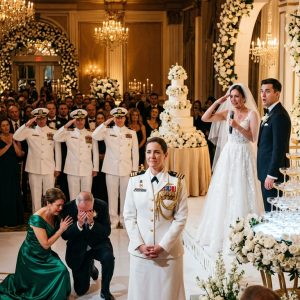
You truly have to picture the grotesque majesty of the procession. Twenty-five curated guests. My mother commanded the lead, draped in floor-length, shimmering emerald green, literally dripping in the obnoxious diamond necklace my father had purchased for their thirtieth wedding anniversary.
My father trailed a half-step behind her in a crisp tuxedo, looking exactly like the pompous, self-important Regional Vice President of Wealth Management attending his own sixtieth birthday coronation.
Veronica strutted in next, squeezed into a strapless, fire-engine red gown. Her hair was shellacked into a shining updo. She was beaming with the manic, triumphant energy of a woman who has finally, mercifully bagged the affluent prize she had been ruthlessly hunting her entire adult life.
And trailing behind her, lagging three steps back from the pack: Julian Whitfield.
Julian Whitfield. Thirty-two years old. Yale Law graduate. Rapidly ascending the partner track at Cravath. The esteemed son of Senator Marcus Whitfield—the very man my sister had been insufferably bragging about on her Instagram feed for the past six months.
Julian Whitfield, whom I had last seen standing in the fluorescent-lit hallway of the Georgetown Law Library exactly eight and a half years ago. He had been my dedicated study partner for three grueling semesters. He was the closest entity I had possessed to a genuine friend during law school. He was the man who had bought me a terrible cup of coffee the chaotic morning after I realized I was pregnant, held my trembling hand across a sticky cafe table, and fiercely promised me that I was going to survive, no matter what decision I made.
Julian Whitfield, who currently possessed absolutely no idea—no concept on God’s green earth—that the ‘problem sister’ his toxic new girlfriend incessantly complained about was actually me.
I sat perfectly, rigidly still.
I watched Diane scan the crowded dining room, hunting for their reserved mega-table.
She didn’t spot the Governor. She didn’t register the First Lady. She didn’t notice the security detail hovering near the bar.
She saw me.
She locked eyes with me. She saw me radiating power in a dress that cost more than her luxury sedan, situated at the premier banquette by the window, with my six-year-old daughter happily perched on the lap of a man whose iconic face her brain had not yet managed to process.
Diane’s face executed a maneuver I had never witnessed it perform in thirty-one years. It morphed into a violently mottled shade of purple.
She abruptly broke formation from the group. She marched aggressively across the dining room floor. She moved with such furious momentum that my father had to engage in a pathetic half-jog just to keep pace with her. Veronica eagerly trailed behind them, smirking viciously, clearly sensing an impending spectacle.
Julian, straggling at the rear of the line, was entirely oblivious, staring down at his phone.
My mother reached our table. She didn’t hesitate.
“Olivia,” she hissed, her voice vibrating with such venom that it easily carried across forty seats. “How dare you show your face here after I explicitly told you to stay away?”
A wealthy man at the adjacent table abruptly halted his knife, setting his fork down with a soft clink.
“Mom,” I replied, my voice dangerously quiet. “You are embarrassing yourself in public.”
“I am embarrassing myself?!” Her voice cracked, pitching an octave higher into hysteria. “Look at you! Crashing your father’s milestone birthday dinner draped in some ridiculous, rented dress, aggressively bothering these poor strangers, and dragging that… that child along with you.”
“Do not dare speak about my daughter,” I warned, the temperature in my voice dropping to absolute zero.
Diane lost her remaining grip on sanity. She lunged forward. She grabbed my upper arm. Her manicured, French-tipped nails—lacquered to a razor-sharp, high gloss—sank viciously into my skin. I felt the sharp, immediate sting of the skin breaking. I felt the warm blood well up.
I did not move a muscle. I let her hold the grip.
That was the moment my father finally arrived at the scene, panting slightly.
“For God’s sake, Olivia, have you lost your mind?” Richard hissed through clenched teeth, desperately glancing over his shoulder. “Senator Whitfield is literally walking in right behind us. Grab the child and exit through the kitchen doors immediately. We will deal with your insolence later.”
That was the opening Veronica had been salivating for. She stepped forward, flashing a smile composed entirely of teeth.
“Well, well, look at you,” she sneered, looking me up and down. “Desperately pretending to be somebody important. Where exactly did you steal the dress, Liv? Rent the Runway? You are a pathetic paralegal. This event is strictly black tie. Tonight is entirely about Julian’s family, not your sad, delusional little fantasy.”
And right on cue, the explosion occurred.
“How dare you sneak in here?” Diane shrieked, fully losing control.
The slap.
My mother’s open palm struck my cheekbone with explosive force. The blinding flash of pain. The metallic taste of blood pooling in my mouth. The warm trickle escaping the corner of my split lip.
Maya screamed.
It wasn’t a loud, theatrical wail. It was a small, high-pitched, terrified scream. The exact sound a child produces when they are trying incredibly hard to be brave while their entire world is violently attacked.
The First Lady moved with blinding speed. She scooped Maya up off the Governor’s lap, pulled the trembling child into her own chest, and securely covered Maya’s ears with her hands, shielding her from the carnage.
The dining room had plunged into complete, suffocating silence.
That was the precise moment that Julian Whitfield, having finally pocketed his phone, looked up to assess the commotion.
He looked at Veronica’s cruel smirk. He looked at my mother’s enraged, panting face.
Then, he looked at me. He saw the blood slowly dripping from my lip onto my chin.
His face instantly drained of all color, transforming into the shade of ancient parchment.
“Olivia?” he whispered, his voice trembling with sheer disbelief. “Olivia Harrison?”
Veronica aggressively grabbed his forearm, trying to pull him back. “Julian, just ignore her. She’s my problem sister. The mentally unstable one I told you about. Let’s go to our table.”
“Wait.” Julian violently jerked his arm out of her grasp, looking at her as if her touch had physically burned him. He stared at me, his eyes wide. “You are… you are her sister?”
“Do not speak to her, Julian!” my mother snapped, her voice dripping with absolute contempt. “She is absolutely nothing. She is nobody. She is a disgraced paralegal who got knocked up by some random doctor and completely ruined her life—”
That was the exact moment the Governor firmly set his wine glass down on the table.
Chapter 4: The Execution
It was the smallest, most innocuous sound—the delicate clink of crystal against starched white linen. But it detonated in that paralyzed room like a judge’s gavel slamming down to issue a death sentence.
Governor Michael Chin stood up.
He was six-foot-three, broad-shouldered, draped in a masterfully tailored tuxedo, and he was absolutely bristling with barely contained, lethal authority.
He stepped out from behind the banquette. He walked with agonizing slowness until he had positioned his massive frame directly between my hyperventilating mother and me. He formed a physical barricade.
He did not look at me. He locked his furious gaze entirely on Diane.
“Mrs. Harrison,” the Governor stated.
His voice was terrifyingly quiet. It was so low, so saturated with menace, that the patrons sitting two tables away visibly leaned forward, straining to hear the execution.
“I would highly suggest,” he continued, the syllables dripping like acid, “that you think very, very carefully about the next sentence that leaves your mouth.”
My father’s jaw literally fell open.
I watched the realization physically strike Richard. You could almost hear the synapses frantically misfiring behind his terrified eyes. The face confronting him. The famous face plastered across television screens every night. The face currently gracing the cover of the political magazine resting on the coffee table in his own private study.
“Governor… Governor Chin?” Richard stammered, his voice cracking into a pathetic squeak.
“That is correct,” the Governor replied flatly.
The Governor’s cold eyes flicked slowly, evaluating the targets. From my trembling mother, to the smirking Veronica, and back to the sweating, pathetic figure of my father.
“And the woman you just violently assaulted in the middle of this restaurant,” the Governor declared, his voice rising just enough to command the room. “The woman you struck in front of my wife, and in front of her own terrified daughter…”
He paused.
I have obsessively replayed the silence of that specific pause in my mind a thousand times over the years. In reality, it likely lasted a mere two seconds. In that dining room, it felt like an agonizing year.
“…is the sole reason this state currently retains one hundred and eighty million dollars in its operating budget.”
The heavy wine glass my mother was clutching slipped from her paralyzed fingers.
It didn’t shatter against the floor. It merely tipped forward in her grip. The expensive Bordeaux poured out in a dark, slow, agonizing stream, staining the front of her shimmering emerald gown like an expanding bloodstain.
She didn’t even notice. She was entirely catatonic.
The Governor offered a smile. It was the furthest thing from a kind gesture. It was a predator bearing its teeth.
“Now,” he asked the horrified trio, “shall I proudly announce to the rest of the room who Olivia really is?”
You could have heard a pin drop onto the carpet.
I want you to vividly picture the chaotic tableau it presented to the rest of the restaurant.
A towering, furious Governor. A distinguished First Lady fiercely cradling a sobbing six-year-old child. A woman seated in a fourteen-thousand-dollar gown, casually bleeding from her forearm where her own mother had clawed her. A wine-soaked, paralyzed socialite frozen mid-curse. A pompous Regional VP who looked as though he was about to suffer a massive coronary event. A scheming younger sister whose arrogant smirk was dying a brutal death in real-time.
And hovering off to the periphery: Julian Whitfield, who had now very visibly, very deliberately taken three massive steps backward, physically distancing himself from my sister.
And funneling in behind Julian, the remainder of the birthday party had finally begun to arrive. Twenty-five elite guests decked out in evening wear. Several of them were currently in the agonizing process of recognizing the Governor’s face.
One of those arrivals—a tall, distinguished, silver-haired man possessing the unmistakable bearing of a politician—was Senator Marcus Whitfield himself.
Senator Whitfield had abruptly halted his advance. He was staring intensely at the Governor. Then, he shifted his focus, staring intensely at me.
He was, I realized with a surge of adrenaline, about to become the second highly influential person in this restaurant tonight to recognize my face from a boardroom.
I slowly stood up.
“Michael,” I said, placing a gentle hand on the Governor’s arm. “It is all right.”
“It is absolutely not all right, Olivia,” he growled, not breaking eye contact with my mother.
“It’s all right,” I repeated firmly. “I will handle this.”
I slowly raised the back of my hand and dabbed at my split lip. I pulled my hand away and stared at the smear of crimson blood. I deliberately held my hand suspended in the air for a long moment, ensuring every single person in that dining room witnessed me looking at my own blood.
Then, I turned my attention entirely to my mother.
“Mom,” I said, my voice deadpan, echoing through the silence. “You desperately need to sit down.”
“Don’t you dare speak to me like—” she began to sputter, reviving her hysteria.
“You need to sit down before you physically collapse from shock,” I commanded, overriding her. “Dad. Find her a chair. Now.”
My father, operating entirely on panicked autopilot, fumbled blindly, grabbed a vacant chair from an adjacent table, and practically shoved my mother into it. She collapsed into the seat, her emerald dress ruined, staring up at me with wide, terrified eyes, as if she were looking at a complete stranger who had just broken into her house.
I pivoted toward Veronica.
“Where exactly would you like to start?” I asked her, tilting my head. “You loudly announced to the room that I borrowed this dress. Do you want to begin the dissection there? Or would you prefer to start with the part where you have spent the last six years gleefully informing people that I am a struggling, drug-addicted paralegal?”
Her jaw went slack. She opened her mouth, desperate for a comeback, but the processor was jammed.
I held up a single, manicured hand, stopping her.
“Veronica, cease talking,” I ordered. “I am going to offer you a profound kindness today. The kindness is this: I am going to permit you to walk out of this restaurant right now, before Julian discovers the rest of the garbage you’ve been spewing.”
“So,” I continued, gesturing toward the exit, “if I possessed a fraction of your brain capacity, I would grab Mom and Dad, and I would start walking.”
Julian violently stepped forward, breaking his paralysis.
“Olivia,” he stammered, his voice laced with shock. “Are you… are you physically okay?”
“I am perfectly fine, Julian,” I replied, offering him a genuine, soft smile. “It is truly wonderful to see you again. I am so incredibly sorry the reunion had to occur under these circumstances.”
“What… what exactly is happening here?” Julian asked, gesturing wildly at the carnage.
I looked back at my sister, whose eyes were wide with terror.
“Julian was my dedicated study partner in law school,” I announced clearly, addressing the room but looking at Veronica. “We survived Torts and Civil Procedure together. He was the man who drove me to the OB-GYN appointment when I was six weeks pregnant, terrified, and had no idea how I was going to survive. He bought me coffee for three consecutive weeks when I was suffering from brutal morning sickness in Property class. He is a truly wonderful, honorable person.”
I turned my focus back to Julian. “I am glad to see you are thriving. I genuinely had absolutely no idea she was seeing you. I haven’t spoken a single word to my family in seven years.”
Julian stared at me, dumbfounded. He looked at Veronica, whose face was buried in her hands, and then back at me.
“You’re… are you working at Cravath now?” he asked, attempting to reconcile the narrative.
“No,” I replied smoothly. “I am the Chief Legal Officer at Meridian Defense Solutions.”
Julian blinked rapidly. He physically recoiled. “You’re… wait. You are that Olivia Harrison? The attorney who masterminded the Meridian state contract defense last quarter?”
“Yes.”
“Jesus Christ,” Julian breathed.
He slowly, furiously turned to face Veronica. His complexion had morphed from stark white to a violent, mortified shade of crimson.
“You explicitly told me,” Julian said, his voice deadly quiet and vibrating with rage, “that your sister was a disgraced paralegal battling a severe drug addiction. You told me you were forced to cut her off because she was violently unstable and a danger to your family.”
“Julian, please—” Veronica whimpered, reaching for him.
“You told me,” Julian continued, his volume rising, ignoring her hand, “that your family refused to discuss her because she had aggressively stolen a massive amount of money from your mother to fund her habit.”
“Julian, stop!” my father pleaded from the sidelines, looking at the Senator.
“I asked you about her specifically three weeks ago!” Julian roared, finally losing his temper. “Because I had heard the name ‘Olivia Harrison’ floated during a state government strategy meeting regarding the Meridian contract. And you looked me dead in the eye and told me she was dead.”
Veronica sobbed. “I never—”
“You told me she had died of a drug overdose!”
The entire restaurant heard the accusation echo off the walls.
Senator Whitfield was now standing approximately ten feet behind his son. His face was a mask of absolute, terrifying neutrality—the specific, unreadable void that only seasoned, ruthless politicians can successfully deploy during a crisis.
I slowly turned my attention back to my mother, who was shivering in her wine-soaked dress.
For the first time in seven agonizing years, Diane looked genuinely, profoundly terrified of me.
“Mom,” I asked softly, letting the silence amplify the question. “Is that the twisted narrative you have been actively peddling to your friends?”
She didn’t answer. She couldn’t.
“Is that the horrifying story Veronica was raised on?”
Still, she remained silent.
I exhaled a long, shaky breath.
“Okay,” I said, addressing the room. “I want to be brutally honest with everyone here about something. I fully intended, upon walking into Morrison’s tonight, to execute exactly what I just did. I planned to be highly visible with the Governor. I fully anticipated that my mother would lose her temper and create a scene. I fully planned to allow Michael—who, aside from being the Governor, is a man who violently despises seeing women abused—to publicly defend my honor.”
I paused, looking at Julian.
“But I absolutely did not plan for the rest of this horror show. I did not plan for my own sister to have spent the last five years convincing a Senator’s family that I had tragically died of a heroin overdose.”
I took a deep breath.
“I did not plan for Julian to be here. And I certainly did not plan for the fact that, resting inside my purse right now, directly beside my phone, I happen to be carrying a highly specific folder of documents.”
It was time to drop the final payload and completely eradicate the foundation.
Chapter 5: The File and the Exodus
“I brought this folder along tonight,” I continued, my voice echoing in the paralyzed dining room, “not because I genuinely expected to deploy it, but because I have spent so many agonizing years preparing for a moment exactly like this, that I simply no longer leave my house without it.”
I listed the inventory aloud, ensuring every guest heard the contents.
“The folder contains my certified tax returns for the last five consecutive years. It contains a notarized copy of my executive employment contract as Chief Legal Officer at Meridian. It holds an official letter on state letterhead from Governor Chin’s office, formally thanking me for my flawless execution of the state defense contract. It contains a photograph of my fully paid-off home. It holds Maya’s elite private school records.”
I turned my gaze to Diane.
“It also contains a printed screenshot of a text message transmitted by my mother, dated exactly three hours ago, viciously ordering me not to attend this dinner.”
I let that detail hang in the air, watching my father physically wince.
“And,” I concluded, delivering the kill shot, “resting at the very bottom of the file, is a color copy of a public Facebook post my mother authored exactly eleven months ago. It was posted on the fabricated ‘anniversary’ of the daughter she supposedly ‘lost.’ In this post, she explicitly writes—and I quote—that her eldest child had ‘tragically succumbed to her darkest demons,’ and that the family was ‘still engaged in the agonizing healing process.'”
I had meticulously screenshotted the post the very morning she published it. I had filed it away in the dark. I had not, until this exact, explosive moment in Morrison’s Steakhouse, decided what I was ultimately going to do with it.
I finalized my decision in approximately four seconds.
I calmly sat back down at the banquette. I reached into my designer purse. I extracted the thick manila folder. I slid it aggressively across the polished wood table until it bumped against Julian’s hand.
“You will want to immediately hand this over to your father, Julian,” I advised him softly. “I am quite certain the Senator is going to have some incredibly aggressive questions regarding the background of his future daughter-in-law.”
Julian slowly opened the cover of the folder. He reviewed the top document for perhaps thirty seconds.
His hand slowly drifted up to cover his mouth in horror.
He didn’t say a word to Veronica. He closed the folder, turned around, and walked very, very slowly back to his father. He handed the damning evidence to Senator Whitfield.
The Senator donned his reading glasses. He reviewed the contents. He looked up, his expression lethally calm. He stared at my mother. He stared at my sobbing sister. He looked briefly at me, offering a microscopic, acknowledging nod.
“Julian,” Senator Whitfield commanded, his voice barely above a whisper, yet possessing the authority to cut through steel. “Mrs. Harrison, I believe it is best if our party departs immediately.”
“Marcus, please!” my father begged, scrambling out of his chair. “This is a massive, horrific misunderstanding! I can explain—”
“It is not a misunderstanding, Richard,” the Senator replied flatly, turning his back. “Julian, retrieve your coat. We are returning home.”
“Marcus, Diane, please, don’t do this!” my father pleaded to the retreating backs.
The Senator ignored him and marched out of the restaurant. Julian trailed closely behind. As Julian reached the heavy brass doors, he paused. He turned back, locked eyes with me across the room, silently mouthed the words, “I am so incredibly sorry,” and vanished into the night.
The twenty-three remaining guests—the affluent friends, my father’s influential colleagues, the prestigious members of my mother’s charity boards—remained standing in their expensive evening wear, utterly paralyzed, watching the empire burn to ash.
A distinguished man standing near the coat check, whom I recognized as my father’s former law school roommate, awkwardly cleared his throat.
“Richard,” the man muttered, avoiding eye contact. “I think… I think my wife and I will be heading home early, as well.”
And just like that, in the span of approximately ninety seconds, the entire room of hand-selected guests began politely, quietly, and utterly devastatingly, walking out the front door.
By exactly 7:31 PM, the massive, opulent table reserved to celebrate Richard Harrison’s triumphant sixtieth birthday was completely empty, save for three broken people.
My mother remained slumped in her chair, the spilled wine rapidly drying on her dress, staring vacantly at her trembling hands. My father sat heavily beside her, his face as white as the starched linen, staring into the abyss, saying absolutely nothing.
Veronica stood isolated in the dead center of the abandoned dining room, her red dress looking absurdly festive against the wreckage. She slowly turned to face me. Tears were ruining her expensive makeup.
“You did this,” she whispered venomously. “You orchestrated this entire thing on purpose.”
I looked at her, feeling absolutely zero pity.
“No, Veronica,” I replied evenly. “I simply showed up for dinner. You three built the bomb. I just finally let you detonate it.”
I want to explicitly detail what occurred next. But first, it is equally important to document what I didn’t do.
I didn’t yell. I didn’t gloat over their corpses. I didn’t snap a single photograph of the humiliation. I didn’t immediately post a triumphant narrative online. I didn’t even mention the incident to a single colleague at the office on Monday morning.
Here is exactly what I did.
I signaled for Antoine, the maître d’.
“Antoine,” I said softly. “Please send a fresh round of whatever they were drinking to my family’s table. Put the drinks on my personal tab. And when they finally locate the courage to order their food, please place the entirety of their birthday dinner on my account as well.”
Antoine stared at me as if I had just sprouted a second head. “Ma’am?” he stammered.
“Please,” I insisted with a polite smile. “Whatever they desire to consume tonight. It is entirely on me.”
I stood up. I gently retrieved Maya from the First Lady’s protective embrace. I deeply thanked the Governor and Mrs. Chin for their presence and their intervention. I kissed my daughter softly on the top of her head and asked her if she was ready for an enormous dessert.
She vigorously nodded her head.
We walked slowly, hand in hand, past the wreckage of my parents’ table. I stopped walking. I looked down at the woman who had birthed me. She stubbornly refused to lift her eyes to meet mine.
“Mom,” I said quietly.
“Maya is performing in her very first school recital next month,” I informed her. “It is scheduled for November 18th. The exact address and time are printed on the card currently resting in your hand.”
I had flawlessly slipped a small, embossed card into her limp palm without her even registering the movement.
“You are absolutely not required to attend,” I continued gently. “Honestly, you probably shouldn’t. But she is your biological granddaughter, and she is a wonderful, brilliant child. I thought you deserved to possess the information.”
I waited for ten seconds. She remained completely mute, staring at the card.
I turned and walked away.
Maya and I enjoyed our dessert sitting at the mahogany bar. She proudly ordered a massive hot fudge sundae the size of a bowling ball. Antoine personally delivered it, ensuring it featured two extra cherries and a delicate, spun-chocolate elephant resting on top.
The Governor and Mrs. Chin joined us at the bar shortly after. We conversed for approximately forty-five minutes about absolutely nothing of consequence. Maya enthusiastically detailed the backstory of her stuffed dolphin to the First Lady. Mrs. Chin reciprocated by sharing amusing anecdotes about her own grandchildren.
At exactly 9:14 PM, I paid the bill and drove us home.
Maya fell asleep instantly in the backseat, exhausted by the adrenaline. I carried her limp body inside, carefully unzipped her tiny black silk dress, wrestled her into her favorite pajamas, and tucked her securely into bed.
Then, I walked into my pristine kitchen. I sat at the island, still wearing my custom black gown, and I finally cried.
I wept uncontrollably for about twenty minutes. I wasn’t crying because I was devastated, or heartbroken, or grieving the loss of my family.
I was crying because, for the first time in thirty-one years, I was completely, undeniably free.
The aftermath was a masterclass in swift, silent destruction.
Epilogue: The Architecture of the Aftermath
I will provide the fallout, because I understand it is the closure required to process a story of this magnitude.
Senator Whitfield’s press office released a brief, sterile, highly polished statement exactly two days later. It officially confirmed that Julian Whitfield had formally terminated his relationship with Veronica Harrison. The statement did not provide a specific reason for the split. It didn’t need to; the silence was damning enough.
Three days following that release, the Whitfield family’s aggressive communications director—a shark of a woman who, in an alternate timeline, would have made a brilliant colleague at Skadden—quietly, efficiently leaked a tip to a friendly political reporter. The leak vaguely insinuated that the Harrison family had been discovered fabricating “repeated, highly dishonest statements regarding a close family member,” and that the relationship was immediately severed on those ethical grounds.
It was a microscopic news item. It ran buried in the back pages of two local newspapers and gained traction on one moderately popular political blog. But in their social circle, it was a nuclear bomb. It was enough.
My mother’s most prestigious charity board quietly requested she step down within thirty days of the dinner. The official, publicly cited reason was “personal family restructuring.”
The actual, brutal reason was that Linda Castayano—the very same Linda who had mockingly inquired about my non-existent medication in the produce aisle—had been covertly forwarding screenshots of my mother’s old, fabricated Facebook post regarding her “dead” daughter to every single member of the board, accompanied by a vicious little note.
Olivia is very much alive. She is the Chief Legal Officer of Meridian Defense Solutions. Diane has been lying to our faces for years.
Linda arrived unannounced at my corporate office six weeks after the incident. She bypassed security clutching a homemade casserole. She sat in my office and cried hysterically. She apologized profusely for an entire hour.
I forgave her. And I genuinely meant it.
My father was forced into early retirement that February. The wealth management firm had supposedly been searching for an excuse to ‘restructure’ his division anyway, and his sudden, toxic association with a publicly humiliating family scandal—even a relatively quiet one—served as the perfect, convenient pretext to sever ties. He was allowed to retain his pension, but he violently lost his prestigious title, his corner office, and his fragile ego.
Veronica quietly packed her bags and relocated to Arizona. I am reliably informed she secured a mid-level position in commercial real estate. I have not spoken a single word to her since the night she called me a paralegal.
My mother actually mailed me a handwritten letter in late January. It was an agonizing, rambling eight pages long. It was the absolute closest approximation to an apology I will ever receive from her. And yet, it still wasn’t a genuine apology. It was littered with manipulative phrasing like, “I have always loved you deeply,” and “We all make mistakes in the heat of the moment,” and ending with, “We are just so incredibly proud of you now.”
That final word—now—told me absolutely everything I needed to know about her growth.
I drafted a concise, one-page response.
I informed her that Maya was thriving emotionally and academically. I stated that Maya would eventually like the opportunity to know her biological grandmother. I explicitly dictated that if Diane desired any access to Maya’s life, she would be required to travel to my city, operate strictly on my terms, and she would never, under any conceivable circumstance, speak to me or my child with the venom she deployed at Morrison’s.
I informed her that the door was currently cracked open approximately six inches. I told her she was permitted to push it gently.
I have not received a reply.
That is perfectly acceptable. I didn’t draft the letter for her benefit. I wrote the letter for Maya. So that one day, when my daughter is old enough to comprehend the darkness of the world and asks me what truly happened to her grandparents, I can look her in the eye and honestly say I offered them every conceivable chance at redemption.
Julian called my private cell phone three weeks after the dinner.
He was desperate to apologize for the chaos. He wanted to know if I required any assistance navigating the fallout. He wanted to know if Maya was recovering from the shock.
We agreed to meet for coffee. It was not a romantic date. It wasn’t a tearful reunion. It was simply two individuals who had shared a profound friendship in a different lifetime, sitting across from each other in a quiet, bustling cafe, desperately trying to figure out how to bridge the gap.
Halfway through his latte, he confessed that he had thought about me frequently over the intervening years. He admitted he had constantly wondered what path I had taken, assuming I had quietly finished my degree and settled into a mundane, quiet life.
I told him I had indeed finished.
He laughed, a genuine, joyful sound. “Olivia,” he beamed, “you didn’t just ‘finish.’ You are commanding the legal division of a massive defense contractor. You are personally advising the Governor. You are… you are absolutely crushing the world. I thought I was doing okay. You are operating on a completely different planet.”
We finished our coffee. We exchanged updated contact information.
We have not, in the six months since that meeting, gone on a single date. We are simply friends. We text occasionally. He mailed Maya a massive stuffed dolphin for her birthday because I had casually mentioned during our coffee that she was obsessed with them. It arrived in a cardboard box the size of a mini-fridge. Maya immediately named the dolphin Julian.
She is six. She has absolutely no concept of who he actually is in the grand narrative. And that is perfectly fine.
It has now been approximately eight months since the explosive dinner at Morrison’s.
Maya is thriving in the first grade. She excels at math, her favorite movie is The Color Purple, and she harbors a massive crush on a boy in her class named Theo, whom she has confidently informed me she intends to marry. I am in absolutely no rush to confirm or deny the feasibility of this arrangement.
I am still commanding the legal department at Meridian. We successfully negotiated the renewal of the massive state contract for another lucrative five-year term.
Governor Chin’s wife, Susan—the First Lady, the brilliant former federal judge—calls my cell phone religiously once a month to demand I join them for dinner at the mansion. I have accepted the invitation twice. Maya now considers Mrs. Chin her honorary grandmother. Mrs. Chin, who already possesses three biological grandchildren of her own, considers this arrangement entirely fair and delightful.
I think about my biological parents occasionally. Significantly less frequently than I used to.
I think about the exact microsecond my mother’s palm struck my face. The specific moment when the agonizing realization washed over me that absolutely nothing she inflicted upon me that night could actually destroy me, because she had permanently surrendered the power to do so.
She was completely oblivious to that fact. She had operated for seven years under the delusion that I was the pathetic, broken daughter she had molded and ruthlessly abandoned. The failed experiment. The cautionary tale she whispered about at cocktail parties.
She failed to realize that the cautionary tale had meticulously constructed an empire she couldn’t even conceptualize, residing in a city she had never bothered to visit, raising a brilliant granddaughter she had never met, utilizing the very brain she had actively tried to break.
The brain she had tried to break was the exact same brain that possessed the discipline to keep her wine glass resting calmly on its coaster, her explosive secret secured in a manila folder, and her terrified granddaughter safely shielded in the lap of the most powerful politician in the state.
I reflect on that reality often.
I think about my daughter, who, on the most chaotic night of our lives, sat securely in the lap of a titan, calmly drawing a horse possessing wings. I think about how she stared at her grandmother—really examined her soul—in that terrifying second before the slap connected. And how I could clearly recognize, even then, that my six-year-old child understood exactly what kind of monster she was observing.
Children possess a terrifying clarity. They always know.
That is the fundamental flaw those toxic women never comprehended. Whatever horrific lies you desperately spin about your own flesh and blood, the truth eventually claws its way to the surface. And whatever cruelty you normalize and teach the next generation… the next generation eventually grows up. They walk into a five-star restaurant draped in a dress that costs more than your vehicle, and they decide, in one terrifyingly quiet moment, whether to return the cruelty, or whether to dismantle you with precision.
I chose not to be cruel. I chose to be precise.
The physical swelling from the slap faded within a week. The deep, purple bruising on my forearm lingered longer. The vicious crescent moons carved by my mother’s fingernails left four tiny, permanent white scars on my skin that are only visible if you look extremely closely.
I kept them. I refuse to cover them with makeup or long sleeves.
Every now and then, when I am locked in a brutal deposition, or sitting across from arrogant opposing counsel, or walking confidently into the Governor’s mansion for a dinner I once would have sacrificed a limb to attend, I casually glance down at my forearm and trace them.
Four tiny, crescent scars. Four permanent, physical reminders that the people who desperately attempted to bury me like a dirty little secret failed to realize they were burying a seed.
That the woman they mockingly dismissed as a pathetic paralegal walked into that restaurant a ghost, and walked out a legend.
And that the six-year-old girl drawing a winged horse on the back of a menu—the child who listened to her grandmother declare her mother was “nothing”—will grow up possessing the absolute certainty of exactly who her mother is.
A woman who possessed the discipline to wait seven years in the dark. A woman who simply picked up the phone. A woman who, when the moment of reckoning finally arrived, didn’t have to lift a single finger to destroy her enemies… because the undeniable truth lifted the executioner’s axe for her.
If you have stayed with me this far into the narrative, you already comprehend what the dress actually cost. You already understand the staggering value of the silence.
The only variable left unresolved is whether, the next time someone arrogantly informs you that you are nothing, you possess the courage to remember:
The people who eagerly write you off as a failure are the exact same individuals you eventually invite to dinner… solely to watch the realization dawn on their faces that you have been sitting at the head of the table all along.