The Architecture of Worth: A Blueprint for Retribution
Chapter 1: The Weight of an Envelope
My name is Sophie Fowler. I am thirty-four years old, and it took three decades for me to fully comprehend the devastating weight a single sheet of paper can press onto a man’s soul. The man in question was my adoptive father, Raymond Albright, and his education occurred precisely at his sixty-fifth birthday gala.
He stood there, bathed in the warm, amber glow of the country club chandeliers, hoisted a crystal flute of champagne before sixty distinguished guests, and finally uttered the punchline he had been hoarding for decades.
“You’re not really mine,” he chuckled, his voice echoing through the expensive microphone. “I just forgot to cross you out of the will.”
The ballroom erupted. Crystal chimed against crystal. A woman dripping in pearls near the bay window trilled that it was just so like Raymond to be so refreshingly blunt.
Everyone in that room laughed. Everyone except me.
They were oblivious to the payload resting quietly at the bottom of my leather purse. They had absolutely no conception of what I had legally executed at nine o’clock that very morning, or why my hands remained as still as carved marble while the cruel laughter washed over the linen-draped tables, and the sixty-five candles melted into the pristine frosting of his colossal cake.
What I orchestrated next is the sole reason I am breaking my silence today. This is a chronicle of the exact moment a woman decides to stop auditioning for a role she was never meant to play, choosing cold, architectural dignity over messy, emotional noise.
Let me rewind six weeks to a brisk Tuesday morning in Michigan. It began like every other productive day I had meticulously engineered for myself. I unlocked the doors to the Bright Frame corporate office by 7:00 AM, long before the phones began their relentless ringing, before anyone required me to be a boss, a negotiator, or a visionary.
Bright Frame is the modular housing company I founded from scratch. We manufacture net-zero homes—structures so ruthlessly efficient that heating them through a brutal Midwestern blizzard costs less than a bad month’s electric bill in a standard apartment. That morning, I signed a lucrative forty-unit municipal contract. Forty working-class families were going to own something warm, solid, and undeniably theirs. I recall the satisfying scratch of my fountain pen against the heavy paper, the profound quiet of my office, the bone-deep satisfaction of constructing something that refuses to collapse.
Then, my assistant dropped the morning mail onto my mahogany desk. The envelope was sitting dead center on the pile.
It was heavy, expensive cream stock. My old, discarded name was inscribed in my adoptive mother’s—Diane’s—impeccable, looping calligraphy.
Sophie Albright.
Never Fowler. They refused to acknowledge the name I had legally chosen to build my life under.
Inside was a gilded invitation to Raymond’s sixty-fifth birthday blowout. The address printed below the gold-leaf lettering was the prestigious country club in Brier Hollow, the exact zip code where I had spent eighteen years mastering the art of making myself invisible.
I read the embossed text twice. Then, I placed it face down on my desk, the way you drop a piece of hot iron you accidentally grabbed without gloves. I forced my eyes back to the municipal contract. The contract made logical sense. Forty insulated roofs. Forty high-efficiency furnaces. It was a universe of numbers that behaved predictably.
The invitation did not behave. It sat there, face down, radiating a toxic energy all morning. I felt its presence the way you feel a freezing draft creeping under a door you could have sworn you deadbolted.
I am, fundamentally, a woman who solves complex structural problems. I had dedicated my entire adult existence to transmuting rejection into tangible, profitable utility. But as I stared at that cream envelope, I had absolutely no blueprint for how to handle it. And that unsettling void of a plan followed me out to the asphalt parking lot, buckling itself into the passenger seat of my car for the long drive home.
I was five years old when the Albrights selected me. My earliest memory is the cloying scent of new leather in their luxury sedan, and the way Diane gripped my small hand in both of hers, as if I were a rare, fragile antique she had been hunting for years.
For a brief, shimmering period, it was a good life. Diane purchased me a vibrant yellow wool coat and paraded me through her elite garden club luncheons. The other wealthy wives would sip their mimosas and coo about how extraordinarily brave Diane was, how unimaginably generous, what an absolute gift I was receiving.
Gift. That was the specific noun permanently attached to my existence.
Diane had spent the previous decade agonizing over her inability to conceive. Somewhere deep within that cavern of biological wanting, she convinced herself that ‘saving’ a discarded child would miraculously heal the perceived defect in her own body. I analyze it now with the detached clarity of an adult. Diane didn’t adopt a daughter; she adopted a compelling narrative about her own benevolence—a story she could wield like a weapon at cocktail parties.
And for a few confusing years, I was desperately happy to serve as the living, breathing proof of her sainthood. The maternal warmth felt genuine, I think. But it was entirely dependent on an audience. She would meticulously braid my hair on Sunday mornings, ensuring her voice carried over the rhododendrons so the neighbor could hear her loudly declare that she had rescued me from absolute squalor and molded me into something acceptable.
I learned very quickly to stand perfectly still and allow myself to be admired as a project, because to a traumatized five-year-old, being admired felt dangerously close to being loved. I couldn’t distinguish the counterfeit from the real currency.
I can tell the difference now.
The most treacherous aspect of being someone’s ‘good deed’ is that you can be unceremoniously shelved the very second a more compelling storyline presents itself. And a vastly superior story was already gestating. Diane just hadn’t taken the test yet, and I was blindly enjoying the final, ticking seconds of my childhood.
When I turned eight, the impossible happened. Diane got pregnant. And the moment my brother took his first breath, my expiration date was officially stamped.
Chapter 2: The Folding Chair
The fertility specialists had explicitly labeled a natural pregnancy impossible. And then, defying millions of dollars of medical consensus, it wasn’t. Spencer arrived in a blustery March, sporting Raymond’s arrogant chin, Diane’s piercing eyes, and an imported cashmere blanket bearing a monogram before they had even settled on his middle name.
I genuinely adored him at first. I was eight years old, he was impossibly tiny, and my childish logic dictated that possessing a baby brother was the final puzzle piece required to cement my belonging. I thought he was the anchor that would finally secure me to this family.
Instead, a tectonic shift occurred within the walls of that sprawling house. It wasn’t violent; it was slow, silent, and absolute, like a harsh winter killing off a garden.
The framed photographs lining the grand staircase were the first casualty. The new, professional portraits featured exactly three human beings. I would frequently find myself positioned just outside the camera’s frame, awkwardly holding Diane’s heavy wool coat, suddenly designated as the photographer rather than the subject.
Then, the dining room geography was redrawn.
Our antique mahogany table came as a set with five intricately carved, matching chairs. For Sunday dinners, however, a sixth seat was required. This was a cheap, rattling metal folding chair that permanently resided in the hall utility closet.
Without a single formal announcement, the folding chair became mine.
Diane simply unfolded it and positioned it at the sharp corner of the table, closest to the swinging kitchen doors. One agonizing evening, acting on muscle memory, I reached to pull out one of the carved wooden chairs. Diane’s hand materialized, clamping down on my shoulder. Her grip was gentle, but the pressure was undeniable. She physically steered me in front of the entire family.
“You’ll take the folding chair, Sophie,” she said, her voice smooth glass.
I was eight. I took the folding chair.
I sat in that squeaking metal contraption for the next ten years. Every Thanksgiving turkey, every Christmas ham, every tense Tuesday night casserole—the cold, unforgiving steel pressed into the backs of my knees. I desperately lied to myself, insisting it held no symbolic weight. It was merely a logistical necessity. A chair is just a chair, right?
Just as a single sheet of paper is merely processed wood pulp—until the day you print a deed on it.
I would end up meditating on the symbolism of that folding chair far more than I ever anticipated. It would haunt me all the way to a country club in Brier Hollow decades later, but I am rushing the timeline.
Raymond was a significantly harder cipher to crack than Diane, primarily because Raymond was a ghost haunting his own life. He sold high-end commercial insurance, obsessively golfed to maintain his networking handicap, and returned home exhausted. His conceptualization of fatherhood consisted entirely of signing checks and demanding groveling gratitude for doing so.
With Spencer, however, a pulse emerged. Spencer received the clumsy attempts at playing catch in the manicured backyard. Spencer sat in the front seat of the sedan. When Raymond said his biological son’s name, the syllables held a distinct, undeniable warmth.
I received the accountant’s version of a father. He was the man who absentmindedly scrawled his signature on my public school permission slips without ever once inquiring where the field trip was going. I convinced myself that this was simply the emotional bandwidth of men of his generation—until a humid Tuesday night completely shattered that delusion.
I was ten years old. I had crept halfway down the carpeted stairs, seeking a glass of water from the kitchen. Raymond and his boisterous older brother, Uncle Arthur, were nursing scotch in the dim light of the den, the baseball game humming quietly on the television.
I heard my name drop into the conversation. I froze on the landing, my bare feet sinking into the plush carpet, employing the terrifying invisibility children master when they sense danger.
Arthur had asked Raymond a practical question regarding my future. Something about setting aside a college fund, about what the long-term financial strategy was for ‘the girl.’
Raymond laughed.
It wasn’t a cartoonish, villainous cackle. It was worse. It was a casual, careless, exasperated chuckle. The exact sound a man makes when complaining about a stray cat his wife insists on feeding.
“She is Diane’s problem, Art, not mine,” Raymond sighed, the ice clinking in his crystal glass. “She’s Diane’s little charity project.”
The volume on the television was nudged higher. The conversation seamlessly pivoted to golf handicaps.
I stood paralyzed on that dark staircase for an eternity. I didn’t cry, a fact that surprised my ten-year-old self. I didn’t run to my room and slam the door. I simply absorbed the data, categorized it, and permanently filed it away in my mind. The same exact way I would later meticulously file vendor invoices, zoning permits, and the names of subcontractors who lied to my face.
She is Diane’s, not mine.
I carried the radioactive weight of that sentence for twenty-four years. I carried it every time I sat down on that freezing metal folding chair. I carried it every time I clicked the camera shutter while they posed perfectly.
I want you to burn that sentence into your memory, because Raymond was destined to repeat a far crueler version of it into a live microphone, standing behind a cake. And by the time he did, the ten-year-old girl on the stairs would be dead, replaced by a woman holding a match.
At eighteen, my financial utility to the Albright household evaporated overnight. The faucet of minimal support was violently wrenched shut.
Spencer was ten, receiving expensive private tutoring for math and being packed off for a prestigious summer immersion trip to Spain. I received a generic, drugstore graduation card containing two crisp twenty-dollar bills and a chillingly brief note from Diane. It cheerfully noted how ‘fiercely independent’ I was, assuring me I would be perfectly fine because I ‘always landed on my feet.’
It wasn’t an expression of maternal confidence. It was an eviction notice.
So, I packed everything I owned into two canvas duffel bags, walked out of the Brier Hollow zip code, and never looked back.
This is the precise juncture where my history ceases to be a tragedy, because I absolutely refused to perform the role of the pathetic victim for anyone—especially not the people who had actively tried to break my spirit.
I secured grueling, back-breaking labor framing houses. For two brutal years, I was the only woman on a crew of twenty roughnecks. I learned how to swing a heavy framing hammer from dawn until dusk, my hands blistering into calluses, and I spent my nights aggressively deciphering complex architectural blueprints under the flickering fluorescent lights of the local community college.
I discovered a profound, addicting satisfaction in constructing physical structures that would outlive the flawed humans who built them.
There was a specific, pathetic phrase Raymond used to regurgitate at every extended family dinner. A pipe dream he coveted so intensely it had mutated into a running joke.
“When my ship finally comes in,” he would announce, swirling his wine, “we’re buying Loon Lake.”
Loon Lake was the crown jewel of the county. A massive, historic stone manor sitting on an expansive, private peninsula at the edge of town. It boasted a slate roof, a private deep-water boathouse, and was the ultimate yardstick by which the wealthy men of Brier Hollow measured their worth. Raymond had lusted after that property his entire adult life, and he had never once possessed the capital to even tour it.
As a child, I used to hear that phrase and naively assume that intensely wanting a thing was synonymous with deserving it. It required years of inhaling sawdust on a freezing framing crew to realize those two concepts exist in entirely different universes.
I stopped waiting for an invitation to anyone else’s table. I learned how to draft, cut, and build my own damn tables. And somewhere in the exhausting blur of those years, completely oblivious to the destiny taking shape, I was acquiring the exact skillset required to purchase Loon Lake right out from under his nose.
Bright Frame was born in a damp, rented garage bay. And as my company exploded, so did my desperate, pathetic attempts to buy my way back into the Albright family.
Chapter 3: The Architecture of a Bribe
Bright Frame began its life in a drafty, rented industrial bay alongside a business partner who panicked and abandoned ship after twelve months of eating ramen. At twenty-seven, I found myself holding the entire liability alone.
The core business model was aggressively simple, yet entirely unglamorous. We engineered superior, hyper-insulated modular homes inside a controlled factory environment, shipped the components flat on flatbed trucks, and assembled them on-site. The thermal efficiency was so staggering that the winter heating bills humiliated the traditional developers relying on outdated methods.
For three brutal years, I slept on a cot in my cramped office more frequently than I slept in my own apartment. I bled for that company.
The breakthrough arrived when a desperate county housing authority took a massive gamble on my firm for a thirty-home affordable development. We delivered early and under budget. The project functioned flawlessly. The adjacent county immediately called. Then a private developer. Then a massive corporate entity.
By the time I turned thirty-four, Bright Frame employed one hundred and ten people. The corporate valuation was a number I refused to say aloud in mixed company for fear of sounding arrogant. I had built an empire with zero inheritance, zero trust funds, and zero nepotism. Just a decade of relentless, unapplauded grinding.
And yet, here is the psychological rot I am deeply ashamed to admit.
With every record-breaking fiscal quarter, I sent the Albrights a token of my success. A ridiculous, oversized gourmet Christmas basket. A heavy check supposedly “helping out” with Spencer’s first car purchase. One brutal winter, when Raymond casually complained twice on a rare phone call about their aging furnace rattling, I dispatched my best HVAC crew to install a top-of-the-line system, fully paid.
I lied to my own reflection, claiming I was practicing grace. The reality was infinitely uglier and infinitely sadder.
I had spent my entire adult existence desperately attempting to purchase a reserved seat at a dining table that was fundamentally closed to me. Throwing money at them was simply the adult, corporate equivalent of silently accepting the metal folding chair. I was weaponizing my generosity, harboring this pathetic, childish fantasy that if I just bought them enough things, Raymond would eventually turn to me, tears in his eyes, and say, “Pull up a real chair, Sophie. You belong.”
Nobody ever said it.
I just kept drafting blueprints, kept signing checks, kept working past midnight in a glass office I owned outright, while the people I was agonizingly trying to impress remained utterly indifferent.
I couldn’t see the toxic pattern. You never can when you’re trapped inside the maze. I would only see the aerial view when it arrived in the form of a devastating, glowing screenshot.
Two days after the cream-colored invitation landed on my desk, my cell phone vibrated. The caller ID read Brenda.
Brenda was Raymond’s younger sister, and she was the singular entity possessing the Albright surname who had ever treated me as a human being rather than a tax write-off. When I was a miserable kid, she would covertly slip me the expensive bakery cookies Diane hoarded, call me ‘kiddo,’ and actually inquire about my thoughts on the books I was reading. She had engaged in screaming matches with Diane on my behalf—arguments held in hushed tones in the kitchen that never fundamentally altered my reality, but proved that at least one person saw the abuse.
“They really do want you to attend, Soph,” Brenda pleaded, her voice crackling over the line. “Raymond is turning sixty-five. Men mellow out at that age. It makes them reflective. Maybe… maybe this is a genuine chance.”
I sat in my ergonomic desk chair, letting the silence stretch.
Maybe it was a chance.
I am a ruthless, analytical woman in a boardroom, but family dynamics infect you with a very specific, incurable brand of stupidity. The desperate eight-year-old girl who just wanted a matching chair never truly evacuates your psyche. She just hides in the basement of your brain, waiting for someone to crack the door open a fraction of an inch.
“I don’t know, Brenda,” I murmured, rubbing my temples. “I’ll process it.”
But I was already processing it through the broken, toxic algorithm I had used my whole life. The giving algorithm.
I immediately began calculating: What could I bring? A bottle of vintage Bordeaux was insufficient. A handwritten card was pathetic. I needed something astronomical. Something with enough gravitational pull to force Raymond to publicly revise that devastating sentence he had spoken in the den twenty-four years ago.
I lay awake staring at my ceiling that night, reducing my own human worth to a dollar amount—which is a uniquely agonizing way to induce insomnia. And somewhere in the dark, an idea materialized that should have terrified me. Instead, it washed over me like a warm wave of relief.
Loon Lake.
The historic stone manor he had lusted after his entire pathetic life. I could hand him the one singular object he had never been able to conquer. I had absolutely no idea that this grand gesture was about to detonate in my face and teach me a lesson I desperately needed to learn.
I demand honesty from myself here. The sanitized version of this story makes me appear angelic. The easy narrative is that I decided to attend the party to foster peace and heal generational trauma.
The ugly, unvarnished truth? I went to win.
Not by causing a loud, embarrassing scene, but the way I dominated my industry: by being so overwhelmingly, undeniably superior that the judges had no choice but to alter their verdict. If I walked up to Raymond on his sixty-fifth birthday, in front of the entire country club elite he worshipped, and handed him the deed to Loon Lake free and clear… the sentence ‘She’s Diane’s, not mine’ would be instantly vaporized.
He would be forced to claim me. He would have to embrace me in front of the entire Brier Hollow aristocracy, practically weeping with gratitude over the boathouse.
That was my pathetic, manipulative master plan. And I draped it in the noble camouflage of ‘generosity.’ I called Brenda back and confirmed my attendance. She was so relieved she choked back a sob. I used her tears to validate my terrible decision.
But beneath the frantic logistics of the real estate acquisition, a low, warning hum vibrated in my chest. I refused to acknowledge it. It was the hum of a grown woman preparing to incinerate four million dollars purely to purchase the illusion of a father’s love.
I initiated the inquiries the very next morning. The terrifying part is that the universe handed me the property with zero resistance, almost as if it were a cosmic setup designed to ensure I learned this lesson the hardest, most expensive way possible.
Loon Lake was actively on the market. I almost burst into hysterical laughter when my broker confirmed it.
The ancient patriarch who had hoarded the estate for four decades had passed away in February. His spoiled children, residing in Phoenix and Denver with zero interest in maintaining a freezing stone fortress in Michigan, had quietly listed the property that spring.
Four million dollars, give or take negotiation. That price secured the manor, the historic deep-water boathouse, eleven acres of pristine timber, and the longest stretch of untouched, private shoreline in the entire county.
This was the exact yardstick Raymond had tortured himself with. I vividly remembered those agonizing Sunday drives. Raymond creeping the sedan along the perimeter road, Diane sighing wistfully, Raymond muttering, “When my ship comes in…” while golden-boy Spencer pressed his greasy hands against the glass, acting as if he already held the keys.
They could never touch it. Raymond sold insurance policies. The mathematics of his life would never align to purchase this echelon of wealth. He spent forty years agonizing over a prize he was destined to lose, broadcasting his false intentions to everyone in town. I now recognize that as a very specific, humiliating brand of quiet misery.
And now, three weeks before his monumental birthday, it was sitting on the MLS.
I drove out to inspect it on a bleak, gray Thursday. I walked the perimeter. I stood at the very end of the weather-beaten dock where he had always fantasized about standing with a cigar.
I could write the check in cash without losing a single hour of sleep. That reality sat heavily in my chest. The discarded daughter, the girl banished to the folding chair, was now standing on the shoreline he had coveted his entire existence, holding the power to buy it on a whim.
I instructed my agent to draft the offer. I furiously maintained the lie that I was doing this for him.
The paperwork accelerated. But the closer we crept to the closing date, the louder the warning hum in my chest became, asking a question I violently suppressed.
I executed the purchase through a corporate foundation, not to obscure my identity, but because it is the most efficient, tax-shielded method to transfer real estate of that magnitude. Two years prior, I had legally established the Open Door Foundation and subsequently let it gather dust.
I had initially created Open Door after a tough-as-nails girl on one of my framing crews aged out of the state foster care system on her eighteenth birthday. She arrived at the job site clutching two black garbage bags containing her entire life, with absolutely nowhere to sleep.
I recognized that brutal mathematics. I knew the weight of those two bags.
The foundation had quietly funded a handful of trade school scholarships, but it remained a hollow vessel—a good intention possessing a hefty bank account, waiting for me to dictate its true purpose.
So, the four million dollars flowed through Open Door. The closing was finalized. My aggressive corporate attorney drafted a clean grant deed, legally transferring the sprawling property out of the foundation’s control and directly into the personal names of Raymond and Diane Albright.
Free and clear. A breathtaking gift with absolutely zero strings attached. The kind of miraculous windfall that simply does not happen to mediocre men like Raymond.
I held the final draft of that deed at my kitchen table on a Sunday night, waiting for the euphoria to hit. I waited to feel the warmth of a daughter finally coming home. Instead, I just felt the cold metal of a folding chair pressing into my spine.
Chapter 4: The Joke I Wasn’t In On
One single sheet of heavy, textured legal paper. A sterile notary block anchoring the bottom. Two blank, dotted lines waiting for the grantees’ signatures: Raymond Albright. Diane Albright.
I stared at their names, meticulously typed by my high-priced lawyer, and waited for the triumphant rush of vindication I had paid four million dollars to experience.
It never arrived.
Instead, a suffocating wave of nausea rolled over me. I felt the phantom pressure of the metal folding chair against the backs of my knees. I felt ten years old, shivering in a dark hallway, listening to a man reduce my existence to a burdensome ‘project.’
I set the deed down on the granite counter exactly the way I had discarded the party invitation—face up this time—and stared at it until the letters blurred. The warning voice I had been violently suppressing finally screamed loud enough to shatter the glass.
I dialed Brenda’s number before I did something completely unhinged.
We met at a dilapidated diner located exactly halfway between our respective cities—the kind of greasy spoon featuring cracked vinyl booths and waitresses pouring bottomless, burnt coffee. I unloaded a sanitized version of the plan. I omitted the staggering price tag and the foundation mechanics. I simply confessed that I had secured a way to hand Raymond something incomprehensibly massive, and that I was suddenly, terrifyingly unsure of my own motivations.
Brenda slowly stirred two sugar packets into her mug, observing me with a heavy, sorrowful gaze.
“Kiddo,” she sighed, the diner noise fading into the background. “Can I ask you a truly brutal question?”
I braced myself. “Hit me.”
“When you close your eyes and picture the moment you hand this… this thing to him,” she said softly, “what exactly are you hoping he will do?”
I opened my mouth, fully intending to deliver a noble, rehearsed speech about grace and forgiveness. But the exhaustion stripped away my filters, and the pathetic truth bled out.
“I am desperately hoping he will finally look at me and say that I am his daughter.”
Brenda closed her eyes and nodded slowly, as if she had been waiting two decades to hear me finally confess it out loud.
“He won’t, Sophie,” she stated. Her tone wasn’t malicious; it was burdened with the absolute, agonizing certainty of a sister who had watched her brother actively refuse to evolve for sixty years. “Raymond is exactly who he is. A piece of real estate is not going to magically rewire his soul. It will simply provide him with a much larger, more expensive object to completely fail to deserve.”
She reached across the sticky Formica table and gripped my hand. Her palm was warm, dry, and fiercely steady. She delivered a sentence I would eventually carry into that country club ballroom like a loaded weapon.
“Not everybody who shares his last name is him, Sophie. You know that, right?”
I did not entirely know it yet. But the foundation was beginning to crack.
I drove home that night with the un-signed deed burning a hole in my leather tote bag. A radically different blueprint was beginning to formulate in my mind—slow, glacial, and terrifyingly clear. It wasn’t a plan rooted in loud, chaotic revenge. It felt like the profound, exhausting relief of finally setting down a crushing weight.
I just required one final, undeniable piece of structural proof before I authorized the demolition.
The proof materialized at a preliminary dinner I never should have attended. Diane summoned me to the Brier Hollow house the week before the gala. She pitched it as an ‘intimate family gathering’ to finalize the party logistics. Like a fool, the traumatized eight-year-old within me still snapped to attention when summoned.
Walking into that house was like stepping into a perfectly preserved museum of my own neglect. Nothing had changed. The antique table was set. The five carved wooden chairs were positioned flawlessly. And there, exiled to the sharp corner near the swinging kitchen doors, sat the metal folding chair.
It was already set up, waiting for me before I had even unbuttoned my trench coat.
Nobody attempted to hide it. At thirty-four years old, the CEO of a multi-million-dollar corporation, I was still designated to the folding chair. The sheer audacity of it almost made me burst into laughter.
Spencer was holding court in the kitchen, swirling a glass of expensive bourbon. He was thirty-something now, possessing alarmingly soft hands, an MBA he lacked the work ethic to utilize, and a luxury watch strapped to his wrist that my previous ‘generous’ checks had undoubtedly financed.
As I approached the table, Spencer dramatically pulled the squeaking metal chair out, offering a mock, exaggerated bow, his lips curled in a punchable smirk.
“Your royal throne awaits, Soph,” he sneered.
Diane offered a light, tinkling laugh from the stove. “Oh, don’t be so dramatic, Spencer,” she chided mildly.
But she didn’t order him to stop. She didn’t march to the hall closet and retrieve a real chair. And my analytical mind logged that data point with cold precision.
We suffered through the meal. They dominated the conversation, obsessing over the party logistics, the exorbitant cost of the caterer, and Raymond’s highly anticipated speech.
“Dad has been furiously polishing his toast for three weeks,” Spencer announced, shooting a conspiratorial, malicious smirk into his wine glass.
Diane instantly shot him a look of sheer terror—the specific, wide-eyed glare people deploy when a highly classified secret is enjoying itself far too openly.
I allowed the moment to pass undetected. I had spent a lifetime training my facial features to remain a placid lake while my brain frantically took inventory of the weapons in the room. But as I drove back to the city, I turned Spencer’s smirk over and over in my mind, the way you obsessively worry a deeply embedded splinter.
There was a cruel, internal joke pulsing through this family. A joke I was the punchline of, and the grand reveal was officially scheduled for Saturday night in front of sixty high-society witnesses.
I didn’t yet know the exact architecture of the trap.
Brenda was the one who handed me the blueprints the very next morning, her voice trembling with absolute disgust.
Chapter 5: The Blueprint for Demolition
My phone vibrated violently against the nightstand at 7:00 AM the next morning. The caller ID flashed Brenda’s name. When I answered, her voice was entirely wrong—it was a terrifying hybrid of careful hesitation and boiling, unadulterated rage.
“They accidentally added my new number to the core family group chat,” she stated, skipping any pleasantries. “Soph, I am about to text you a screenshot. I am so incredibly sorry. I debated deleting it, but you absolutely deserve to know the exact minefield you are walking into on Saturday.”
The image file chimed through.
I stood paralyzed at my marble kitchen island, dressed in my tailored work clothes, my expensive coffee rapidly turning to sludge. I read the glowing text messages three times, mirroring the exact process I used with the invitation. Except this time, the nausea was gone. Nothing inside me wanted to look away.
There were four messages in the thread.
Spencer initiated the volley: Is the charity case actually showing up to this thing? LOL.
Diane responded immediately: Be nice, Spencer. She is good for the photographs. It makes us look incredibly generous in front of the club members.
Spencer, relentless: Just confirm she isn’t secretly back in the will, right?
And then came the final strike. It was from Raymond. My adoptive father. The man whose name I had legally authorized my attorney to type onto a four-million-dollar real estate deed.
Raymond: Don’t panic, Spence. I will make it official on Saturday during the toast. It is time everyone in that room knew exactly where things stand.
I set my phone face down on the cold granite. I placed it very, very gently. I have learned through managing volatile construction sites that the most terrifying, dangerous form of anger is the kind that makes you meticulously careful.
So, that was the toast Spencer couldn’t stop smirking about. That was the punchline.
They weren’t inviting their estranged daughter to celebrate a milestone birthday. They were inviting a silent, breathing prop. A prop designed to stand dutifully in the background of their expensive photographs, projecting an illusion of magnanimity, only to be formally, publicly humiliated and legally severed for the entertainment of their golfing buddies while eating vanilla cake.
I expected my chest to cave in. I expected to collapse onto the hardwood floor and weep for the father I never had.
Instead, a profound, chilling quiet descended over my mind.
It was the specific, crystalline silence I experience right before I solve a massive structural failure on a blueprint. The beautiful quiet of a complex, agonizing problem finally revealing its true, naked shape.
I looked at the leather tote bag resting by the front door. I looked at the un-signed deed hidden inside it. And with absolute, terrifying clarity, I knew exactly what I was going to do.
Here is the fundamental truth I finally accepted while staring at that glowing screenshot: For twenty years, I had been exhausting myself trying to win an unwinnable argument against a jury that had permanently disqualified me before the trial began. I had been constructing a desperate case out of free furnaces, substantial checks, and now, literal lakefront mansions, begging them to rule that I deserved to belong.
And they had been laughing at my desperation in a group chat.
You cannot earn, buy, or build your way into a room that has fundamentally decided you are merely the hired help. The only viable solution is to stop knocking on the damn door.
I did not cancel my RSVP. I did not call Diane and scream hysterically into the receiver, which is exactly the chaotic reaction they would have anticipated and weaponized against me.
Instead, I sat down at my kitchen island, dialed my corporate attorney at his private residence on a Saturday morning, and issued a lethal directive.
“I need to immediately alter the grantees on the Loon Lake deed,” I stated, my voice devoid of any emotion. “Eradicate Raymond and Diane Albright from the document entirely.”
I instructed him that their names would never again appear adjacent to mine on any legal document, as long as I drew breath. The property was going to be routed to the exact destination it should have been aimed at from the beginning. It was going to a place where a single sheet of paper possessed the power to blow open an actual, life-saving door.
“Transfer the Loon Lake deed entirely to the Open Door Foundation,” I commanded. “Permanently. Irrevocably. The estate will be fully converted into high-end transitional housing for teenagers who age out of the foster care system clutching two trash bags and possessing nowhere to sleep.”
Kids exactly like me at eighteen. Kids exactly like the terrified girl I hired on my framing crew.
My attorney, clearly taken aback by the sudden pivot and the sheer magnitude of the asset, paused. “Sophie, are you absolutely certain about this?”
“I have never been more certain of a structural decision in my entire life,” I replied.
“I didn’t come here to buy a name,” I added, though I knew he lacked the context to understand the weight of the metaphor. “I came to give one away.”
He drafted the revised deed that very afternoon. I established a rigid, unyielding timeline. We would sign, notarize, and officially record the transfer first thing Saturday morning—hours before the caterers arrived at the club, hours before the first cork was popped, and hours before Raymond Albright ever cleared his throat to lift his glass.
We convened at the notary’s sterile office at precisely 8:30 AM on Saturday. My attorney, myself, and a bored woman named Patricia, whose job was applying ink stamps to paper, and who remained entirely oblivious that she was officiating the funeral of my childhood.
I signed the grant deed, legally and permanently transferring Loon Lake to the Open Door Foundation. Patricia aggressively stamped it.
By 9:00 AM, my attorney had electronically filed the document with the county register of deeds. The second the green confirmation number populated on his iPad screen, the transaction was absolute. It was finished. Carved into the impenetrable granite of public record, where no tearful apology, no manipulative birthday speech, and no high-priced litigation could ever unravel it.
The sprawling stone manor now belonged to the discarded kids.
Then, I executed one final, tactical maneuver. I instructed my lawyer to print a single, physical copy of the officially recorded deed.
One sheet of heavy paper. The grantee line proudly displaying The Open Door Foundation in stark, undeniable black typeface. I folded the document exactly once down the middle and slipped it into my clutch purse.
The genuine, legally binding instrument was already entombed in the county servers. This was merely the theatrical prop I was transporting to the gala. The version I intended to lay flat on the white linen. The version Raymond was going to hold in his trembling hands while sixty members of his country club watched his empire burn.
I want to pause here. If you are currently agonizing over an invitation to a room that has never bothered to save you a genuine seat, listen to me. You do not owe any human being your smallness. You are not obligated to bankrupt your soul purchasing a love that demands you keep the receipt. I drove toward Brier Hollow with that folded paper resting in my bag, and for the first time in twenty-six years, my hands were perfectly, terrifyingly steady.
Chapter 6: The Toast and the Tearing
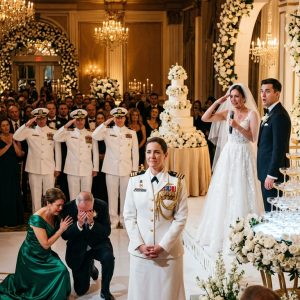
The Brier Hollow Country Club was an opulent monstrosity, featuring a grand ballroom encased in floor-to-ceiling glass and a meticulously manicured lawn that sloped aggressively down toward the dark water. On the evening of Raymond’s sixty-fifth, it was packed to the fire code limit with the exact demographic he had spent four decades desperately trying to emulate.
There were his former colleagues from the commercial insurance sector, men who had grown comfortably gray and aggressively prosperous. There were his golf partners, flanked by wives draped in subtle, expensive jewelry. And scattered throughout were the specific neighbors who had observed the Albrights creeping their sedan past Loon Lake every Sunday for thirty years.
A massive, ostentatious banner—gold lettering against stark white—screamed: 65 AND NEVER BETTER. A grotesque swan ice sculpture was actively losing a thermodynamic battle against the heated room. And positioned near the head table sat the cake—a fondant-covered monolith the size of a coffee table, bristling with sixty-five unlit candles.
I lingered in the arched doorway for a prolonged moment, executing a threat assessment the same way I evaluate a chaotic construction site. I scanned for the load-bearing columns. I identified the social pressure points.
This ballroom was a theatrical stage explicitly constructed to service one man’s fragile vanity. Every soul present was an extra he had cast to validate his illusion of success. They were also, entirely unbeknownst to them, the jury I had assembled for his execution.
I had spent my entire adolescence being paraded through rooms possessing this exact atmospheric pressure. I was the ‘gift,’ the ‘project,’ the brave little rescue dog performing tricks. I understood the lethal acoustics of these spaces. I knew exactly how cruel laughter rippled through a crowd. I knew how a single, devastating sentence, amplified by a microphone, could physically pin a human being to the floor.
Raymond was heavily banking on those acoustics. He had selected his weapon: sixty captive witnesses, a live mic, and the oldest, most cowardly form of cruelty—humiliation disguised as a folksy joke.
He had no earthly idea I had already armed the warhead.
I smoothed the lapels of my tailored jacket and stepped onto the parquet floor.
Diane intercepted my trajectory before I had cleared three paces. She was practically vibrating, radiating the specific, manic energy she exclusively channeled when an audience was present. She extended both arms in a theatrical embrace.
“Sophie! You actually came! Just look at you!”
She air-kissed the vacant space a safe two inches from my cheek and immediately clamped her fingers around my elbow, physically steering me toward a cluster of heavily perfumed women congregating near the mahogany bar. She was already narrating my existence.
“Ladies, this is Sophie. Our Sophie. You’ve surely heard me brag about her. She has done so incredibly well for herself out in the city. Hasn’t she done just marvelously?”
I offered firm handshakes, delivered the socially required platitudes, and allowed her to utilize me as a prop. The illusion of her grand generosity was practically glowing on her skin like expensive highlighter.
Eventually, she steered me toward the front of the room. I spotted the insult before she even opened her mouth to excuse it.
The head table was an expansive, white-draped affair. There were exactly five plush banquet chairs, each meticulously adorned with an oversized gold silk bow tied around the backrest.
And banished to the extreme far corner, precariously close to the swinging doors leading into the chaotic catering kitchen, sat a single, raw metal folding chair. No gold bow. No padding.
Resting on the linen in front of it was a cheap, tented place card. I leaned in slightly to read the calligraphy. It read simply: Sophie.
No last name. Just Sophie. The exact methodology they had employed to systematically erase the name ‘Fowler’ from my identity for sixteen years.
Diane caught me staring at the metal insult. She possessed the bare minimum of social grace to lower her voice to a conspiratorial whisper.
“We ran desperately short on the good chairs, sweetheart,” she murmured smoothly. “You won’t mind, will you? You’ll just take the folding chair.”
There it was. The ghost of my eight-year-old self, resurrected and handed to me one final time in a room packed with elites who would never comprehend the psychological violence of the gesture.
I looked at the freezing metal. I looked at the battered kitchen doors behind it, where the invisible hired help frantically rushed back and forth serving other people’s feasts.
I turned and smiled at Diane. It was a genuine, terrifying smile. Because I was holding a secret she couldn’t possibly fathom.
I was never going to sit in that damn chair again.
I spent the subsequent hour floating through a gala explicitly designed to facilitate my public execution. I navigated the room clutching a flute of vintage champagne I refused to let touch my lips, armed with a terrifying, serene calm.
Spencer cornered me near the floor-to-ceiling windows, violating my personal space, engaging in his trademark routine where he hurls thinly veiled insults and attempts to brand it as sibling banter.
“So, what is it your little company actually manufactures again?” he sneered, aggressively swirling a glass of neat scotch. “Mobile homes, right? Modular stuff?”
“Correct,” I replied, my voice a flat line. “Trailers.”
He barked a harsh laugh at his own perceived wit. I allowed him his delusion.
Moments later, a distinguished, silver-haired executive from Raymond’s former insurance firm approached, kindly inquiring how the ‘family business’ was treating me. Before I could even draw breath to respond, Spencer interjected loudly.
“Oh, she’s not actually involved in the business.”
A suffocating, awkward silence descended over the small circle. The executive’s eyes darted nervously between Spencer’s smirk and my deadpan expression. I watched the man internally process a dark truth about the Albright family dynamic they arrogantly believed they were concealing.
This micro-aggression occurred twice more within the hour. A nosy neighbor inquired if I would be attending their annual Christmas Eve bash. Diane immediately cut in, “Oh, we shall see. Sophie is just so incredibly busy,” utilizing a tone that effectively slammed a steel door in the neighbor’s face. Another guest complimented my timepiece. Spencer muttered, just loud enough to be overheard, that it was likely a high-end counterfeit.
Every single interaction was a microscopic laceration. The exact kind of paper cuts they had been inflicting upon me my entire life. Too small to warrant a massive hemorrhage, but too numerous to ignore.
The previous version of Sophie would have absorbed the abuse. She would have smiled brighter, laughed louder, desperately attempting to earn a fraction of the warmth that was mathematically impossible to receive.
But I had read the group chat. I possessed the undeniable proof that my absolute best behavior was, to them, merely ‘good for the photographs.’
So, I ceased performing entirely. I stood there, relaxed and quiet, and allowed them to reveal their grotesque, true nature in front of their wealthy peers. Because the guests were actively observing now. They were analyzing the cracks in the facade. And that observation was going to be critical in approximately ten minutes.
Across the cavernous room, the sharp clink-clink-clink of a silver fork striking crystal shattered the ambient chatter.
The ballroom fell into a hushed, expectant silence. Raymond stood proudly at the center of the head table, gripping the microphone in his right hand, his reading glasses dangling from his left. At sixty-five, he was practically vibrating with the narcissistic energy he had been harvesting his entire life.
He was admittedly skilled at the theatrical aspect of this. He smoothly thanked the attendees. He landed a self-deprecating joke regarding his deteriorating knees, a mild jab at Diane’s culinary skills, and a standard country-club quip about an accountant stopping laughing. The room ate out of the palm of his hand.
He transitioned into a nostalgic monologue about the insurance agency. He waxed poetic about the grueling early years, explicitly claiming he had “built a towering empire from absolute scratch.”
I bit the inside of my cheek hard enough to draw copper. Raymond had inherited a fully functional, highly profitable agency directly from his father. He had never built a damn thing from scratch in his entire miserable life.
He raised his glass high, offering a booming toast to Spencer. “My son. The absolute future of our legacy.”
Spencer stood up, offering a smug, practiced bow. The room erupted in polite, sustained applause. Diane dramatically dabbed the corners of her eyes with a linen napkin.
I stood in the shadows near the periphery of the room, intentionally far from my designated folding chair, still clutching my warm champagne. I could feel the trajectory of his speech curving toward me, the inevitable way a hurricane bends toward a vulnerable coastline.
I could sense the impact coming. Spencer was practically vibrating with malicious glee, grinning into his scotch. Diane had composed her features into a mask of expectant, synthetic grace. Across the expanse of the ballroom, Brenda had gone deathly pale and completely rigid. She was the only other soul present who had read the group chat. She was bracing for the shrapnel.
Raymond dramatically shuffled his notecards. He surveyed his captive audience, his eyes scanning the crowd until they locked onto me, standing isolated at the edge of the light.
A dangerous flicker ignited behind his lenses. It was raw anticipation. The undeniable hunger of a man who is milliseconds away from delivering the punchline he has been obsessively polishing in the mirror for three weeks.
He offered a wide, predatory smile. He hoisted his champagne flute an inch higher.
“Now,” Raymond boomed, his voice echoing off the glass, “I would be entirely remiss if I did not take a moment to say a few words about Sophie.”
But before Raymond could deploy his weapon, a microscopic anomaly occurred in the matrix. An anomaly he absolutely had not budgeted for.
A man seated near the front row—a heavy-hitter from the elite country club circle, a ruthless commercial developer named Harlan Pierce whom I had never formally met but whose reputation I respected—suddenly lowered his lowball glass to the table.
“Wait,” Pierce interrupted. His voice wasn’t a shout, but it carried the undeniable authority of a man unaccustomed to being ignored. “Sophie Fowler?”
The rapt attention of the room instantly fractured, swiveling between Raymond and Pierce.
Raymond, caught completely off-guard with the microphone still hovering near his mouth, frowned in confusion. “Yes, Harlan. That is correct. Our Sophie,” he replied, utilizing a condescending tone designed to reclaim ownership of the narrative.
But Pierce wasn’t looking at Raymond. He had turned in his chair, his eyes locked dead onto me. His face had morphed into a complex expression hovering between sheer shock and profound professional respect.
“You own Bright Frame,” Pierce stated. It wasn’t a question; it was a revelation. “Your firm executed the massive Hartwell municipal development. You secured the county net-zero infrastructure project.”
“Yes, Mr. Pierce,” I replied, my voice steady and clear. “That was our bid.”
Pierce let out a sharp, genuine bark of laughter, pivoting his body to address the stunned room at large, completely hijacking Raymond’s stage. He was suddenly explaining my existence to the very people who had spent the last hour dismissing me as a glorified trailer salesperson.
“My firm aggressively bid against her on the Hartwell contract,” Pierce announced to the silent ballroom. “She runs one of the most ruthless, fastest-growing commercial homebuilders in the entire state. True net-zero engineering. My analysts couldn’t even touch her margins.”
A visceral, audible murmur ripped through the sixty guests. It was the highly specific, synchronized hum of dozens of wealthy individuals violently recalculating a human being’s status in real-time.
The nosy neighbor who had mockingly admired my watch was suddenly staring at my wrist with naked envy. Spencer’s arrogant smirk had vanished, replaced by a look of sheer panic. The synthetic, expectant mask plastered across Diane’s face developed a massive, visible fracture.
And Raymond stood paralyzed at the head table. The microphone remained suspended in the air. His polished, cruel punchline was still loaded in the chamber. But he was suddenly suffocating under the realization that within a fifteen-second window, the entire room had discovered that the pathetic ‘charity case’ banished to the folding chair was exponentially more successful than any man he had ever invited to his club.
He could have aborted the mission. A man possessing a singular ounce of strategic wisdom would have immediately surrendered, pivoted the speech, raised his glass in genuine tribute to my success, and sat down before the damage became terminal.
But Raymond had been salivating over this moment for weeks. And a bruised ego is a current that only flows in one catastrophic direction.
He cleared his throat aggressively, desperate to reclaim control.
“Yes, well, Sophie has certainly done quite well for herself. That is undeniably true,” Raymond stammered, attempting to recover his footing. He deployed the slick, artificial smile that had closed insurance policies for four decades, arrogantly deciding he could fold Pierce’s revelation into his premeditated joke and ride the wave.
“She has done remarkably well for somebody who… let us be brutally honest here… didn’t exactly originate from much.”
A smattering of uneasy, nervous laughter rippled through the front tables. He was testing the structural integrity of the ice. Believing it held, he arrogantly stepped out into the deep water.
“Now, some of you in this room are privy to the whole story, and some of you are not,” Raymond continued, his confidence swelling. “Diane and I took Sophie in many, many years ago, long before our Spencer finally came along to bless us. And we did right by her. I firmly believe everyone here tonight would agree that we did right by her.”
He paused theatrically, demanding the murmur of validation. He received it, purely because the room still fundamentally wanted to remain on his side.
Then, he detonated the payload. The exact line ripped from the group chat. The line he genuinely believed was the hilarious, self-deprecating capstone to a life of unparalleled generosity.
He locked his eyes directly onto mine. He hoisted his glass high into the air. And leaning into the microphone, broadcasting to sixty captivated witnesses, he executed the strike.
“But I’ll share a rather amusing secret with all of you,” he chuckled darkly. “Diane and I were finally re-drafting the estate will last month with the lawyers. The attorney specifically asks me about Sophie’s allocation. And I had to pause and really think about it.”
He laughed—a harsh, barking sound.
“Because here is the honest truth, sweetheart. And absolutely no hard feelings.” He pointed the rim of his glass at me. “You’re not really mine. I just forgot to cross you out.”
The ballroom erupted.
It was the specific, terrifying laughter of a mob that has just been granted explicit permission to be cruel. It was loud, relieved, and entirely unrestrained. Crystal glasses were hoisted into the air. Several men offered drunken whoops of approval. Spencer’s obnoxious, braying laugh cut through the din like a chainsaw. Diane was literally clutching her chest, howling with laughter as if the sheer brilliance of his wit had physically wounded her.
The grotesque ice swan continued to melt onto the linen. The sixty-five candles continued to burn down. Sixty wealthy elites howled at the expense of the orphan assigned to the folding chair, exactly as the script had dictated.
And standing directly in the epicenter of that deafening noise, I remained completely, utterly motionless.
For the first time in twenty-six years, I realized that there was absolutely nothing inside of me that their cruelty could touch. They could not reach the vault.
I deliberately placed my full flute of champagne onto the nearest cocktail table. I did not slam the crystal down in a dramatic fit of rage. I placed it gently, with the precise, detached care of a master carpenter setting down a hammer she no longer requires to finish the job.
Then, I reached down and gripped the cold metal of the folding chair. My folding chair. The squeaking, pathetic piece of steel bearing the card that read only Sophie.
The uproarious laughter nearest to me began to falter and die as people noticed the deliberate nature of my movements.
I carried the chair exactly three paces. I folded it with a sharp, metallic clack, and leaned it unceremoniously against the far wall, entirely out of the walkway. The exact manner in which you permanently store a broken tool you will never utilize again.
I smoothed the lapels of my tailored jacket one final time. And I began to walk directly toward the head table.
My pace was slow, methodical, and entirely unhurried. The sharp click-clack of my heels against the parquet flooring sounded like a metronome ticking down to zero. The deafening laughter began to die, rolling backward from my footsteps like a receding tide, until the cavernous ballroom plunged into an absolute, suffocating silence.
By the time I reached the center of the room, you could hear a pin drop.
Raymond’s arrogant smile was still frozen halfway up his face. The microphone was still gripped tightly in his fist. His eyes tracked my approach, and for the first time in his life, a distinct flicker of primal terror breached his confidence.
Diane half-rose from her gold-bowed throne, her mouth opening in silent panic.
“Soph, Jesus, it’s just a joke,” Spencer hissed nervously. “Just sit down.”
But Spencer’s voice cracked violently on the final syllable. Because there was no chair left for me to sit in. I had ensured that reality.
I arrived at the edge of the head table. The long, pristine white barricade displaying the massive cake, the burning candles, and the five luxurious chairs they had hoarded for themselves.
I stopped dead center, directly in front of my adoptive father.
I reached a steady hand into my leather clutch.
And I demand you stay with me for this exact moment. Because what I extracted from that purse and placed onto the linen is the sole reason I am breathing life into this memory. It is the reason I turned the camera on.
Chapter 7: The Final Demolition
I extracted the single sheet of heavy stock paper, folded perfectly in half. I meticulously unfolded it, pressing the crease flat with my palm, and laid it squarely onto the pristine white tablecloth, directly in front of Raymond Albright’s plate.
I executed the movement so deliberately that the entire ballroom physically leaned forward, desperate to decipher the document.
“Happy birthday, Raymond,” I stated.
My voice was not a scream. It was dangerously even, chillingly quiet. And within the vacuum of that silent room, my unamplified words carried with infinitely more devastating force than his expensive microphone ever could. I did not raise my volume a single decibel. I knew I would never need to again.
“I brought you a gift tonight. I have been meticulously planning the logistics for three weeks. But I require every single person in this room to understand exactly what the gift was. Because you all just loudly applauded what you believe I am. Now, you are going to sit in silence and learn the rest of the equation.”
I tapped the sharp corner of the paper with my index finger.
“Three weeks ago, I purchased Loon Lake.”
The name of the estate ripped through the ballroom like a high-voltage current. Loon Lake. Half the men in that room had spent the last thirty years listening to Raymond pathetically covet that exact fortress.
Diane emitted a strangled, high-pitched gasp. Raymond’s eyes dropped violently to the paper. The hand holding his champagne glass slowly, shakily lowered to the table.
“The historic stone manor resting on the deep water,” I elaborated, ensuring my voice penetrated the back row. “The boathouse. The eleven acres of timber. The private shoreline you used to slowly drive us past on Sunday afternoons when I was a terrified little girl. The property you stared at while you promised everyone that someday, when your ship came in, it would be yours.”
I paused, letting the silence crush him.
“I bought it in cash. And I instructed my corporate attorney to draft a deed.”
I locked my eyes onto his, and I ensured my tone was as smooth, gentle, and utterly toxic as Diane’s had been when she first assigned me to the folding chair.
“I was going to hand it to you tonight, Raymond. I was going to authorize putting both your name and Diane’s name on the title. I was prepared to hand you the singular object you have lusted after your entire miserable life, presenting it as a grand, unearned birthday present in front of this exact audience.”
Somewhere near the bar, a man’s voice whispered in absolute shock, “Four million dollars.”
Raymond was staring at the paper as if it were an unexploded bomb. His hand twitched erratically toward it, desperate to verify the claim.
And right there, suspended in the deepest, most profound silence that ballroom had ever contained, I delivered the line I had carried out of the parking lot. The line I had spoken to my bewildered attorney.
“But I didn’t come here tonight to buy a name,” I said softly. “I came here to give one away.”
Then, while sixty high-society witnesses held their breath, I calmly picked the deed back up off the tablecloth. I gripped the heavy paper firmly in both hands.
And I tore it in half.
The sound of the thick stock ripping was deafening in the silence. It was a single, violent, clean tear.
Diane shrieked.
I calmly placed the two halves together. I tore them again. And again. My movements were slow, methodical, and entirely unhurried, mimicking the exact rhythm of a person shredding a voided check they have decided is fundamentally worthless. I tore the document until it was reduced to a small, jagged pile of confetti resting in my palm.
I opened my fingers.
I allowed the shredded pieces to rain down onto the white tablecloth directly in front of Raymond. They scattered across the linen, drifting between his expensive cake and his reading glasses.
“That was merely a copy,” I announced, my voice slicing through the shock. “I want to be unequivocally clear about the legal reality, because I am intimately aware of how aggressively this family attempts to manipulate inconvenient truths. What I just tore up was a prop.”
Raymond snapped his head up to look at me. For the first time all evening, the slick insurance salesman possessed zero comebacks. The joke was dead.
“The original document,” I stated, articulating every consonant, “was signed at exactly eight-thirty this morning. It was notarized. It was electronically recorded with the county register of deeds at nine o’clock, long before I drove to this club. It is absolute. It is finalized. It is a matter of permanent, impenetrable public record. And it cannot be undone by any lawyer in this room, nor can it be undone by me.”
I allowed the permanence of the legal trap to sink into his bones. Sixty people forgot to exhale.
“Loon Lake does not belong to you, Raymond,” I said, my voice dropping to a lethal whisper. “And it never will. As of this morning, the entire estate belongs to the Open Door Foundation. It is currently being converted into a massive transitional home. A real home. For teenagers who age out of the foster system at eighteen, holding two plastic garbage bags and possessing absolutely nowhere to sleep.”
My voice remained terrifyingly steady.
“Kids exactly like the terrified girl you dragged into your house purely for the photo ops, only to abandon her in a metal folding chair for twenty-six years. They get the lake house, Raymond. They get the deep-water boathouse, the private shoreline, and the ‘someday.’ And you get the privilege of reading about my philanthropy in tomorrow’s newspaper.”
What Raymond did next is an image that will be burned into my retinas for the remainder of my life.
This sixty-five-year-old patriarch, draped in a custom-tailored suit, desperately reached out with both hands. He frantically began gathering the torn, jagged shreds of the deed off the tablecloth. His movements were clumsy, pathetic, and urgent. He aggressively shoved his reading glasses up the bridge of his nose and literally began attempting to piece the document back together right there on the linen, in front of his horrified guests.
Nobody stepped forward to assist him. Nobody dared to speak.
He manipulated the scraps with visibly shaking fingers, desperately trying to align the torn edges. He looked exactly like a broken man attempting to reverse time and rebuild a priceless vase he had already smashed to powder.
As the legal text slowly reassembled beneath his frantic hands, I watched his eyes scan the words.
GRANT DEED… LOON LAKE…
And there, situated on the specific line where he had spent weeks desperately assuming he would finally see his own name printed in bold ink, he found the typed reality: THE OPEN DOOR FOUNDATION.
He read it. He blinked rapidly and read it a second time.
The remaining color instantly evacuated his face. I watched the ruddy, arrogant country-club tan drain from his forehead down to his neck, until his complexion matched the sickly, gray February sky the day the previous owner of Loon Lake had died.
His jaw fell open. No sound emerged.
The most successful, powerful individual he had ever permitted to cross his threshold had just handed him undeniable, physical proof that the adopted daughter he had publicly humiliated for a cheap laugh had quietly, legally donated an asset worth more than his entire combined estate to the exact demographic of vulnerable child he had fundamentally failed to protect.
“She’s Diane’s, not mine,” he had callously declared when I was ten.
“I just forgot to cross you out,” he had joked into the microphone tonight.
Now, he sat paralyzed behind a pile of shredded paper, fully comprehending that I had preemptively crossed myself out of his narrative. I had seized control of the red pen, and I had taken the only prize he ever truly worshipped with me when I left.
His face turned ashen white. And the entire ballroom witnessed his absolute ruin.
Then, the fragile social construct of the room violently collapsed. The aftermath exploded exactly as one would predict, with every individual desperately showcasing their true nature under extreme pressure.
Diane launched her counter-offensive first. She lunged upward from her gold-bowed chair. The synthetic tears materialized instantly—the practiced, theatrical weeping of a seasoned martyr. She physically turned her back to me, addressing her audience, desperately trying to reclaim the narrative.
“After absolutely everything we sacrificed for her!” Diane wailed, her voice shrill and desperate. “We provided her a beautiful home! We gave her everything she ever needed! And this… this catastrophic cruelty is how she repays our generosity? In public? On your father’s milestone birthday?!”
She was frantically reaching for sympathy, throwing a lifeline to a sinking ship.
Not a single guest reached back. The silence from the crowd was deafening.
Spencer’s reaction was infinitely more pathetic, because Spencer didn’t even possess the decency to pretend this was an emotional betrayal. His panic was purely financial.
“You can’t just legally give away a four-million-dollar asset!” Spencer shouted, his voice cracking, entirely forgetting his polished persona. “That is insane! That is our… That should have been… You have to call your lawyers and reverse that transaction right now!”
He had actually screamed the word ‘our.’ The will hadn’t been read, the patriarch was still actively breathing, and the golden boy was already violently grieving an inheritance that was never going to materialize in his bank account.
I looked at Spencer and felt a sudden, profound wave of pity. It was the exact emotion you feel when observing a vicious animal that was fundamentally trained wrong by its handlers.
And Raymond?
Raymond never stood up to defend himself. He remained slumped at the center of his own ruined gala, his gray hands resting limply over the shredded deed. He slowly raised his eyes to meet mine.
And for one fleeting microsecond, something intensely real managed to break through the impenetrable armor of his narcissism. Something buried deep beneath sixty years of superficial performance. It was a flicker of grief so raw, so violently genuine, that it almost cracked my resolve.
“Sophie,” he whispered.
He didn’t use an insult. He didn’t demand I fix it. He just said my name. His voice was hoarse, fractured. His eyes were suddenly pooling with unshed tears, and his right hand lifted a tragic inch off the tablecloth, desperately reaching out toward me.
For that single, agonizing second, he was a man who possessed total, devastating clarity regarding the magnitude of what he had casually thrown into the incinerator.
Then, Diane’s voice snapped like a whip.
“Raymond!”
It was a harsh, terrified command. And Raymond heard it. His hand dropped heavily back to the linen. He blinked away the tears and averted his gaze, staring blankly at the floor.
He chose her. Just as he had chosen her every single day for twenty-six years.
I remained perfectly, terrifyingly calm. I did not scream at them. There was absolutely no truth left in that room that required volume to be heard.
I casually reached down and retrieved my leather purse. I methodically buttoned the center button of my tailored jacket. I looked at the three of them one final time, burning the tableau into my memory. Diane, hysterically performing her synthetic martyrdom. Spencer, furiously performing mental math regarding his lost inheritance. Raymond, utterly defeated, staring vacantly at the shredded paper.
And a profoundly strange sensation bloomed in the center of my chest. It wasn’t the fiery rush of triumphant revenge. Nor was it the crushing weight of grief. It was an emotion infinitely cleaner than both. It was the physical sensation of finally setting down a crushing weight you have carried for so long you forgot it had a bottom.
“I spent my entire adult life,” I said, my voice quiet but commanding, aimed solely at Raymond, “desperately trying to force you to claim me. I tried buying it. I tried earning it. I brought you expensive gift baskets, I installed luxury furnaces, and I came within a signature of bringing you a damn lake.”
I reached down and pinched a single, torn scrap of the deed between my fingers. Just one piece. I closed my fist around it.
“But tonight, you proudly stood up in front of all your closest friends and explicitly informed me of exactly who I am to you. So, I have decided to finally believe you.”
I dropped my hand to my side.
“You can keep the shredded pieces on the table,” I said. “I already kept the only part of this transaction that actually mattered.”
I turned on my heel. I began the long walk down the center of the silent ballroom, heading toward the massive glass doors. The only audio in the room was the rhythmic click-clack of my heels striking the parquet.
Sixty members of Brier Hollow’s elite silently parted like the Red Sea to allow me passage.
Brenda was waiting for me near the exit. Her eyes were wet, but her posture was rigid. As I passed, she reached out and firmly gripped my forearm. Her hand was warm, dry, and fiercely steady, mirroring our moment in the diner.
“Atta girl, kiddo,” Brenda whispered fiercely. “Atta girl.”
I pushed through the heavy glass doors and stepped out of the Brier Hollow Country Club into the crisp, biting night air. A strong breeze rolling off the dark lake rushed up the manicured lawn to greet me.
I did not look back over my shoulder. Not even once.
The metal folding chair remained leaning against the far wall exactly where I had abandoned it. I have never sat in one since.
Epilogue: The Architecture of a Home
The resulting fallout was swift, brutally quiet, and entirely absolute—which is the hallmark of the most devastating legal victories.
The transfer of the deed could not be reversed, primarily because there was no fraudulent action to reverse. The Loon Lake estate legally, lawfully, and permanently belonged to the Open Door Foundation. The only individuals highly motivated to contest the transfer possessed zero legal standing to file a grievance, because the asset had never legally belonged to them in the first place.
I heard through the grapevine that Spencer had frantically consulted with an aggressive litigator later that week. The attorney bluntly informed him of the exact reality my lawyer already knew: You cannot sue your way into securing a gift that was never legally offered to you.
Two weeks post-gala, the local Brier Hollow Gazette ran a front-page feature. It was a glowing, heartwarming piece detailing how a self-made, female commercial homebuilder had anonymously purchased and donated the county’s most historic lakefront estate to house vulnerable foster youth.
The article did not mention the names Raymond or Diane Albright a single time. I suspect that total, public erasure wounded their fragile egos far more profoundly than any direct accusation ever could.
Within the tight-knit country club ecosystem, Raymond’s social standing suffered the exact fate status always endures when the financial illusion supporting it suddenly shatters. The elite members remained polite to him, but they no longer admired him. Diane abruptly ceased hosting her lavish garden club luncheons. Spencer quietly relocated to a condo in Florida, supposedly pursuing a ‘startup opportunity.’
Brenda—the singular Albright who had consistently treated me as a human being—drove out to the construction site with me that autumn. We stood side-by-side at the end of the deep-water dock, the exact spot Raymond had lusted after. She looked at the sprawling renovations and told me she was profoundly proud of me. It was a tone of voice no one bearing that surname had ever utilized toward me before.
I never spoke a single word to Raymond or Diane again. It wasn’t born out of a festering hatred. I simply reached a point where I required absolutely nothing from them. I learned that a boundary isn’t always a screaming match; sometimes, a boundary is simply the peaceful absence of a door you used to obsessively knock on.
I returned my focus to my empire. I continued building highly efficient houses. I finally granted the traumatized eight-year-old residing in my chest permission to rest.
The following spring, Loon Lake officially opened its newly reinforced doors.
We finalized the massive structural renovations in mid-March, almost exactly one year to the day after the original patriarch of the estate had passed. I had aggressively retrofitted the entire manor to achieve net-zero status, because I simply cannot suppress my engineering instincts, and more importantly, because the incoming kids deserved a massive stone fortress that cost absolutely nothing to keep blazingly warm during a Michigan winter.
The facility boasted eight sprawling bedrooms, an industrial-grade kitchen, a fully staffed counselor’s suite, a soundproofed study hall, and a massive, custom-built wooden dining table. I had personally designed and constructed the table in my private shop on the weekends, aggressively sanding the heavy oak down by hand until it was perfectly smooth.
The inaugural cohort of residents arrived the very week we cut the ribbon. Six teenagers. Every single one of them had aged out of the brutal state system holding nothing but trash bags. They carried the exact same terror I had carried. They carried the exact same invisible weight the girl on my framing crew had carried.
On their first official night in the manor, I drove out unannounced to verify the HVAC telemetry was functioning properly and to ensure the commercial pantry was fully stocked. They hesitantly asked me to stay for dinner. I accepted.
There were seven heavy, beautifully carved wooden chairs positioned around the massive oak table I had built. Every single chair was identical. Every single chair was sturdy.
A young girl named Tasha—eighteen years old, having officially aged out of the system a mere three weeks prior, and the youngest of the group—was nervously lingering near the swinging doors of the industrial kitchen. She was instinctively waiting to be directed toward the lesser, inferior seat. She was already absolutely certain that a designated ‘garbage’ chair existed for her.
I recognized that defensive posture instantly. I had practically invented that posture.
I walked to the head of the massive oak table. I pulled out the premier chair—the heavy, carved seat boasting the unobstructed, panoramic view of the dark water through the bay windows.
I locked eyes with Tasha. “This one belongs to you,” I said gently.
She stared at me, paralyzed by disbelief. They never believe it at first. The unlearning process takes time.
Slowly, she walked over and sat down at the head of the table. She sat in a chair inside a historic mansion that a mediocre man had violently coveted his entire life and completely failed to earn. She gazed out the window at the private shoreline that was legally designated to protect her, and a small, fragile smile broke across her face. It was the smile of someone who has finally been allowed inside, out of the freezing rain.
There was not a single metal folding chair located anywhere on the eleven-acre property. There never will be.
I squandered thirty years of my life desperately attempting to earn a seat at a table that was fundamentally designed to exclude me. The exact moment I finally ceased dragging out my own folding chair and decided to construct a longer table, I realized there had always been more than enough room in the world. I had just been begging for scraps at the wrong address.
This is my history. One squeaking metal chair, one shredded sheet of heavy paper, and a sprawling stone fortress that finally belongs to the kids who only ever needed someone to open the damn door.
If this chronicle reminded you that you are under no obligation to purchase your way into anyone’s family, or shrink yourself to fit into a room that refuses to save you a legitimate seat, consider this your sign to stop knocking.
Like and share this post if you find it interesting.