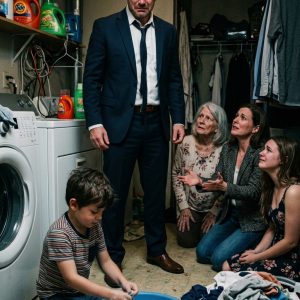
Title: The Ledger of Betrayal
Chapter 1: The Arithmetic of a Broken Chest
My name is Paige Tanner. I am thirty-four years old, and I discovered the exact, depreciated value my family placed upon my life from the sterile confines of a trauma ward.
Six weeks prior to this revelation, I had given birth to a daughter, Nora. Life was a blur of swaddles, sleepless nights, and the profound, terrifying gravity of keeping a tiny human alive. Then came the Tuesday evening I was driving home from a late-quarter financial review. A commercial delivery truck blew through a red light on Colfax Avenue. The physics of the impact were brutal and immediate. I regained consciousness to the acrid smell of deployed airbags and burning rubber, eventually waking fully in an emergency room with three fractured ribs, a punctured right lung, and a heavy plaster cast encasing my dominant arm.
My husband, Daniel, was stranded in an airport terminal in Seattle, agonizingly six hours away from touching down in our time zone. Someone desperately needed to care for my six-week-old newborn that night. My mother, Linda, resided a mere twenty-minute drive from the hospital doors.
When my husband called her, begging for help, she uttered a single syllable: “No.”
She followed that refusal with a specific sentence directed at Daniel. That single, weaponized sentence is the absolute reason you are reading this account today. She told my terrified husband, “Your sister never has these emergencies.”
My younger sister, Megan, was currently sipping overpriced cocktails on a luxury Caribbean cruise. My mother, meanwhile, was firmly planted in front of a blinking slot machine at a casino.
What I executed from that uncomfortable vinyl mattress over the subsequent three minutes ended a staggering nine-year grift that had cost me exactly $486,000. Yet, the financial severing isn’t even the hammer that ultimately shattered their reality. The element that truly broke them walked through my hospital door three hours later: an elderly man clutching a violently worn manila folder. When he finally spoke, he articulated a truth none of them ever anticipated hearing aloud.
If you have ever been the designated beast of burden in your family circle—the individual whose relentless stability is treated like a blank check for others’ dysfunction—this chronicle belongs to you.
Let me drag you into the claustrophobia of that phone call, because that is the epicenter of the earthquake.
I surfaced from the narcotic haze of anesthesia in a curtained bay of the ER. The initial sensation was the suffocating weight of the cast on my right arm, a foreign, dead limb. Then came the plastic identification band, cinched just a fraction too tight around my left wrist. A triage nurse was murmuring my name, a repetitive loop indicating she had been trying to rouse me for several minutes. Every time I inhaled, my ribs screamed, feeling as though a concrete block had been parked squarely on my sternum.
Daniel’s voice was emanating from the phone’s speakerphone, resting on the thin pillow beside my ear. His tone possessed that flat, meticulously careful cadence he only adopts when he is terrified and desperately trying to mask it.
“Paige,” he started, the digital static crackling. “The teenage sitter absolutely cannot stay past eleven. I called your mom.”
My gut clenched. The algorithms of my family dynamic processed the variables instantly. I knew the outcome before the words materialized.
“She won’t come,” I whispered, the effort sending a sharp lance of pain through my lung.
There was a heavy, saturated pause on the line. Behind Daniel’s strained breathing, I could detect another sound bleeding through the connection from whatever voicemail or background noise he was analyzing. It was faint but entirely unmistakable to anyone who grew up in my house. The electronic, chiming chatter of a casino gaming floor. The chaotic, synthetic fanfare a slot machine blares when it spits out a minor payout.
My mother was up in Blackhawk, the mountain gambling town, allegedly “blowing off steam” with her girlfriends.
“She told me she couldn’t possibly drive down the mountain,” Daniel explained, his voice thick with suppressed rage. “She claimed she has to stay at the house to cat-sit while Megan is on her cruise. A cat, Paige.”
My vulnerable, six-week-old infant required a guardian for the night because her mother had nearly been crushed to death in an intersection. And my mother’s prioritized answer was a feline.
I didn’t weep. I want you to internalize that specific detail, because society always anticipates the battered woman in the hospital bed to dissolve into hysterics. I did not shed a single tear. I stared at the barcode printed on my wristband. Then, fighting the agonizing pull in my chest, I reached awkwardly across my torso with my functional left hand and dragged my smartphone off the plastic tray table.
I possessed a monumental deficit to correct, and I was exceptionally, ruthlessly skilled at managing crises. That, historically, had always been the root of the cancer.
You need to understand my psychological baseline before that night to comprehend why my blood relatives treated my empathy the way a leaky faucet treats a glass—letting it fill only to drain it dry. My childhood was anchored to a drafty, rented duplex in Aurora, Colorado, where the furnace was merely a suggestion during the winter months. I financed my community college tuition by grinding out the closing shifts at a regional grocery store, scrubbing checkout lanes at midnight. I eventually transferred on an academic scholarship, clawing my way into an elite corporate finance program that nobody in my genetic orbit could even pronounce, let alone understand.
By the age of thirty, I was a Senior Financial Analyst at a sprawling, downtown Fortune 500 firm. I was the individual the executives summoned into the glass boardroom when the quarterly projections absolutely had to be flawless. I dissected complex spreadsheets for a living. I loved numbers because numbers lack emotional favorites. They do not possess the capacity to lie directly to your face, which was infinitely more than I could claim regarding the people who shared my last name.
Daniel and I had married at twenty-six. We deliberately postponed having children, partially out of personal preference, but largely because there was perpetually some catastrophic “family emergency” on my parents’ end that required my immediate financial triage. We existed drastically below our means in a quiet, invisible manner. Two solid corporate incomes, one reliable used sedan, zero consumer debt. That strict fiscal discipline is the exclusive reason the staggering reality I am about to confess was even mathematically possible.
For one hundred and eight consecutive months—nine long years—I had been quietly funneling my parents $4,500 every single month.
I had never vocalized that specific integer aloud. Not to my devoted husband, not to my entitled sister, not to my closest confidantes. I rationalized the bleeding by telling myself it was funding my father’s severe heart condition medications and keeping their mortgage out of foreclosure. I convinced myself I was the solitary pillar sturdy enough to shoulder the architecture of their survival. Over time, being the “dependable one” had metastasized into its own toxic identity.
I am confessing this so you grasp the nuance. I was not a gullible fool. I was hyper-responsible to the point of complete self-erasure. There is a vast, psychological canyon between the two.
And lying beneath those fluorescent ER lights, that canyon finally swallowed me whole. But before I dealt with the parasite, I had to secure my daughter. Let the triage begin, I thought, my left thumb hovering over the glass screen.
Chapter 2: Canceling the Deficit
The initial action I executed was not an act of vengeance. The first maneuver was purely operational: solving the immediate logistical nightmare. Because that is my core programming.
Operating entirely left-handed, I navigated to the contact details for a premium, licensed overnight childcare agency Daniel and I had extensively vetted prior to Nora’s birth, but had never actually utilized. A dispatcher answered on the second trill.
I delivered my name, my catastrophic situation, and my home address in a rapid, nine-sentence sequence. My tone was as placid as a Tuesday morning staff meeting.
“I require a board-certified night nurse for a six-week-old infant. Tonight. The shift commences immediately.”
The dispatcher hesitated, likely thrown by my icy composure. “Is the infant medically stable, ma’am?”
“My daughter is mathematically perfect,” I replied. “I am the one currently bolted to a hospital bed.”
Forty-two minutes later, an accredited pediatric nurse named Yvette punched the temporary keypad code Daniel provided into our front door. She washed her hands, established a secure perimeter, and immediately texted me a high-resolution photograph of Nora. My daughter was sound asleep in her bassinet, her tiny, perfect fist pressed firmly against her plump cheek.
I stared at that digital image for an eternity, the adrenaline slowly seeping out of my muscles.
The attending ER nurse, checking my vitals, observed me lower the device. Her eyes were soft, brimming with the customary pity reserved for accident victims. “Do you have any family local who can come sit with you?” she inquired gently.
“It is handled,” I stated flatly. “What is the next medical step?”
She blinked. People invariably blink rapidly when you fail to perform the emotional breakdown they have braced themselves to manage. I wasn’t attempting to be callous. I was simply executing mental triage, the exact survival mechanism you develop when you’ve spent three decades acting as the sole functioning adult in a room packed with chronological adults.
My infant was secure, warm, and monitored. My husband was hurtling through the stratosphere toward me. My fractured ribs would eventually calcify and knit together.
There was exactly one glaring, radioactive item remaining on my mental ledger that evening. It was a burden I had silently hauled for nine years, a locked vault I had never permitted myself to audit. And now, with my left hand free and my mind stripped of all familial illusion by the sheer clarity of physical trauma, the vault was opening.
I tapped the icon for my primary banking application. The biometric login screen illuminated the darkened hospital bay, glowing with the pale, unforgiving light of a cold moon.
Deep within the app’s architecture, there exists a submenu labeled ‘Recurring Transfers’. I maintained four active directives there. I had memorized their parameters the way a veteran knows the precise dimensions of shrapnel embedded in their thigh.
The first directive was labeled: Mom & Dad – $2,000/month.
The second read: Home – $1,100. (Earmarked for the mortgage I falsely believed I was anchoring).
The third stated: Dad Medical – $900.
The fourth was simply titled: Megan Support – $500.
Four thousand, five hundred dollars. Extracted on the first day of every month, for one hundred and eight months.
I had authorized the primary transfer at the naive age of twenty-five, the evening my father had phoned me, weeping hysterically about a catastrophic cardiologist bill. I had never permitted myself to calculate the aggregate sum, because calculating the total felt akin to opening a door I could never mentally walk back through.
Tonight, I forced myself to step through the frame.
My brain ran the compound math before the app even fully loaded. Four hundred and eighty-six thousand dollars.
Nearly half a million dollars of my labor, my youth, and my marital security, siphoned out of my existence through quiet, automated digital pulses. All while my mother confidently bragged to our extended relatives at every Thanksgiving that she and my father “managed wonderfully on their own.”
I pressed my thumb against the word Cancel adjacent to the first transfer.
A vibrant green checkmark materialized, accompanied by a line of sterile text I will retain until my final breath: Recurring transfer successfully canceled.
I tapped the second directive. Canceled.
The third. Canceled.
The fourth. Canceled.
Four taps of a glass screen. Approximately twenty seconds of exertion. And a nine-year financial hemorrhage simply ceased. Just like violently twisting the valve on a broken pipe.
I experienced zero triumphant euphoria. I felt no crippling grief. I solely experienced a bizarre, flattened clarity—the exact sensation that washes over an analyst the microsecond a chaotic, sprawling spreadsheet finally balances to absolute zero.
Then, as I prepared to force-close the application, my exhausted eyes snagged on a glaring anomaly within the transaction history ledger I had never previously scrolled deep enough to unearth. It was a solitary line item, intentionally buried beneath the Dad Medical category, dated twenty-four months prior.
It read: Loan M – $40,000.
The initial “M” did not correspond to a medical facility. It stood for Megan.
I locked the device and lay perfectly rigid in the semi-darkness, listening to the rhythmic, synthetic chirp of my heart monitor. I forced myself to confront the agonizing question I had actively avoided for nearly a decade: Why had I done it?
The simplistic answer, the psychological platitude strangers might offer, is that I was a pathetic pushover, desperately attempting to purchase my parents’ affection. That hypothesis is entirely incorrect. And if you have ever occupied the role of the “dependable one,” you inherently understand the true pathology.
I executed those transfers because, somewhere deep in my formative years, I had subconsciously calculated that being necessary was the exact equivalent of being safe. If I functioned as the financial load-bearing wall of the Reynolds family, they could never afford to demolish me.
My maternal grandmother possessed the intellect to diagnose this flaw within me long before I recognized it myself. Her name was Ruth, a towering, flinty matriarch who constantly smelled of dark roast coffee and sewing machine oil. She was a woman who never once required volume to command a room’s absolute attention.
A year prior to her passing, Ruth had cornered me in the kitchen during Thanksgiving, her arthritic grip surprisingly fierce around my wrist. “Somebody has to keep a vigilant eye on this family’s ledger, Paige,” she rasped. “Your mother refuses to do it, so the burden falls to you.”
At the time, I foolishly interpreted her words as an instruction to be endlessly generous. Lying in the trauma ward, I realized she meant something entirely different. She was ordering me to be ruthless.
Ruth had passed away the previous spring, slipping away quietly in her sleep. I had been entirely consumed by severe morning sickness and a brutal corporate quarter, too exhausted to investigate what estate she had left behind, or to whom. I blindly assumed my mother, Linda, had managed the probate with the same fictitious competence I assumed my money was buying my father’s heart medication.
I had squandered a lifetime projecting the best intentions onto people who had never once produced the collateral to earn it, and I had mistakenly labeled that projection “love.”
The actual, unfiltered family had just abandoned my newborn for a stray cat.
My phone vibrated, violently snapping me back to the clinical present. It was Daniel, calling from his terminal layover. This time, he recited my mother’s exact dialogue verbatim, understanding I required the raw data.
He had pleaded with Linda at 9:00 PM, detailing my emergency surgery and the baby’s vulnerability. He merely asked her to navigate the twenty-minute drive.
“She let out that massive, theatrical sigh she always does,” Daniel recounted, his voice trembling. “She told me she absolutely couldn’t. She said Megan was finally enjoying her ‘dream vacation’ and someone had to ensure the cat didn’t get lonely. And then, Paige… she literally said, ‘Besides, Paige always lands on her feet.'”
Paige always lands on her feet.
As if the commercial truck that T-boned my sedan had politely verified my family ranking before crushing my ribcage.
Daniel’s voice completely fractured as he finished the report. I immediately shifted into my designated role. I instructed him to regulate his breathing. I assured him Nora was heavily guarded. I promised him my vitals were stable. I ordered him to board his connecting flight.
After severing the connection, a masochistic impulse drove me to open Instagram—an application I typically ignored. Resting at the absolute top of my feed was Megan’s latest “Story.” It was a hyper-saturated, glistening video reel showcasing a turquoise cruise ship pool deck, a hollowed-out coconut beverage, and a superimposed text graphic that read: Living my absolute best life. Finally.
My twenty-nine-year-old sister. A chronically unemployed, aspiring “lifestyle influencer” boasting a meager 11,000 followers, surviving on a $500 monthly stipend she genuinely believed was manifested by the universe.
I did not leave a scathing comment. I did not hurl my phone against the sterile wall. Instead, I opened my text messages and drafted three simple words to a contact I had not utilized in months. A number saved plainly as: Grandpa H.
We should talk, I typed.
The three gray ellipsis dots materialized on his end almost instantaneously, as if the old man had been sitting in the dark for nine years, waiting for that exact digital flare to launch.
I fully anticipated a text reply from Grandpa Harold. Instead, my screen violently illuminated with an incoming FaceTime request broadcasting directly from the middle of the Caribbean Sea. It was Megan. What spectacular timing, I mused, accepting the call.
Chapter 3: The Audit of Illusions
I accepted the video call utilizing my left hand, ensuring my face remained partially obscured by the room’s shadows. Megan didn’t even register the acoustic ceiling tiles of the hospital ward behind my head. She didn’t notice the heavy plaster cast resting on my chest. She certainly didn’t inquire why I was lying horizontally in the middle of the night.
“Paige, literally finally,” she whined, shoving her smartphone so close to her face that her peeling, sunburned nose dominated my screen. “My debit card just got brutally declined at the ship’s spa. It was humiliating, like, beyond words.”
I maintained absolute silence. I allowed the void to stretch.
Nature abhors a vacuum, and Megan abhors silence. She immediately plugged the gap with the exact intel I required. “Mom specifically said the family account always has overdraft protection to cover me. Did you accidentally touch something in the settings?”
And there it rested. The entire, rotting architecture of my mother’s nine-year fraud, perfectly distilled into a single, oblivious sentence.
The family account.
My sister, nearing her thirtieth birthday, authentically operated under the delusion that her $500 monthly allowance materialized from some mystical, communal Reynolds family treasury—a magical wellspring our mother benevolently administered. She possessed zero comprehension that the liquidity flowed directly from my corporate paycheck, because Linda had devoted a decade to ensuring Megan remained financially blind.
“Megan,” I asked, my tone eerily level. “Are you aware that I was involved in a severe car accident this evening?”
She paused, adjusting her oversized sunglasses. “Wait, what? Are you being dramatic right now?” In the background, a lively steel drum band launched into a tropical rhythm. “Look, can you just call the bank and fix the card? We dock in Cozumel tomorrow morning and I have a massively important brand shoot scheduled.”
A brand shoot.
“I will definitely look into the account metrics,” I replied, which was technically accurate. “And I have to disconnect now,” which was equally true.
I terminated the call before her brain could process the dismissal. I lay in the shadows, the phantom echo of steel drums ringing in my ears. My sister wasn’t inherently evil. She was something arguably more destructive: a parasite who had never once been required to imagine that the well possessed a finite bottom, because our mother had never permitted her to see the exhausted sister constantly hauling the heavy buckets.
The following morning, orderlies transported me to a standard recovery suite. The moment the sun crested the horizon, my phone began vibrating off the plastic tray table.
I belonged to a sprawling group text thread titled Reynolds Family, containing over a dozen extended relatives—mostly gossipy aunts and distant cousins. I historically kept it muted, but the screen was flashing like a distress beacon. Against every rational instinct, I unlocked the device.
My mother had been industriously weaving her narrative.
Exactly one hour prior, she had published a massive, multi-paragraph manifesto that commenced: I am utterly heartbroken to announce that Paige is acting out dramatically again. She has abruptly cut her struggling parents off from our accounts entirely out of spite.
She masterfully detailed how fragile my father’s cardiac health remained. She weaponized nostalgia, listing all the phantom sacrifices they had made for my upbringing. She rhetorically wept to the digital audience about how she would possibly afford his life-saving prescriptions now.
And then, she deployed her signature closer for the gallery: We have always managed on our own, but this unprovoked attack is just cruel.
There it was. The exact same lie, glowing on a different digital stage. We manage on our own. This woman had been reciting that specific mantra to our bloodline for one hundred and eight months, while simultaneously cashing my wire transfers on the first of every month like clockwork.
Aunt Carol—the family’s self-appointed moral compass—had already fired back a reply featuring three shattered-heart emojis. Shame on her. Kicking a sick man when he is quite literally down.
A cousin chimed in with the praying-hands emoji.
Not a single soul residing within that group chat possessed a shred of the truth, because the truth had never been granted a guest pass into the room.
I gripped the phone tightly. The ancient, deeply ingrained reflex surged upward—the desperate, suffocating urge to draft an explanation, to soften the blow, to meticulously manage everyone’s fragile emotions exactly the way I had managed their finances.
I took a sharp breath, wincing at the rib pain, and placed the phone face-down on the tray.
Explaining myself was the pathetic, discarded version of Paige. The upgraded version—the one the delivery truck had violently installed—craved something infinitely colder and infinitely more precise. The new Paige demanded that the raw data speak for itself. And I knew exactly where the bodies were buried in the ledger.
Daniel breached the doorway of my hospital room at 11:00 AM. He looked completely shattered. He was unshaven, his skin gray with aviation exhaustion, awkwardly hauling Nora in her plastic carrier with a bulky diaper bag slung over his shoulder. He had bypassed sleep, flown straight to our house, relieved Nurse Yvette, and immediately driven the baby to my bedside.
He carefully deposited the car seat onto the foot of my bed. He simply stared at me—absorbing the sight of the heavy cast and the blooming, violent purple bruising painting my jawline. His eyes rapidly filled with tears.
I held up my good hand, signaling him to stop. “Do not break down, Daniel. If you start weeping, my chest will heave, and it feels like swallowing glass. Furthermore, I have a substantial amount of work to execute.”
He swallowed hard, gently lifting Nora from her constraints and laying her warm, tiny body against my uninjured collarbone. For three suspended minutes, the three of us simply existed, breathing in synchronized rhythm. It remains the singular fragment of that entire week I would willingly endure again.
Then, the invasive ringtone shattered the peace. It was my father, Roy Reynolds. The sixty-four-year-old man whose defective myocardium I had been single-handedly underwriting for nearly a decade.
His voice was a thin, tremulous reed. “Paigey,” he rasped, deploying a childhood nickname he hadn’t used since I was in middle school. “I… I didn’t know it had deteriorated to this point. The vast sums of money. This terrible accident. I swear to God, I didn’t know.”
For one, agonizingly suspended microsecond, I genuinely believed he might finally step into his own power. I believed he might finally stand upright in the house he supposedly commanded.
“I never desired for you to carry all of that weight alone,” Roy whispered. I could audibly hear him inhale, the sound of a terrified man preparing to step off a towering ledge.
Then, bleeding through the background audio, I detected Linda’s voice. It was sharp, low, and lethal, demanding to know who he was speaking with.
The phone connection became instantly muffled as a palm clapped over the receiver. When Roy eventually returned to the line, the fragile courage had entirely evaporated. His tone had flattened back into its customary, defeated retreat. “I should let you rest. Feel better soon, kiddo.”
He abruptly terminated the call.
That brief interaction encapsulated my father’s entire existence. He was fundamentally a decent man who had dedicated forty years to learning that the absolute safest maneuver in Linda’s kingdom was to execute no maneuvers at all.
That afternoon, I requested Daniel retrieve my corporate laptop from my tote bag and prop it upon the rolling hospital table. I prepared to perform the singular activity in this chaotic universe that has never failed to steady my pulse.
I constructed a forensic spreadsheet.
Operating entirely with my left hand, exhibiting the patience of a sniper, I breached my banking portal. I systematically exported nine years of complex PDF statements and fed the raw CSV data into a highly sophisticated pivot table. I perform this exact forensic accounting for multinational corporations valued in the billions; executing it upon my own life was rudimentary.
I aggressively sorted the staggering $486,000 by its ultimate destination. And the portrait that materialized, cell by agonizing cell, bore absolutely zero resemblance to the impoverished masterpiece my mother had painted for Aunt Carol and the cousins.
The critical mortgage payments I possessed the delusion I was covering? They had been executed precisely ten times over nine years. Not one hundred and eight times. Ten.
My father’s documented, verifiable medical expenditures—the actual copays for the cardiologist and the pharmacy receipts—amounted to roughly $65,000 across the entire timeline.
The chilling question blinked on my screen: Where had the remaining $421,000 evaporated to?
I applied a geospatial filter, sorting the withdrawals by location and date stamps. Instantly, a massive cluster illuminated the screen like a viral outbreak.
Cash withdrawals. Hundreds upon hundreds of them. The overwhelming majority executed at ATMs within a tight, two-mile radius of a highly specific zip code.
I opened a secondary tab and mapped the coordinates. The zip code belonged to Blackhawk, Colorado.
My mother had not merely been visiting a casino on that one unlucky night she abandoned her infant granddaughter. Linda had been treating that casino like a part-time job for the better part of a decade, entirely bankrolled by my anxiety. She was feeding slot machines while looking a dozen relatives dead in the eye and declaring her financial independence.
As I dug deeper, a secondary, narrower tributary of cash branched off the main river, flowing in an entirely different direction. It was steady, deliberate, and entirely parasitic.
I traced the routing numbers. The destination was Megan.
I reclined against the elevated mattress, ignoring the screaming in my ribs, and permitted the numbers to articulate the brutal truth. Because numbers, unlike my blood relatives, have never once attempted to gaslight me.
I am going to explicitly itemize the data for you, because I need you to feel the weight of it precisely the way it crushed me. Everything that transpires next hinges entirely on these specific digits.
Out of a grand total of $486,000:
$65,000 was legitimately matched to my father’s cardiac care.
$11,000 had intermittently touched the mortgage principal.
That left an agonizing $410,000 utterly unaccounted for, violently splitting into two rivers of deceit.
River One: Approximately $290,000 over nine years. Extracted in small, meticulously dignified cash increments strictly near the Blackhawk casinos, mathematically designed so no single withdrawal would trigger a bank fraud alert.
River Two: Approximately $120,000 funneled directly to my sister. This horrific sum included that glaring $40,000 line item marked Loan M. My mother had intentionally filed that massive transfer under my father’s medical category to camouflage it—burying it inside the singular category she knew my guilt would never permit me to question.
It was a “loan” Megan had never been requested to repay. A staggering sum that, piecing together her social media timeline, had exclusively funded a year of “brand building,” the lease on a luxury SUV, and a professional photographer for a month-long excursion in Tulum.
I routed the damning summary to the nursing station’s laser printer. It condensed onto one, crisp, immaculate sheet of paper. The entirety of my lost decade, neatly contained within twelve formatted rows.
As I retrieved the document, Daniel approached the bed holding his phone. He had been quietly monitoring the toxic relatives chat. He presented a screenshot of a message Linda had fired off to Aunt Carol a week prior—before the truck, before the reckoning.
Linda had bragged: “We completely covered the costs for Megan’s new lifestyle brand launch ourselves, Carol. That is simply what devoted parents do. We covered it completely ourselves.”
I stared at Daniel’s glowing screen, and then I glanced down at my solitary printed page.
Something fundamental inside my chest cavity—deeper than the fractured ribs—went entirely dormant. The temperature of my blood dropped. I was not going to draft a vitriolic text message. I was not going to justify, defend, or negotiate.
I was going to physically drag this piece of paper into a populated room. I was going to present it to the exact audience my mother had spent nine years performing her martyr act for. And then, I was going to walk out the front door and permanently defund the circus.
“It is handled,” I stated to Daniel.
And for the inaugural time in my life, that phrase felt less like a desperate triage maneuver, and distinctly more like a judicial verdict.
The trap was set. But I had no idea my mother was already building a trap of her own.
Chapter 4: The Subpoena and the Stage
My mother uncovered the reality that the financial pipeline had been severed utilizing the exact methodology she discovered everything: when it directly inconvenienced her.
The first of the month dawned. The automated digital deposit failed to materialize. By noon, my smartphone was vibrating violently, her contact photo flashing on the screen.
I permitted it to ring through to voicemail twice. On the third assault, I answered. Avoidance was a tactic employed by the old Paige.
Her voice transmitted through the receiver as warm and inviting as a freshly baked pie—the exact, sugary octave she utilizes to manipulate extended relatives and restaurant waitstaff.
“Paige, honey! Are you feeling okay? We have just been worried absolutely sick about you and that precious baby. Worried sick!”
The woman who actively chose a cat over her newborn granddaughter.
“I am currently in the recovery phase. Thank you,” I replied, my tone devoid of any inflection.
A heavy, calculating pause stretched across the line as she realized her warmth was failing to gain traction. Then, the sugary tone curdled, degree by degree, morphing into the weaponized guilt I had endured my entire life.
“Well, I happened to notice the family account transfer didn’t come through this morning,” she stated smoothly. “Is there some sort of glitch with the bank’s servers?”
“There is absolutely no glitch,” I informed her.
Silence. Then, the inevitable barrage of emotional artillery, arriving precisely on schedule.
“After everything your father and I sacrificed for you?” she escalated, her voice trembling with manufactured betrayal. “We shuttled you to every single extracurricular practice! We kept a solid roof over your ungrateful head!”
I allowed her to rant, conserving my breath. She eventually circled back to the singular weapon that had historically never failed to break my resolve. She deployed it softer this time, adopting the tone of a deeply wounded martyr dealing with an unreasonable tyrant.
“You know, Paige… your sister never causes these types of dramatic emergencies.”
And there it was. The third iteration of that cursed sentence in seventy-two hours. Except this time, my pulse didn’t spike. I didn’t flinch. And I certainly didn’t attempt to explain myself.
“I am fully aware of that, Mom,” I said, allowing the words to hang in the air, meaning something entirely different than she intended.
Megan never experienced emergencies because Megan possessed an involuntary, invisible underwriter: me. And now, Megan possessed a violently declined debit card and a luxury SUV lease she lacked the liquidity to maintain.
I calmly informed my mother I needed to feed my infant, and I terminated the call while she was mid-sentence. It was an act of defiance I had never once executed in thirty-four years of existence.
When the matriarch fails to break the target, she invariably dispatches the lieutenant.
That late afternoon, Aunt Carol texted my personal number directly. This was a rare occurrence; she had contacted me perhaps twice in my adult life, both times to aggressively solicit donations for a church raffle. Her incoming message was a dense paragraph overflowing with borrowed, righteous outrage.
I am physically disgusted by your behavior, Paige. Your parents are barely scraping by, and you cruelly cut them off while your father is critically ill. Your Grandmother Ruth would be deeply ashamed of the woman you have become. Real family takes care of family.
I digested the text twice. The inclusion of my Grandmother Ruth’s name almost successfully breached my defenses. Ruth was the solitary individual in our bloodline I had actively feared disappointing.
Then, the memory of Ruth’s actual, raspy voice echoed in my skull. Somebody has to keep a vigilant eye on this family’s ledger… and your mother refuses to do it.
I realized with absolute clarity that Carol possessed the narrative entirely backward.
Therefore, I did not draft a defensive, multi-paragraph rebuttal. I did not weep, and I did not offer a groveling apology.
I simply attached the single PDF file I had printed—the document containing twelve irrefutable rows summarizing nine years of financial data. I typed a single, surgical sentence beneath it:
Here is exactly where the money your sister-in-law claims she “manages on her own” actually went. The Blackhawk ATM withdrawals belong entirely to her. I suggest you ask her about them.
I placed the phone face-down on the mattress and proceeded to change Nora’s diaper with my functional hand. I experienced a profound, glacial calm I had not tasted in a decade.
The phone vibrated precisely once. The digital ellipsis indicated Carol was typing a response. Then, the dots vanished.
Then, absolute silence. No reply materialized. Not in that hour. Not the entire day.
I vividly envisioned Aunt Carol sitting at her Formica kitchen table, staring blankly at twelve rows of forensic accounting she lacked the capacity to argue against. Because that is the lethal beauty of a spreadsheet. You can accuse a human being of being “dramatic” or “spiteful.” You absolutely cannot accuse a chronological column of ATM withdrawals of being dramatic. It simply exists on the page, radiating indisputable truth.
I had squandered my youth desperately attempting to manage this family’s volatile feelings. It had never once dawned on me that the most compassionate, yet devastating, action I could take was to hand them a concrete fact and force them to sit in the uncomfortable silence with it.
However, my mother is a creature of infinite maneuvers. When the sugary warmth failed, and the Aunt Carol proxy war failed, she pivoted to the one battlefield she maintained absolute control over.
She summoned a mandatory family dinner.
The summons arrived via the massive group text thread, composed in her most regal, wounded-matriarch register.
Let us all gather at the house this Sunday to joyfully welcome baby Nora into the world, and to clear the air as a unified family. Paige, I sincerely hope you will attend so we can put this unfortunate misunderstanding firmly behind us.
A misunderstanding. Five days after explicitly choosing a stray cat over my vulnerable newborn, she was rebranding the incident as a minor clerical error.
Daniel read the glowing screen over my shoulder, his jaw tightening. “Paige, you absolutely do not have to subject yourself to this. We can remain at our home with Nora and let them marinate in their own toxicity.”
He was entirely correct. I held zero obligation to attend. But my analytical brain recognized exactly what Sunday’s true objective was. It possessed nothing to do with welcoming my daughter. It was a calculated ambush. She intended to lock me inside a dining room packed with judgmental relatives and utilize peer pressure to force me to turn the financial spigot back on. She demanded an audience to witness my inevitable surrender, exactly as I had surrendered a thousand times before.
I decided I would grant her the audience. I simply intended to substitute the surrender with an execution.
I replied to the group thread with two words: We’ll come. I could practically feel the steel jaws of her trap attempting to snap shut around me.
Immediately after hitting send, I placed one final phone call to Grandpa Harold. We conversed quietly for forty minutes. As the call concluded, he asked me a single, piercing question in his dry, gravelly voice.
“Do you want this situation handled quietly, Paige? Or do you want it handled truly?”
I gazed down at Nora, peacefully sleeping in the protective crook of my uninjured arm. I looked at the fragile, beautiful life I had nearly sacrificed to fund a generational lie.
“I want it true, Grandpa,” I whispered.
“Then I will bring the folder,” he replied, severing the connection.
I did not inquire about the contents of the manila folder. A primal instinct already assured me it contained the absolute finality required to burn this kingdom to the bedrock.
I just needed to survive the dinner.
Chapter 5: The Shareholders’ Meeting
To fully comprehend the explosive yield of Sunday’s confrontation, I must rewind the timeline slightly, returning to the night of my hospitalization. This interaction is the crucial hinge upon which the entire narrative swings.
Three hours after I ruthlessly canceled the recurring transfers, while Daniel was still desperately navigating the skies above Seattle, the heavy door to my hospital room eased open.
My grandfather walked in.
Harold was seventy-eight years old, my mother’s father. He arrived wearing a meticulously pressed flannel shirt buttoned rigidly to the collarbone. He advanced into the room with agonizing slowness, leaning heavily upon a wooden cane he visibly despised relying upon. I had not informed him of my location; he had systematically dialed every trauma center in the Denver metroplex until he located my bed.
Tucked securely beneath his free arm, he carried a thick, aggressively worn manila folder. Its corners were furred and soft from decades of handling, bound tightly shut by two crossed rubber bands that had turned pale and brittle with extreme age.
He deposited the heavy folder at the foot of my bed. It landed with the definitive thud of a man finally relinquishing a burden he had hauled across a vast desert. He assessed my condition—the massive plaster cast, the violent bruising—and a muscle in his jaw feathered with suppressed fury.
“Your mother informed the family you were involved in a minor ‘fender bender,'” Harold stated, his voice a low rumble. “I drove past three highway exits before my common sense overrode her lies.”
He slowly lowered his frame into the sterile vinyl visitor’s chair, folding his age-spotted hands over the curved handle of his cane. He looked me dead in the eye and delivered a sentence that will echo in my consciousness forever.
“I knew, Paige. I always knew.”
I shifted against the pillows, my ribs protesting. “What exactly did you know, Grandpa?”
He did not look at me. His gaze remained locked on the battered manila folder. “About the money. All nine agonizing years of it. I knew exactly where your mother has been squandering her afternoons. I knew exactly the fictitious narrative she was spinning to this family while you were quietly bleeding your own future dry to save them.”
He tapped the thick folder with one rigid finger. “However, tonight is not the night for this. You have endured enough trauma for one evening. We will handle this properly, in front of the entire congregation, where Linda cannot possibly squirm out the side exit.”
He was absolutely correct. Certain truths only possess gravity when they are detonated inside a fully occupied room.
Before departing that night, Harold offered me a critical fragment of the puzzle, insisting I should not walk into Sunday’s ambush entirely blind. He spoke of my grandmother.
Ruth, his fierce wife of fifty-one years, had not merely slipped into the ether peacefully, ignorant of the decay surrounding her. During her final year of cognitive clarity, she had grown deeply suspicious. She possessed a predator’s eye for inconsistencies. She noticed Linda’s reckless spending habits, the suspiciously new vehicles, the constant, casual references to the casino. She recognized that the math of their household simply did not compute.
Ruth began asking highly targeted, quiet questions regarding where the “family’s” financial buoyancy was truly originating.
According to Harold, she cornered him in their study one evening and declared, “Somebody is actively keeping Linda from drowning, and I know it isn’t coming from our accounts. Find out who the ghost is.”
It required considerable effort. Harold was elderly, and the banking institutions were legally hostile to his inquiries. But Harold had spent forty years meticulously managing the complex ledger books of a massive regional cattle operation. He possessed a savant-like ability to track a rogue digit.
He eventually located the ghost. He found me. He uncovered a nine-year trail of a hyper-responsible granddaughter quietly wiring her entire financial safety net into a bottomless crater her mother gleefully continued to excavate.
Ruth desperately desired to rectify the injustice before her body failed her. “She realized she was running out of time,” Harold explained softly. “So, she executed the next best contingency plan.”
He refused to elaborate further on the specifics, hoarding the details for the impending Sunday. But he explicitly assured me that Ruth had spent her final, lucid months sequestered with a high-powered estate attorney in Boulder. He promised that whatever legal mechanism she had set into motion bore her verified signature, and his, and that the lawyers guaranteed it was ironclad.
“In the state of Colorado,” Harold noted, leaning heavily on his cane as he stood, “a trust structured the exact way Ruth and I structured ours executes precisely what it was commanded to do.”
He gathered the brittle folder back beneath his arm and paused at the threshold of the hospital door.
“She was never ashamed of you, Paige,” he said, his voice thick with emotion. “Regardless of whatever toxic venom your mother spits at you this Sunday, understand this: Your grandmother trusted you with absolute authority. That is precisely why she chose you.”
He vanished into the corridor, and I remained awake until the dawn fractured the sky.
The day before the impending Sunday dinner, Harold visited my house to assess my recovery. Sitting at my kitchen island, I finally asked him the agonizing question that had haunted my entire psychological development.
“Why Megan?” I pleaded. “Why has my mother spent thirty years treating one daughter like a magnificent, fragile prize, and the other like a disposable utility appliance?”
Harold remained silent for a long duration, slowly rotating his ceramic coffee mug. “To understand Linda, you have to understand how Ruth raised her,” he finally said.
I braced myself. I adored Ruth, and I hated the thought of her memory becoming complicated.
“Ruth was a remarkably hard woman,” Harold admitted. “She was fair, mostly, but she was forged from iron. And she undeniably possessed a favorite child. It wasn’t your mother. It was your Uncle Danny. God rest his soul.”
“Linda grew up occupying the exact role you do,” Harold continued, his eyes sad. “She was the workhorse who managed the ugly logistics, while Danny received all the unearned warmth and affection.”
I felt the kitchen floor tilt beneath my feet. I recognized that suffocating role. I had inhabited it my entire life.
“So, when Linda gave birth to you,” Harold explained, “and you rapidly developed into this steady, quiet, terrifyingly capable child—a mirror image of what she had been forced to be—something broken inside of her fundamentally resented it. And then Megan arrived. Megan was loud, constantly needy, and dazzling. With Megan, Linda finally received the opportunity to play the role of the devoted mother to the ‘favorite’ child, rather than remaining the forgotten workhorse. She got to perform for Megan the exact unconditional worship nobody had ever performed for her.”
He took a slow sip of coffee. “I am not offering this as an excuse, Paige. It is simply the tragic architectural shape of the damage.”
I sat immobilized by the revelation. My mother was not a cartoonish villain twirling a mustache. She was a deeply damaged woman who had functioned as the unloved, load-bearing wall in her own mother’s household. Yet, instead of doing the agonizing work to shatter the generational trauma, she had lazily handed the heavy yoke down to me, and gleefully crowned my sister in her own twisted image.
“The casino,” Harold added softly, “was the singular environment on earth where Linda ever felt she might win a jackpot she didn’t have to earn through exhausting servitude.”
I comprehended her pathology completely. And yet, I remained utterly, irrevocably done with her.
That evening, I strategized the precise parameters of Sunday’s engagement. It would absolutely not devolve into a screaming match. I had witnessed Linda win a thousand screaming matches. She was a maestro of volume and hysterics. The microsecond I elevated my vocal pitch, I would be willingly handing her the exact script she desired: the hysterical, ungrateful, aggressive daughter, with a dozen relatives serving as an eager jury to convict me.
I would not offer her noise. I would offer her documentation.
This was the asymmetry I needed to leverage. Linda’s entire arsenal consisted of words—lies delivered with sugary warmth, guilt deployed with tactical precision, and a fictitious narrative performed for an audience.
My arsenal consisted of a single, freshly printed spreadsheet, a digital screenshot residing on Daniel’s phone, and a battered manila folder resting in my grandfather’s hands.
She would inevitably shout. I would calmly place documents upon a table. She would perform a soliloquy. I would force the raw numbers to testify. She traded exclusively in emotional manipulation. I intended to respond exclusively with facts, in front of the exact audience she had assembled to witness my execution.
I outlined the strategy to Daniel. “I am not going to debate her,” I stated. “I am going to arrive, place the reality on the dining room table, and allow the paperwork to execute the talking.”
Daniel looked deeply concerned. “Are you absolutely certain you can maintain your composure? Knowing how deeply she can cut?”
I thought about every toxic holiday dinner I had silently swallowed, every massive wire transfer I had authorized, every instance I had managed her fragile ego instead of articulating a hard truth.
“I have remained calm my entire life, Daniel,” I replied. “Somewhere along the line, I simply stopped being silent, too. Those are two radically different concepts.”
It had required a near-fatal truck collision, a plaster cast, and a grandfather armed with a folder to finally teach me the difference.
I meticulously folded the single spreadsheet summary and tucked it deep inside Nora’s diaper bag, buried beneath the wet wipes where no one would ever think to search.
Megan returned from her Caribbean cruise on Saturday and immediately phoned me from the airport baggage claim. The call illuminated exactly how little her universe had shifted, while mine had been entirely rebuilt from the foundational studs.
“Okay, so the back half of the cruise was literally ruined,” Megan announced. No “hello.” No “how are your punctured lungs?”
“I spent the entire time violently stressed about my debit card. Do you have any concept of how socially embarrassing it is to get declined in front of wealthy people?”
I held the phone to my ear, gazing down at my beautiful daughter, and offered absolute silence. Megan, per usual, interpreted the void as permission to escalate.
“Mom claimed you suffered some sort of massive mental meltdown and unilaterally froze the family money,” Megan complained, her vocal fry grating against my nerves. “Which, like, fine. Have your dramatic feelings. But I have a massive brand launch scheduled for next week, and I literally cannot function without accessing the account. So, can you just log in and fix it before dinner tomorrow, so we don’t have to endure a whole awkward thing with the relatives?”
Fix it before dinner.
As if my brush with death and my newborn’s abandonment were merely a clogged drain slightly inconveniencing her content creation schedule.
I asked her one, quiet question. “Megan, where exactly do you believe that money originates from?”
There was a profound pause. It was the first authentic hesitation I had ever detected in her voice.
“From Mom and Dad,” she replied. But the statement ended with a slight, upward vocal inflection. A question poorly disguised as a statement of fact. It was the inaugural hairline fracture of doubt I had ever witnessed her experience. “It’s a family trust thing… right?”
“I will see you tomorrow at dinner,” I told her. “I’ll let you piece the logistics together on your own. Some invoices you simply have to read with your own eyes before you’ll accept them.”
She was blissfully unaware, but she was about to discover exactly who had been underwriting her existence for a decade, inside a dining room packed with witnesses, possessing no active debit card and zero fictitious narratives left to hide behind.
Chapter 6: Liquidating the Asset
Sunday evening arrived. We navigated Daniel’s sedan to my parents’ residence—the exact property harboring the mortgage I had falsely believed I was protecting from foreclosure.
I remained seated in the parked car in the driveway for a long moment, physically and mentally centering myself. I still wore the heavy plaster cast. Around my left wrist, the plastic hospital ID band remained firmly cinched. It was five days old now, the edges gone soft and gray with wear. I had deliberately refused to cut it off.
I finally peeled the band away, tucking it securely into the pocket of my wool coat. I required its presence on my person. It served as a small, hardened piece of physical evidence, confirming exactly where my body had been located the night my mother elected to prioritize a cat.
Daniel unlatched Nora’s car seat, gripping the heavy plastic handle. From the shadowy curb behind our vehicle came the slow, rhythmic tap-tap of a wooden cane striking the concrete.
Harold emerged from the dusk, dressed in his Sunday flannel. The heavily worn manila folder was firmly pinned beneath his arm, the brittle rubber bands straining against the bulk. He had explicitly insisted on arriving in a separate vehicle, ensuring Linda would not witness our unified arrival and possess the time to construct a defense.
“Are you ready for this?” Harold asked as we congregated on the front porch.
Through the sheer curtains of the front bay window, I could observe the entire tribunal assembled. Aunt Carol sat stiffly beside two of my older cousins. My father, Roy, was sunken deep into his leather recliner. My mother fluttered among them, perpetually topping off coffee mugs, executing her role as the wounded, benevolent hostess. She was the undisputed queen of a kingdom I had entirely financed without ever being permitted to sit on the throne. Megan lounged on the arm of the sofa, severely sunburned and entirely oblivious, aggressively scrolling through her phone.
“I am ready,” I replied, and the conviction in my voice resonated deep within my chest.
Harold pushed the heavy oak door open with the brass head of his cane, and the three generations my mother least desired to occupy the same room stepped out of the October chill. We entered carrying a sleeping infant, a broken body, a hospital wristband, and a manila folder.
The ambient chatter of the room instantly evaporated. My mother turned, the glass coffee pot suspended in her hand, her tragic, welcoming smile already flawlessly plastered across her face. The final performance commenced.
Linda is—and I will grant her this singular compliment—a phenomenally gifted actress. She opened with a masterclass execution.
She hastily deposited the coffee pot onto a coaster, pressed a dramatic hand against her sternum, and surged across the carpet toward Nora, her eyes already welling with tears for the benefit of the gallery.
“Oh, thank God! There is my precious grandbaby!” she cooed, reaching out with grasping fingers.
Daniel fluidly angled the heavy car seat away from her trajectory, a motion that was incredibly gentle yet entirely immovable. The desperate reach devolved into an awkward, fluttering hand gesture.
Denied the prop of the baby, Linda immediately initiated the first act of her monologue. She physically pivoted away from me, addressing the assembled relatives.
“I am just so profoundly relieved we are all gathered here together,” Linda declared, her voice trembling with manufactured exhaustion. “Because this has truly been the hardest week of my entire life.”
Her life. The week I spent tethered to machines in a trauma ward, agonizing over my abandoned newborn, had somehow been the most difficult week of her life.
She proceeded to narrate the fiction to her audience, dabbing her eyes with a tissue. She claimed her daughter had suffered a “minor little accident,” thank the Lord, but had subsequently utilized the minor inconvenience as a cruel excuse to abruptly cut off her struggling, elderly parents. She claimed I had abandoned them to poverty out of some psychotic, imagined grievance.
Aunt Carol nodded along in solemn agreement, though my analytical eye noticed Carol steadfastly refused to make direct eye contact with me. I knew the twelve rows of my spreadsheet were currently burning a hole in the back of Carol’s mind.
My father stared intently at his orthotic shoes. Megan finally glanced up from her glowing screen, a look of genuine confusion crossing her features, sensing the script was deviating from the “fixing the bank account” resolution she had demanded.
Then, Linda delivered her fatal closer. It was the exact line she had utilized to command and conquer every room for thirty years. She turned, finally facing me directly, her eyes wide, wet, and deeply wounded. She pitched her voice perfectly to ensure it reached the furthest corners of the room.
“I simply do not understand where this sudden, vicious cruelty stems from, Paige. You know perfectly well… your sister never has these types of emergencies.”
It was the fourth time in five days she had handed me that exact sentence. The sentence she used to leave my newborn utterly alone in the dark.
She had absolutely no realization that she had just loaded a heavy-caliber weapon and handed it directly to me, grip first.
The crowded room held its collective breath, eagerly waiting for me to dissolve into tears, to scream in frustration, or to inevitably crumble into submission.
I executed none of those actions.
I reached calmly into the diaper bag, bypassing the plastic wipes container, and extracted one single, folded sheet of paper.
I did not stand up to deliver a grand, sweeping speech. I deliberately unfolded the page, smoothed it flat against my thigh utilizing my uninjured left hand, and then gently placed it directly onto the center of the mahogany dining table, positioning it precisely where the warm light of the chandelier illuminated the ink.
Then, utilizing the exact, level cadence I employ when presenting a hostile quarterly corporate forecast to a board of directors, I spoke.
“You are entirely correct, Mom. Megan never experiences these types of emergencies. And I would like to show everyone in this room exactly why.”
I slid the printed spreadsheet one inch closer to the center of the table.
“This single document accounts for every solitary dollar I have wired to this family over the past nine years. Four hundred and eighty-six thousand of them.”
The ambient noise in the room died. It was a suffocating, absolute stillness. Aunt Carol physically leaned forward, despite her desperate attempt to appear detached.
“The top two rows represent the truth,” I continued, my voice unwavering. “Sixty-five thousand dollars allocated for Dad’s cardiac care, his specialized cardiologist, and his pharmacy copays. Eleven thousand dollars intermittently applied toward the principal of this mortgage.”
I allowed the math to sit heavily in the air for one agonizing beat.
“The remainder of the ledger constitutes the portion Mom repeatedly tells all of you she ‘manages entirely on her own.'”
I gently tapped the center of the page with my index finger. Not for theatrical flair, but simply to guide the jury’s eyes to the evidence.
“Two hundred and ninety thousand dollars in cash, manually withdrawn over a span of nine years. Almost every single transaction executed within a two-mile radius of the casino floors in Blackhawk.”
A collective, sharp sound rippled through the room. It was the synchronized intake of breath. The distinct, audible sound of a thirty-year-old mythology violently cracking under pressure.
“And,” I added, “one hundred and twenty thousand dollars transferred directly to Megan. This sum includes a massive forty-thousand-dollar block that was intentionally misfiled under ‘Dad’s Surgery’ so nobody in this room would ever think to question its disappearance.”
My sister’s head snapped up with terrifying velocity.
“That is exactly where the funding for your debit card originates, Meg,” I said, my tone surprisingly gentle. Because the genesis of this fraud was not her fault. “It did not come from a magical family trust. It came from my paycheck. It always came from me.”
My mother’s elaborate performance suddenly found itself trapped in a dead end. The tears she had meticulously summoned to harvest sympathy were now merely wet streaks on the face of a woman caught executing a massive fraud in a fully occupied room. Her hand, previously clutching the tissue, was now trembling violently around nothing.
I locked eyes with her and did not elevate my volume a single decibel.
“It is handled,” I stated.
Three agonizing days of physical trauma and nine years of suffocating, silent servitude had compressed into three words. They landed in the center of that dining room with the absolute finality of a judge’s gavel.
Linda’s mouth gaped open. I watched her frantically search her mental arsenal for the only weapon she had remaining: attempting to brand me a pathological liar, a thief, a dramatic, ungrateful child. She prepared to bury twelve rows of indisputable accounting beneath a catastrophic landslide of hysterical emotion, exactly as she had done my entire life.
She managed to stammer, “That is… that is deeply twisted! You have twisted everything! Your father and I have never—”
That is the exact millisecond my grandfather stepped forward.
Harold leaned his wooden cane heavily against the edge of the mahogany table. He produced the thick, battered manila folder and laid it down directly beside my printed spreadsheet.
The brittle, ancient rubber bands had to be forcibly coaxed off the cardboard. They had been stretched over the spine for so long they had carved deep, permanent grooves into the material. Harold opened the cover with the slow, unhurried precision of a sniper who had waited over a year for the wind to die down.
He spoke for the very first time since entering the house. His dry, gravelly voice somehow managed to dominate the acoustic space infinitely more than Linda’s hysterical tears ever had.
“I knew,” Harold announced. “I always knew.”
He directed his statement to the assembled relatives, completely ignoring Linda.
“Ruth knew the truth, as well. At the very end of her life, she instructed me to trace the missing capital.”
He extracted a thick, heavily stapled legal document from the folder. It looked official and terrifying. The embossed logo of a prestigious Boulder law firm was stamped across the cover page.
“This document constitutes your grandmother’s irrevocable trust, and mine,” Harold declared. “Last spring, Ruth and I legally transferred the vast majority of our assets into it. The acreage, this specific house—which physically sits on our subdivided parcel and historically always has—and the bulk of the liquid accounts.”
He held the document aloft, ensuring every eye in the room registered its existence.
“It does not transfer to Linda,” Harold stated, his voice ringing with absolute authority. “Linda does not possess the legal authority to manage a single dollar of it.”
He finally turned his gaze upon my mother. There was no venom in his expression, only a profound, exhausted, and final clarity.
“We left the entirety of the estate to Paige, and to the new baby. We established a fully funded educational trust for Nora’s schooling. The remainder is locked in an ironclad trust, precisely the way Ruth demanded it, where it absolutely cannot be gambled away in a mountain town.”
He tapped the embossed cover page with a heavy, calloused finger. “My attorney guarantees it will withstand any challenge. We made damn sure the concrete was fully cured.”
My mother’s facial architecture underwent a transformation I had never witnessed in my life. The mask of the wounded, benevolent matriarch simply detached and fell away. Beneath it lay raw, unadulterated panic.
Because the expensive home she was currently standing in, the fraudulent kingdom she had ruled with an iron fist, the fictitious narrative she had peddled for thirty years, had just been legally handed—via a stapled document bearing two verified signatures—directly to the daughter she had abandoned in a trauma ward.
The room was no longer looking at me with judgment. The entire room was staring at her in horror.
What transpires next is the segment of the story where hopeful people always anticipate a tearful apology. It never arrives. And I want you to mentally brace yourself for that reality, exactly the way I desperately wish someone had braced me.
My mother did not utter the word “sorry.” She frantically cycled through every other available manipulation tactic first.
She wailed, a loud, sudden, and jarring noise. And when the relatives in the room did not rush to comfort her, she violently pivoted toward my father.
“Roy!” she shrieked. “Are you seriously going to sit there and let them do this to me? This was your financial mess, too! The cardiac surgery, the medications, all of it!”
My father physically flinched deep into his leather recliner.
For one, fleeting moment—the exact same spark of rebellion I had briefly glimpsed during our phone call—he lifted his chin. He looked directly at me, his mouth opening. I thought, This is the moment. This is where he finally reclaims his dignity.
“Paige is right,” Roy whispered, his voice barely audible over the tension. “Linda, the casino… you know it has been completely out of control.”
Linda’s head snapped toward him with the velocity of a striking viper. The look she leveled at him contained forty years of accumulated, localized terror.
Roy stopped. He instantly ceased speaking. He lowered his head and resumed staring blankly at his orthotic shoes.
And that was my father’s final contribution to the dialogue. Sitting in that room, I felt a heavy chain inside me snap. I let him go. Gently, and permanently.
Linda, abandoned even by her husband’s customary cowardly silence, immediately resorted to scorched-earth rage.
“You will deeply regret this!” she hissed at me, the manufactured tears instantly evaporating because they had never been authentic. “I will aggressively fight that trust! I will hire a vicious lawyer! You cannot simply steal a person’s home out from under them!”
Harold parried the threat before I even needed to draw breath. His tone was as mild as warm milk.
“It was never legally your home, Linda. It always belonged to your mother. And these specific types of trust challenges… they almost never gain any traction in a probate court when the foundational paperwork is immaculate.”
Almost never. He was meticulous with his phrasing; he was an honest man to his core.
In the periphery, Megan was actively weeping actual, genuine tears. She wasn’t crying out of empathy for my suffering. She was weeping in the dawning, horrific realization of a young woman discovering the magical well had a concrete bottom, and she had spent her entire adult life standing on the throat of the person trapped at the bottom of it.
I smoothly gathered my printed spreadsheet, folding it back into a neat square. I possessed exactly one final task to execute, and it was the easiest maneuver of the entire evening.
I stood up with deliberate slowness, because the fractured ribs still refused to accommodate sudden movements, even when the dramatic tension called for it. I accepted Nora’s car seat from Daniel, resting the heavy plastic carrier on my lap for a brief second.
I reached deep into the pocket of my wool coat and retrieved the soft, gray hospital ID band I had worn for five agonizing days.
I did not offer a dramatic soliloquy regarding its meaning. I simply looped the plastic band securely around the carrying handle of my daughter’s car seat, allowing it to dangle prominently. It was a small, aesthetically ugly piece of undeniable proof, positioned exactly where I would be forced to see it every single time I lifted her.
Not the banking app. Not the forensic spreadsheet. Not the Boulder trust folder. That tiny, gray plastic band encapsulated the entire narrative. The night I nearly perished, and my bloodline prioritized checking a Caribbean cruise itinerary.
My mother was still babbling in the background. Her aggressive threats were rapidly degrading into desperate pleading. “Paige, honey, please… we can fix this mess. We are a family.”
But her voice had permanently lost the frequency required to reach my ears. It faded away, identical to how a song ceases to exist the moment you finally walk out of the room it is playing in.
I turned my attention to Aunt Carol, whose face had drained of all color, sitting in stunned silence. I spoke to her without a trace of malice.
“Thank you for taking the time to review the numbers, Carol,” I said calmly. “I trust you will convey the absolute truth to the rest of the family.”
It was not a threat. It was an inevitable fact, and her wide eyes confirmed she knew it. She offered a slow, jerky nod.
Then, I looked at my father for the final time. He managed to meet my gaze. I offered him a microscopic nod—a silent communication indicating that I understood his cowardice, that he was forgiven, but that I was unequivocally leaving his sinking ship.
Daniel hoisted the diaper bag onto his shoulder. Harold gathered his empty manila folder and gripped his wooden cane. The three generations my mother least desired to occupy the same structure walked back out into the freezing October evening.
I pulled the heavy oak door shut behind us using my functional left hand. I closed it softly until the latch clicked. Violently slamming the door would have implied I still possessed residual anger, or that I still required something from the individuals trapped on the other side.
I did not. The ledger was permanently closed. The account balance was zero.
Here is the epilogue detailing how the dust eventually settled, because I know the suspense demands resolution.
The Boulder trust held with absolute ironclad integrity. Linda aggressively consulted two separate probate attorneys, and both delivered the identical, crushing verdict: Harold possessed immaculate, airtight legal documentation, and a legally competent grantor is nearly impossible to successfully challenge. The aggressive threats evaporated into silence.
She and my father currently still reside in the property, solely because the specific parameters of Ruth’s trust permit them to occupy the residence for the remainder of their natural lifetimes. I am not in the vindictive business of evicting an elderly man with a failing heart onto the curb, regardless of what his cowardly silences cost my youth.
However, the casinos in Blackhawk no longer operate utilizing my financial margin. And a bustling casino starved of fresh capital rapidly devolves into a highly depressing room covered in ugly carpet.
Megan was forced to secure formal employment. A legitimate, salaried position at a mid-level marketing firm that does not care in the slightest about her Instagram follower metrics. The latest intelligence I received suggests she is slowly, painfully learning that launching a “brand” you must finance with your own labor feels radically different than a launch your sister unwittingly underwrites.
She texted me exactly once, several months post-fallout. The message contained merely three words: Where’d it go?
I replied by attaching the exact same PDF spreadsheet I had placed on the dining room table. She never responded to the message. But, critically, she also never requested another dime from me.
Aunt Carol disseminated the truth to the extended relatives, precisely as I predicted she would. The chaotic family group chat went completely dormant for a very long time. My father occasionally calls my cell phone, but exclusively when he is driving alone in his vehicle. I always answer those specific calls.
Yvette, the phenomenal night nurse, remained on our payroll for two full weeks while my ribs finalized their calcification. She continues to mail Nora a beautiful, handwritten card every single birthday.
And Grandpa Harold successfully liquidated his property on the opposite side of the metroplex. He relocated into a modest, comfortable rental property a mere ten minutes from our house. He attends our Sunday dinners every single week. He brings the battered manila folder with him every time, ceremoniously placing it upon my living room bookshelf upon arrival.
“Just in case anybody suddenly develops amnesia,” he always grumbles with a wink.
If there is a singular, profound lesson I extracted from a trauma bed, a brittle folder, and four taps on a banking application, it is this:
The individuals who endlessly praise you for being the “strong one” are usually just attempting to apply a flattering label to the specific person they have quietly decided they will absolutely never have to carry.
And the exact day you permanently resign from acting as their uncompensated bank is the day you finally grant yourself permission to evolve into something infinitely better. Which, for me, was simply becoming a present mother to my own daughter, rather than remaining an exhausted parent to a house full of adults who adamantly refused to grow up.
That is my ledger. Nine years of fraud, a manila folder, and the devastating truth my entire bloodline attempted to bury.
If this narrative resonated with you, if it reminded you to fiercely audit a bank statement tonight, or forced you to honestly evaluate exactly who you would dial from a hospital bed, take that as a direct sign from the universe. Do the hard math today.
If you recognize someone in your life who is perpetually cast as the “strong one,” share this chronicle with them. Drop a comment below detailing your own breakthrough, hit subscribe, and I will see you in the next one.
Like and share this post if you find it interesting.