The Architecture of Exile
Chapter 1: The Ghosts at the Gate
The security monitor practically hummed with the high-definition clarity of wealth, casting a pale, bluish glow across my imported mahogany desk. I set down my bone-china cup of single-origin espresso, the ceramic clicking softly against the wood, and stared at the digital feed. Rain was coming down in sheets over the Santa Monica Mountains, turning the world into a smeared gray watercolor. And there, standing at the reinforced steel gates of my Malibu estate, were two figures huddled miserably beneath a flimsy, inverted umbrella.
Even through the distorted lens of the surveillance camera, I recognized the slump of those shoulders. Karen and Dale Thompson. The same two people who, exactly seven years ago, had bagged up my adolescence in black plastic and tossed it onto a dead patch of Georgia lawn. The people who had looked me in the eye and declared me a parasitic drain on their existence.
“Ma’am?” The voice of my head of security, Marcus, crackled through the brass intercom on my desk, pulling me back to the present. “I apologize for the interruption, but the individuals at the perimeter are refusing to leave. They’re claiming it’s a family emergency.”
Family. The word rolled around in my mouth, tasting like battery acid and old pennies.
To the world, I am Luna Thorne. I am twenty-five years old, the sole founder and CEO of Path Forward, an integrated tech startup recently valued at two hundred million dollars. I reside in a fortress of glass and stone that costs more capital than the Thompson bloodline could generate in ten consecutive lifetimes. I built an empire from the absolute zero of homelessness, forging my success not just without a foundation, but actively despite the sabotage of the people who were supposed to be my bedrock.
But to the soaked, shivering figures on my monitor, I was supposed to be Lucy Ann Thompson. The daughter they had proudly erased.
“Let them wait, Marcus,” I said, my voice as level and unbothered as a flatline. “I’m in the middle of a critical meeting. Tell them I will deal with them when I have a spare moment.”
I wasn’t in a meeting. The massive, sun-drenched office was entirely empty save for me and the rhythmic drumming of the Pacific rain against the floor-to-ceiling glass. But they could stand in the deluge for a while. God knows I had endured far worse weather at their hands.
“Understood, Ms. Thorne. But the woman… she appears to be crying.”
A cold, dead sensation settled at the base of my spine. Karen Thompson did not cry for other people. She cried when the local grocer wouldn’t honor an expired coupon. She cried when the neighbors bought a slightly newer pickup truck. She certainly hadn’t shed a single tear the day she locked me out of the only home I had ever known. If she was weeping now, it wasn’t out of remorse. It was out of terror.
I leaned closer to the glowing screen, watching my father pound a weathered fist against the unyielding callbox. He looked frantic. Desperate. They had tracked me down, piercing the thick veil of corporate shell companies and private security I had wrapped around myself, which meant whatever crisis had driven them to my doorstep was catastrophic.
I reached forward and pressed the intercom button. “Marcus. Put them in the lower guest house. Do not let them past the citrus grove. I’ll be down in thirty minutes.”
“Right away, ma’am.”
I leaned back in my leather chair, closing my eyes as a phantom chill crawled over my skin. The scent of rain suddenly transported me back to a suffocatingly humid morning in the deep South, to the very hour my life had been violently ripped off its hinges. Because before you can understand why I was going to make them bleed for whatever they wanted, you have to understand the specific, surgical cruelty of how they discarded me.
Chapter 2: The Tuesday Trash
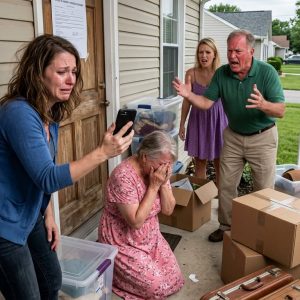
The eviction lacked the dramatic thunder of a movie scene; it was executed with the chilling, bureaucratic efficiency of taking out the Tuesday trash.
I had woken up on my eighteenth birthday to the violent sensation of my thin cotton quilt being yanked off my body. The humid, stagnant air of my childhood bedroom in Oakhaven, Georgia, immediately clung to my skin.
“Get up,” my mother had snarled, her face flushed with a bizarre, triumphant manic energy. She was holding a stack of heavy-duty garbage bags. “You’re eighteen today. A legal adult under the eyes of the law. Your time under this roof is officially up.”
I had blinked up at her, the sleep still heavy in my eyes, my brain struggling to process the hostile geometry of the room. “Mom? Go where? It’s Tuesday. I have AP Calculus in an hour.”
“Not anymore, you don’t,” my father, Dale, rumbled from the doorway. He leaned against the jamb, nursing a mug of cheap drip coffee. “We called the principal yesterday and formally withdrew you. Karen and I discussed it. We’ve fulfilled our legal obligation. We are done raising you.”
A sickening vertigo spun the room. “But… I graduate in two months. I have college applications pending.”
“You should have thought about your precious little graduation before you decided to be such an arrogant disappointment,” Karen spat, throwing the first black bag onto my mattress. “Pack your things. You have ten minutes before I call the sheriff for trespassing.”
My singular, unforgivable crime? Ambition.
At sixteen, my father had demanded I drop out of high school to take a minimum-wage graveyard shift at my uncle’s sheet-metal factory. I had flatly refused. I wanted to finish my education. I harbored a desperate, burning dream of escaping the generational gravity of Oakhaven, of working in technology, of building systems that actually functioned. To Karen and Dale, my desire to learn wasn’t seen as drive; it was interpreted as a direct insult. It meant I thought I was superior to their grinding, paycheck-to-paycheck misery. It meant I was “uppity.”
From behind my father’s shoulder, my younger brother, Kyle, appeared. He was sixteen, already working under-the-table construction with Dad. Kyle was the golden child—the son who understood his “place,” who mocked reading, who parroted my father’s bitter worldview with terrifying accuracy. He stood there in his steel-toed boots, watching my world collapse, and he smirked.
“Mom, please,” I had begged, the panic finally cracking my voice. I scrambled out of bed, grabbing her wrist. “Where am I supposed to sleep? I don’t have a car. I don’t have anywhere to go.”
She violently shook off my hand as if I had burned her. “Not my problem anymore. Maybe those fancy, high-society dreams of yours will keep you warm at night.”
Ten minutes later, I was standing on the cracked concrete of the front walkway. Neighbors peeked through their vinyl blinds, their faces twisted with a mix of pity and harsh rural judgment. In a town like Oakhaven, the parents’ narrative was gospel. If the Thompsons were throwing their daughter onto the street like a feral dog, the consensus was that the daughter must have committed an unspeakable sin.
My father stood on the porch, his arms crossed over his flannel chest. “Don’t come crawling back here begging when you fail, Lucy. You made your choice. Now go live with it.”
“What choice?” I had screamed, tears finally scalding my cheeks. “Wanting an education? Wanting a future?”
“Thinking you’re better than the people who put food in your mouth,” he corrected coldly. “Let’s see how far that arrogant attitude gets you in the real world.”
The heavy wooden door slammed shut. The deadbolt clicked with a heavy, metallic finality. Just like that, the universe I knew evaporated. I was entirely alone, possessing nothing but two trash bags of cheap clothing and exactly seventy-three dollars I had meticulously saved from tutoring middle-schoolers in algebra.
I dragged the bags two miles to the county library, the only sanctuary I could think of. I sat in a secluded corner near the reference section, staring at the frayed carpet until the sun went down, paralyzed by a terror so profound it felt like I couldn’t draw oxygen into my lungs.
Just before closing, the head librarian, Mrs. Chen, found me.
“Lucy? Honey, shouldn’t you be getting home for dinner?” she asked gently, noting my swollen eyes and the plastic bags at my feet.
“I don’t have a home anymore, Mrs. Chen.”
I broke down. I poured out the entire humiliating story. She listened in absolute silence, her mouth tightening into a thin, furious line. When I finished, she didn’t offer hollow platitudes. She walked into her back office and returned holding a heavy, scratched, silver object.
“It’s an old Dell. The battery only holds a charge for an hour, but it works,” Mrs. Chen said, pressing the laptop into my shaking hands. Her dark eyes were fierce. “Listen to me, Lucy. Do not let those people win. I have watched you tutor those kids for three years. I have seen the way your mind processes complex logic. You possess a gift they cannot even comprehend. Use it.”
I slept in the overgrown grass behind the municipal park that night, the heavy laptop clutched to my chest like a shield. As the Georgia chill seeped into my bones, a new sensation began to replace the crushing grief. It was a cold, pure, crystalline rage.
The next morning, I sat outside a coffee shop, stealing their Wi-Fi. I didn’t search for local homeless shelters—I knew the local systems were broken, underfunded traps. I searched for an escape velocity. That was when I discovered Future Path, a radical nonprofit incubator for unhoused youth located in Los Angeles. They offered temporary dormitories, food security, and intensive coding bootcamps for teenagers willing to work ninety-hour weeks.
I spent my seventy-three dollars on a one-way Greyhound ticket to California. I left the trash bags of clothes at the bus terminal. I took only the clothes on my back and Mrs. Chen’s laptop.
I didn’t know it then as the bus hurtled westward through the night, but my parents hadn’t just thrown away a daughter. They had inadvertently ignited a supernova. But as I sat in my Malibu office seven years later, preparing to walk down to the guest house, I knew my past had finally caught up to me. And the people sitting in my guest house were about to drop a bomb that would force me back into the very nightmare I had escaped.
Chapter 3: The Architecture of Spite
The walk across my estate grounds took exactly five minutes. It was five minutes of navigating meticulously manicured topography—past the infinity pool that mirrored the gray sky, beyond the pristine clay of the tennis courts, and through the quiet Zen of the meditation garden. Five minutes to armor myself against the faces I had only encountered in the darkest corners of my nightmares for nearly a decade.
My journey from that sticky Greyhound seat to this sprawling Malibu compound was not a fairy tale; it was a brutal, relentless siege.
When I arrived in Los Angeles at eighteen, the city was a concrete jaw ready to swallow me whole. I secured a cot in a shared room at the Future Path facility. For the first two months, I lived on instant ramen and the sheer, burning adrenaline of survival. I completed the remnants of my high school curriculum online in six manic weeks.
Then, I opened Mrs. Chen’s battered laptop and began to code.
I discovered that the architecture of software made profound, elegant sense to me in a way human beings never had. Code didn’t lie. Code didn’t harbor petty resentments. If a system failed, it was because the logic was flawed, not because the machine fundamentally hated you. I devoured programming languages—Python, Ruby, C++—with the desperate hunger of a starving animal.
By nineteen, I was operating under the name Luna Thorne. Lucy was dead; she had died in a park in Georgia. Luna was a machine. I began freelancing backend web design, working until my vision blurred and my fingers cramped. By twenty, I had clawed together enough capital to lease a micro-studio in Koreatown.
By twenty-one, the phantom memories of sleeping on the street birthed an idea. I built a comprehensive, geolocation-based application designed specifically for youth in crisis. It bypassed the bureaucratic red tape of government websites, instantly connecting unhoused teenagers with available shelter beds, food banks, free medical clinics, and job-training incubators in real-time. I called it Path Forward.
I launched it quietly. Three weeks later, a prominent tech journalist in Silicon Valley stumbled upon it and wrote a scathing op-ed about how a twenty-one-year-old girl with a busted laptop had engineered a more effective social safety net than the entire state of California.
The application went supernova.
The venture capitalists descended like sharks smelling blood in the water. I remember sitting in a glass boardroom on Sand Hill Road, wearing a thrift-store blazer, staring down a table of billionaires.
“The algorithm is breathtakingly efficient, Luna,” one of the partners had purred, studying my prospectus. “What’s the origin? Personal experience in the sector?”
“You could say that,” I had replied, my voice coated in frost.
They injected two million dollars in seed funding. I utilized every cent to aggressively scale the infrastructure, hiring top-tier developers and forging ironclad partnerships with municipal governments. By twenty-three, Path Forward had successfully matched over one hundred thousand homeless youths with life-saving resources. By twenty-four, Google attempted a hostile acquisition, offering two hundred million dollars to absorb us.
I looked the Google executives in the eye and declined. I wasn’t building a product to cash out. I was building a kingdom where I made the rules.
And I had orchestrated this entire symphony of success entirely in the dark. I did it without the safety net of familial support, without a word of encouragement, without a single soul from my past cheering me on. I had built my life on spite and survival.
Now, at twenty-five, the architects of my trauma were sitting in my lower guest house, dripping rainwater onto my imported Italian tile.
I pushed open the heavy oak door of the guest suite. The sterile, minimalist luxury of the room provided a jarring contrast to the two people shivering on the velvet sofa. Karen looked a decade older than her fifty years. Her hair, once a proud, brassy blonde, had faded to a brittle, unkempt gray. She was physically smaller, her shoulders rounded in defeat. Dale was a shadow of the intimidating patriarch he had once played; his face was gaunt, his skin possessing a sickly, yellowish pallor.
They both flinched as the door clicked shut behind me. They looked up, their eyes tracking from the subtle gleam of my Cartier watch to the impeccable cut of my designer sweater, and finally, to the cold, unrecognizable geometry of my face. I saw the exact microsecond their brains short-circuited.
“Lucy…?” my mother breathed, the word trembling on her lips like a fragile soap bubble.
“My name is Luna,” I corrected, my voice echoing off the vaulted ceiling. “Lucy Ann Thompson froze to death seven years ago. You look terrible, Karen.”
Dale’s jaw actually dropped. He took in my posture, the unmistakable aura of absolute authority I now projected. “You… you’re alive. You’re fed. You’re not…”
“Begging on the streets like a feral animal, as you so confidently predicted?” I offered, walking slowly toward the sleek glass coffee table that separated us. “No. I’m afraid I must disappoint you once again.”
“We didn’t know,” Karen whispered, fresh tears spilling over her wrinkled cheeks. “God, Lucy, we had no idea you were… we thought…”
“You thought what?” I snapped, the icy veneer cracking just a fraction. “That you could throw your teenage daughter into the garbage, change the locks, and I would magically materialize into a functional adult? Or did you pray I would fail, just so you could feel validated in your pathetic, small-town mediocrity?”
“We made a terrible mistake,” Dale rasped, staring at his muddy boots.
A sharp, humorless laugh tore from my throat. “A mistake, Dale, is forgetting to renew your vehicle registration. You forcefully withdrew a high-school honor student. You hurled my possessions onto the grass. You looked me in the eye and told me I was a worthless burden. That isn’t a mistake. That is an assassination attempt.”
“We were so angry,” Karen sobbed, reaching a trembling hand toward me.
I stepped back, out of range. “Angry about what? That I possessed the audacity to want a high school diploma? That I harbored dreams that extended beyond the county line? That I refused to drown in the same miserable puddle you both lived in?”
They exchanged a look of profound, suffocating shame.
“Why are you sitting in my guest house?” I demanded, crossing my arms. “What is the emergency that required you to track down a ghost?”
Dale swallowed hard, his Adam’s apple bobbing in his thin throat. He looked at me with the eyes of a man walking to the gallows.
“It’s your brother,” Dale choked out. “Kyle is dying.”
Chapter 4: The Price of Flesh
The silence in the room was absolute, broken only by the rhythmic drumming of the rain against the skylight.
Kyle. The golden boy. The teenager who had smirked from the doorway while I begged for my life. The brother who had texted me three weeks after I arrived in Los Angeles, starving and terrified, to say: Stop calling Dad’s phone. You’re not our problem anymore. Have a nice life, loser.
“Of course,” I murmured, staring down at them with clinical detachment. “There was always going to be a catch. The universe doesn’t send the Thompsons to my door for an apology tour. Sick how?”
“Kidney failure,” my mother wept, burying her face in her hands. “He was in a horrific accident at the construction site three years ago. The crush injury destroyed his renal function. He’s been on dialysis, but his body is rejecting it. His heart is straining. The doctors say he has months, maybe weeks, without a transplant.”
“And he’s O-negative,” Dale added, his voice cracking. “A rare match. Karen and I aren’t viable donors. He’s languishing on the national registry list, but the wait is five years. He won’t make it to Christmas.”
I stared at them, the puzzle pieces clicking together with sickening precision. “And you want me to get tested.”
“You are his sister,” Karen pleaded, looking up with red, swollen eyes.
“I was his sister,” I corrected fiercely, my voice dropping to a dangerous whisper. “I was his sister right up until the second you decided I was disposable. I was his sister when I called you from a payphone in downtown LA, sobbing because I hadn’t eaten in two days, and you hung up on me. I was his family when I mailed you my GED certificate and you returned it to sender, unopened.”
“We didn’t know you had become… this!” Dale gestured weakly at the luxurious surroundings, his desperation overriding his filter.
I froze. The temperature in the room seemed to plummet twenty degrees.
“This?” I repeated, my eyes narrowing. “You mean successful? Powerful? Wealthy?”
Dale flinched, realizing his fatal error, but the truth was already bleeding out on the table.
“So, let me ensure I understand the logic perfectly,” I said, leaning over the glass table, forcing them to look at me. “If I were still homeless, if I were still fighting for scraps in an alleyway, you wouldn’t be sitting here. You only traversed the country to claim me as your beloved flesh and blood because I possess two things you desperately need: biological compatibility, and the financial resources to afford top-tier surgical intervention.”
“That is wildly unfair, Lucy!” Karen cried out.
“Fair?” I roared, the volume finally breaking the sterile quiet of the room. “Was it fair when I slept with a knife in my shoe in a municipal park? Was it fair when I cried myself to sleep every night for three years, dissecting my entire personality to figure out what was so inherently repulsive about me that my own parents couldn’t bear to love me?”
“We don’t hate you!” Karen wailed, sliding off the sofa and onto her knees on the tile. “We never hated you!”
“Then what do you call it?” I demanded.
Dale finally broke. The patriarch crumbled, his shoulders shaking as he stared at his hands. “We were terrified of you,” he confessed, the words raw and jagged. “You were so smart. So driven. You looked at our life, at the factory, at the town, and you saw a cage. We couldn’t give you college. We couldn’t understand code or startups or your grand dreams. You made us feel small. It was infinitely easier to label you ungrateful and banish you than to look in the mirror and admit our own profound limitations.”
The sheer, pathetic honesty of the admission stunned me for a fraction of a second. It was the absolute truth. They hadn’t thrown me out because I was bad; they threw me out because my light exposed their darkness.
But understanding the origin of a wound does not magically heal the scar tissue.
“So, you threw me into the incinerator,” I summarized coldly.
“We were wrong. We were horribly, unforgivably wrong,” Dale wept. “But Luna… please. Kyle is a twenty-three-year-old boy. He’s strapped to a machine for four hours a day. He’s dying. Please. Name your price. We will do anything.”
I slowly straightened my posture, looking down at the two broken people who had engineered my trauma. I thought about the thousands of kids my app had saved. Kids who had been thrown away for being gay, for being too loud, for wanting more. I held the power of life and death in my hands. It was a godlike, intoxicating power.
“Where is Kyle?” I asked sharply. “If he wants my internal organs, why isn’t he sitting on that sofa begging me himself?”
Another agonized glance passed between them.
“He doesn’t know we are here,” Karen whispered. “He told us not to look for you. He said… he said he would rather die than ask you to save him after the way he treated you.”
Shame. Kyle felt shame. That was a new variable.
I turned my back on them, walking toward the massive window overlooking the raging Pacific ocean. The silence stretched until it felt like the glass might shatter. I calculated the variables. I weighed the revenge against the sheer, undeniable reality of human life.
“I will undergo the preliminary testing,” I finally announced to the glass.
I heard two simultaneous, shuddering gasps of relief behind me.
I spun back around, my eyes locking onto theirs with the intensity of a predator. “But I want to be crystal clear. I am not doing this for you. And I am not even doing this for Kyle. I am doing it for the sixteen-year-old boy who was poisoned by your toxic bitterness. Because maybe, if he survives with a piece of a woman who actually made something of herself, he’ll learn that it’s acceptable to dream.”
“Thank you,” Karen sobbed, crawling forward to try and touch my boots. “Oh God, thank you, we’ll pay you whatever we—”
“You have absolutely nothing I want,” I interrupted, stepping out of her reach. “You couldn’t afford to pay my landscaping team. No. We are going to execute a very specific transaction. If I am a match, I require a trade.”
Dale wiped his face. “Anything.”
“First, you will both sign binding, legally enforceable volunteer contracts. You will report to the primary Path Forward crisis shelter in downtown Los Angeles. You will serve hot meals, scrub toilets, and sort donated clothing for unhoused youth for forty hours a week, for the next two years.”
They stared at me, stunned.
“I want you to look those kids in the eye,” I sneered. “I want you to listen to their stories. I want you to understand, on a cellular level, exactly what you subjected me to. Every single one of those teenagers in my shelter is somebody’s Lucy.”
“We will do it,” Dale promised instantly.
“Second,” I continued, my voice hardening into steel. “You will sit in front of my media team’s cameras. You will record a public, unscripted confession detailing exactly why you threw your daughter out, the abuse you inflicted, and the profound regret you carry. We will use it as the flagship video for our national awareness campaign on familial youth abandonment. I will broadcast your failure to the entire world.”
Karen gasped, her vanity finally colliding with her desperation. “Luna… everyone back home will see it. Our friends, the church…”
“That is my price, Karen,” I said, my tone brokering absolutely zero negotiation. “Take it, or I call security to escort you off the premises, and you can go home and buy a black suit for your son’s funeral.”
The silence was agonizing. The ego warring with the biological imperative to save their offspring.
Dale looked at his wife, nodded once, and looked back at me. “We accept the terms.”
“One final stipulation,” I added, walking toward the door. “If I am a match, and the surgery is successful, this transaction is permanently concluded. There will be no tearful family reunions in the recovery ward. There will be no Sunday dinners. You will not use my name or my success to brag to your small-town friends. You permanently surrendered the right to claim me as family seven years ago. When Kyle wakes up, we are strangers again.”
“We understand,” Karen whispered, utterly broken.
I grabbed the brass handle of the door, pausing for just a moment before stepping out into the storm.
“You know what the ultimate tragedy of this is?” I asked, looking over my shoulder at the architects of my misery. “If you had just supported me. If you had just exhibited an ounce of belief in my potential… I would have shared this entire empire with you. I would have bought you a mansion. I would have ensured you never had to look at a price tag again for the rest of your natural lives. But you threw me in the garbage because I dared to look at the stars.”
Dale closed his eyes, fresh tears leaking out. “We know we lost the best thing we ever had, Luna.”
“No,” I corrected, opening the door to the rain. “You threw away the best thing you ever had. I lost absolutely nothing. I gained the world.”
Chapter 5: The Ledger Balanced
My executive assistant, an incredibly efficient woman named Sarah, handled the logistics with the sterile precision of a military operation. She coordinated the blood panels, the tissue typing, and the psychological evaluations.
Two weeks later, the encrypted medical file hit my inbox. I was a perfect, six-point biological match.
The machinery of the agreement immediately ground into motion. My legal team drafted the contracts. Karen and Dale Thompson, looking terrified and small, sat under the blinding studio lights of my media department and confessed their sins to a 4K camera lens. The following Monday, they donned blue Path Forward volunteer aprons and began serving chili to the very demographic they had once created.
The transplant surgery was scheduled at Cedars-Sinai Medical Center.
The evening before I went under the knife, I walked down the sterile, fluorescent-lit corridor of the nephrology ward. Two massive private security guards flanked me. I pushed open the door to Room 412.
Kyle was hooked to a terrifying array of monitors. He looked miniature, his skin a translucent, sickly gray, entirely devoid of the cocky, arrogant swagger that had defined his teenage years. The poison in his blood had humbled him.
He opened his eyes as I approached the bed. He stared at me, taking in the tailored suit, the unyielding posture, the sister he hadn’t seen in seven years.
“Luna,” he croaked, his voice raw. He tried to push himself up. “Mom told me… I can’t believe you’re actually… I’m so sorry, Lucy. I’m so sorry for what I texted you. For watching them do it.”
“Stop,” I commanded gently, pulling a chair to the edge of his bed. “Do not apologize to me. Do not thank me. Guilt is a useless emotion, Kyle. It doesn’t build anything.”
He swallowed hard, tears pooling in his sunken eyes. “Then why are you doing this? Why give a piece of yourself to someone who didn’t fight for you?”
“Because letting you die doesn’t fix the past,” I said, leaning closer. “Just promise me one thing. When you wake up, when your blood is clean and you have your strength back… do not waste this. Do not let their generational fear become your cage. Get your GED. Go to a community college. Build a life that actually matters.”
He nodded frantically against the pillows. “I will. I swear to God, I will. I want to be exactly like you.”
“No,” I smiled, a sad, sharp expression. “I built my entire existence on a foundation of spite and raw survival. It is an exhausting way to live. Be better than me, Kyle. Build your life on purpose. Build it on possibility.”
The surgery was flawless. The robotic precision of the surgical team transferred my healthy kidney into my brother’s failing cavity, and it immediately began to function, filtering out the toxins that had been killing him.
I recovered in a penthouse VIP suite, surrounded by laptops, financial reports, and my executive team. My parents attempted to bypass the nurses’ station to visit me twice. Marcus and my security detail intercepted them, firmly escorting them off the surgical floor. The transaction was complete. The ledger was balanced. The bridge remained permanently burned.
Exactly one year later, a thick, manila envelope arrived at my Malibu estate, cleared by my security screening team.
I opened it on my balcony, the Pacific breeze pulling at the edges of the paper. Inside was a handwritten letter and a photograph. The photo showed Kyle, looking robust, healthy, and smiling genuinely. He was standing in a commercial kitchen, wearing a blue Path Forward volunteer shirt, holding a tray of roasted vegetables alongside a diverse group of teenagers.
Luna, the letter read, his handwriting slightly messy. I enrolled in the local community college in Pasadena last semester. I’m studying systems architecture. It’s brutal, but I love it. Mom and Dad finished their mandatory two years of volunteering yesterday. But… they signed up for another year. Voluntarily. Dad says it’s the only thing that helps him sleep at night. I know you don’t want a relationship, and I respect your boundary. I just wanted you to know that the piece of you inside me is working. And I am trying to build something good with it. Thank you for the second chance.
I read the letter twice. I traced my thumb over the ink, feeling a profound, quiet stillness settle over my chest. I didn’t write back. Some chasms are simply too wide to cross, and some relationships exist only as monuments to the wars we survived.
I walked back into my office and pulled up the archived security footage from that rainy Tuesday a year ago. The digital image of Karen and Dale begging at my gates.
I didn’t keep the file as a trophy of revenge. I kept it as undeniable, empirical proof. Proof that the frightened, homeless girl they had callously deemed worthless had possessed the raw titanium will to construct an empire.
They had kicked me out at eighteen, convinced my ambition was a terminal disease. Seven years later, I had given them exactly what they had given me: nothing but an opportunity. The opportunity to earn their redemption by serving the very outcasts they had created.
The fundamental difference between us was finally clear. I had made myself priceless by reaching into the darkness and pulling others into the light. They had rendered themselves worthless the precise second they threw their daughter away. And that was the truest form of karma. Not the wealth, not the sprawling estate, not the vengeance.
It was the undeniable knowledge that every single youth my company shielded from the cold was a living, breathing repudiation of what my parents had done to me. Every success story born in a Path Forward shelter proved that throwing away a child doesn’t inevitably break them.
Sometimes, it simply teaches them how to build a fortress where everyone finally belongs.
Like and share this post if you find it interesting.