Title: A Bitter Brew: The Price of Blood and Silence
Chapter 1: The Anatomy of a Burn
The physical sensation of scalding liquid hitting your face doesn’t actually register as pain in the first split second. It registers as a profound, terrifying intrusion. That is the one detail nobody ever tells you about being assaulted by your own mother in the middle of a crowded room. The searing heat arrives well before the humiliation, before the adrenaline, before the slow, devastating realization of what has just transpired in front of sixty gaping guests.
The burning came first. It was a sharp, immediate scorch across my left cheek and jawline, the dark liquid instantly soaking through the collar of the ivory silk blouse I had spent forty meticulous minutes steaming that very morning. I had wanted to look immaculate. I had wanted to present myself as the woman I had spent ten grueling years building—professional, impenetrable, and successful.
Then, I screamed. It wasn’t a word. It was a jagged, involuntary animal sound ripped from the throat of someone whose nervous system had just been ambushed. The living room went dead silent. It was that specific, suffocating vacuum of noise that occurs when something deeply unnatural has happened—an event that cannot ever be un-happened.
My mother, Diane Harland, stood perfectly still on the opposite side of the mahogany side table. Her hands were still extended mid-air, the porcelain coffee cup now empty in her palm. Her face was flushed a violent shade of magenta, her chest heaving against her formal silk dress. She stared down at me, her eldest daughter, dripping and gasping, and delivered six words with a chilling, detached precision.
“Now look what you made me do.”
To understand the sheer, calculated cruelty of that moment, I have to rewind. I need to take you back to the origins of the invisible ledger that ruled our household. My name is Rebecca Harland. I am thirty-four years old, and I am a founding partner at Blackwell Capital Partners, a venture capital firm anchored in Chicago’s West Loop, managing roughly $800 million in assets.
I did not inherit a dynasty. I was born into a thoroughly average, three-bedroom suburban home in Naperville, Illinois. My father, Gerald, was a commercial insurance broker who preferred to live his life blending into the wallpaper. My mother ran our family with the ruthless efficiency of a corporate raider, treating my younger sister like a prized asset and me like a regrettable tax burden.
I hauled myself through the University of Illinois entirely on merit scholarships, Pell grants, and the exhaustion of two part-time jobs. I shelved books at the campus library by day and slung steaks on Green Street until two in the morning on weekends. I graduated magna cum laude, fought my way into a cutthroat mid-market private equity firm, and subsequently spent my nights earning my MBA from Booth. By 2019, I had built the network and the ironclad track record necessary to co-found Blackwell.
Then there is Madison. My sister is twenty-eight, breathtakingly charming, and possesses the unique ability to float through life without ever touching the ground. She has never retained a job for longer than fourteen months. She coasted through DePaul University on our parents’ dime—tuition, sorority dues, and a semester abroad in Florence that my mother casually mentioned in an email as if reporting the weather. Madison works vaguely defined marketing roles that never require her to log on before 9:30 AM. She is the golden child, crafted in our mother’s image.
My anchor in all this chaos is my fiancé, Aaron Choy. At thirty-seven, Aaron is an attending physician in the Emergency Department at Northwestern Memorial Hospital. He carries the specific, quiet competence of a man who spends his weeks making life-or-death decisions in real-time. He is a rock. And, crucially, up until the day of the engagement party, he was one of only three people on earth who knew the colossal, suffocating secret I had been harboring for three years.
It began with a phone call on a rainy Wednesday afternoon in the fall of 2021. My father never called me during business hours. Usually, all family communications were routed through my mother, who acted as the strict gatekeeper of our family’s narrative. But this time, his voice came through the receiver sounding compressed, small, and terrifyingly fragile.
“Becky,” he had whispered, the static of the line crackling with unspoken dread. “We have a situation.”
It was the mortgage. They were four months in arrears. The bank had issued a formal notice of intent to foreclose. He begged me not to tell my mother he had reached out. He didn’t explicitly ask for cash, but he sounded like a man standing on the edge of a very high cliff. I had resources. He was my father. So, I did what I had always done: I stepped into the breach to fix the unfixable.
But as I looked at the numbers he sent over later that night, a cold knot formed in my stomach. I realized exactly what this bailout was going to cost me, and it wasn’t just money. It was the terrifying realization that if I opened this door, I might never be able to close it again.
Chapter 2: The Architecture of Silence
I moved quickly and quietly, employing the same detached strategy I used during hostile acquisitions. I contacted my attorney, Dana Wexler, a razor-sharp legal mind at Harland & Pierce (no relation). Together, we established a blind entity: the Lakeview Family Revocable Trust. It was meticulously structured so that the monthly mortgage payments to First Midwest Bank would appear to originate from an automated disbursement account. My name was buried behind walls of legal jargon.
The initial payment was wired in November 2021. Every month for the next thirty-seven months, a payment cleared. Between the mountain of back dues and the ongoing installments, I had quietly bled $105,139 into the walls of the house in Naperville.
I kept it buried. I didn’t even tell Aaron. Not initially, anyway.
He discovered the truth eight months into the arrangement. He was looking for a pen on my home office desk and inadvertently uncovered a quarterly statement from Dana’s office. Aaron didn’t yell. He didn’t accuse. He simply sat me down on the edge of our bed, leveled his dark, searching eyes at me, and asked me to explain. It was the same calm, penetrating tone he used to stabilize panicked trauma patients.
When I laid bare the mechanics of the trust, he remained perfectly silent for a long minute.
“Does Diane know?” he finally asked.
“No,” I replied, staring at my hands.
“Does Madison?”
“Absolutely not.”
Aaron exhaled a slow breath, his shoulders dropping. “Are you ever going to tell them?”
“What good would that do, Aaron?” I asked, a defensive edge creeping into my voice. “What exactly would change?”
He pondered this. One of Aaron’s greatest virtues is his refusal to speak just to fill the silence. “Probably nothing good,” he conceded. He wrapped his arms around me, pulling me against his chest, burying his face in my hair. “Okay. Just tell me what you need from me.”
Over the next two years, the secret expanded. I couldn’t stomach the thought of Madison drowning in interest rates while living in her blissful bubble, so I funneled $31,400 through the same blind trust to entirely liquidate her student loans. I manipulated the memo line to read “Federal Loan Forgiveness Program Disbursement.” It was just plausible enough for Madison. She Googled it, convinced herself she was the beneficiary of a new government initiative, and celebrated her financial liberation by purchasing a velvet sectional couch. I let her believe the fiction.
I outline these massive financial hemorrhages so you can fully comprehend the agonizing irony of what unfolded at Madison’s engagement party. I was not a greedy, self-centered corporate drone. I was the invisible scaffolding holding my entire family upright.
The party was scheduled for two o’clock on a Saturday. Aaron was pulling a morning shift at the ER and promised he’d rush over in his street clothes by 3:30. I arrived punctually at two, carrying a high-end Vitamix blender that Madison had casually admired eight months prior. I had noted it in my phone because that’s how I love people—I pay attention to the details they forget.
My mother intercepted me in the foyer. She was draped in her special-occasion silk and her genuine pearls, her eyes glittering with that manic, performative energy she adopted for large crowds. She pecked my cheek, assessed my outfit with a fleeting, critical glance, and immediately asked for Aaron.
“He’s in the ER,” I explained softly. “He’ll be here around 3:30.”
“Of course he will,” she hummed, the cadence of her voice carrying a phantom judgment.
I drifted into the living room. The space was packed with at least sixty bodies—neighbors, distant relatives, and women from my mother’s church. The room was aggressively staged to project an illusion of wealth. Cheap Trader Joe’s florals were strategically crammed into crystal vases. Diane had even rented crystal champagne flutes from a boutique in Wheaton.
In the center of it all stood Madison, glowing in a designer sundress that cost more than my first car, laughing brightly. Her fiancé, Bradley, was lurking near the kitchen island, aggressively slapping backs and laughing a little too loud at jokes he didn’t understand. In the fourteen months I had known Bradley, my only solid observation was that he always seemed to be scanning the room for someone more important to talk to.
I grabbed a glass of sparkling water and endured thirty minutes of agonizingly hollow small talk. I smiled. I nodded. I played my part.
At exactly 2:31 PM, I felt sharp fingernails dig into my forearm.
“Rebecca,” my mother murmured, her grip tightening. “Come help me with the charcuterie board.”
She didn’t lead me to the kitchen. She steered me directly past it, down the dim hallway, and shoved me into my father’s cramped study. My father was already standing by the bookshelves, intensely studying the carpet. It was a calculated ambush.
My mother closed the heavy oak door. The lock clicked. She turned to face me, and her expression shifted from party-hostess warmth to something entirely predatory.
“Madison’s dream wedding is going to cost fifty thousand dollars,” she announced. It wasn’t a request. It was a decree.
I felt the air thin out in the small room. I looked at her, then at my father, who refused to meet my gaze. The trap had been set, and I was standing right on the trigger.
Chapter 3: The Price of Saying No
I forced my facial muscles to remain entirely neutral. It was a skill I had honed in boardrooms filled with aggressive men trying to talk over me. “Okay,” I said, my voice dangerously calm.
“We thought you would want to contribute,” my mother continued, her tone laced with a sickeningly sweet assumption.
I stared at her. The sheer audacity of the demand momentarily short-circuited my brain. “No,” I said flatly.
The counterfeit smile vanished from her face. “Rebecca. Don’t be difficult.”
“Mom, I am planning my own wedding,” I replied, keeping my hands perfectly still at my sides. “Aaron and I have a strict budget. I am not draining my savings to finance a luxury event for Madison after everything I’ve already done.”
Her eyes narrowed. “You have saved every penny for yourself,” she hissed, abandoning the sweetness. “You have more money than you know what to do with. Family helps family, Rebecca.”
“You don’t have the slightest idea what I have, or what I do with it,” I shot back, the years of repressed resentment beginning to simmer just below the surface. “My college was funded by midnight shifts and debt. My master’s was earned on weekends while I worked eighty-hour weeks. Everything I have, I bled for.”
“You are a partner at a firm!” she snapped, stepping aggressively into my personal space.
“The answer is no,” I stated, picking up my water glass. “It is not up for negotiation. Let’s go back to the party.”
She froze. For four agonizingly long seconds, the only sound in the study was the ragged breathing of my father in the corner. Then, my mother pivoted on her heel, threw open the door, and marched back down the hallway.
I made the catastrophic mistake of following her out. I naively believed the conversation was over. I had vastly underestimated the depths of her vindictiveness when denied what she felt she was owed.
She didn’t return to the kitchen. She marched directly into the exact center of the living room. The party was experiencing one of those natural, cyclical lulls in conversation. It was a pocket of relative quiet, and she weaponized it perfectly.
“I need to say something,” she called out. Her voice wasn’t a shout; it was a projected, theatrical lament.
Sixty heads swiveled toward her.
“I just think everyone here deserves to know the truth about where we stand as a family,” she continued, her voice trembling with manufactured grief. “My daughter, Rebecca—my wealthy, executive daughter—has just been asked to help make her sister’s wedding the beautiful celebration she deserves. And she has looked me in the eye and refused.”
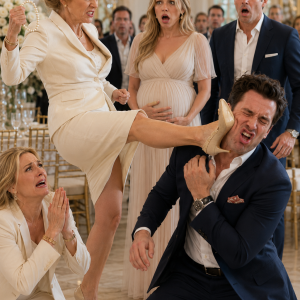
The silence that followed was suffocating. I felt a sickening wave of vertigo wash over me. It was the absolute, naked exposure of my private boundaries dragged out for public consumption. Madison’s hands flew to her mouth, her eyes welling with dramatic, photogenic tears. Bradley smirked from the corner—a fleeting, instinctive twitch of satisfaction. My father hovered in the hallway, looking like a hollow shell of a man.
“Mom,” I warned, my voice surprisingly steady despite the violent tremor in my hands. “Let’s discuss this in private. This is not the time or the place.”
“You want privacy?” she sneered, her mask completely disintegrating. She turned toward the mahogany side table.
My mother always insisted on a formal coffee service at her events. A massive silver carafe, delicate porcelain cups. It was an aesthetic choice I had witnessed a hundred times. I had never once considered it a tactical arsenal.
She snatched a full, steaming cup of dark roast from the tray. She locked eyes with me, her expression twisting into something deeply ugly.
And then, she threw it.
The liquid struck me like a physical blow. The next few minutes fractured into a chaotic kaleidoscope of sensory overload. The immediate, searing burn on my cheek. The collective gasp of sixty people. A woman I vaguely recognized lunging forward with a fistful of cocktail napkins. The heavy, wet cling of the ruined silk against my collarbone.
Through the ringing in my ears, I heard my mother desperately trying to reclaim the narrative.
“Oh my goodness, it slipped! It was an accident! I didn’t mean to!” she babbled, looking around at the horrified faces, frantically trying to manage the public relations nightmare she had just birthed.
Someone shoved a dining chair behind my knees, forcing me to sit. I pressed the dry napkins against the side of my face, my brain rapidly triaging the damage. No blistering yet. High degree of erythema. I am in shock.
Madison didn’t approach me. She was hovering near the staircase, whining loudly to Bradley about how I always found a way to “ruin her moments.” My father remained glued to the doorway, a perennial spectator to my abuse.
I sat there, shivering, stained, and burning under the fluorescent lights, wondering how the hell I was going to get out of this house.
And then, I heard the distinct click of the front door opening.
Chapter 4: The Triage
Aaron walked in at exactly 3:22 PM.
He moved exactly as he always did—unrushed, grounded, wearing his faded blue Patagonia fleece over his scrubs. He scanned the room, his eyes cutting through the crowd. That is the thing about Aaron. He doesn’t look at the spectacle; he looks for me.
He saw me slumped in the chair, a ring of horrified guests giving me a wide berth. In four massive, purposeful strides, he crossed the room. He didn’t run. Running invites panic. He moved with the terrifying focus of an apex predator closing in on its objective.
“What happened?” he demanded, his voice low and firm. He immediately framed my face with his large, calloused hands, tilting my head toward the natural light pouring from the window. His touch was clinical yet incredibly gentle.
“I’m okay,” I stammered, the adrenaline making my teeth chatter.
“You have a first-degree burn traversing your zygomatic arch,” he muttered, his thumbs lightly grazing the uninjured skin around my jaw.
Before I could protest, my mother materialized at his elbow. Her social smile had been hastily re-glued to her face, though it twitched at the corners.
“Aaron, dear! So glad you made it,” she chirped nervously. “We just had a little family disagreement. Rebecca was being terribly stubborn, and I’m afraid things just got a bit heated. An unfortunate spill.”
Aaron slowly turned his head to look at her. He took in the empty cup on the floor. He noted the brown splatter patterns across the pristine hardwood. He looked at my ruined blouse.
When he finally spoke, his voice was dangerously quiet. It was the voice he used when a drunk driver was brought into his trauma bay.
“You threw scalding liquid at your daughter’s face because she wouldn’t give you cash?”
“It was an accident!” Diane cried, her pitch elevating.
“Stop talking.”
The command cracked through the room like a whip. The ambient murmuring died instantly. Nobody—not my father, not the pastor, not her sister—had ever commanded Diane Harland to shut her mouth.
Aaron stood up, placing himself squarely between my chair and my mother. He didn’t raise his voice. He didn’t need to.
“I have kept my mouth shut about the dynamics of this family for two years,” Aaron announced to the room at large. His gaze swept over the crowd, daring anyone to interrupt. “I watched Rebecca absorb your toxic entitlement because she begged me not to interfere. She is infinitely more protective of you people than you deserve.”
He paused, letting the silence stretch until it became unbearable. “I am done keeping quiet.”
Diane let out a shrill, panicked giggle. “Aaron, please, this is a private family matter—”
“You want to talk about private matters?” Aaron interrupted, his tone chillingly conversational. “Let’s talk about the Lakeview Family Revocable Trust.”
My mother’s eyes went wide. The color rapidly drained from her face, leaving her looking sickly and gray.
“For the last thirty-seven months,” Aaron projected his voice so even the people by the front door could hear every syllable, “Rebecca has been paying the entirety of your mortgage. She set up a blind trust specifically so you wouldn’t know it was her. Your lender is First Midwest Bank. Your account number ends in 7741.”
A collective, complicated murmur rippled through the sixty guests. People were mentally calculating, their eyes darting between my mother’s horrified face and my stained, exhausted form.
“That… that’s impossible,” Diane whispered, stumbling backward.
“The back payments to prevent your foreclosure in the winter of 2021 totaled $11,388,” Aaron continued, reciting the numbers flawlessly from memory. “The ongoing monthly payment is $2,477. She saved your house. And today, you threw hot coffee in her face for not giving you more.”
My father finally stepped out of the shadows of the hallway. He looked at me, his face crumpled in anguish. “Becky… is that true?”
I offered a single, stiff nod.
Chaos erupted. My Aunt Patricia accidentally knocked her champagne flute over, the liquid pooling on the credenza. Two of Bradley’s groomsmen shamelessly whipped out their smartphones. Madison was clutching her chest, genuinely gasping for air.
But Aaron wasn’t finished. He turned his sights on my sister.
“And Madison,” he said, his voice dropping a register, morphing from an executioner’s axe to a gentle scalpel. “Those student loans you thought were miraculously wiped out by a federal forgiveness program? Rebecca paid every single dime. Thirty-one thousand, four hundred dollars. She falsified the memo line because she didn’t want you to feel inadequate.”
Madison let out a loud, ugly sob, burying her face in her hands.
“She is not just some finance worker,” Aaron told the room, a fierce pride bleeding into his tone. “She is a founding partner at Blackwell Capital Partners. She built an empire from absolutely nothing, and she has been writing your survival checks while she did it.”
Bradley took a hesitant step toward me, his opportunistic brain visibly recalculating the power dynamics of the room. “Rebecca, I had no idea you were—”
“Don’t,” I snapped, pointing a trembling finger at him. He swallowed hard and froze.
I looked back at my mother. She was standing perfectly still in the center of the home she had almost lost. The performative mask wasn’t just slipping; it had shattered into dust. Her face had gone a terrifying, ashen white. Her mouth opened and closed silently, like a fish pulled onto dry land.
She reached out blindly, her manicured fingers grazing the back of an armchair. And then, her knees simply gave out.
She collapsed entirely. It wasn’t a graceful, theatrical faint. She went down hard, pitching sideways, her body hitting the hardwood floor with a heavy, sickening thud.
Someone screamed. The room exploded into motion, but Aaron was already there.
Because of course he was. He dropped to his knees beside the woman who had just assaulted his fiancé, his fingers instantly flying to her carotid artery, his professional programming overriding his personal rage. But as I watched him shout for space and pull out his phone to call the paramedics, I realized the devastation of this day was far from over.
Chapter 5: The Margin of Error
The paramedics arrived in under nine minutes. The piercing wail of the siren cutting through the quiet Naperville subdivision felt like the final nail in the coffin of my mother’s social standing.
Aaron had correctly diagnosed it as a vasovagal syncope—a severe, stress-induced fainting spell. My mother regained consciousness after roughly three minutes on the floor. When she blinked her eyes open and saw the EMTs hovering over her, a profound confusion washed over her face, quickly followed by an intense, agonizing shame. She steadfastly refused to look in my direction as they maneuvered her onto the collapsible stretcher.
The engagement party dissolved into a surreal, awkward exodus. Guests practically tripped over themselves to escape the house, whispering fiercely as they hurried to their cars. Madison was slumped on the carpeted stairs, sobbing uncontrollably. The mascara ran down her cheeks in dark, jagged lines, ruining her expensive dress. For the first time in her life, the consequences of reality had breached her protective bubble.
I stood by the bay window, clutching my purse, feeling completely hollowed out.
Aaron walked over and placed a warm hand on the small of my back. “The ambulance is taking her to Edwards Hospital. Her vitals are stable. Are you ready to get out of here?”
“More than ready,” I whispered, the exhaustion settling deep into my bones.
We turned toward the heavy front door, eager to escape the lingering smell of cheap champagne and spilled coffee. I had my hand on the brass knob when I felt a grip on my elbow.
It was my father.
Gerald Harland was sixty-three years old, and for thirty-four of those years, I had watched him actively choose the path of least resistance. He wasn’t malicious, but his cowardice had made him an accomplice to every indignity I had suffered.
His grip was weak, trembling. I turned to face him, ready to unleash a decade of fury, but the words died in my throat. His face was entirely broken open. It looked as though a dam behind his eyes had finally cracked.
“Rebecca,” he rasped, his voice cracking. “Please. There is something else.”
Aaron stepped forward defensively, placing himself half in front of me. “Gerald, I think there has been enough trauma for one day.”
“No,” my father pleaded, tears pooling in his deep-set eyes. “She needs to know. Something your mother fought to keep buried.”
I stared at him, my heart hammering against my ribs. “Dad. What is it?”
He glanced nervously at the empty living room, at Madison weeping on the stairs, and then back to me. He swallowed hard.
“Your mother’s family… they had money,” he began, his voice barely a whisper. “Her parents. Your grandmother, specifically. There was a considerable trust.”
I frowned, confusion cutting through the adrenaline. “Grandma died in 2009. I was a sophomore in college. What does that have to do with anything?”
“She left the estate split,” he choked out. “Half to your mother. And the other half… it was left directly to you.”
The house seemed to tilt slightly on its axis. “Half to me?” I repeated, the math trying to compute in my exhausted brain.
“Your mother,” he continued, unable to maintain eye contact. “She met with the estate attorney. She told them that you had waived your claim. She presented a disclaimer form, bearing your signature.”
A cold sweat broke out across the back of my neck. “I never signed anything.”
“I know,” my father wept. “She forged your signature, Becky. She told the lawyers you were estranged and wanted no part of the inheritance. The liquid assets were roughly $340,000. Your rightful half was $170,000.”
I heard the number, but it felt like it was floating in the air, disconnected from reality. “She stole my inheritance,” I said, my voice dead and flat.
My father nodded, a pathetic, jerky motion. “She used it to fund the massive kitchen renovation. She used it to pay for Madison’s tuition, the Florence trip, her cars. Everything.”
“And you knew?” Aaron’s voice was a low, terrifying rumble.
“I didn’t find out until two years later!” my father cried, shrinking back. “I found the paperwork hidden in a lockbox. By then, the money was entirely gone. I should have told you. I should have blown the whistle. But she threatened to leave me, to destroy me…”
I stared at him for a long, terrible moment. I thought about the $170,000. I thought about the grueling library shifts, the smell of steak grease in my hair at 3 AM, the crushing weight of the MBA loans I had only finished paying off four years ago. I thought about the 37 months of mortgage checks. I thought about Madison’s velvet couch.
A dark, dangerous calm washed over me.
“Did you keep the evidence?” I asked, my voice devoid of any emotion.
My father blinked through his tears. “What?”
“The estate documents. The forged disclaimer form with her fake signature. The transfer records. Do you still have them?”
He nodded frantically. “Yes. I kept everything. Hidden in a false bottom in my filing cabinet.”
I looked at Aaron. He looked back at me, his eyes dark with understanding. He knew exactly what gears were turning in my head.
“Go to your office,” I commanded my father, my voice echoing with the authority of the boardroom. “Get me those documents. Now.”
Because Diane Harland had just made the gravest miscalculation of her life. She had waged war against a woman who destroyed corporations for a living.
Chapter 6: The Paper Trail
By 6:15 that evening, I was sitting cross-legged on the plush rug of Aaron’s downtown high-rise apartment. A gel cold-compress was pressed firmly against the angry red welt on my cheek. A glass of expensive Cabernet sat untouched on the glass coffee table, right next to my open laptop and a massive stack of manila folders my father had handed over.
I had Dana Wexler on speakerphone. Dana had practiced estate and family law in Cook County for twenty-three years. She was a cynical, brilliant shark who had seen the absolute dregs of human behavior, yet as I outlined the timeline and the forged documents, the line went deathly silent.
“She forged your signature on a federal disclaimer to intercept a six-figure inheritance,” Dana finally summarized, her voice tight with professional outrage. “Rebecca, that isn’t just a family squabble. That is felony estate fraud.”
“I am acutely aware,” I said, flipping open the folder to stare at the sloppy forgery of my own name.
“With Gerald willing to authenticate the original documents and testify, this is a slam-dunk civil recovery,” Dana plotted, her typing echoing rapidly over the phone. “Frankly, we could refer this to the District Attorney. We could put her in prison.”
“I know,” I breathed, closing my eyes.
“Do you want me to draft the criminal referral?”
I looked up at Aaron, who was leaning against the kitchen counter, watching me with a mixture of awe and deep concern. “Not tonight, Dana. Tonight, I just wanted to verify my arsenal. Give me until tomorrow morning to decide how deep I want to cut.”
We disconnected. The apartment plunged into a heavy, contemplative silence. Outside, the Chicago skyline glittered against the twilight, a sprawling grid of lights and ambition. It was the city I had conquered through sheer, brute-force grit, completely unaware that a safety net had been stolen from beneath me.
Aaron walked over, took the melting compress from my hand, and sat down beside me. He didn’t offer unsolicited advice. He just offered his presence.
“What are you thinking?” he finally asked softly.
“I’m thinking about the irony of it all,” I murmured, staring at the sprawling city. “I spent a decade and a half clawing my way up from the dirt because I believed I was entirely on my own. I thought nobody was ever going to throw me a rope. And the whole time, my mother was sitting on $170,000 of my money, sipping wine in her newly renovated kitchen.”
“It’s monstrous,” Aaron agreed, his jaw clenching.
“And yet,” I continued, tracing the rim of my wine glass, “I am also thinking about a sixty-one-year-old woman waking up in an emergency room, realizing her entire social universe has just vaporized. I am thinking about a weak old man who finally, after fifteen years of cowardice, handed me the sword to slay the dragon.”
I turned to look deeply into Aaron’s eyes.
“I’m going to file the civil suit, Aaron. I am going to bleed her dry and recover every single penny of my inheritance, plus interest. But I am not going to send her to prison.”
Aaron raised an eyebrow. “Why? She deserves a cell.”
“Because if I press criminal charges, I will spend the next three years tied to her in courtrooms,” I explained, a profound sense of clarity settling over me. “I would be tethering my future to her misery. I don’t want to destroy her. I just want to erase her from my life.”
Aaron studied my face, searching for any hint of hesitation. Finding none, a soft, proud smile touched his lips. “It’s your call, Becky. And I think it’s the right one.” He pulled me into his chest, burying his face in my neck. “We still have a wedding to plan, you know.”
“We do,” I agreed, the tension finally draining from my muscles. “And we are sticking to our budget.”
He laughed, the sound vibrating against my ribs. But the war wasn’t completely over. I still had one final, crucial decision to make regarding the spoils of the upcoming victory.
Chapter 7: The Settlement and the Silence
The legal machinery moved with devastating efficiency. In late September, Dana Wexler formally filed the civil complaint in Cook County Circuit Court.
My father was a ghost of a man, but he held firm. He provided the original estate documents, the fraudulent transfer logs, and his own sworn affidavit without requiring a subpoena. I think, in his broken, twisted way, he viewed it as his final act of penance.
The case never even approached a judge. My mother had retained a strip-mall attorney named Greg Gould, a man who clearly spent most of his career haggling over DUIs. When Dana slid the ironclad evidence package across the mahogany conference table, Gould physically paled. He strongly advised his client to surrender immediately to avoid a criminal referral.
The final settlement number was $194,000. It accounted for the original stolen $170,000, compounded with fifteen years of statutory interest under Illinois law.
When the wire transfer hit my accounts, I executed my final maneuvers with surgical precision.
First, I transferred $100,000 into the Lakeview Family Revocable Trust and immediately instructed the bank to permanently cease all payments to the Naperville mortgage. Diane and Gerald were officially on their own.
The remaining $94,000 was split evenly. I allocated $47,000 to pad Aaron and my wedding fund. The final $47,000, I wired directly into a newly minted, high-yield savings account.
I sent a single text message to Madison with the routing details and a brief note: This is yours. No conditions. No strings. Build something real.
She called me precisely twenty minutes later. For the first four minutes, all I heard was the sound of her hyperventilating into the receiver.
“I didn’t know,” Madison finally choked out, her voice ragged and devoid of its usual performative lilt. “I swear to God, Becky. The mortgage, the student loans, the inheritance… Mom told me you were just greedy. I didn’t know.”
“I know you didn’t,” I replied, leaning back in my office chair, looking out over the Chicago skyline.
“How?” she sobbed. “How do you just absorb all of that? How do you carry an entire family and let them hate you for it?”
“Because for a very long time, I believed that love meant suffering in silence so others didn’t have to,” I told her honestly. “But I am actively unlearning that. I can’t be your mother anymore, Maddie. I am stepping down.”
There was a long, heavy pause on the line.
“I’m going to change,” Madison whispered, sounding older than she ever had. “I don’t want to be like her. I want to figure out how to stand on my own.”
“That is entirely up to you,” I said gently. And then, I hung up.
My mother attempted to call me exactly once, in late October. I let it ring through to voicemail. The message dragged on for four agonizing minutes. She managed to inject the word “sorry” exactly twice, though both times it was heavily buffered by lengthy excuses about “complex financial pressures” and “misunderstood intentions.” It was a masterclass in narcissistic deflection.
I deleted the audio file. I blocked her number. I have never spoken to her since.
Aaron and I were married in the second week of November. We abandoned the chaotic city for a restored, rustic farmhouse in Galena, Illinois. It was brutally cold, but the air was crisp and smelled of pine and woodsmoke. We invited exactly twenty-two people. There were no rented champagne flutes. There was no performative audience.
My father attended. He sat in the second row, his shoulders hunched, and wept silently through our vows. At the reception, he quietly helped Aaron’s mother bus the tables and never once attempted to draw attention to himself. It was the first family gathering in my thirty-four years of life where I felt I could actually breathe.
The morning after the wedding, Aaron woke up early. He brewed actual, high-quality coffee—the kind you have to grind yourself and steep slowly. We carried our heavy ceramic mugs out onto the wraparound porch. We sat side-by-side in the freezing November wind, wrapped in heavy wool coats, watching the frost melt off the surrounding fields.
I held the steaming mug with both hands, lifting it close to my face. The heat radiated against my left cheek, directly over the spot where the angry red burn mark had finally faded into a faint, pale scar.
It was just warmth. There was no pain. There was no anxiety. There was no impending trap waiting to snap shut.
I leaned my head against my husband’s shoulder, took a long, slow sip of the bitter brew, and realized, for the first time in my life, I was finally, truly free.
Like and share this post if you find it interesting and want to read more stories about breaking free from toxic family dynamics!