Chapter 1: The Illusion of the Apron
The magistrate’s lips curled into a thin, perfunctory line before I had even uttered a single syllable. It wasn’t a comforting expression, nor the sort that anchors your faith in the blind scales of justice. It was the tight, patronizing grimace that telegraphs a foregone conclusion, signaling that the remainder of the morning’s proceedings was merely a bureaucratic pantomime.
My father, Arthur, didn’t bother to glance in my direction. He didn’t need to. His groundwork had already been meticulously laid.
“Your honor, she’s just a waitress.”
The words had been dropped into the heavy air of the courtroom clean, efficient, and dripping with rehearsed condescension. A smattering of titters rippled through the gallery behind me. Someone in the third row attempted to muffle a cough that was definitely a laugh; someone else let their amusement ring out unabashed. I stood perfectly still, my hands resting neutrally at the seams of my slacks, while a lifetime of discipline, my very identity, and an eleven-million-dollar legacy were abruptly reduced to the cotton strings of an apron and a tray of ceramic mugs.
Judge Harrison leaned back against the tufted leather of his chair, regarding me not as a grieving granddaughter, but as a peculiar sociological anomaly. “A waitress assuming control of a multi-million dollar portfolio,” he mused, the amusement practically rolling off his tongue.
And just like that, the gavel of public opinion struck. The room had collectively decided the parameters of my existence.
The chamber itself wasn’t particularly cavernous, yet it hummed with the claustrophobic electricity unique to small spaces packed with spectators craving a spectacle. It wasn’t a cinematic uproar—there were no shouting matches or dramatic gasps. Instead, it was a quiet, methodical dismantling. The mahogany benches groaned under the weight of local legal voyeurs and a flock of estranged relatives who had suddenly developed a passionate, vested interest in probate law. Even Mrs. Gable and Mr. Finch, two neighbors from my grandfather’s street who hadn’t spoken a word to me in a decade, were leaning over the wooden railing like patrons at a matinee.
My father sat in the second row, his arm draped languidly over the polished oak backrest. He exuded a nauseating comfort. That was the very first detail that had registered when I pushed through the double doors: he looked like a man who had arrived to collect a prize, not to wage a battle.
At the plaintiff’s table, his retained counsel, Mr. Sterling, was already shuffling a glossy stack of printed exhibits. I didn’t need to see the face of the photographs to know their contents. The fastidious, triumphant way Sterling tapped the edges of the folders against the desk telegraphed the entire trajectory of his offensive strategy.
Stripped of its theater, the docket was elementary. My grandfather, Colonel Henry Whitaker, a decorated and retired officer of the United States Army, had taken his final breath six months prior. His worldly accumulation hovered just north of eleven million dollars. It was a portfolio utterly devoid of flash—no speculative tech startups or overseas shell companies. It was a bedrock of municipal bonds, blue-chip dividends, and quiet real estate, the byproduct of a relentless, decades-long discipline.
He had bequeathed the lion’s share of this empire to me, his sole granddaughter. Arthur, his actual son, was left a fraction. It was a sum most would consider life-changing, but next to mine, it was a glaring, intentional disparity. That mathematical insult was the engine driving this circus. They weren’t challenging the math. They were launching a surgical strike on my mental and professional capacity.
“Your honor,” Sterling projected, his baritone voice a masterclass in faux-sympathy. “We are not here to contest the validity of the Colonel’s final testament. We are here to raise an urgent, necessary inquiry into whether the respondent possesses the baseline financial literacy, emotional stability, and executive judgment required to shepherd an estate of this magnitude.”
Stability. The word echoed off the wood paneling. It was a weaponized term.
Sterling pivoted smoothly toward the digital monitor mounted beside the witness box. “With the court’s indulgence, we submit visual documentation into evidence.”
Harrison gave a curt nod. The screen flared to life, illuminating the dim room.
The first photograph expanded to fill the frame. It was me, positioned behind the espresso machine of a cramped, sunlit cafe. I was clad in a faded navy apron, my hair wrenched back into an unforgiving bun, balancing two steaming lattes. A digital timestamp glowed in the bottom right corner: Tuesday, 11:14 AM.
The atmospheric pressure in the room shifted. It wasn’t a gasp, just the collective exhalation of a confirmed bias.
A second image materialized. I was aggressively wiping down a sticky laminate table, offering a tired smile to a patron just out of frame. Then a third: hunched over a glowing register screen. A fourth: weaving through a crowded patio with a tray balanced on my palm.
They had captured multiple angles, spanning different days. They were establishing a bulletproof consistency.
“These images,” Sterling purred, letting the silence stretch, “were cataloged over a consecutive three-week surveillance window. They depict, without ambiguity, regular and sustained employment in a low-wage, entry-level service role.”
He didn’t lean into the phrase low-wage. The restraint made it cut deeper.
“The stewardship of an eleven-million-dollar trust,” he continued, pacing a slow, deliberate line in front of the bench, “demands profound financial sophistication. It requires the fortitude to execute high-stakes decisions under duress, and an aptitude for long-term fiscal architecture.” He stopped, turning his gaze toward me, allowing the implication to crystallize. “These are attributes intrinsically absent from the duties of pouring coffee and clearing dishes.”
Judge Harrison leaned forward, his elbows pressing into the leather pad on his desk. His eyes flicked from the glowing monitor to my face. “Miss Whitaker,” he rumbled. “Are you presently drawing a wage from the establishment depicted?”
“I am, Your Honor.” My voice was a flat, unreadable calm.
A secondary ripple of murmurs washed through the gallery.
“And the duration of this tenure?”
“Approximately three weeks.”
Harrison picked up a silver fountain pen, tapping the nib rhythmically against his ledger. “And I presume the income derived from this… endeavor… is variable? Part-time?” He scribbled a note. “Managing a multi-million dollar bond ladder, Miss Whitaker, is an entirely different species of labor than asking a customer if they prefer oat milk.”
There it was. The judicial death blow. It wasn’t an angry reprimand; it was the suffocating weight of absolute dismissal. A few dry chuckles broke out behind me. I didn’t turn around.
Arthur was staring intently at the judge, a faint sheen of victory warming his features. The most alarming part of this wasn’t the legal ambush. It was the overwhelming familiarity of the feeling. The smug assumption that the sliver of reality they had captured on film—the apron, the rag, the deference to a customer—was the totality of my existence. They genuinely believed that nothing of substance lived beneath the canvas of that uniform.
“Your honor,” Sterling pressed, sensing the blood in the water. “We formally petition this court to install a temporary, independent administrator to seize oversight of the estate, pending a comprehensive psychiatric and financial review of the respondent. Leaving these assets in her current custody presents an unacceptable risk of catastrophic mismanagement.”
Mismanagement. Harrison nodded, the motion slower, more definitive. “Miss Whitaker,” he said, fixing me with a stern glare. “Do you have legal counsel present today?”
“I am acting as my own representative, Your Honor.”
The judge let out a long, highly publicized sigh. “That is your constitutional prerogative. However, I am compelled to strongly advise you to secure competent representation. The complexities of probate litigation are vast.”
Complexity. It was the polite, bureaucratic translation for you are profoundly out of your depth, little girl. Sterling seamlessly took the opening, rattling off a laundry list of demands: supervised asset freezes, mandatory audits, psychological evaluations. He delivered each humiliation with the gentle cadence of a doctor prescribing vitamins. I didn’t object. I didn’t interrupt his rhythm. I let him build his gilded cage of assumptions.
When Sterling finally yielded the floor, Harrison folded his hands. “This judiciary has a sworn obligation to ensure the legacy of Colonel Whitaker is not left to wither in inexperienced hands.”
Inexperienced. The word hung in the air, suspended by the dust motes. The entire courtroom was holding its breath. They were waiting for the breakdown. They wanted the waitress to cry, to stammer, to offer a pathetic, emotional plea that would only cement their verdict. Arthur shifted his weight behind me, and out of the corner of my eye, I saw the ghost of a smirk touch his lips. He thought he had finally pinned me down.
I looked down at the slim, manila folder resting on the defendant’s table. I placed my fingertips against the cool cardboard.
“Your honor,” I said, my voice projecting clearly, cutting through the smug silence. “May I address the court’s anxieties regarding my… capacity?”
The judge raised an eyebrow. “You may proceed.”
I picked up the folder, but I didn’t open it. I stepped out from behind the heavy wooden table, closing the physical gap between myself and the towering bench. I was about to show them exactly what happens when you build a cage for a ghost.
Chapter 2: The Architect of Discipline
The digital monitor to my left still beamed the frozen image of me holding the coffees. A trapped moment, leveraged to define a lifetime.
As I stood in the center of the room, the sterile walls of the courthouse seemed to dissolve. For a fleeting heartbeat, I wasn’t facing Judge Harrison; I was staring at the doorway of a dark mahogany study, smelling the sharp scent of pipe tobacco and old paper. I saw my grandfather standing there, his posture a rigid plumb line. The Colonel never intervened when I was struggling. He would simply cross his arms and wait to see if I had the spine to fix it myself.
I blinked, snapping the courtroom back into focus.
“Yes, Your Honor,” I began, my tone stripped of any defensive tremor. I deliberately kept the folder closed against my hip. Paper is meant to corroborate, but narrative is what alters a jury’s pulse. “I will address the evidence. But first, if this court is genuinely evaluating my aptitude to govern the Colonel’s legacy, then the context of that legacy is paramount.”
Harrison frowned, but the pen stopped tapping. “Get to the point, Miss Whitaker.”
I gestured subtly toward the screen. “That photograph is technically accurate. But it is a fraction of a fraction of the truth. To understand why I am equipped to manage eleven million dollars, you have to understand how I was built.”
I didn’t look back at Arthur. “When I was eight years old, my parents deposited me on the front steps of my grandfather’s estate. They framed it to their social circle as an ‘educational opportunity.’ A ‘better environment.'” I let a cold, hollow beat of silence pass. “The reality was less poetic. I was an inconvenience to their lifestyle.”
No one chuckled now. The air in the room thickened, turning uncomfortably dense.
“Colonel Whitaker didn’t offer me a hug,” I continued, the memory crystalizing in my mind. “He didn’t ask if I was frightened. He looked at my suitcase, then looked at me, and asked one single question: ‘Is this permanent?’“
I watched Harrison’s eyes narrow slightly.
“My parents promised him it was temporary. A brief arrangement.” I took a slow, steadying breath. “It wasn’t. They never came back.”
I could hear the subtle creak of wood as the gallery leaned forward. The voyeurs were realizing this wasn’t a sitcom; it was an autopsy of a family.
“Henry Whitaker was a man who worshipped at the altar of three concepts,” I stated, my voice echoing off the high ceilings. “Absolute discipline, radical accountability, and the unyielding belief that you must earn the right to breathe the air in any room you enter.”
I allowed a microscopic, wistful smile to touch my face. “My first night in his house, a typed schedule was slid under my bedroom door. Reveille at 0530. Bunk tight enough to bounce a quarter by 0535. Rations at 0600. Mandatory reading of historical texts at 0630. I was eight.” I looked directly into the judge’s eyes. “I cried and told him it was a prison. He looked down at me and said, ‘You crave structure, kid. Your bones just don’t know it yet.'”
The judge’s pen remained frozen. He was no longer looking at a waitress. He was looking at a soldier’s project.
“There was no shouting in that house,” I pressed on. “No emotional outbursts. If I failed a task, there was no punishment—only consequence. If I complained that a rule was unfair, he would stop whatever he was doing, stare me down, and ask: ‘Is it illegal?’“
A few members of the local bar association sitting in the gallery shifted uneasily.
“That was the metric. Not fairness. Not comfort. Legality.” I tapped the cardboard folder against my thigh. “By the time I was twelve, I could articulate the fundamental differences between equitable relief and breach of contract. By fourteen, I was drafting mock lease agreements for his rental properties.”
Arthur shifted loudly in his seat behind me. The noise was an ugly, scraping sound of a man losing his grip on the narrative.
“My parents made cameo appearances,” I said, my voice hardening into obsidian. “Holidays. Milestones. Whenever there was a photo opportunity that required the illusion of a family. They told people I had become ‘cold’ and ‘distant.’ The Colonel corrected them. He said I was ‘focused.'”
I paused, letting the silence stretch until it was nearly unbearable.
“When I was sixteen, I was sitting in the library reading. The door to the Colonel’s study was cracked open. My parents had come to visit. I listened as they begged him to liquidate a portion of his municipal bonds to fund a ‘business venture.'”
The courtroom was paralyzed. I finally turned my head, just enough to catch Arthur’s eye. His face was a mask of pale, constrained fury.
“He didn’t just refuse,” I said softly, turning back to the bench. “He decimated them. He told my father, ‘Inheritance is not an entitlement. It is a terrifying responsibility.’“
The phrase dropped like an anvil onto the defense table.
Judge Harrison cleared his throat, the sound unnaturally loud. He adjusted his glasses, suddenly hyper-aware of the gravity in the room. “That is compelling family history, Miss Whitaker,” he conceded, his tone entirely stripped of its earlier amusement. “But Mr. Sterling’s core argument pertains to your professional qualifications. Your… current trajectory.”
Sterling leaped at the lifeline. “Exactly, Your Honor! The respondent is spinning a touching coming-of-age yarn to obfuscate the reality that her professional peak is foaming milk.”
I turned my body to fully face the opposing counsel. “You want to discuss my professional trajectory, Mr. Sterling?”
“I demand it,” Sterling snapped, though his voice lacked its previous velvet confidence.
I didn’t break eye contact with him. I was about to spring the jaws of the trap.
Chapter 3: The Art of the Trap
“After I graduated high school,” I began, my voice a rhythmic, hypnotic cadence, “I pursued a degree in jurisprudence. I didn’t choose the law out of a passion for debate. I chose it because it is the ultimate system of structural clarity. It is the language my grandfather taught me.”
Sterling crossed his arms, his jaw tightening. He was searching for the loophole, the weakness. He was mentally scanning public records he suddenly realized he might not have checked thoroughly enough.
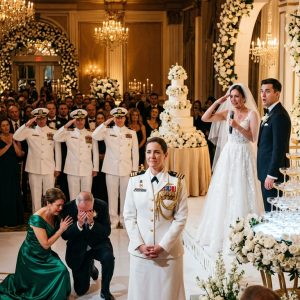
“Following the attainment of my degree,” I continued smoothly, “I did not seek employment in a corporate firm. I swore an oath. I commissioned into the United States Army.”
The word Army acted like a physical shockwave. A man in the back row let out an audible breath. Sterling’s posture broke; his arms uncrossed, falling limply to his sides.
“I endured Officer Candidate School,” I said, the memory of the mud, the sleep deprivation, and the screaming drill sergeants flashing behind my eyes. “Upon earning my commission, I funneled my legal acumen through military channels, subjecting myself to a crucible of physical and intellectual pressure that civilian life cannot replicate.”
Judge Harrison leaned so far forward his robes bunched around his shoulders. “And your current status within the armed forces?”
I held the judge’s gaze with the icy stillness of a predator. “Active Duty, Your Honor.”
The silence that followed was total. It wasn’t the quiet of people listening; it was the vacuum of a paradigm violently imploding. The girl in the apron had just vanished, replaced by a phantom they had utterly failed to anticipate.
Sterling panicked. He lunged toward his microphone, practically knocking over his water glass. “Your Honor! While we—we, of course, honor the respondent’s service to our nation, this is a distraction! The matter at hand is estate management, not military commendations. Her current daily reality is still the cafe!”
“It is not a distraction, Mr. Sterling,” I fired back, my voice never rising above a conversational volume, yet commanding the room entirely. “It is the structural foundation of my defense.”
Harrison raised a heavy hand, palm out, silencing the lawyer. “Let the respondent finish.” It was a command, not a suggestion.
“Thank you,” I said softly. I turned my attention back to the glowing screen, pointing a solitary finger at the photograph of myself wiping the table. “My current posting places me in a mandatory transitional holding period between overseas assignments. Because I am an active-duty officer, and because my grandfather’s estate exceeds eight figures, I am currently navigating a labyrinth of Department of Defense financial compliance protocols.”
I looked back at Sterling, watching the blood drain from his cheeks.
“Those federal protocols explicitly restrict my ability to directly execute trades or unilaterally manage specific asset classes until a comprehensive military ethics review is finalized. If I touch those accounts right now, I violate federal directives.” I let the legal weight of that reality crush the space between us. “So, rather than sit in an empty apartment and atrophy, I sought temporary, manual labor. I took three shifts a week at a local cafe. It keeps me grounded. It demands consistency.”
I paused, looking down at the defense table. “It is entirely lawful. And it in no way reflects a ceiling on my cognitive or professional capabilities.”
Harrison folded his hands beneath his chin. “Miss Whitaker. You are making extraordinary claims. The court requires concrete documentation.”
“I am aware, Your Honor.” I finally unclasped the manila folder. “But before I submit my exhibits, I must address the… methodology… of the plaintiff’s evidence.”
I turned to face my father. Arthur looked physically ill.
“The court has been spoon-fed a narrative of incompetence,” I said, my voice echoing like a tolling bell. “Constructed from a highly curated, deeply flawed dataset. Mr. Sterling noted these photos were taken over three weeks.”
I pulled a single sheet of paper from the folder. “I reviewed the timestamps on the digital discovery files. Every single photograph was captured between the hours of 0800 and 1400. Tuesday through Thursday. Never an evening. Never a weekend.”
Harrison frowned. “Your point, Miss Whitaker?”
“My point, Your Honor, is that this wasn’t an investigation into my capacity. It was an assassination of my character via selective surveillance. Those hours perfectly align with the liberty windows granted by my current garrison command.” I turned the full force of my gaze onto Sterling. “If the plaintiff’s counsel had bothered to conduct a rudimentary background check—if they had pulled my tax records, queried the bar association, or checked my social security number against federal databases—they would have known exactly what I do when I take that apron off.”
Sterling opened his mouth, a desperate, gasping fish pulled onto the dock. “Your Honor, the respondent is—”
“I am stating empirical facts!” I cut him off, the sudden sharpness in my tone slicing through his objection like a scalpel. “They didn’t look, because they found a picture that fit their prejudice, and they stopped digging.”
I turned back to the judge. “You asked who I am in this context, Your Honor.”
Harrison stared at me, his face an unreadable mask. “I did.”
I reached into the folder, my fingers brushing against the heavy, embossed parchment of my truth. I was done playing defense.
Chapter 4: The Revelation
“I am not just a waitress.”
I didn’t shout it. I didn’t need to. I let the words hang in the stagnant air of the courtroom, a quiet detonation that sent shockwaves through the mahogany benches.
I pulled the first document free and handed it to the bailiff, a burly man whose eyes were currently wide with undisguised fascination. He carried it up the steps to the bench.
“I am a Captain in the United States Army,” I stated, the military title feeling like armor slipping over my shoulders. “Exhibit A, Your Honor. My current active-duty orders, issued by the Department of the Army, stamped and verified.”
Judge Harrison took the paper. He didn’t just glance at it; he studied it, his eyes tracking the official seals, the commanding officer’s signature, the undeniable reality of the ink. The dismissive aura he had worn an hour ago had evaporated, replaced by a stark, rigid professionalism.
I pulled the second document. “Furthermore, I serve as a Judge Advocate General Officer.” I handed it to the bailiff. “Exhibit B. My certificate of admission to the State Bar, alongside my military legal credentials.”
Behind me, I heard the distinctive sound of a heavy leather chair squeaking in protest. It was Arthur. He was physically retreating from the table.
“My daily responsibilities,” I continued, pacing slowly, commanding the floor, “do not involve milk temperatures. They involve advising garrison commanders on rules of engagement, prosecuting violations of the Uniform Code of Military Justice, and managing the legal triage of soldiers deploying to combat zones. My life is an exercise in discretion, high-stakes analysis, and unyielding accountability to the federal government.”
I placed the final document squarely on the corner of Sterling’s table. He stared at it like it was radioactive.
“Exhibit C,” I whispered, just loud enough for the microphone to catch. “A signed affidavit from my commanding officer, verifying my compliance protocols regarding the Whitaker estate, and attesting to my executive functioning under extreme duress.”
I stepped back, returning to my designated spot. The silence in the room was absolute, suffocating. The entire architecture of my father’s case lay in ruins around his perfectly polished Italian loafers.
Harrison slowly lowered the papers. He looked over the rims of his reading glasses, his gaze shifting from the documents, to Sterling, to Arthur, and finally resting on me.
“Captain Whitaker,” the judge said. The title fell from his lips with a heavy, newfound reverence. “The court requires a brief recess to thoroughly review these submissions.” He struck the gavel once—a sharp, cracking sound. “We will reconvene in fifteen minutes.”
As the judge swept out of the room, the gallery exhaled in a chaotic rush of whispers and shifting bodies. I remained perfectly still, organizing my empty folder.
I could feel Arthur’s eyes burning into my spine. I didn’t grant him the satisfaction of turning around. He had brought a camera to a war zone, and he was just realizing the artillery was pointed directly at his chest.
The fifteen minutes bled by. When the bailiff barked for the room to rise, the atmosphere had mutated. The voyeuristic glee was gone, replaced by a tense, electric anticipation.
Harrison took his seat. He didn’t look amused. He looked annoyed—specifically, at the plaintiff’s table.
“Counsel,” Harrison barked, his voice devoid of any earlier warmth. “This court has reviewed the respondent’s exhibits. They are exhaustive, verified, and frankly, completely contradictory to the narrative you attempted to establish in my courtroom.”
Sterling stood up. He looked ten years older than he had before the recess. He tugged at his silk tie, his practiced composure fracturing. “Your Honor… we… the plaintiff acknowledges Captain Whitaker’s impressive credentials. We do.”
He swallowed hard. I watched the gears grinding in his head. He had lost the capacity argument. He needed a new angle, desperately.
“However,” Sterling stammered, pivoting violently, “our primary concern shifts to… to the execution of the Colonel’s will itself. Given the Captain’s demanding military schedule, we must question if the decedent was subjected to… undue influence.”
A collective groan almost slipped from the gallery. It was a pathetic, grasping reach.
“Undue influence?” Harrison echoed, his eyebrows skyrocketing toward his hairline.
“Yes, Your Honor,” Sterling rushed on, sweating now. “Perhaps the Colonel did not fully comprehend the impossibility of a deployed officer managing this real estate empire. Perhaps he was manipulated into believing—”
“Mr. Sterling,” I cut in, my voice cracking like a whip. I didn’t ask for permission to speak. I seized the floor.
Chapter 5: Legacy Assured
I took three purposeful strides toward the center of the room, my posture screaming military bearing. I locked eyes with the crumbling attorney.
“You are now asking this court to believe that Colonel Henry Whitaker—a man who commanded infantry battalions, a man who personally audited his stock portfolio every Sunday morning at 0600 until the week his heart failed—was somehow confused?”
I let out a sharp, humorless laugh that echoed off the walls.
“My grandfather possessed a mind like a steel trap until the absolute end. He did not make errors in judgment. He did not make decisions based on sentiment.” I turned a searing glare toward Arthur. “He made decisions based on performance.”
I looked back up at the bench. “Your Honor, included in my exhibits are the Colonel’s own handwritten ledgers from the final month of his life. He outlines his exact rationale for the estate distribution. He knew my assignment. He knew the compliance laws. He trusted my discipline to navigate them, just as he taught me to.”
Harrison flipped to the back of the file, his eyes scanning the attached ledger copies.
Sterling opened his mouth to object, but no sound came out. He was out of ammunition, out of narrative, and out of time.
Judge Harrison closed the thick manila file with a resounding thud. He removed his glasses, pinching the bridge of his nose.
“Mr. Sterling,” the judge said, his voice dropping an octave, carrying the fatal weight of absolute finality. “You brought a petition to strip an heir of her rightful legacy based on a handful of photographs taken at a coffee shop. You alleged gross incompetence. You failed to mention she is a commissioned officer and a sworn officer of the court.”
Harrison leaned forward, glaring at the plaintiff’s table.
“You have utterly failed to demonstrate incapacity. You have failed to demonstrate mismanagement. And your desperate pivot to undue influence borders on insulting the intelligence of this court.”
The judge picked up his gavel. He didn’t look at Arthur. He looked at me.
“Captain Whitaker. The plaintiff’s motion to appoint a temporary administrator is denied with extreme prejudice. The estate remains fully under your authority, subject to your military compliance framework.”
Crack. The gavel hit the sound block. “This matter is adjourned.”
The tension in the room shattered like glass. The gallery began to empty, moving with hushed urgency. Sterling aggressively shoved his documents into his leather briefcase, snapping the brass locks shut and fleeing the room without a backward glance.
I took my time. I carefully slid my military orders and bar admission back into my single folder.
When I finally turned around, the courtroom was empty, save for the bailiff by the door, and Arthur.
He was standing in the aisle, his tailored suit suddenly looking slightly too large for him. We stared at each other across the expanse of the wooden benches. It was the exact same distance that had separated us an hour ago, but the terrain had violently shifted.
“You didn’t have to humiliate us,” Arthur said. His voice wasn’t angry. It was hollow, carrying the pathetic resonance of a man who had gambled his ego and lost his soul.
I held his gaze. I felt no rage, no sorrow. Just a cold, clinical clarity. “I didn’t humiliate you, Arthur,” I said, my voice barely above a whisper. “I just let you introduce yourselves.”
He blinked, searching my face for the little girl he had abandoned twenty years ago. She wasn’t there. He nodded once, a jerky, defeated motion, and turned toward the heavy oak doors, walking out into the corridor alone.
I stepped out of the courthouse a few minutes later. The heavy humidity of the city hit my face, a stark contrast to the sterile, air-conditioned theater of the law. Cars honked in the distance. Pedestrians hurried past, holding coffees, completely oblivious to the war that had just been won behind those stone pillars.
I reached into the pocket of my slacks and pulled out my phone. The screen illuminated with a new notification. A secure message from my garrison command.
Transition complete. Orders finalized. Report to Fort Bragg, 0800 Monday.
I read the text, feeling the familiar, grounding weight of duty settle back over my shoulders. I locked the screen and slid the phone away.
I looked up at the sky, hearing the gravelly, uncompromising voice of the Colonel whispering through the rustling leaves of the courtyard trees.
Good, the ghost said. Now, what’s next?
I adjusted my grip on my folder, stepped down onto the pavement, and marched forward.