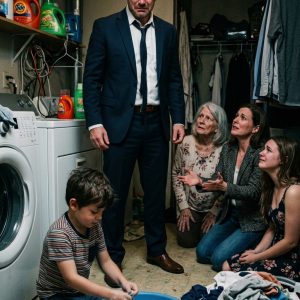
Chapter 1: The Silver Trojan Horse
I am Claire Donovan, and by my thirty-sixth year, I had finally absorbed a horrifying truth about my bloodline: a gift can be wrapped in pristine, shimmering paper and still harbor an malice potent enough to detonate a family’s foundation.
The air in Madison, Wisconsin, carried the bitter, biting chill of late November, but the cold that seeped into my bones that afternoon had nothing to do with the weather. My nine-year-old daughter, Harper, returned home from a supervised visit hours before the agreed-upon time. I heard the deadbolt click, followed by a sound in the foyer that instantly paralyzed my lungs. It wasn’t a scream. It wasn’t the loud, theatrical wailing of a scraped knee. It was a rapid, shallow wheezing—the fractured respiration of a child exerting every ounce of her willpower to keep from shattering.
I dropped the laundry basket and sprinted to the hallway. Harper was standing on the welcome mat, her heavy winter parka zipped askew, one snow boot completely untied. Her cheeks were violently flushed, her eyes swollen into red, glistening slits.
Pressed tightly against her small chest was a silver-wrapped box.
She didn’t run into my arms. She stood rigid, holding the package outward as if it contained radioactive material, even though the box was scarcely larger than a pair of children’s shoes.
“Harper, baby, what happened?” I asked, my voice trembling as I dropped to my knees on the hardwood floor.
She violently shook her head, tears finally spilling over her eyelashes. “They told me to give it to you,” she whispered, her voice raw. “They said I can’t let you overreact.”
A block of solid ice materialized in my stomach.
My parents had spent my entire life judging my trajectory. They had scrutinized my marriage, mocked my career, and audited every joy I managed to scrape together. But weaponizing my weeping child as a postal carrier for their venom? That was a terrifying new frontier.
I pulled her onto the living room sofa, frantically checking her face, lifting her chin, inspecting her wrists for bruises. “You are completely safe,” I promised her, kissing her damp forehead. “Nobody is going to hurt you.”
I gently pried the silver box from her white-knuckled grip and set it on the coffee table. The wrapping was impeccable—crisp, metallic paper bound by a flawless white satin ribbon. Cruelty, in my family, was always heavily heavily disguised by aesthetics.
My childhood home had been a masterclass in psychological camouflage. From the sidewalk, we were the quintessential Midwestern success story. But my father, Victor Whitaker, had spent twenty-two years as a deputy sheriff, and he brought the suffocating authority of his badge to the dinner table every evening. He didn’t ask questions; he issued subpoenas. My mother, Marlene Whitaker, a retired school secretary, was his devoted enabler. She possessed a terrifying talent for rebranding his abuse. If Victor screamed, Marlene claimed he was passionate. If he belittled me, she insisted I was simply fragile. Peace in the Whitaker household was entirely contingent upon my absolute silence.
I thought physical distance and a quiet, successful adulthood would neutralize their control. I became a pediatric occupational therapist, dedicating my life to helping traumatized children reclaim agency over their bodies. Victor sneered at my degree, calling it a glorified hobby. He had wanted a lawyer daughter married to a surgeon, someone he could parade at country club mixers.
Instead, I married Ethan. Ethan was a carpenter—a man with calloused hands, a gentle laugh, and an ocean of patience. He wasn’t flashy. He couldn’t be intimidated by Victor’s booming voice or interrogations, which infuriated my father.
When Harper was born, their obsessive need for control simply bypassed me and latched onto her. But nothing prepared me for the escalation that triggered this afternoon’s nightmare.
I took a deep breath, hooked my finger under the white satin ribbon, and pulled. The silver paper fell away. I lifted the lid of the white cardboard box beneath it.
The smell of black sharpie ink hit my nose first. Then, my eyes focused on the mutilated contents resting inside. And in that horrifying fraction of a second, I realized this was no longer a toxic family dynamic.
I was looking at the work of a predator.
Chapter 2: The Coordinates of Control
To comprehend the sheer madness resting inside that box, you have to rewind to the Sunday dinner two weeks prior.
Ethan had been offered a regional director position in Denver, Colorado. It was the miracle we hadn’t dared to vocalize—a staggering salary increase, brilliant school districts, and most importantly, the Rocky Mountains acting as a thousand-mile barricade between us and my parents’ suffocating orbit.
We announced the relocation over pot roast at my parents’ immaculate dining table. I expected polite disappointment, perhaps a passive-aggressive comment about the altitude.
Instead, the dining room plunged into a vacuum of silence. Marlene set her wine glass down with a sharp clink. Victor slowly lowered his fork, his eyes locking onto Ethan with the cold, dead stare of a law enforcement officer sizing up a suspect.
“You do not get to take my granddaughter away just because your husband got lucky,” Victor stated.
The air in the room evaporated. I felt Ethan’s warm, rough hand grip my thigh under the table. Harper, sensing the atmospheric drop, froze mid-bite.
My father hadn’t said our daughter. He hadn’t even said your daughter. He had claimed ownership. My granddaughter.
We left minutes later. I assumed the move would ignite a cold war. I was profoundly wrong. The very next morning, the Whitakers executed a flawless, terrifying tactical pivot.
Marlene began flooding my phone with heart emojis and nostalgic anecdotes. Victor, a man who would rather swallow glass than admit fault, left a voicemail claiming he had spoken out of shock and didn’t want his legacy to be that of a bitter old man.
The performance was Oscar-worthy, and it made my skin crawl. It didn’t sound like remorse; it sounded like a newly drafted strategy. But Harper was nine. She didn’t bear the scars of my adolescence. She was thrilled when her grandmother overnighted a brand-new set of charcoal pencils and her grandfather asked to critique her sketches over FaceTime.
When they requested a private farewell brunch with Harper, my instincts screamed. I confessed my dread to my best friend, Rachel Moore, over lukewarm cafeteria coffee. Rachel was a razor-sharp paralegal at a prominent family law firm. She had spent a decade watching “loving” families immolate each other in court.
“Don’t rely on their sudden goodwill, Claire,” Rachel had advised, her eyes dark and serious. “What boundaries do you have in writing?”
Taking her advice, I texted Marlene a rigid itinerary. Harper would visit for exactly two hours. Marlene would provide transportation. No surprise guests. No psychological manipulation regarding the Denver move. Marlene agreed instantly. Victor replied with a thumbs-up emoji—a digital gesture so entirely alien to his personality that Ethan had stared at my phone and muttered, “I do not like this.”
Harper had spent her entire Saturday night working on a masterpiece to bring them. It was a sprawling drawing of a timber-framed house with majestic purple mountains in the background. Ethan was holding a hammer, I was holding a coffee mug, and Harper stood directly between us, smiling. “I want to show them that Denver doesn’t mean we are forgetting them,” she had told me, breaking my heart with her unearned generosity.
On Sunday, Marlene arrived right on the minute. She hugged Harper, complimented her braided hair, and promised me a peaceful afternoon. Victor remained idling in his pristine SUV at the curb. I watched my baby climb into the backseat, clutching her green drawing folder, and wave at me through the tinted glass.
Forty-five minutes later, I texted Marlene for an update.
We are just talking, she replied.
Just talking. In the Whitaker lexicon, those three words were a siren. I tried calling Harper’s cell phone. It went straight to a generic voicemail. My hand was literally reaching for my car keys when the doorbell rang, bringing me face-to-face with my sobbing child and the silver box.
Now, sitting on the sofa, I asked Harper what had transpired.
She pulled a knit blanket up to her chin, shivering. The brunch, she explained, had started normally. Then Victor began his interrogation. He asked Harper if Ethan and I were forcing her to pretend she liked Denver. When Harper defended our family, Victor leaned across the table and told her that children are often blind to their parents’ selfish, destructive choices.
Harper, desperate to de-escalate, had pulled out her drawing of the mountain house.
Victor hadn’t smiled. He stared at the purple mountains and demanded to know why she hadn’t drawn her grandparents. Before she could answer, Marlene snatched the folder away, hissing that Harper was too young to comprehend the pain she was inflicting.
Then, Victor had marched out of the kitchen with her artwork.
“I heard him tearing the paper in the hallway,” Harper whispered, a fresh tear escaping. “When he came back, he shoved this box into my hands. He told me to give it to you, and said, ‘This is what happens when people forget where they belong.’ Grandma didn’t even say goodbye. She just drove me home and told me you needed a wake-up call.”
My vision tunneled. A primal, violent maternal rage roared to life in my chest, hot and blinding. I pulled out my phone and texted Rachel a single sentence: Get to my house right now.
I turned my attention back to the coffee table, reached into the white cardboard box, and realized the nightmare had only just begun.
Chapter 3: The Anatomy of a Threat
The first object my trembling fingers extracted was the remnants of Harper’s beautiful mountain drawing.
Victor hadn’t simply ripped the paper in half; he had meticulously, methodically dissected it. Ethan’s figure had been torn away entirely, leaving a jagged, empty void on the page. My drawn face had been violently scrubbed over with a thick red marker, silencing my paper mouth.
But the most chilling detail lay at the bottom of the box. The cutout figure of Harper had been severed from our hands and placed alone, isolated in the dark corner of the cardboard.
It was a psychological threat rendered in crayon.
Resting atop the mutilated artwork was a sheet of heavy cardstock, folded in half. I opened it. Victor’s aggressive, blocky handwriting stared back at me.
Do not overreact. Harper belongs close to family. If you force this move, people will learn what kind of mother takes a child away from everyone who loves her. We have enough to prove you are unstable. Think carefully.
I read the words three times, my brain struggling to process the sheer audacity of the extortion. He was threatening to fabricate a narrative of my mental instability to rip my child away.
“Mom?” Harper’s tiny voice broke my trance. “There’s something else. It sounds weird.”
I leaned closer to the box. A faint, rhythmic, electronic beep was emitting from the shadows of the cardboard.
Beneath the threatening note lay Harper’s favorite stuffed rabbit—a faded plush toy she had accidentally left at my parents’ house three months ago. Marlene had sworn up and down she couldn’t find it. Now, the rabbit lay on its back.
Its plush stomach had been surgically sliced open and hastily sewn back together using thick, black industrial thread. Red marker had been smeared aggressively around the crude stitches to simulate a bleeding wound.
The front door burst open. Rachel charged into the living room, her coat flying behind her. She took one look at my face, then at Harper shivering on the couch, and immediately shifted into her paralegal combat mode. She ushered Harper into the guest bedroom, setting her up with noise-canceling headphones and an iPad.
When Rachel returned, I was using kitchen shears to snip the black thread on the rabbit’s stomach. The beeping grew louder.
I reached two fingers into the synthetic stuffing and pulled out a small, rectangular black plastic device. A tiny green LED light pulsed rhythmically.
Rachel stepped back, the color draining from her cheeks. “Claire. Oh my god. That is a GPS tracker.”
The room violently tilted on its axis. A torn drawing was a cruel tantrum. A threatening note was emotional blackmail. But a functional tracking device, physically sewn into a child’s comfort object? That was premeditated stalking. They weren’t just throwing a fit over our relocation; they were actively establishing a surveillance network to monitor my daughter’s geographical coordinates.
“Put it down,” Rachel ordered, her voice sharp and authoritative. “Do not touch anything else. We are photographing the entire scene, and then we are calling the police. Not Ethan. Not your mother. The police.”
As I set the tracker on a sheet of clean parchment paper to preserve any fingerprints, I noticed the final layer of the box.
Three glossy, 4×6 photographs were lying face down. I flipped them over with the edge of the scissors.
My breath caught in my throat. The first photo was of Harper walking through the chain-link gates of her elementary school. The second showed her sitting on a bench outside her Saturday morning pottery class. The third was a wide shot of Harper standing next to Ethan’s Ford F-150 in the parking lot of our local grocery store.
None of these pictures had been posted on social media. None of them had been taken by me or Ethan. They were taken from a distance. From inside a vehicle.
My father had been hunting my child.
I dialed the non-emergency police dispatch line, my voice eerily calm as I reported a stalking incident, a concealed tracking device, and terroristic threats against a minor.
Twenty minutes later, a cruiser pulled into my driveway. Officer Daniel Price was a tall, stoic man with kind eyes. I had been terrified he would write this off as a domestic squabble, but the moment he saw the severed drawing, the mutilated rabbit, and the pulsing GPS unit, his demeanor shifted to dead serious professionalism.
He knelt down and spoke gently to Harper, recording her account of the brutal brunch interrogation in his notebook. He documented the photos of the stalking.
We were standing in the kitchen, bagging the evidence, when the noise shattered the silence.
Bang. Bang. Bang. Three violent, commanding strikes against my front door. It wasn’t a knock requesting entry; it was a demand from a man who believed he owned the hinges.
Officer Price placed a hand on his utility belt. Rachel moved protectively in front of the hallway leading to Harper’s room.
I walked to the door and peered through the brass peephole.
Victor was standing on my porch, his jaw locked in a furious grid, his eyes burning with the arrogant certainty of a tyrant who had come to collect his disobedient subjects.
Chapter 4: The Ambush in the Asphalt
“Claire,” Victor’s voice boomed through the solid oak door, dripping with condescension. “I know you called the squad car. Open this door right now before you embarrass this family more than you already have.”
My hands shook, a Pavlovian response deeply ingrained from childhood, but I forced my spine to straighten. I slid the brass chain into its track and unlocked the deadbolt, opening the door a mere three inches.
Victor’s eyes darted past my face, locking onto the navy blue uniform of Officer Price standing in the center of my living room. For a fraction of a second, Victor’s lips twitched, but he quickly arranged his features into a mask of weary, paternal indulgence.
“Officer,” Victor said smoothly, projecting his old deputy sheriff cadence. “I appreciate you responding, but this is a massive overreaction. Just a private family matter. A misunderstanding over a move.”
Officer Price walked toward the entryway, his expression unreadable. “Step back from the threshold, sir. The homeowner has not invited you inside.”
“I am her father,” Victor growled, his pleasant facade instantly slipping. “I have a right to be here to protect my granddaughter from a hysterical situation.”
That was the exact moment the roar of an engine cut through the tension. Ethan’s silver truck careened into the driveway, the tires biting aggressively into the concrete. I had managed to text him just three words before dialing 911: Come home now. Ethan threw his truck door open and vaulted up the porch steps, still wearing his canvas work jacket, his boots heavy against the wood. He expected to find me crying. He expected to find a heated argument.
He did not expect to find a uniformed police officer standing guard over an evidence table, Rachel acting as a human shield for his daughter, and his father-in-law attempting to breach the perimeter.
Ethan slammed to a halt. His face, usually flushed with the cold air, drained of all color. He didn’t look angry; he looked horrified. His eyes snapped from Victor’s smug face to mine.
“Claire,” Ethan said, his voice dropping to a trembling whisper. “What is he doing here?”
The sheer terror in my husband’s voice made the hair on the back of my neck stand at attention. Ethan wasn’t afraid of Victor. Ethan was a pragmatist. But right now, he looked like a man who had seen a ghost.
“He came to check on his handiwork,” I replied, gesturing to the box. “Ethan, what’s wrong?”
Victor’s arrogant smile flickered, a dark, triumphant gleam settling in his eyes.
“Claire,” Ethan said, ignoring Victor and stepping closer to the door crack. “He was waiting for me in the parking lot of the lumber yard this morning.”
The living room went deathly silent. Officer Price pulled out his notepad.
Ethan explained, his voice thick with suppressed rage, that Victor had ambushed him before his shift. Victor hadn’t yelled or made a physical scene—he was far too cunning to leave witnesses. Instead, he had leaned against Ethan’s truck and quietly weaponized my husband’s deepest trauma.
Five years ago, Ethan had survived a horrific scaffolding collapse on a job site. The trauma had triggered a severe, six-month battle with acute clinical anxiety. He had sought intensive therapy, conquered the panic attacks, and built a bulletproof life. Victor only knew about the psychological struggle because Marlene had eavesdropped on a private phone call I made years prior.
“He told me that if we tried to take Harper across state lines, the family courts would care deeply about stability,” Ethan explained, his hands balling into fists. “He said, ‘I know a man with your psychiatric history could never handle a custody audit. I know your work schedule. I know Claire works late on Thursdays. If you push this Denver move, I will make sure a judge hears exactly how unstable your mind really is.’“
Bile rose in the back of my throat. Victor was threatening to launch a fraudulent CPS investigation using Ethan’s conquered PTSD as ammunition.
“I thought he was just blowing smoke to scare me,” Ethan groaned, burying his face in his hands. “I was going to tell you tonight. I didn’t know he was coming for Harper.”
“This is absolute slander!” Victor barked from the porch, pointing a finger at Ethan. “He’s making this up to alienate me from my blood!”
Officer Price stepped directly into Victor’s line of sight. “Sir, can you explain the GPS tracking device found sewn inside the minor’s stuffed animal?”
Victor didn’t miss a beat. “The world is a dangerous place, Officer. If these two are determined to make reckless, unstable choices with my granddaughter’s life, someone responsible has to monitor her safety.”
“You sliced a toy open and smeared it with fake blood, Dad,” I said, my voice eerily calm. “You tore Ethan out of a family portrait.”
“Because you only listen when you are terrified, Claire!” Victor roared, finally losing his grip on his temper.
Just then, a silver sedan screeched to a halt behind Ethan’s truck. Marlene stumbled out, her coat half-unbuttoned, tears streaming down her face. She sprinted up the walkway and shoved past Ethan, looking frantically at the police officer, then at the box on the counter.
“We didn’t mean to hurt anyone!” Marlene wailed, clasping her hands together in a theatrical display of maternal panic. She looked at Officer Price, desperate to control the narrative. “The photos were just to show we care! We were just trying to protect her!”
Then, my mother made the fatal, irrevocable error. The mask slipped completely off.
“We only wanted to scare Claire enough so she would think clearly and cancel the move!” Marlene sobbed.
Rachel closed her eyes, letting out a sharp breath of disbelief. Officer Price’s pen scratched loudly against his notepad, immortalizing the confession.
“You wanted to scare me,” I repeated, staring at the woman who gave birth to me, “by terrorizing a nine-year-old child.”
Marlene wept harder, reaching a hand out toward the crack in the door. “Claire, please…”
“Shut your mouth, Marlene!” Victor snapped, glaring at his wife.
And there it was. The ancient, pathetic choreography of my childhood playing out on my front porch. He commanded; she folded. But I was no longer a participant in their sick ballet.
“You need to vacate this property immediately,” Officer Price informed my parents, his hand resting definitively on his radio. “If you do not leave, you will be arrested for criminal trespassing. Given the evidence collected today, any further contact with this family will result in severe legal consequences.”
Victor sneered, adjusting his jacket. “I know the law better than you do, rookie.”
“Then you know exactly how much trouble you’re in,” Price countered smoothly.
I slammed the oak door shut, throwing the deadbolt, severing the umbilical cord to my past once and for all. But as Ethan wrapped his arms around me in the hallway, I knew the Whitakers wouldn’t surrender. The physical battle was over, but the digital and legal war had just been declared.
Chapter 5: The Collapse of a Kingdom
The following seventy-two hours were an orchestrated symphony of absolute defensive warfare.
Ethan didn’t just change the locks; he installed reinforced strike plates and high-definition security cameras on every angle of our property. I contacted Harper’s elementary school the very next morning, legally stripping both Victor and Marlene from every emergency contact sheet, pickup authorization, and medical release form on file.
Rachel, abandoning her role as a friend to become my relentless legal strategist, compiled the “Doomsday Folder.” It contained the photographs of the mutilated box, the GPS tracker serial number, Officer Price’s official incident report, and Ethan’s sworn affidavit regarding the parking lot extortion.
But Victor, drunk on decades of unchecked authority, struck back first.
He initiated a scorched-earth smear campaign. On Tuesday morning, a sprawling, melodramatic email was blasted to thirty members of our extended family. In it, Victor painted a tragic portrait of himself: a devoted grandfather fighting against a manipulative, mentally unstable daughter and an abusive, controlling son-in-law who were actively isolating a child.
He thought he controlled the narrative. He was unaware of the digital guillotine hanging over his neck.
He didn’t know our new doorbell camera had recorded crystal-clear audio of him demanding I open the door before I “embarrassed the family.” He didn’t realize Officer Price had documented his admission that the tracker was placed intentionally.
And most damning of all, Victor was oblivious to the secret Harper had whispered to Rachel while the police were present. “Grandpa told me that if I kept the box a secret, he could call a judge and make sure I got to stay in Madison forever.”
That sentence eradicated any lingering trace of my daughterly guilt.
On Thursday evening, I called a mandatory family meeting at my aunt’s house. I didn’t convene it to negotiate peace; I convened it to execute a public dismantling. Victor arrived looking smug and victorious in a tweed blazer. Marlene trailed behind him, looking nervously at the floor.
Ethan sat rigidly at my right side. Rachel sat at my left, functioning as the impartial witness who had processed the crime scene.
Victor began his grand, booming speech about “grandparents’ rights” and the sanctity of family loyalty. I let him speak uninterrupted for three full minutes, letting him dig the hole as deep as possible in front of my aunts, uncles, and cousins.
When he paused for breath, Ethan pressed play on a Bluetooth speaker.
The room echoed with the high-definition audio of Victor threatening me on my porch. Then, Rachel silently slid glossy, 8×10 photographs across the dining room table. The severed mountain drawing. The gutted rabbit with the tracker. The stalker photos of Harper at school.
The blood violently drained from the faces of my extended family. The silence was absolute.
Victor’s face turned an ugly, mottled purple. He slammed his fists down onto the oak table, rattling the coffee mugs. “She is my granddaughter!” he roared, pointing a trembling finger at me.
I stood up, pushing my chair back. I looked the tyrant dead in the eye.
“No, Victor,” I stated, my voice echoing off the walls with terrifying calm. “She is my child. And you will never use her as a weapon to control my life ever again.”
The very next morning, Rachel’s recommended attorney walked Ethan and me into the county courthouse. We filed for an emergency, ex-parte protective order.
The judge took one look at the evidence file—specifically the GPS tracker embedded in a child’s toy and the parking lot extortion threat—and granted the temporary restrictions without hesitation. The Whitakers were legally barred from approaching within five hundred feet of Harper, our home, or her school. They were prohibited from using third-party relatives to pass messages or gifts.
I expected Victor to rage against the dying of the light. I expected Marlene to bombard me with tearful voicemails from burner phones.
What I did not anticipate was how spectacularly, and how swiftly, their meticulously crafted public image would disintegrate.
Victor had spent his entire life curating the persona of the respectable, retired deputy. But suburban gossip is a lethal virus. When the school administration was briefed on the restraining order, a faculty member recognized Victor’s SUV from the stalker photos. The teacher formally reported that Victor had been parked suspiciously near the playground perimeter on multiple occasions over the past month.
When “concern” morphs into covert surveillance, the illusion of love shatters. The country club whispers began. The neighbors stopped waving.
Marlene attempted a backdoor diplomatic mission. She sent messages through my aunt, claiming she was a victim of Victor’s intense personality, that she missed Harper terribly, and that the box was just a “misguided metaphor.” For a fleeting, pathetic hour, the traumatized inner child in me almost wavered.
Then I remembered my nine-year-old daughter standing in the freezing foyer with a crooked coat, crying while her grandmother’s taillights disappeared down the street.
I texted my aunt a single reply: She handed my child the box. The diplomatic channel closed forever.
Victor made one final, fatal miscalculation three weeks before moving day. Arrogant enough to believe a piece of paper couldn’t stop him, he walked into the front office of Harper’s elementary school clutching a bouquet of daisies and a giant teddy bear, demanding to say a final goodbye to his blood.
Because the staff was primed, the lockdown protocol was initiated immediately. The principal blocked the office door and dialed 911.
Victor fled the premises before the squad cars arrived, but the brazen violation of the protective order was documented. It fortified our legal case into an impenetrable fortress. The respectable deputy was officially a fugitive from family court.
Our exile from Madison was finally secure. The mountains were calling, but the echoes of the war would take time to fade.
Chapter 6: The Architecture of Safe People
We crossed the Colorado state line in early April, the crisp mountain air rushing through the cracked windows of Ethan’s truck. Denver was a canvas of towering pines, sprawling blue skies, and absolute anonymity.
The physical transition was seamless, but the psychological unspooling was agonizingly slow.
For the first month, Harper flinched violently every time the Amazon delivery driver rang the doorbell. She systematically removed every single stuffed animal from her bedroom, piling them in the hallway, terrified of what might be lurking inside their synthetic bellies. Three times a week, she would creep into our bedroom at midnight, her voice trembling in the dark, asking if Grandpa knew our new zip code.
Every single time, I held her tightly and offered her age-appropriate, unvarnished truth. “The police and the lawyers built a giant wall around us, baby,” I would whisper into her hair. “You are completely safe. You were so incredibly brave for telling me the truth about the box.”
We enrolled her with a brilliant pediatric trauma therapist. Slowly, millimeter by millimeter, the vibrant, creative child we knew began to claw her way back to the surface.
Ethan, ever the patient architect, built a custom drafting desk out of reclaimed oak and situated it beneath the large bay window in Harper’s new bedroom. I stocked it with fresh, high-quality sketch pads, charcoal pencils, and watercolors. But I never once asked her to draw our family again. That sacred territory had to be reclaimed on her own timeline.
Two months into our new life, the scent of roasting chicken filled our Denver kitchen. I walked down the hallway to call Harper for dinner and paused at the threshold of her bedroom.
She was hunched over her drafting desk, colored pencils scattered in chaotic, beautiful disarray across the wood. She didn’t cover the paper when I walked in; she proudly stepped aside.
It was a sprawling, vibrant illustration of our new timber-framed house. The Rocky Mountains loomed majestically in the background, capped with white snow. Ethan was in the front yard, clutching a wooden hammer. I was standing on the porch, holding a steaming coffee mug. Harper was standing squarely between us, her hand resting firmly on the doorknob of the house.
But it was the words she had meticulously written in block letters above the doorframe that brought me to my knees.
ONLY SAFE PEOPLE CAN COME IN.
I sank against the doorjamb and wept. They were not tears of residual grief, but of profound, overwhelming relief. The drawing was an honest, brutal, beautiful testament to survival.
That was the fundamental truth my parents, in their obsessive quest for obedience, could never comprehend. Family is not a biological title you get to wield like a loaded weapon. Love does not orchestrate surveillance, slice open comfort objects, or weaponize a child’s terror to extract compliance from adults.
Real love is the architecture of safety. Real love provides a foundation secure enough for a child to speak the ugliest truths without fear of retribution. Real parenting meant looking at my own deep-seated terror of my father and choosing to obliterate it rather than pass the inheritance of silence down to my daughter.
Harper learned that afternoon in Madison that her voice possessed the power to shatter fortresses. Ethan learned that his conquered past could never be used to dictate his future. And I learned the most vital lesson of my thirty-six years on earth.
Protecting your peace sometimes requires becoming the villain in someone else’s narrative. We are not a flawless family, but we are an impenetrable one. My parents had deployed fear as a tactic to chain me to their front porch. Instead, that fear served as the very compass that pointed us toward freedom.
If anyone ever tells you that erecting boundaries is an act of cruelty, look closely at their hands. Boundaries do not destroy healthy relationships. They simply illuminate the parasites that were entirely dependent on your absolute silence to survive.