The Architecture of Abandonment: A Chronicle of the Collins Reckoning
Chapter 1: The Architecture of Abandonment
My name is Mara Collins, and I was seventeen years old on the night my family decided that the physical structure of our house was worth more than the pulse in my veins.
The storm warnings had been a frantic, high-pitched scream across every television and smartphone in the county for forty-eight hours. Category 4. Mandatory evacuation. The kind of atmospheric violence that turns oak trees into toothpicks and coastal roads into rivers. I watched our neighbors in the Outer Banks tape their windows with a desperate, frantic energy, stuffing their lives into trash bags and fleeing before the bridges were surrendered to the rising tide.
I truly believed I was leaving with them. I had already positioned my sneakers by the door. I had carefully packed three days of kibble for our two dogs and the ancient, tattered gray cat who sought sanctuary under my bed.
Then, my mother looked at the animals, looked at the limited space in our two SUVs, and then looked at me with a terrifyingly clinical detachment. She said someone had to stay. She said hotels didn’t accept pets, and she claimed that “opportunists” loved empty houses in the wake of a gale.
I laughed, a sharp, nervous sound, because I assumed it was a punchline. But nobody laughed back. The air in the kitchen turned to solid ice.
My father, Grant Collins, didn’t say a word. He simply walked to the garage, retrieved his heavy-duty drill, and carried a sheet of plywood to my bedroom window. He nailed it shut from the outside while I watched, paralyzed, from the hallway. When I asked why he was boarding up my specific room while everyone else was piling into the cars, he didn’t look at me.
“It’s so you don’t get any ideas once the wind gets bad, Mara,” he muttered. “Stay away from the glass.”
My mother, Lydia Collins, took the last car. My younger brother, Caleb, claimed the entire back seat. My Aunt Marlene sat in the passenger side, clutching a cooler full of sandwiches. They drove away while the sky turned a bruised, sickly shade of violet. My father flipped the main breaker before he stepped off the porch, plunging the house into a suffocating, absolute darkness before the first raindrop even hit the roof.
Six hours later, my phone died. Nineteen hours later, I was huddled in the hallway closet with wet towels stuffed under the door to keep the rising water at bay. One dog was shivering against my ribs, the cat was clawing through my hoodie in a blind panic, and something heavy—a branch, a piece of a neighbor’s roof, a death warrant—slammed into the ceiling so hard I thought the world was ending.
And I smiled.
It wasn’t a smile of bravery or some cinematic display of grit. It was a smile of profound, crystalline realization. For the first time in my seventeen years, I understood exactly what I was to them: a piece of storm furniture. Useful for protecting the property, but entirely disposable.
Little did they know that the storm they left me in would eventually become the very wind that blew their lives apart nine years later.
Chapter 2: The Hierarchy of the Unwanted
To understand why they left me, you have to understand the ecosystem of the Collins household.
My father, Grant, worked for the county maintenance department. He was a man who understood the structural integrity of every bridge and levee in the region. He knew exactly what a Category 4 hurricane would do to a dark house. He was the kind of man who performed kindness for the public so that nobody would ever believe the cold, mechanical cruelty he practiced at home.
My mother, Lydia, was the front-office face of the local elementary school. She was a woman of “selfless” reputation, the kind who volunteered for every church bake sale and Thanksgiving drive. She had a “gift,” they said, for making children feel safe. I was the only child that gift seemed to have skipped.
Then there was Caleb.
Caleb was two years my junior, but he was treated like the messiah my parents had been waiting for. I was the “accident” they had too young—the burden that forced them into a life they weren’t ready for. Caleb was the second chance. When Caleb scraped a passing grade in math, it was celebrated like a doctoral thesis. When I earned straight A’s, my father would barely look up from his coffee, grunting that I was simply doing what I was “supposed to do.”
Aunt Marlene had moved in when I was fourteen, following what she called a “rough patch” that had somehow lasted indefinitely. She was a permanent houseguest who paid for nothing but had an opinion on everything. She called Caleb “sweetheart” and called me “the girl with the difficult face.” She told my mother I looked “accusatory,” as if I were always holding a secret against them.
Maybe I was.
The only sanctuary I had ever known was a fifteen-minute drive away. It was a small, blue house with white shutters and a porch swing that squeaked a rhythmic, comforting song. That was the home of Nana June Whitaker, my grandmother.
Nana June was the one who came to my school plays when I only had a single line. She was the one who taught me to drive in the empty parking lot of the Grace Lutheran Church. She was the one who kept my favorite snacks in her pantry because she noticed my mother only bought what Caleb liked.
Once, when I was fifteen, Nana June watched my mother “forget” my birthday dinner because Caleb had a junior varsity baseball game. Nana looked at me across her kitchen table, her eyes full of a fierce, protective sorrow, and said, “Baby, never beg people to see you when they have trained themselves to look away.”
I didn’t realize that evening that she was giving me a survival manual.
When they finally returned after the hurricane—irritated by the traffic and complaining about the hotel’s breakfast—my mother didn’t rush to hug me. She walked past me to check if the dogs had ruined the hardwood floors.
Chapter 3: The Ghost in the House
For the year following the hurricane, I became a phantom.
I lived in their house, ate their food, and sat at their table, but I had vacated the premises emotionally. I stopped asking for rides. I stopped sharing my pain. I stopped reacting to Caleb’s jokes about me being “the family ghost.” I learned that silence wasn’t just a lack of noise; it was a shield.
At school, the teachers called me “mature” and “focused.” They didn’t realize that “focus” was just the clinical term for a desperate, singular obsession with escape.
I filled out scholarship forms with the intensity of a prisoner planning a tunnel. I chose a university in Raleigh, specifically targeting a program in Disaster Planning and Coastal Property Risk. People found it odd—a young girl interested in insurance compliance and hurricane codes. I told them the weather interested me.
The truth was much darker. I wanted to understand every system that had failed me that night. I wanted to know the legal, moral, and insurance-based definitions of “abandonment.”
The night I graduated high school, I didn’t wait for a celebration that would never come. I packed a single suitcase and a duffel bag. My mother sat in the kitchen, scrolling through her phone, asking if I was “sure I wasn’t making a scene” by leaving so abruptly. My father asked when I’d be back to help him clean out the garage. Caleb told me not to “act fancy” just because I was going to college.
Nana June was waiting in the driveway, her engine idling, a box of homemade sandwiches on the passenger seat. As we drove away, I looked at the house in the rearview mirror. It didn’t feel like I was leaving home; it felt like I was shedding a costume that had been cutting off my circulation for eighteen years.
College didn’t heal me, but it gave me a vocation. I worked part-time in the campus housing office, then interned with a coastal insurance firm. I learned how claims were denied, how houses were appraised, and how easily people lied when a payout was on the line. Every skill I gained was another lock on the door I was building between myself and the Collins family.
They barely called. When they did, it was purely transactional. Could I look over an insurance form? Could I explain a letter from the county? Could I send Caleb fifty bucks for his car payment?
I usually said no.
Nana June called every Sunday. She was my only tether to that world until I was twenty-two, when she sat me down in my tiny Raleigh apartment and told me the truth about the “family home.”
“Your parents have been living in my property for twenty years, paying almost nothing, Mara,” she said, her voice small. “The coastal house is mine. They treated it like an inheritance they’d already received. I kept giving because I hoped stability would make them better parents. I was wrong.”
Then she told me she had changed her will. The house wouldn’t go to her daughter, Lydia. It would go to me.
“I did not have an answer for her then. I didn’t know that Nana June was handing me the keys to my own kingdom—and the match to burn theirs down.”
Chapter 4: The Sentinel of the Will
Nana June passed away in her sleep three years later, after a morning spent feeding the birds on her porch. She left the world exactly as she had lived in it: quietly tending to things smaller than herself.
The funeral was a performance of the highest order. My mother, Lydia, wailed in the front pew, accepting condolences as if she had been the primary caregiver. My father stood stiffly, playing the role of the grieving son-in-law. Caleb looked bored until the topic of the estate was whispered in the lobby.
I stayed silent. I had learned that silence makes guilty people nervous.
The will was read two weeks later. I wasn’t in the room with them. I sat in my office in Raleigh until my attorney called. Ten minutes later, my phone began its rhythmic, frantic dance.
Eleven missed calls from my mother. A text from my father: Call me now. A long, rambling message from Caleb about how “Nana would never want to divide the family.” Aunt Marlene left a voicemail accusing me of “poisoning” an elderly woman.
I put the phone face down and went back to my spreadsheets. For the first time in my life, I understood that power doesn’t have to be loud. It just has to be legal.
I didn’t evict them immediately. I didn’t give them the satisfaction of playing the “cruel daughter” card to the town. Instead, I used my professional training. I sent a formal, market-rate lease agreement. I imposed rules: only my parents were approved tenants. Aunt Marlene was not listed. Caleb was not listed. Maintenance requests had to be in writing. Late fees applied after the fifth of the month.
My mother called it “humiliating.” My father called it “disrespectful.” They signed on day twenty-eight.
For three years, I kept it professional. I was a landlord, not a daughter. I ignored the emotional baiting. Then, in the third year, the payments started coming late. Then a month was missing entirely.
Suddenly, Caleb became friendly. He texted to ask how I was doing. He sent a picture of his new real estate business card. He said, “Maybe we should catch up as adults, Mara.”
I knew immediately that the wolves were at the door. Caleb never reached for my hand unless someone behind him wanted me to open it.
Chapter 5: The Market Price of Betrayal
Caleb’s friendliness lasted exactly four messages before the “solution” was proposed.
He told me our father’s health was “rough.” He said our mother was under “unbearable stress.” He said he had been thinking, as a real estate professional, that there was a way to help “everyone.”
“Everyone,” in Collins speak, always meant themselves.
They had gathered $55,000 by emptying their savings and selling my father’s fishing boat. They wanted to buy the house from me at a “family price.” The property, located in a prime Outer Banks rental market, was worth at least six times that amount.
I didn’t argue. I didn’t scream. I simply drove back to the coast six days later with a manila folder on the passenger seat.
The house looked like a reflection of their characters—tired, neglected, and decaying. Nana’s blue paint had faded to a sickly gray. The flower beds were choked with weeds. They had treated the house exactly the way they had treated me: they used it until it required care, then ignored it.
My mother opened the door with a fake, beaming smile. “Mara, you look so thin!”
My father was in his recliner, wearing that hard, disappointed expression he used to keep the world at bay. Caleb was “accidentally” there, leaning against the kitchen counter.
They gave their rehearsed speech. They talked about “legacy” and “sacrifice.” My father told me I had done well and didn’t need to “squeeze” my own parents. He said they had “made mistakes,” but all parents do.
“Do you remember what you said when you nailed my bedroom window shut before the hurricane, Dad?” I asked. The room went so quiet I could hear the refrigerator hum.
My mother’s face tightened. “We are not doing this again, Mara. You’ve held onto that storm for too long. The house is still standing. You’re alive. Normal daughters don’t punish their families forever over one bad night.”
“I’m not a normal daughter,” I said, opening my folder. “And this isn’t a family meeting. It’s a business one.”
I informed them I wasn’t selling to them. I had already accepted a higher offer from a Coastal Retreat Company. They were going to renovate the property into a storm-safe, pet-friendly rental. I handed them a sixty-day notice to vacate.
The explosion was immediate. My mother’s tears were a weapon she had honed for decades. She asked how I could “throw them out.” My father’s voice went low and dangerous, telling me Nana would be “disgusted” by my greed.
Then Aunt Marlene walked down the stairs in her slippers, holding a mug. She hadn’t even bothered to hide. She had been living there in direct violation of the lease for three years.
I pulled out my phone and started recording.
“You lived in my house, broke my lease, lied to my face, and still thought I came here unprepared,” I said.
Caleb tried to play the peacemaker, but I cut him off. “Caleb, I saw your truck parked down the street. I know you were reporting back to them every time I answered a text. You aren’t a brother; you’re a scout.”
My father stood up, his face purple with rage. “If you do this, you will never be welcome in this family again!”
Chapter 6: The Storm-Rated Reckoning
I left the house to the sound of their shouting, but the real battle was just beginning.
I met with Mr. Jonah Bell, Nana’s old neighbor, the next morning. He told me what they had been saying in town. They had told the neighbors I was “unstable” and had “manipulated a confused old woman” into changing her will. My mother had gone door-to-door with red eyes, claiming she was “scared of what Mara might do next.”
They were trying to block the building permits for the rental company. They were trying to poison the well before I could sell it.
I hired an attorney named Claire Maddox. She was a woman who was entirely unimpressed by emotional theater. I brought her the lease, the payment records, the video of Aunt Marlene, and the text from my father threatening to “make things complicated” with the county board.
“Good,” Claire said, reviewing the text. “He put the intimidation in writing.”
The community permit meeting was held in a low brick building near the library. It was a room where history mattered, and my parents thought their “good neighbor” reputation would act as an armor.
The Coastal Retreat Company presented their plan first—a beautiful, storm-rated restoration. Then came public comments.
My mother stood up, wearing a soft blue cardigan. She gave an Oscar-worthy performance about a “greedy daughter” and “insurance fraud.” She said the board had a “moral duty” to protect elderly residents.
Then I stood up.
I didn’t talk about money. I talked about structure. I showed the room the video of Aunt Marlene violating the lease. I read my father’s threatening texts aloud.
Then, I pulled out the weather report from the night of Hurricane Isabella. I told the room I was seventeen when my family evacuated without me. I told them about the nailed-shut window. I told them about the nineteen hours in the closet with the pets while the roof shook.
The room went so quiet you could hear a pen drop.
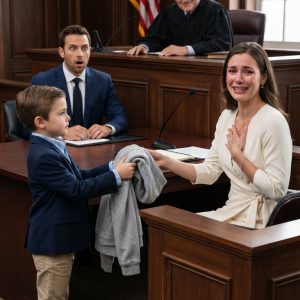
A board member looked at my father. “Is this true, Mr. Collins? You left a minor in a mandatory evacuation zone with the power cut?”
My father stammered. “The storm wasn’t that bad… she was almost eighteen… we did it for the house…”
“You boarded the window from the outside?” the board member asked, horror dawning on his face.
“For protection,” my father muttered.
“Protection for the house, or for her?” I asked.
The permit was approved unanimously. The “good neighbor” mask didn’t just slip; it shattered into a million pieces.
When the meeting ended, people who had known my parents for twenty years walked right past them without a word. My mother started to cry, but for the first time, nobody moved to comfort her.
Chapter 7: The Quiet After the Gale
The thirty-day deadline for their eviction arrived on a Tuesday—the anniversary of the storm.
I arrived with Claire and a sheriff’s deputy. I wasn’t taking chances.
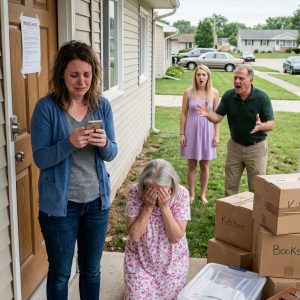
My mother stood in the driveway, begging for two more weeks. She said the apartment they found was “too small.” She said my father’s health was failing. She said I was “killing the family.”
“Thirty days is more mercy than you gave me that night,” I said. “And the family died the moment you nailed that plywood over my head.”
Caleb tried to speak, but I held up a hand. “There’s nothing left to translate, Caleb. You can go be the ‘good son’ in a two-bedroom apartment inland.”
The next morning, my phone exploded. 53 missed calls.
At 7:30 AM, my father texted: Please stop. Do not do this.
At 9:30 AM, my mother wrote: We were wrong. Please forgive us.
I didn’t answer. I sent a single group message to every relative who had suddenly discovered my number:
When I was seventeen, my parents left me in a Category 4 hurricane to protect a house. They boarded me in and cut the power. None of you protected me then. Do not lecture me now on ‘family values’ because they finally met the consequences of their choices.
Nobody replied.
The sale closed three weeks later. I used a portion of the proceeds to start a small emergency fund in Nana June’s name. It helps local shelters stock pet evacuation supplies and provides emergency lodging for families with children during storm warnings.
I didn’t do it for revenge. I did it because children are not property guards, and pets are not excuses for abandonment.
My parents live in a small apartment forty minutes from the coast. My mother lost the social status she spent decades building. My father lost the house he valued more than his daughter. Aunt Marlene lost her free ride. And Caleb? He lost the inheritance he thought was his birthright.
Nine years ago, I smiled in the dark because I finally understood I was alone. Today, I smile because I am no longer trapped in the dark they created for me.
Forgiveness without accountability is just permission for the next cruelty. I didn’t wish them pain; I only wished for them to live inside the reality they built for me. And finally, the weather is clear.
Like and share this post if you find it interesting.