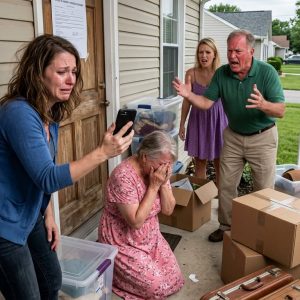
The Inheritance of Dust and Bone
Chapter 1: The Outcast’s Sanctuary
The pounding on my front door began at 11:43 p.m., a rhythmic, violent thudding loud enough to rattle dust loose from the warped ceiling beams. I froze midway across the living room, my phone gripped in one hand and a heavy industrial flashlight in the other. I stared at the deadbolt—a flimsy piece of hardware I had installed myself just two weeks ago—as if it might simply disintegrate under the pressure.
“Open this door, Leah!” my mother’s voice shrieked from the porch. It was a tone she usually reserved for uncooperative waiters or people she deemed beneath her social standing. “You think you can steal from this family and hide in this dump? Open up!”
Behind her, I heard the dull thud of something heavy slamming against the vinyl siding. My sister Rachel’s voice cut through the night, sharp and breathless. “She’s in there. I saw her car behind those overgrown bushes. She’s hiding like the coward she is.”
I stepped back, my heart hammering against my ribs. This house—this “dump,” as my mother called it—had cost me eight hundred dollars in cash at a desperate county tax auction. It was a sagging, weary structure on the outskirts of Millfield, Ohio, complete with cracked windows, floors stained by decades of neglect, and a roof that groaned like a dying beast whenever the wind picked up.
My family had laughed until they were red in the face when I bought it. They hadn’t reached out to offer a hammer or a bucket of paint. Instead, they had thrown me out of the family home because I refused to hand over five thousand dollars of my savings to fund Rachel’s “healing retreat” in Sedona.
My mother, Helen, had stood in her pristine, granite-countertopped kitchen, arms crossed over her chest as she sneered at me. “You’d rather own a hovel than help your sister find her spiritual center? Fine. Go. Enjoy living like junk, Leah. Don’t come crawling back when the walls fall in on you.”
So, I did exactly that. For three quiet months, I scrubbed away years of mold, patched the most egregious leaks, and slept on an air mattress in the middle of the living room. I kept my distance. I thought I was finally free of the toxic cycle of their demands.
Then, that afternoon, everything changed. A man in a battered gray truck had slowed down by my mailbox. He had looked at the house, then at me, with an expression that fell somewhere between pity and terror.
“You the new owner of the Carter place?” he’d asked.
When I nodded, the color drained from his weathered face. He leaned out the window, his voice a low rasp. “Then listen to me, girl. Don’t let your family in. Not tonight. Not ever. There are things in that dirt that don’t want to stay buried.”
I had dismissed him as a local eccentric, but as the door frame groaned under the weight of my mother’s fury, I realized the warning wasn’t a metaphor.
Chapter 2: The Midnight Invasion
My phone suddenly buzzed in my hand, the screen illuminating my pale face. It was an unknown number, a text message that sent a chill straight to my marrow.
DO NOT OPEN THE FLOOR IN THE KITCHEN. THEY KNOW.
I barely had time to process the words before a thunderous crash hit the front door. The wood splintered with a sickening crack.
“She found it before us! I know she did!” Rachel shouted, her voice laced with a frantic, ugly greed I had never heard before.
Found what? I hadn’t found anything but old newspapers and dead spiders.
I ran toward the kitchen anyway, the beam of my flashlight bouncing erratically across the peeling linoleum. I reached the center of the room just as the porch light flared through the broken front window. Suddenly, a floorboard near the sink—one I had walked over a hundred times—lifted from below with a violent, agonizing crack.
I had spent the last three months convinced my family came to humiliate me, to sneer at my poverty and remind me of my place. I was wrong. The moment the floor opened, I understood this house wasn’t just a cheap tax-auction win. It was a tomb, hiding something people were willing to destroy my life to possess.
The floorboard snapped upward so hard it nearly struck my knees. I stumbled back, grabbing the edge of the grease-stained counter as a square of absolute darkness opened beneath the kitchen floor. A rush of cold, subterranean air billowed out, carrying the heavy scent of damp earth and something sharply metallic—the smell of old copper and dried blood.
It was a hidden compartment, perfectly concealed beneath the subflooring.
Before I could shine my light into the void, the front door finally gave way. The sound of wood exploding inward echoed through the house like a gunshot. My mother stormed in first, her cream-colored cashmere coat looking absurdly out of place against my stained, water-damaged walls. Rachel was right behind her, her hair wild and her face flushed with a terrifying sort of adrenaline.
But it was the third person who made my blood run cold: my Uncle Brent. He was a man who had always existed on the fringes of our family, a “businessman” with a permanent tan and eyes that never quite settled on anything. In his hand, he gripped a heavy tire iron.
“There,” Rachel said, her finger trembling as she pointed toward the kitchen. “I told you she’d be standing right over it.”
I stepped away from the opening, my flashlight shaking. “You broke into my house. This is a crime. Get out.”
My mother barely acknowledged my existence. Her eyes were locked onto the hole in the floor with a hungry, desperate intensity. “Move out of the way, Leah,” she hissed.
“No,” I snapped, find a sliver of my own courage. “This is my property. Whatever is down there belongs to me.”
Brent stepped forward, rolling the tire iron in his palm with a rhythmic, threatening motion. “Leah, don’t make this ugly. You’re out of your league. Just step back, and we can all walk away from this with what we need.”
“Ugly?” I laughed, the sound brittle and sharp. “You threw me out into the street because I wouldn’t fund Rachel’s five-thousand-dollar sound-bath vacation. You called me junk. You told me to rot here.”
“It wasn’t a vacation!” Rachel shrieked, her voice cracking. “It was a necessity!”
I looked at the tire iron in Brent’s hand and the madness in my sister’s eyes, realizing that for them, this house was never about me—it was about a debt they were finally coming to collect.
Chapter 4: The Ghost of Mara Carter
For one heartbeat, the room fell into a suffocating stillness. The only sound was the wind whistling through the broken front door.
Then, Uncle Brent swung.
The tire iron slammed into the leg of the kitchen table with a deafening crack. Wood splintered, and the table lurched sideways. I flinched, tripping over a loose piece of linoleum, and in that split second of distraction, Rachel darted past me. She dropped to her knees beside the opening in the floor, her hands disappearing into the darkness.
She let out a triumphant cry and pulled out a rusted metal box, roughly the size of a briefcase. It was heavy, covered in a thick layer of oily grime.
My heart sank. She smiled at me, a jagged, victorious expression. “You always were too slow, Leah. Too busy playing house in the dirt to see the gold right under your feet.”
But as she struggled with the rusted latch, her expression began to shift. The lock snapped, and she flung the lid open.
Inside, there was no gold. No stacks of cash. No glittering jewelry.
There was only a thick bundle of papers sealed in yellowed plastic, an old, heavy revolver, a faded black-and-white photograph, and a single yellow envelope with one name written across the front in bold, block letters: MARA.
My mother made a strangled, gargling sound in the back of her throat. She looked as if she had seen a ghost.
Rachel looked between the envelope and my mother, her confusion evident. “Why is Grandma’s name on this? I thought this was the Carter place. We aren’t Carters.”
The air in the room seemed to thin. My grandmother, Mara Carter, had died when I was only eleven. I remembered her as a woman made of iron and silence, someone who smelled of lavender and earth. My mother had always told us that Mara was cruel, unstable, and impossible to love. We were forbidden from asking questions about her past or the house she had supposedly abandoned decades ago.
Brent reached for the envelope, his fingers twitching, but I was faster. I lunged forward, snatching it from the box before he could react. “Don’t touch me!” I yelled, holding the envelope to my chest.
For once, the sheer fury in my voice made him pause.
My hands trembled as I tore the seal. Inside was a brittle letter and a folded document stamped by the county recorder’s office. I read the first line, and a wave of ice-water dread washed over me.
“If my daughters or their husbands ever come for this property after forcing Leah out, this letter is to be given to her alone.”
My mother lunged at me with a speed that was terrifying. She knocked the flashlight from my hand, and it rolled across the floor, the beam spinning like a lighthouse siren, casting long, distorted shadows against the walls.
“Give me that letter!” she screamed, her fingernails clawing at my arms. “It’s a lie! It’s all the lies of a dying, bitter woman!”
I backed away into the dark hallway, my eyes frantically scanning the page. Mara had written that this house had originally belonged to her husband, Daniel Carter—the grandfather I had been told had abandoned us. According to this letter, he hadn’t run. He had died on this very property under “suspicious circumstances” after discovering that Helen and Brent’s father were forging land records to steal settlement money from local farming families.
Mara had hidden the proof here, beneath the floor, and had protected the deed for decades, waiting for the only grandchild she believed had the “stubbornness to survive the truth.”
Rachel whispered, “Mom… what is she talking about? What land?”
Uncle Brent moved then. He didn’t shout. He simply walked to the kitchen door, slid the heavy iron bolt into place, and turned toward me. The tire iron was gone, replaced by a cold, calculating look of absolute malice.
“Leah,” he said quietly. “Hand over the letter, and maybe we can discuss a way for everyone to leave this house in one piece.”
I looked at the second document in my hand, realizing it wasn’t just a deed—it was a notarized transfer for forty acres of undeveloped land behind the house, worth millions in mineral rights.
Chapter 5: The Siege of Millfield
The realization of the land’s value hit me like a physical blow. I wasn’t just standing in a “shack”; I was standing on a fortune that my family had been trying to steal through a shell-company scheme for twenty years. They hadn’t come back for me. They had come back to finish the job they started when they buried my grandfather.
Suddenly, headlights swept across the kitchen window, cutting through the darkness with a harsh, clinical white light.
The gray truck.
Brent’s expression shifted instantly from cold control to frantic panic. “He found us,” he hissed. “How did he find us so fast?”
Before I could ask who he was talking about, a gunshot shattered the glass above the sink.
The window exploded inward in a rain of crystalline shards. Rachel screamed and dove behind the broken kitchen table. My mother hit the floor, her hands over her head, sobbing hysterically. Brent cursed and ducked as another shot tore through the floral curtains and lodged itself in the drywall with a sickening thud.
I threw myself against the base of the counter, clutching Mara’s letter and the transfer papers to my chest as if they were a shield. Glass crunched beneath my knees. Outside, the headlights flooded the yard, trapping us in a high-contrast nightmare.
A man’s voice bellowed from the darkness, amplified by the silence of the countryside. “Brent! It’s over! Step away from the girl!”
I recognized that voice. It was the man in the gray truck—the one who had warned me.
Brent moved with a desperate, animal speed. He grabbed the heavy revolver from the rusted box, his hands steady as he checked the cylinder. He had clearly done this before. He aimed the weapon at the window, his eyes narrowed with a murderous intent.
My mother looked up from the floor, her face a mask of horror. “Brent, don’t! Please, not like this!”
He didn’t even blink. “He should’ve stayed buried with the rest of it, Helen. You were always too weak to finish the job.”
“Who is he?” I shouted, my voice trembling.
Rachel stared at Brent, then at my mother, and I watched the moment of realization hit her like a lightning strike. The spoiled, entitled sister I had known was gone, replaced by someone who was finally seeing the rot at the center of her own home. “Oh my God,” she whispered. “You knew. You all knew.”
My mother’s face collapsed. She wasn’t angry anymore; she looked exhausted, like a structural beam that had finally given way under the weight of a thirty-year lie.
“It was an accident,” she said weakly, her voice barely audible over the sound of the wind.
Brent let out a sharp, jagged laugh. “No, Helen. It was a choice. It’s always been a choice.”
He fired a shot through the broken window. The flash illuminated the kitchen for a fraction of a second, casting a demonic glow over the room.
A return shot splintered the cabinet directly above his head. Brent ducked, swearing under his breath. In the chaos and the smoke, I crawled through the glass toward the fallen flashlight. I shoved it into Rachel’s shaking hands.
“Call 911,” I hissed.
She stared at me, her eyes wide with terror. “Leah, they’ll kill us all.”
“Do it now, Rachel! For once in your life, do something that isn’t for yourself!”
She fumbled for her phone, her fingers slick with sweat, just as the back door began to groan under the force of a battering ram.
Chapter 6: The Unraveling
The truth began to unravel with the speed of a forest fire.
I grabbed the remaining papers from the floor and caught sight of the photograph. It showed my grandmother, Mara, standing on this very porch. She looked younger, her jaw set with a grim determination. Standing beside her was a tall teenage boy with eyes that looked exactly like mine. On the back, in faded, elegant ink, were the words: Eli, summer of ’92. Tell him when it’s safe.
The man outside shouted again, closer this time. “Leah! Your grandmother told me if they ever came back for the land, they’d come ready to kill for it! Don’t let him take the box!”
I looked at my mother, the pieces of the puzzle finally clicking into place with a terrifying click. “Who is Eli?”
Her lips trembled, and she looked away from my gaze. “My brother,” she whispered.
I froze. “You told us Grandma only had one child. You said you were an only child.”
“She told everyone that after he disappeared,” my mother said, her voice hollow. “But Eli didn’t disappear. I told him to run. I told him that if he stayed, Brent’s father would do to him what he did to Daniel.”
The history of the Carter place was a chronicle of blood and greed. Eli was Daniel Carter’s son from a previous marriage—my grandmother’s stepson. He was the one who had helped Mara uncover the fraud. When Daniel discovered that Brent’s father had been forging signatures to skim settlement money tied to the mineral rights, he had threatened to go to the sheriff.
He never made it. Brent’s father had cornered him in the barn. There was a fight. Daniel fell, hit his head, and died.
Accident or not, they had buried the truth in the very land they were trying to steal. Mara spent the rest of her life gathering proof, waiting for a generation that was far enough away from the crime to finally settle the debt. Brent had continued the scheme after his father died, keeping the land tangled in false tax filings, waiting for a shell buyer to reclaim it cheaply.
But the county auction had happened faster than they anticipated. I had bought the house before they could mobilize their funds. That’s why they came back. Not out of regret. Not out of a desire to reconcile.
They came because I was standing on the evidence of a murder and a multi-million-dollar fortune.
Brent lunged across the floor, grabbing my mother by her cashmere sleeve and pulling her up to use as a shield. “Tell her the rest, Helen! Tell her how you watched them bury him!”
Tears streamed down her face, ruining her expensive makeup. “Eli stayed away until Mara died. He’s been watching from a distance, waiting. When you bought the house, Leah, he knew the papers might finally come to light. He’s been protecting you.”
Sirens began to wail in the distance, the sound echoing through the valley.
Brent heard them. His eyes flicked to the back door, his pupils dilated with a feral, trapped-animal panic.
Then he lunged at me.
I barely rolled out of the way in time. We crashed into the kitchen table, the rusted box flying across the room and scattering papers like autumn leaves. He shoved the barrel of the revolver toward my face, his finger tightening on the trigger.
“No!” Rachel screamed. She rushed forward, wielding a broken table leg like a club, and struck Brent across the side of the head.
He staggered, dazed. I slammed my shoulder into his ribs with every ounce of strength I had left. My mother screamed a wordless sound of grief and terror. The gun slid across the linoleum, spinning into the dark corner of the pantry.
Brent bolted for the back door, but he only made it two steps. The door exploded inward, and Eli—the man from the gray truck—burst through it like a storm. He tackled Brent into the pantry with a force that shook the entire house. Shelves collapsed. Cans of soup rolled across the floor.
By the time the deputies rushed through the front door with their weapons drawn, Brent was pinned to the floor under Eli’s weight, and the decades of silence were finally, irrevocably broken.
Chapter 7: The Brass Plate
The aftermath was a blur of flashing lights, legal depositions, and the cold reality of the morning sun. The documents in the rusted box matched perfectly with old county records, bank ledgers, and a series of letters Eli had kept hidden for nearly thirty years.
Uncle Brent was charged with multiple counts of assault, fraud, conspiracy, and obstruction of justice tied to the original land theft. My mother wasn’t arrested that night, but she was forced to give a full, televised statement two days later. She avoided prison by cooperating with the state’s investigation into the mineral-rights fraud, but she lost everything else. She didn’t look like a woman of status anymore; she looked like a hollow shell of a person who had spent her life holding a lie together.
Rachel tried to apologize—a real apology this time. It wasn’t about the Sedona retreat or the insults she’d hurled at me. It was an apology for following our mother so blindly that she had never once questioned why I was the one always pushed to the margins. I didn’t forgive her right away. I don’t know if I ever fully will. But I started answering her calls.
As for Eli, he stayed in Millfield long enough to help me navigate the legal complexities of the inheritance. The land behind the house carried mineral rights and access points that developers had been eyeing for a decade. After the lawyers were paid and the back taxes settled, I found myself with more money than I had ever dared to imagine.
But the house—the “junk” house—was the first thing I kept.
I didn’t tear it down. I repaired the porch, replaced the roof, and refinished the warped floors until they shone like glass. I left the kitchen almost exactly as it was, a reminder of the night the floor opened up and changed my world.
Except for one thing.
I sealed the hidden compartment with a heavy, polished brass plate. On it, I had an engraver scribe the name: MARA CARTER.
My mother had told me to enjoy living like junk. She thought poverty would break me, that I would crawl back to her on my hands and knees, begging for a place in her pristine, lying world.
Instead, six months later, I stood on my newly painted front steps, watching the sunset reflect off the clean, new windows. I realized that my family had tried to bury me in the same house where they had buried the truth.
They thought the dust would consume me. They forgot that I was a Carter, and Carters are built to survive the dirt. I ended up owning the truth, the house, and the future they tried so hard to steal.
And for the first time in my life, I wasn’t just surviving. I was home.
Like and share this post if you find it interesting!