Chapter 1: The Golden Cage
The orchestral crescendo of the waltz was deafening, a sweeping wave of cellos and violins that almost—almost—drowned out the visceral, splintering fracture of my own heart. It was a physical sensation, a hollow crack echoing in my chest beneath the layers of imported French lace. Standing beneath the blinding crystal canopy of the St. Regis Grand Ballroom, I watched as my husband, Adrian, raised his crystal champagne flute. He stood upon the dais, smiling with the magnanimous grace of a newly crowned king blessing his adoring subjects. He leaned into the microphone, his voice a velvet purr that had once convinced me he was my sanctuary.
“This dance,” he murmured, his eyes scanning the sea of upturned faces, “is for the woman I’ve loved with my entire soul for ten years.”
For one agonizing, blinding second, I truly believed he meant me.
I was positioned at the exact geographical center of the ballroom, encased in a bespoke white silk gown that cost more than his vintage Aston Martin. Above us, suspended chandeliers scattered fractured prisms of light over three hundred impeccably dressed guests. The room was a monument to my family’s legacy. My father’s most influential business partners occupied the front tables. State judges sipped vintage Dom Pérignon. Journalists from the city’s most elite society pages lingered near the ice sculptures, their cameras poised like hungry vultures. As Adrian spoke those words, every lens, every eye, and every expectation in that vast, echoing space pivoted toward me.
I took one tentative, hopeful step forward.
And Adrian walked right past me.
He didn’t hesitate. He didn’t offer a reassuring squeeze of my hand or even a fleeting, apologetic glance. The breeze of his tailored tuxedo brushed my arm as he marched purposefully toward the edge of the dance floor, straight toward my younger sister, Vanessa.
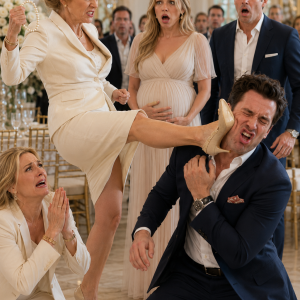
Vanessa pressed a manicured hand to her collarbone, pantomiming a breathless shock that wouldn’t have fooled a child. Yet, the triumphant smile that followed breached the surface entirely too fast, radiating a blinding, predatory heat. She had been anticipating this exact moment. Of course she had. She stepped fluidly into his waiting arms, wearing a liquid-gold, skin-tight gown she had coyly assured me was “perhaps a bit too much” for a sibling’s wedding. As their bodies pressed together, the crowd—God, the absolute hypocrisy of the crowd—actually emitted a collective flutter of laughter and applause, as if they were witnessing some daring, unconventional romantic climax from an indie film, rather than the public slaughter of my dignity.
From the periphery of my vision, I saw my mother’s hand fly to her mouth in a stifled gasp. Somewhere in the back, a drunken groomsman whistled.
A sharp, metallic tang flooded my tongue. I had bitten down on the soft tissue inside my cheek with such sudden, savage force that my mouth was instantly pooling with the taste of iron.
On the polished mahogany floor, Adrian spun Vanessa outward. The hired string quartet, initially stumbling over the sheer audacity of the moment, quickly recovered. Under the frantic direction of the conductor, they smoothed the melody into something softer, achingly dreamy, and deeply obscene. Adrian rested a proprietary hand at the lowest dip of her spine, lifting his chin as he drank in the scandalized attention of the room. Vanessa, draped against him, rested her cheek on his shoulder. Slowly, deliberately, she rotated her head to meet my gaze over the crest of his lapel.
Her eyes were dark, glittering with a lifetime of festering envy finally satiated. That single look articulated everything she didn’t need to say.
I won. You lost.
The silence around me shattered, replaced by the rustle of a hundred hushed voices. The whispers pierced the air like a volley of silver needles, pricking at the edges of my composure.
“Wait, was Claire just the financial backup all along?” “Oh, God, poor Claire. How humiliating.” “Well, she always was the quiet, boring one…”
That was the fatal miscalculation society made regarding quiet women. People invariably confused silence with a lack of comprehension. They mistook a calm demeanor for inherent weakness. They constructed elaborate, self-serving fantasies predicated on the assumption that if a woman didn’t scream, weep, or tear at her hair, she lacked the capacity to destroy them.
Adrian had built the entirety of his adult life, and his burgeoning financial empire, on the foundation of underestimating me.
He truly believed I was nothing more than the polished, socially acceptable fiancée his conservative investors demanded. He saw me as the compliant daughter tethered to an old-money surname, the oblivious woman who smiled placidly through his midnight “client meetings,” his unexplained corporate expenses, and Vanessa’s toxic little barbs wrapped in the scent of expensive perfume. He operated under the delusion that I had never noticed the subtle, electric flinch of his muscles whenever my hand brushed past his unlocked phone. He thought I was blind to the sudden appearance of diamond teardrop earrings on my sister’s vanity after Adrian returned from a “solo business retreat” in Milan. Most of all, he thought I was ignorant of the way they occasionally looked at me when they thought my attention was elsewhere—a shared, impatient hunger, like starving scavengers circling a creature they believed was already bleeding out.
He stood there under the lights, holding my sister, entirely convinced that tonight was his victory lap.
I remained utterly still. I surveyed the guests, their faces contorted in varying shades of pity and morbid fascination. I looked at the flashing bulbs of the cameras. I noted the florist’s thousands of imported white roses, their petals trembling slightly under the frigid blast of the venue’s ventilation system. I watched the musicians, who were now desperately pretending not to stare at the bride they had just musically abandoned.
Let them look, I thought. Let them all burn this image into their retinas.
Then, I turned my back on the dance floor and took my first measured step toward the abandoned microphone.
Chapter 2: The Paper Trail
My maid of honor, Chloe, lunged forward from the bridal party table, her fingers closing like a vice around my wrist. Her eyes were wide with a terrified, protective panic. “Claire, please,” she begged, her voice a frantic, breathless hiss. “Don’t do this. Don’t make a scene. Let’s just go to the bridal suite. We’ll call a car.”
I paused. I looked down at her trembling hand, then shifted my gaze back to the center of the room. My husband was dipping my sister low, his face buried in the crook of her neck, erasing my existence with every beat of the music.
“No, Chloe,” I replied, my voice so soft it barely disturbed the air between us. “I am not making a scene. I am about to end a regime.”
I slipped from her grasp, ascended the three carpeted steps to the dais, and wrapped my fingers around the cold steel of the microphone stand. I didn’t adjust it gently. I wrenched the microphone free. A piercing, high-pitched shriek of electronic feedback tore through the ballroom, shattering the romantic ambiance like a brick through a stained-glass window. Three hundred people winced in unison.
The music halted with a dissonant screech of a cello bow.
Adrian stopped dancing. He turned toward the stage, his features cycling rapidly through a Rolodex of emotions: initial irritation, a flash of genuine confusion, and finally, settling into a patronizing, amused indulgence.
“Sweetheart,” he called out, projecting his voice to ensure the front row of investors could hear his magnanimity. He offered a strained, forgiving smile. “Not right now. We’ll have your dance next. Let Vanessa have her moment.”
My hand holding the heavy microphone did not tremble. My pulse, which had been racing only moments before, settled into a slow, predatory rhythm.
“Before this little performance continues,” I announced. My voice resonated through the state-of-the-art sound system, cold and clear enough to cut crystal. “There is a minor addendum to the evening’s schedule that I believe our guests deserve to hear.”
Adrian’s practiced smile grew brittle, the edges sharpening into something hostile. On the dance floor, Vanessa’s fingers dug reflexively into the fabric of his shoulder. Despite the interruption, they still managed to look incredibly smug. They looked like two children who thought they had successfully stolen the key to the candy store.
It was almost adorable, in a pathetic sort of way.
Because neither my deceitful husband nor my venomous sister knew that precisely sixty minutes before I walked down the aisle, cloaked in white and feigning bridal jitters, I had calmly signed the towering stack of legal documents they had spent twenty-four grueling months trying to coerce me into signing blind.
Neither of them realized that I had not just signed them. I had read them. I had dissected every buried clause, every obfuscated legal precedent, every hidden trapdoor.
And crucially, neither of them had ever fully grasped that the woman they had selected to psychologically dismantle in front of the city’s elite was not simply a decorative bride.
I was also the senior corporate litigation attorney who had meticulously reverse-engineered the trap they thought they were setting, and had spent the last week quietly sealing the exits.
You can learn everything you need to know about the anatomy of a traitor, I thought, staring down at my husband, by observing what they do in the exact moment they believe shame has paralyzed you.
Adrian chose to laugh. He actually threw his head back and emitted a rich, booming chuckle designed to disarm the tension.
“Claire, darling,” he said loudly, extending one placating hand toward me while keeping his other firmly anchored to Vanessa’s waist. “Let’s not be dramatic. It was a joke. A toast to the sister of the bride. You’re taking this too seriously.”
A collective, palpable murmur of relief rippled through the sea of guests. Human nature is a cowardly thing; people are always desperately eager for a palatable explanation that allows them to keep sipping their free champagne and maintaining their comfortable illusions.
Vanessa tilted her head, adopting a mask of wounded sibling sympathy that was practically dripping with venom. “Oh, Claire. You know how Adrian is. He just loves theatrics. Don’t ruin the party just because you’re feeling a little insecure tonight.”
I stared at the woman who shared my blood. I thought of every childhood birthday she had systematically ruined by throwing a tantrum. I thought of the promising boyfriends she had seduced during our college years, not out of love, but simply to prove that she could take what was mine. I remembered the countless times she had leaned into my ear, smelling of vodka and mint, to whisper, “Men don’t choose serious, boring girls like you, Claire, unless they’re looking for a bank account.”
Tonight, she didn’t just want to take my husband. She wanted an audience to applaud her for it.
“That is a fascinating perspective, Vanessa,” I replied, my tone conversational but amplified to a thunderous volume. “Because in my experience, jokes usually conclude when everyone in the room stops laughing.”
The lingering chuckles from the sycophants in the crowd instantly died. A suffocating silence dropped over the ballroom.
Adrian’s jaw flexed, a telltale muscle twitching violently beneath his cheekbone. Realizing his charm offensive was failing, he released Vanessa and strode toward the stage. He moved with that fluid, practiced confidence that had successfully defrauded venture capitalists, enchanted legacy banks, and, admittedly, manipulated one spectacularly foolish, much younger version of myself.
He reached the edge of the stage and leaned in close, dropping his voice to a furious, barely audible hiss intended only for me. “That is enough, Claire. You’re emotional. You’re embarrassing yourself. We will discuss this in private, immediately.”
“No,” I countered, leaning down to meet his furious gaze, keeping the microphone firmly between us. “Private is where cowards operate. Private is where you hide.”
His pupils dilated. His eyes flashed with a sudden, unmasked rage. There he was. The real Adrian. The monstrous entity lurking just beneath the bespoke tailoring and the curated, philanthropic smiles. He was thin-skinned, ravenously greedy, and incredibly dangerous when he was denied what he believed was owed to him.
He lunged forward, his hand snapping out to rip the microphone from my grip. I took one smooth step backward, out of his reach.
“Tell them, Adrian,” I commanded, my voice booming across the silent room. “Tell our guests why you spent the last forty-eight hours terrorizing my legal team, pushing so frantically for me to sign the Vanguard-Holdings merger agreement before the reception began.”
The atmosphere in the room fundamentally altered. It wasn’t a loud disruption; it was a sudden, chilling shift in the barometric pressure. The oxygen seemed to evaporate.
“Tell them,” I pressed on, relentless, “why you insisted that my family’s overarching holding company transfer its irrevocable voting proxy directly to you, effective the moment the priest pronounced us husband and wife.”
At the VIP table directly to my left, my father—a man who had survived three decades of cutthroat real estate wars—went terrifyingly still. He slowly set his champagne flute down, his eyes locking onto Adrian with the lethal focus of a sniper.
Adrian, realizing the optics of physically wrestling his bride on stage were untenable, tried to pivot back to his executive persona. He forced a condescending laugh. “Ladies and gentlemen, I apologize. This is complex corporate structuring. Claire, you’re overwhelmed. You don’t understand half of the vernacular in those—”
“I didn’t just read the agreement, Adrian,” I interrupted, my voice dropping an octave, carrying the weight of a gavel striking wood. “I wrote it.”
The color drained from his face so rapidly he looked as though he might faint.
On the dance floor, Vanessa’s triumphant smile finally, permanently, vanished.
Chapter 3: The Diagnosis of Ruin
I let the absolute, terrifying silence breathe. I let them marinate in it. Across the vast room, people physically leaned forward in their chairs, their earlier embarrassment replaced by a morbid, rapt attention. Even the string quartet had ceased their nervous shuffling; the cellist was staring at me with his mouth slightly ajar.
“For the past year, you have whispered to every investor in this room that I was simply ‘too emotional’ for the rigors of high finance,” I continued, pacing slowly across the length of the stage. “You implied that I allowed my father’s aging advisors to handle the serious, masculine work, while I was merely the decorative, legacy half of this partnership.”
I stopped pacing and turned my body slightly, perfectly angling myself to lock eyes with the lead partners of Halbrecht Capital, the primary investors Adrian had spent the last nine months desperately courting.
“What Adrian conveniently omitted from his pitch,” I told them, “is that I graduated top of my class, passed the bar at twenty-four, spent five years specializing exclusively in corporate fraud litigation, and have spent the last eighteen agonizing months secretly auditing every catastrophic, leveraged debt he attempted to bury within my family’s corporate architecture.”
A woman wearing emeralds near the back of the room let out a loud, involuntary gasp, slapping a hand over her mouth.
Adrian scrambled for purchase, his arrogant facade crumbling into panic. “This… this is completely absurd! You’re having an episode, Claire!”
“No,” I corrected coldly. “What is absurd is the fact that you genuinely believed I wouldn’t trace the capital flow through the three shell companies you incorporated in Delaware last spring.”
That broke him. The mention of the shell companies stripped away the last of his restraint. He abandoned the illusion of decorum entirely.
He vaulted onto the stage in two furious, uncoordinated leaps. He closed the distance between us, his face contorted into a mask of pure malice. “Shut your mouth, you stupid bitch,” he hissed, spittle flying from his lips. “Stop talking right now.”
I stood my ground, my posture perfectly erect, staring directly into the abyss of his panic. “Make me.”
He raised a hand, his fingers twitching toward my throat. But he stopped. He felt the weight of three hundred pairs of eyes. He saw the glowing red lights of the videographers’ cameras, still faithfully recording every second of his unraveling. He didn’t touch me.
Good boy, I thought.
Without breaking eye contact, I reached my left hand into the dense foliage of the cascading white bridal bouquet I had placed on the podium during the toasts. From between the imported orchids, I retrieved a pristine, slim white envelope. I held it aloft, the paper stark against the glare of the spotlights.
“Contained within this envelope,” I projected to the mesmerized audience, “is a certified copy of the secondary postnuptial transfer order. The exact document Adrian demanded I sign in the bridal suite an hour ago. This specific legal instrument was designed to grant him unilateral, temporary control over seventy-one percent of my family’s commercial development group.” I paused, letting the silence stretch until it was nearly unbearable. “This control was to be enacted exclusively in the event of my, quote, ‘sudden medical incapacity’ or ‘extended emotional instability.’“
The collective gasp that tore through the ballroom sounded like a sudden rush of wind.
Below the stage, Vanessa physically recoiled, stumbling backward in her gold dress as if she had been struck. Adrian’s voice degenerated into a feral, cornered growl. “You are twisting the legal terminology! That’s standard asset protection!”
I finally looked down at my sister. “Am I, Vanessa?”
Vanessa didn’t look at me. Instead, her terrified eyes darted, just once, in a micro-expression of absolute panic, toward the dimly lit alcove near the rear mahogany bar. She looked directly at a man standing rigidly by a marble pillar.
Dr. Elliot Wren. My family’s trusted, long-term concierge physician.
The man who, a mere seventy-two hours ago, had broken down weeping in my private office, sliding a USB drive across my desk while apologizing hysterically for “what those two monsters asked me to put my signature on.”
That was the precise moment the collective intelligence of the room caught up. You could feel the realization crash over the crowd like a physical wave. This was no longer a dramatic wedding speech about a cheating husband.
This was a meticulously choreographed public execution.
“You planned to slip pharmaceuticals into my drink on our flight to the Maldives,” I stated, enunciating each word with surgical precision so the cameras caught every syllable. “You planned to have Dr. Wren officially certify a stress-induced nervous collapse. Adrian would heroically assume control of my family’s board to ‘protect’ the assets. And my sister, Vanessa, would conveniently move into the penthouse to provide emotional comfort to the grieving husband.”
I gestured broadly to the room. “And this little public betrayal on the dance floor tonight? That was your insurance policy. If I screamed and fought you, I would look historically unstable. If I wept and fled, I’d look broken and fragile. Either way, you would have established the public narrative required to execute the medical proxy.”
Vanessa’s voice shattered as she screamed, “That is a psychotic lie! You’re insane!”
I smiled at her. It was the first genuine smile I had worn all evening.
“If I am insane, Vanessa,” I asked politely, “then why did Dr. Wren preemptively surrender his medical license and provide a sworn, eighty-page confessional statement to my criminal defense team yesterday morning?”
Chapter 4: The Sound of the Blade
Adrian’s knees didn’t buckle immediately. But I could see the structural integrity of his reality collapsing behind his eyes.
There is a profoundly beautiful, almost holy moment in the architecture of every downfall. It is the microsecond when unchecked arrogance finally realizes it has been accelerating at breakneck speed not toward an open door, but into a reinforced concrete wall.
Adrian stared up at me as if I were a stranger. And perhaps I was. Men forged in the fires of his particular brand of narcissism never truly see the women they claim to love. They only see reflections of their own desires—women as mirrors to stroke their egos, women as stepping stones, women as bank accounts, women as prey. But the instant the prey unhinges its jaw and bares a row of serrated teeth, their pathetic little fantasy dies.
“You set me up,” he whispered, the realization draining the blood from his lips.
I almost laughed. The audacity was staggering.
“No, Adrian,” I replied, my voice dropping back to a conversational, deadly calm. “You set the trap. I just changed the locks while you were standing inside it.”
Desperation clawed at him. He spun away from me, looking wildly toward my father, pleading with the investors, begging the very society he had tried to conquer. “Are you people seriously going to believe this hysterical woman? You’re going to destroy my company on the word of a jealous bride?”
“They don’t have to take my word for it,” I said softly.
I gave a curt, almost imperceptible nod toward the heavy oak double doors of the ballroom’s side entrance.
The doors swung inward with a heavy thud. Two uniformed city police officers stepped into the blinding light of the ballroom. They were flanked by a strikingly sharp woman in a tailored charcoal suit carrying a heavy leather litigation briefcase. This was Maya Chen, the ruthless, undefeated lead counsel from my law firm’s white-collar criminal division. Trailing just behind her were three forensic financial investigators, and finally, shuffling like a man walking to the gallows, Dr. Wren himself. His skin was the color of wet ash, his tailored suit hanging off him as he sweated through his collar.
The room exploded. It was a cacophony of shouting, overturned chairs, and the frantic clicking of camera shutters.
Adrian stumbled backward, nearly tripping over a monitor cable on the stage. “What the hell is this? You can’t do this!”
“These are called consequences, Adrian,” Maya Chen announced, her voice projecting effortlessly without a microphone. She was magnificent. Unhurried, precise, and entirely devoid of mercy.
She walked to the front row. She handed one thick, red-tabbed folder directly to my stoic father. She handed a second identical folder to the lead investor from Halbrecht Capital, whose face was purple with rage. She handed the third to the lead detective.
“For the official record,” Maya stated to the hysterically buzzing room, “our office, in conjunction with the district attorney, has compiled irrefutable evidence of corporate embezzlement, attempted coercive control through fraudulent legal instruments, felony conspiracy to commit medical abuse, and gross falsification of corporate disclosures.”
Vanessa swayed on her metallic stilettos, clutching her head. “No. No, no, no.”
“Yes,” I answered her.
Adrian leveled a trembling finger at the doctor. “He’s lying! He’s a pill addict! He’s lying to save himself!”
Dr. Wren let out a sound that was half-sob, half-laugh—a brittle, shattered noise. He looked up at the stage, meeting my eyes with a haunted, destroyed reverence. “I am saving myself, Adrian,” he rasped. “She already had everything by the time she called me into her office. She had the offshore bank routing numbers. She had our encrypted text messages.” He paused, swallowing hard. “She had the audio recordings from the penthouse suite.”
The words audio recordings landed like a physical mortar shell in the center of the room.
Because exactly two weeks ago, when Adrian had vehemently insisted on utilizing the Crestview Penthouse—a property owned exclusively by my family’s trust—for his “private bachelor party meeting,” I had grown suspicious of an alert regarding unauthorized access to my ground-floor study. I had quietly authorized the building’s security network to retain all internal audio for forty-eight hours.
The microphones had captured every damning syllable. They had captured Vanessa cruelly mocking my wedding vows. They had captured Adrian meticulously outlining the phrasing of the medical incapacity clause. It had captured them arguing, over the clinking of my father’s expensive scotch, about precisely how long they needed to wait before announcing their “tragic but beautiful” relationship publicly after my engineered collapse.
Three months, Vanessa’s recorded voice had whined. People will understand. Six weeks, Adrian had countered coldly. The board will need a unified front.
They were so profoundly greedy, they were haggling over the scheduling of my destruction.
I gripped the microphone one last time as the two officers ascended the stage, moving methodically toward my husband.
“This dance, Adrian,” I said, my voice floating over the stunned, breathless hush of the ruined wedding, “is for the woman you should never, ever have underestimated.”
His face drained of the last remnants of its humanity. Panic overtook logic. He turned and made a pathetic, desperate lunge toward the rear stage curtain.
He didn’t make it two steps. The lead officer caught his shoulder, twisting his arm in a brutal, efficient arc. Adrian jerked violently against the hold, his polished dress shoes slipping on the slick stage. His legs gave out, and his knees hit the hardwood floor with a sickening, hollow crack that echoed through the silent ballroom. It wasn’t dramatic. It wasn’t cinematic or dignified. It was just an ugly, pathetic man hitting the floor. Final.
Vanessa screamed, a shrill, tearing sound. “Adrian!” She hitched up her gold dress and rushed toward the stage.
The second officer stepped firmly into her path, holding up a broad hand to stop her.
She ricocheted off the officer and whipped her head toward me. Her flawless makeup was ruined, thick black mascara smearing down her cheeks in jagged rivers. “You ruined everything!” she shrieked, her voice cracking. “You ruined our family! You psychopath!”
I looked down from the stage at my sister. I looked at the stolen gold fabric, the panic, the absolute lack of remorse.
“No, Vanessa,” I said gently. “You and Adrian ruined it. I simply refused to be the one to carry the wreckage for you anymore.”
She began raving then, screaming incoherent nonsense at the crowd about jealousy, about how our parents never loved her enough, about how it was just a mistake, about love. She used all the pathetic, meaningless little words that parasites use when their schemes are violently dragged into the light.
No one rushed forward to comfort her. Not a single person defended him as he was read his rights and hauled to his feet. The Halbrecht investors were already on their cell phones, desperately barking orders to their junior partners to freeze all assets tied to Adrian’s name. My father stood near his table, unmoving, his face carved from granite. Beside him, my mother wept quietly into a linen napkin. I knew, with absolute certainty, she wasn’t crying for the loss of her son-in-law or the arrest of her youngest daughter; she was mourning the agonizing death of her own delusion, realizing that Vanessa’s lifelong cruelty had never been a “phase.”
And through the beautiful, chaotic symphony of their destruction, the hired musicians—God bless their terrified hearts—never quite knew when they were officially dismissed. One lone violin trembled on, playing a few haunting notes of the waltz. Then, another joined in for a brief, discordant measure.
Then, finally, silence fell over the room like the drop of a guillotine blade.
I set the microphone back onto its stand. I unclasped my hands. The first breath I drew into my lungs felt staggering, like breaking the surface after drowning in dark water for a decade.
Six months later, the suffocating opulence of the St. Regis ballroom existed only in a digital file of forensic photographs I never bothered to look at.
Adrian was currently housed in a federal holding facility, awaiting a highly publicized trial for wire fraud and conspiracy. He had been systematically stripped of every corporate board seat, every dime of investor capital, and every fair-weather friend who suddenly decided they preferred not to face a grand jury subpoena. I read in the financial times that his aristocratic parents had been forced to quietly liquidate their historic townhouse just to afford his criminal retainer.
Vanessa, officially named as an unindicted co-conspirator and radioactive to high society, had been completely cut off by our parents and shunned by every socialite she had ever charmed. She had metamorphosed into the one thing she feared more than death: she was entirely irrelevant. The last rumor I entertained was that she was desperately trying to trade sensationalized interviews to trashy tabloids in exchange for public sympathy, and was finding that the market for her tears had completely dried up.
As for me, I kept the holding company. I didn’t just keep it; I expanded it. I moved quietly, methodically, and with absolute, unapologetic ruthlessness when the situation required it. The massive public scandal that Adrian had meticulously engineered to destroy my credibility ended up acting as a brilliant stress test. It exposed the rot and the weak structural points within my family’s business architecture that I had secretly wanted to excise for years.
So, I cut them all away.
On a brilliantly crisp morning in late October, I stood alone on the expansive glass terrace of Vanguard Holdings’ newly acquired headquarters. I leaned against the railing, sipping black coffee, and watched the city skyline glitter sharply beneath a vast, cold blue sky.
There was no veil suffocating my vision. There was no audience demanding my compliance. There were no elaborate, poisonous lies dressed up in the costume of romance.
The heavy glass door behind me slid open, and Maya Chen stepped out onto the terrace. She was holding two steaming cups of espresso. She walked to the railing, handing one to me without a word, her eyes tracking a helicopter moving across the horizon.
She turned her head slightly, studying my profile in the morning light. “You look incredibly peaceful, Claire,” she observed, her voice lacking its usual courtroom edge.
I took a slow sip of the bitter espresso. I thought about the deafening music of that night. I remembered the metallic taste of my own blood on my tongue, the blinding flash of the cameras, the suffocating scent of the white roses. I remembered the exact, glorious microsecond when Adrian’s eyes widened, realizing that the quiet, submissive woman he had attempted to publicly break had already buried him beneath an avalanche of paperwork, undeniable evidence, and the brutal weight of the law.
I lowered my cup and looked out over the sprawling, metallic empire I had fought so brutally to inherit and protect.
“I am,” I said, the wind catching the words and carrying them away.
And for the very first time in ten long years, it was the absolute truth.