The Paper Border: A Chronicle of My Family Coup
Chapter 1: The Weight of a Small Hand
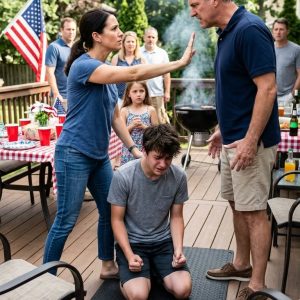
The second my father’s voice cracked across the living room of the Fairwood Estate, every other sound in the house seemed to fall through the floorboards. My seven-year-old stepdaughter, Clara, still had her hand half-raised in the air, a small, hopeful gesture that hung in the sudden silence like a question no one wanted to answer. She looked as though she thought this was merely a misunderstanding—a glitch in the afternoon that someone would surely fix if she just waited long enough.
Then my mother leaned in. She used that soft, sugary tone she reserves for the moments she wants to make something ugly sound like common sense. Her words didn’t just break the silence; they shattered the room.
“Honey,” she said, her eyes skipping over Clara as if she were a piece of furniture that had been moved into the wrong light. “Only real grandchildren get to vote.”
The other children, my nieces and nephews, stopped rustling their little voting slips. My sister, Mallerie, froze with a paper plate halfway to the trash can. My brother, Graham, slowly set his soda down on the mahogany side table, his expression hardening.
I looked at my husband, Evan. I saw the raw, visceral shock on his face, the kind that steals the air from a person’s lungs. He didn’t move. He was paralyzed by a decade of being the “grateful outsider,” the widower who had been “allowed” into our prestigious family circle.
But I wasn’t paralyzed. I felt a cold, crystalline clarity settle over me, a feeling that started in my marrow and radiated outward. I pushed my chair back, the legs shrieking against the polished hardwood like a call to arms.
“I need to make an announcement,” I said.
My father made a small, irritated noise, the sound he makes when a commercial interrupts his favorite news program. “Alyssa, sit down. We’re in the middle of a family decision.”
I didn’t sit. I reached into my tote bag, my fingers brushing against the heavy manila folder I had been carrying all day. It felt like a weapon. I watched the room shift from casual afternoon boredom to sharp, jagged unease in the span of two seconds.
Earlier that afternoon, the Fairwood Estate had been the picture of domestic bliss—at least the version my parents liked to produce for the neighbors. Folding chairs had been dragged from the garage, the smell of charcoal and burgers lingered in the air, and children orbited the living room like noisy little planets. My mother, the self-appointed keeper of Brooks Family Traditions, sat with a notepad, already orchestrating the next “special outing.”
“We need to pick something for the kids next month,” she had said, tapping her pen with a rhythmic click-click-click.
Every child had been given a voice. My nephews debated height requirements at the trampoline park like high-court lawyers. My nieces championed the dinosaur exhibit at the Central Science Museum. Clara had been sitting on the rug between Evan and me, her knees tucked under her chin, her eyes bright with the absolute, shimmering belief that she was finally one of them.
“They have the little coaster!” Clara had chirped, her voice animated and loud, slicing through the chatter. “And the bumper cars! We could all go on the bumper cars!”
She was being a normal seven-year-old. She was being bossy, excited, and present. Three years ago, she would have hovered at the edges of the group, a ghost in a pink tutu. But today, she assumed she belonged.
My father’s mouth had flattened into that tight, white line—the one I had learned to dread as a child. He wasn’t bothered by the noise of his “blood” grandchildren. Graham’s youngest was practically screaming into his ear, and Mallerie’s daughter was whining so dramatically my mother laughed. But every time Clara spoke, my father’s eyes flicked to her with a look that was less like a grandfather and more like a landlord looking at a squatter.
“Let other people talk,” he had snapped at her once, even though three other children were speaking over her.
Now, as the voting slips were passed out, my mother had deliberately bypassed Clara’s outstretched hand. The small scrap of paper—the physical proof of belonging—was withheld.
Only real grandchildren get to vote.
I pulled the folder halfway out of my bag. The room was so quiet I could hear the hum of the refrigerator in the kitchen.
“I said,” I repeated, my voice dropping an octave, “I need to make an announcement. And you are going to want to hear this.”
Chapter 2: Butterflies and Scars
To understand why I was ready to burn my parents’ house down with a few sheets of paper, you have to understand how I met Clara.
Three years ago, I was teaching a Saturday “Creative Movement” class for toddlers at a local Community Recreation Center. The room smelled of lemon cleaner and old gym mats, and the walls were lined with mirrors that reflected every clumsy, beautiful jump. Most of the kids came in already vibrating with energy.
Clara didn’t.
She was four then, small for her age, wearing a pink leotard that kept slipping off one shoulder. She had a face so solemn it made the other children look like they were part of a different species. While the other kids flapped their arms like butterflies, Clara stood near the back wall, clutching the hem of her skirt.
Evan hovered by the door. He had the tired, apologetic posture of a man who was used to carrying a world of grief on his shoulders. During a break, I saw another parent ask him where Clara’s mother was.
“She died in March,” he answered. It wasn’t a dramatic statement; it was a rehearsed one, the kind you say when the wound is so deep you have to cauterize it with plainness.
The next week, I handed Clara a silk scarf—vibrant blue—and asked if she wanted to help me lead the class. She took the scarf first, then my hand. Her fingers were sticky and small, and in that moment, I felt a tether snap into place.
Evan and I didn’t rush. Our relationship grew in the margins of Saturday mornings—parking lot conversations, extra minutes after class, Clara showing me a sticker on her shoe while Evan tried to remember what a normal adult conversation felt like.
She bonded with me first. Children tell the truth with their feet, and Clara kept choosing to stand next to mine. By the time Evan and I admitted we were in love, Clara had already started running to the door when I arrived, shouting, “Alyssa’s here!” as if she were announcing the arrival of spring.
My parents, however, reacted as if I had announced I was joining a cult. We sat over a Sunday roast—potatoes, carrots, and judgment.
“A widower with a child?” my mother had said, her fork frozen in mid-air. She said it like she was describing a corporate merger that was doomed to fail.
“You’re planning to spend your best years raising someone else’s baggage?” my father added. He didn’t even use her name.
“Her name is Clara,” I told them, my voice trembling. “And she isn’t baggage. She’s a little girl who has lost more than you can imagine.”
“Men like that are just looking for a replacement,” my mother sighed. “And children that age… they’re just attached to whoever is convenient.”
I remember staring at my plate, the steam from the roast blurring my vision, realizing for the first time that my parents viewed love as a transaction of biology, not a choice of the heart.
I married Evan anyway. I hoped that seeing Clara’s sweetness, seeing her pull my siblings into games of tag, would wear my parents down. I thought time was the solvent that would dissolve their prejudice.
But I had underestimated their commitment to the “Bloodline.” They had learned to exclude her with a surgical, polite precision. They would order matching holiday pajamas for the grandkids and “accidentally” forget Clara’s size. They would line the kids up for a photo and tell the “real” grandkids to stand in the front row.
And through it all, Evan and I remained the perfect children. We sent money every month to help with their dwindling retirement fund. Evan spent his weekends fixing their leaky roof and repairing their porch steps. We gave them our labor, our money, and our silence.
But as I stood in that living room, watching Clara shrink into herself on the rug, I realized that my silence wasn’t “keeping the peace.” It was financing my daughter’s trauma.
“Alyssa, put that away,” my father said, his voice regaining its bark. “You’re making a scene in front of the kids.”
“Oh, the scene has already been made, Dad,” I said, pulling the manila folder out and slamming it down on the coffee table.
The sound was like a gunshot.
Chapter 3: The Black Ink Ultimatum
The folder slid across the wood, coming to rest right on top of my mother’s notepad. The “voting slips” for the other grandchildren were scattered around it like fallen leaves.
“These,” I said, my voice projecting with the authority of a teacher who has finally lost her patience, “are Clara’s adoption papers.”
The room went into a deep-freeze. Mallerie gasped. Graham stood up, moving toward me as if to offer support or to witness the wreckage—I wasn’t sure which.
“Evan and I have been in this process for months,” I continued. “The legal part is done. The signatures are notarized. As of this morning, Clara isn’t just ‘Evan’s daughter.’ She is mine. Legally, spiritually, and permanently.”
I didn’t wave the papers. I didn’t need to. The notary’s gold seal caught the light, a bright, defiant eye staring back at my parents.
“So,” I said, leaning over the table until I was inches from my mother’s face. “Let’s re-evaluate that sentence you just used. ‘Only real grandchildren get to vote.’ Does this seal look real enough for you? Or does she need to bleed into a vial for you to consider her a person?”
My father stood up, his face turning a shade of purple that matched the bruises on my heart. “Don’t be ridiculous! Nobody said she couldn’t come around. But you can’t force a biological connection where there isn’t one!”
“You’re right, Dad,” I said. “I can’t force you to have a heart. But I can control what you have access to.”
My mother tried to laugh it off, that high, tinkling sound that usually signals she’s about to gaslight me. “Alyssa, honey, you’re blowing a little misunderstanding out of proportion. We love Clara—in her own way. But you know what we mean.”
“I know exactly what you mean,” I snapped. “You mean she’s a second-class citizen in this family. You mean she’s a guest who is expected to be grateful for the crumbs of your attention. But here is the new reality: If Clara is not a ‘real’ grandchild, then I am not a ‘real’ daughter.”
The silence returned, heavier this time. Evan had moved to the rug. He was holding Clara, his chin resting on top of her head. She was clutching his arm, looking at me with wide, tear-filled eyes.
“Listen carefully,” I said, my voice low and dangerous. “If you ever—ever—draw a line between my daughter and her cousins again, you lose me. You lose Evan. You lose the first-of-the-month transfers that pay your utility bills. You lose the son-in-law who spends his Saturdays fixing your house for free. If she doesn’t count, we don’t count.”
“You would choose her over your own blood?” my father hissed.
“In a heartbeat,” I replied. “I will choose my daughter every single time. Because unlike you, I understand that family isn’t something you’re born into. It’s something you’re brave enough to build.”
I reached down and snatched the folder back. I took Clara’s hand.
“We’re going home,” I said to Evan.
As we walked toward the door, Mallerie stepped forward. I expected her to try and mediate, to play the peacemaker. Instead, she looked at our parents with a look of pure, unadulterated disgust.
“She’s right,” Mallerie said. “If Clara doesn’t get a slip of paper, my kids don’t either. We’re leaving, too.”
“Mallerie!” my mother shrieked.
Graham didn’t say a word. He just grabbed his car keys and started herding his children toward the exit. The “Family Production” was falling apart, the cast members walking off stage in a silent, unified protest.
We didn’t look back. We didn’t wait for an apology that would have been hollow anyway. We walked out into the afternoon sun, the air smelling of cut grass and the sweet, sharp scent of freedom.
But as we pulled out of the driveway, I saw Clara in the rearview mirror. She was looking back at the house, her small face unreadable. I knew the battle was won, but I also knew the war for her sense of belonging was just beginning.
Chapter 4: The Digital Severance
We didn’t go straight home. I couldn’t bear the thought of our house feeling quiet after the explosion at Fairwood Estate. Instead, Evan pulled into a small ice cream parlor on the edge of town, a place with bright neon signs and sticky plastic tables.
We sat in the car for a long time. Clara stared at the dashboard, her sneakers dangling.
“Am I not a real grandchild?” she asked. Her voice was flat, devoid of the drama of a child’s tantrum. It was the voice of a child who had just discovered a dark truth about the world.
Evan leaned his head against the steering wheel. “I should have said something sooner, Clara. I am so sorry I let them treat you like that.”
I turned around in my seat, taking her small hands in mine. “Clara, look at me. Being ‘real’ has nothing to do with what those people think. You are my daughter. You are Mallerie’s niece. You are Graham’s sister. Anyone who can’t see that is the one who isn’t ‘real.’ They’re ghosts, honey. And we don’t listen to ghosts.”
She nodded slowly, then asked for chocolate with rainbow sprinkles. We went inside, and I watched her eat, but my mind was already on the next phase of the coup.
That night, after Clara was asleep with her stuffed rabbit tucked under her arm, Evan and I sat at the kitchen island. The light from the pendant lamp cast long shadows across the counter.
“Are we really doing this?” Evan asked. “The money? The help?”
“They called her a ‘nothing,’ Evan,” I said, my phone already in my hand. “They used her to hurt me, and they used me to finance their comfort. The bank of Alyssa and Evan is closed.”
I opened our banking app. I navigated to the recurring transfer—five hundred dollars every month—that went to my parents’ account. It was a “gift” that had become an entitlement.
I hit Cancel.
Then I opened the family group chat. Everyone was there—my parents, Mallerie, Graham, and their spouses. I typed one factual, icy message.
After the events of today, Evan, Clara, and I will be taking an indefinite break from family gatherings. We will not be attending any event where Clara is not treated with the exact same status as every other grandchild. Furthermore, we are stepping back from all financial and labor-related support for Mom and Dad. If family is about biology, then you can rely on your biology to fix the deck and pay the water bill.
I hit Send and turned my phone face down.
Within minutes, it started vibrating so hard it rattled the granite. My mother called. My father called. Then the texts started pouring in.
You’re being vindictive!
How could you do this to us at our age?
We’re family! You can’t just cut us off!
But then, a different kind of notification appeared. A private message from Mallerie.
I just cancelled my contribution to the holiday fund, too. If they want to play favorites, they can pay for the favorites themselves. Proud of you, Sis.
Then Graham: I told Dad I’m not coming over to finish the deck. Told him he should ask one of his ‘real’ relatives for help. See you guys for dinner on Friday? Our house?
For the first time in years, the “Brooks Family” felt like a real family—because the people in it were choosing each other, not just an old name on a mailbox.
Chapter 5: The Gift Bag and the Guarded Door
Six months passed. The silence from the Fairwood Estate was punctuated only by the occasional “emergency” text from my mother, which I ignored, and the legal notifications regarding the finalization of the adoption.
We had built a new rhythm. Every Sunday, we had dinner with Mallerie and Graham. The cousins were closer than ever. They had formed a sort of “Clara Protection Squad,” making sure she always got the first pick of snacks or the best seat in the fort they built in Graham’s backyard.
The adoption was finalized on a Tuesday in November. We took Clara to the courthouse. She wore a navy-blue dress and a pair of shiny black shoes. When the judge signed the decree and handed her a small gavel, she didn’t cry. She just looked at me and said, “Now it’s all the same everywhere, right?”
“Everywhere, baby,” I said, hugging her so tight I could feel her heart beating against mine.
But the real test came two nights later.
There was a knock at our door. It was raining—a cold, dismal drizzle. I opened the door to find my parents standing on the porch. They looked older. My father’s shoulders were hunched, and my mother was holding a brightly colored gift bag.
“Alyssa,” my mother said, her voice lacking its usual sugary veneer. “We’ve… we’ve handled things badly. We want to see the kids.”
“The kids are inside having dinner,” I said, blocking the doorway. I didn’t invite them in. The warmth of my home was a privilege they hadn’t earned back yet.
“We brought a gift for Clara,” my father said, nodding toward the bag. I could see a stuffed dinosaur peeking out of the tissue paper. “And we wanted to talk about the… you know… the holidays.”
“The holidays are already planned,” I said. “We’re spending them with Mallerie and Graham. And as for the gift, you can leave it on the porch.”
“Alyssa, don’t be like this,” my mother pleaded. “We’re trying. We even told the neighbors about the adoption.”
“Did you tell them she was a ‘real’ grandchild?” I asked.
My father’s jaw tightened. “We’re here, aren’t we? Let’s not drag this out forever. We made a mistake. Let’s move on.”
“Moving on requires change, Dad,” I said. “Not just a stuffed dinosaur and a rainy visit when your bank account is low. Trust isn’t something you buy back with a gift bag. It’s built with years of consistent, equal love. And right now, you’re at zero.”
“So that’s it? You’re just going to freeze us out?”
“I’m protecting my daughter,” I said. “If you want to be grandparents, you can start by attending the soccer game on Saturday. But you will sit with the rest of the family. You will cheer for Clara as loudly as you cheer for the others. And if I see even a hint of that ‘biological’ line being drawn, the door closes again—permanently.”
I took the gift bag and set it on the hallway table. “I’ll give her this. But don’t expect a thank-you note to come with a check. Goodnight.”
I closed the door. The thud was solid, honest, and final.
Chapter 6: The True Vote
The soccer game was a chaotic symphony of orange jerseys and grass stains. Clara was a whirlwind on the field, her ponytail bobbing as she chased the ball with a fierce, joyful intensity.
My parents were there. They sat on the folding chairs next to Mallerie and Evan. They looked uncomfortable, stripped of the grandeur of their estate, forced to be just another pair of grandparents in a sea of parents.
But they cheered. When Clara kicked the ball out of bounds, my mother shouted her name. When she nearly scored a goal, my father stood up and clapped. It was a start. A small, fragile, overdue start.
After the game, we all went to a pizza place with long wooden tables and the smell of yeast and tomato sauce. The cousins were all huddled at one end, arguing over what toppings to get.
“We’re going to vote!” Graham’s oldest shouted, holding up a napkin.
I saw Clara freeze. The old shadow flickered across her face for a split second. She looked at the napkin, then at her grandparents, who were sitting at the far end of the table.
My mother looked at me, then at Clara. She reached into her purse, pulled out a pen, and handed it to my nephew.
“Make sure everyone gets a vote,” my mother said, her voice shaky but clear. “Every single person at this table.”
Clara’s eyes widened. She took the napkin when it was passed to her. She looked at me, a question in her gaze. I nodded.
She leaned over the table and wrote her choice in big, bold, purple letters: PEPPERONI AND EXTRA CHEESE.
She didn’t look at her grandparents for approval. She didn’t look at them to see if she was “allowed.” She looked at her cousins, who were already tallying the results.
That night, as I tucked Clara into bed, she was still wearing her grass-stained socks.
“Mommy?” she whispered.
“Yes, baby?”
“Today felt… real.”
“It was real, Clara,” I said, kissing her forehead. “It was the realest day we’ve ever had.”
The Fairwood Estate still stands. My parents are still proud, and they are still flawed. They may never fully understand that blood is just a fluid, while family is a vow. But they have learned the most important lesson of all: In my house, there is only one kind of child.
The kind that belongs.
And as I walked out of her room, I realized that the “Announcement” I had made six months ago wasn’t just for my parents. It was for me. I had finally stopped being a daughter who followed orders and started being a mother who gave them.
The ledger was balanced. The border was gone. We were finally, undeniably, home.
Like and share this post if you find it interesting and believe that every child deserves to be a “real” part of the family!